-
-
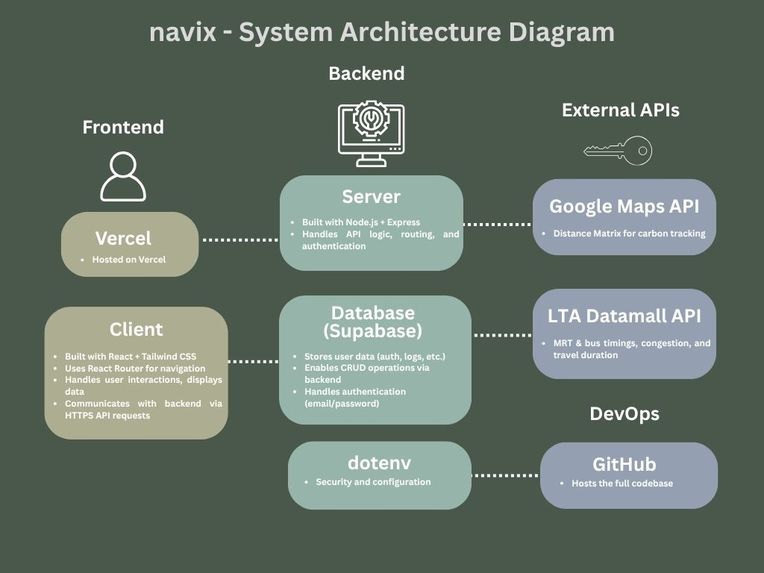
System Architecture Diagram
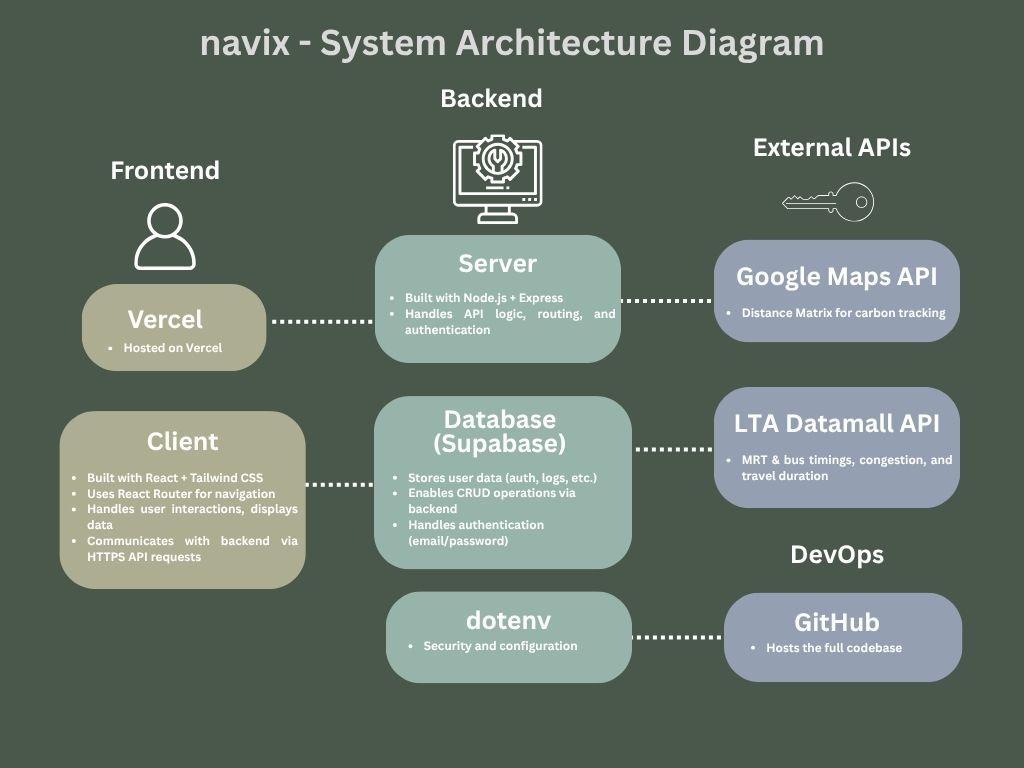
Inspiration
As university students who rely on Singapore’s MRTs and buses every day, we often found ourselves scrambling to plan routes, hoping we wouldn’t miss the last train, or guessing when the next bus would finally arrive. Frustrated by these daily challenges, we wanted a smarter way to commute—a single tool to make getting around Singapore easier, greener, and a little more fun.
What it does
Navix is an all-in-one public transport companion app built to simplify the Singapore commuting experience. The app calculates the shortest MRT routes using Dijkstra’s algorithm, shows first and last train timings, and keeps commuters updated with live service status and station details. For bus users, Navix fetches real-time arrival timings directly from the LTA DataMall API. To encourage a more sustainable lifestyle, our Carbon Tracker estimates the emissions of different journeys and shows users how much CO₂ they save by choosing public transport. We also added two mini-games—EcoSwipe, where users swipe through bite-sized eco-facts, and Trackle, a station-guessing game with clues about Singapore’s MRT system—to make waiting times more enjoyable.
How we built it
The Navix frontend was developed with React and Tailwind CSS and is hosted on Vercel for easy deployment and scaling. Our backend is built with Node.js and Express, with Axios handling API requests. Supabase manages user authentication and stores trip history. We integrated the LTA DataMall API for real-time transport data and used the Google Maps API to estimate journey distances and carbon emissions. Sensitive keys are managed securely with dotenv and environment variables, and our codebase is maintained on GitHub.
Challenges we ran into
One of the biggest challenges was handling real-time data—especially API downtime and rate limits—which required robust error handling and fallback logic. Implementing accurate MRT routing with first/last train timings was more complex than expected. We also spent time ensuring a smooth, responsive user experience across devices, and syncing user authentication between Supabase and the app took a few iterations to get right.
Accomplishments that we're proud of
We’re proud that Navix is a tool we genuinely use ourselves, and that we managed to integrate multiple live APIs and features into a single, seamless experience. Creating interactive mini-games was a fun way to encourage greener choices and keep commuters engaged. Seeing the finished, polished app come together within the short SummerBuild timeframe was a real highlight.
What we learned
This project taught us a lot about working with real-world APIs and the importance of robust error handling. We learned how valuable user feedback can be, especially for refining both functionality and UI design. We gained experience deploying a full-stack app using modern technologies like Vercel, Supabase, and Tailwind CSS, and saw first-hand how gamification can drive real user engagement.
What's next for Navix
We’re excited to keep building on Navix. Our next steps include adding route planning for multi-modal journeys (combining MRT and bus), offering personalized carbon-saving goals, and introducing more interactive games and features. Ultimately, we want to launch Navix publicly so every Singapore commuter can move smarter and greener.
Built With
- axios
- dotenv
- express.js
- framer-motion
- github
- google-maps
- lta-datamall-api
- node.js
- react
- supabase
- tailwind-css
- vercel

Log in or sign up for Devpost to join the conversation.