Inspiration
AI coding agents can reason through difficult work and still lose critical intent when their context is compacted. A transcript preserves chronology, but it does not automatically surface the right prior decision at the moment that decision matters. I wanted to build a memory reflex: a small, automatic process that retrieves relevant evidence before work and restores a trusted state after compaction.
The design was inspired by associative memory in neuroscience, layered and symbolic models of mind from cognitive and Jungian psychology, and the value of examining a problem through multiple perspectives. These are design metaphors, not scientific or paranormal claims. Conversations with ChatGPT helped crystallize that broad inspiration into a testable product boundary: durable local memory for Codex with exact provenance, bounded retrieval, and the ability to abstain.
What it does
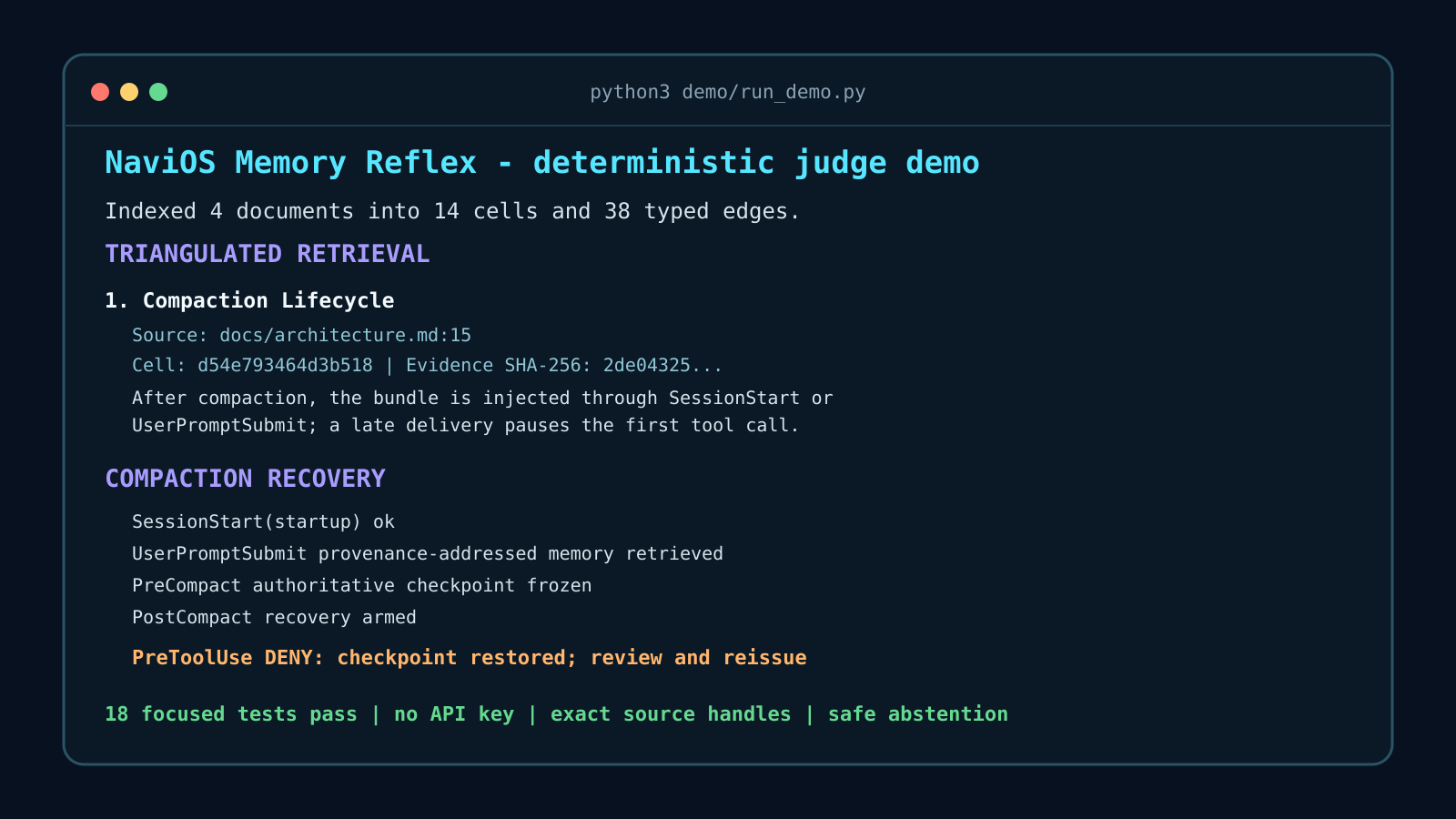
NaviOS Memory Reflex turns selected project notes into provenance-addressed sentence and passage cells. Each cell retains its source path, exact line range, stable identifier, and SHA-256 content handle.
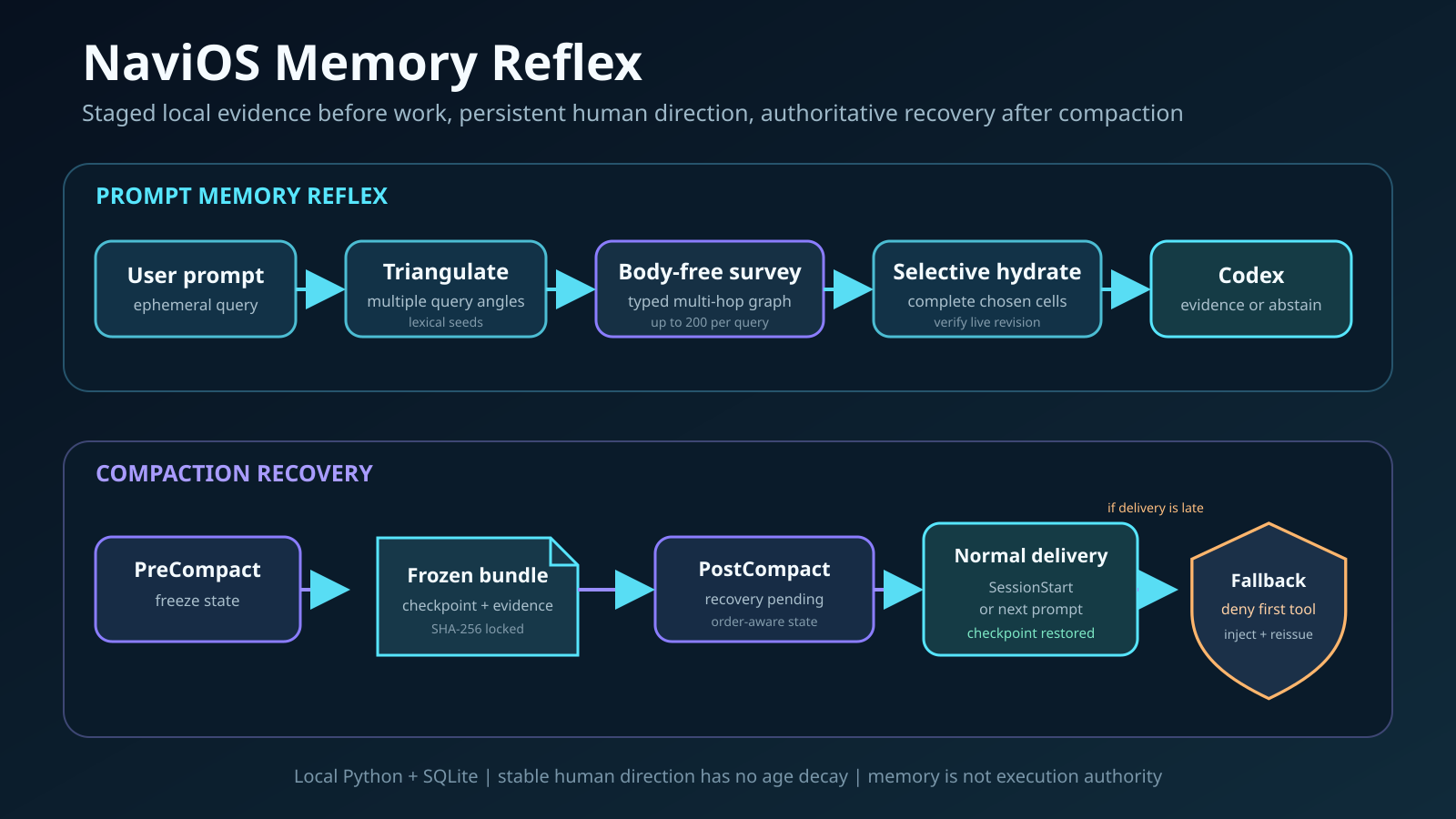
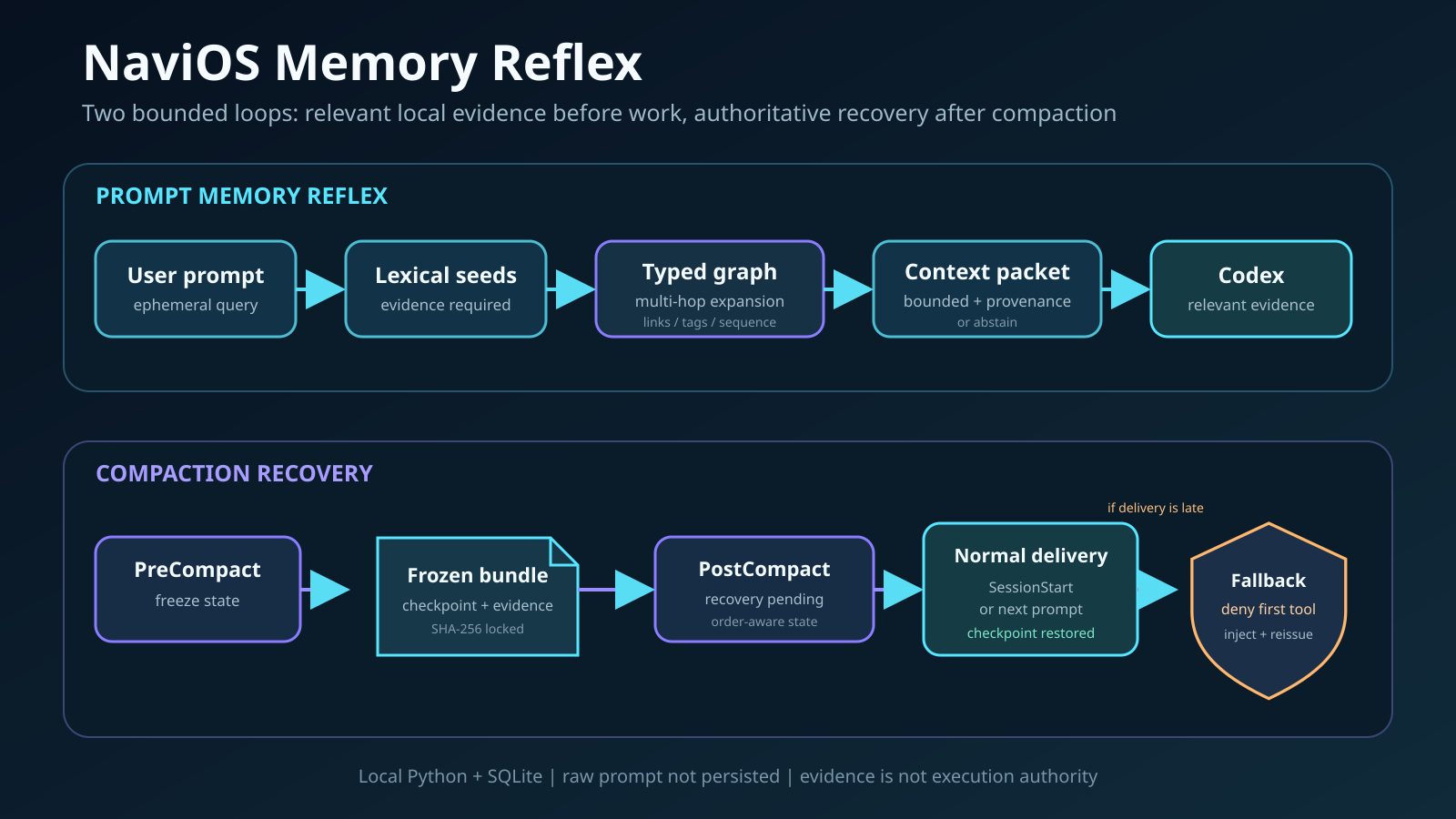
For each prompt, the plugin:
- Finds evidence-bearing lexical seeds.
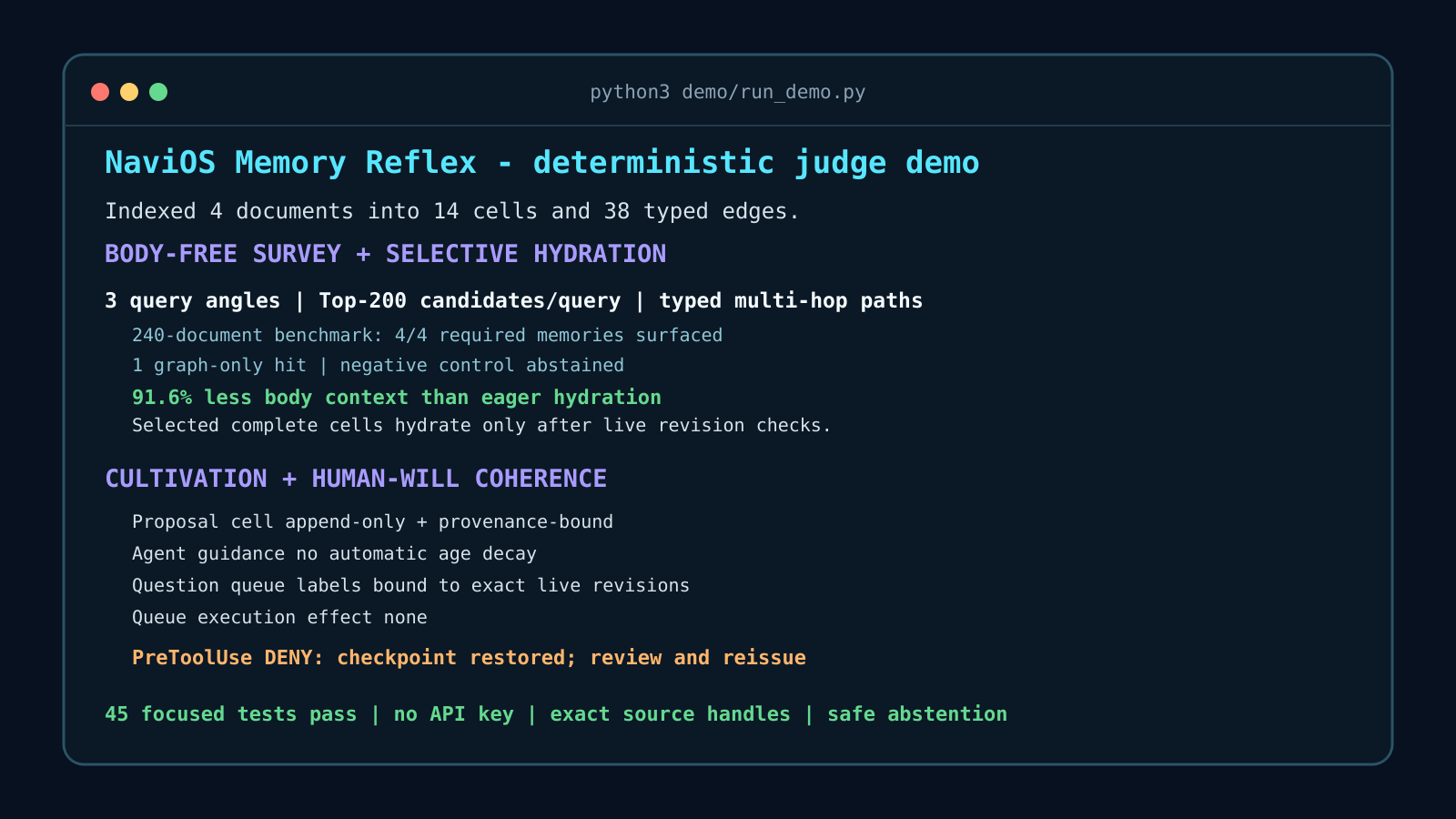
- Expands through typed graph relations such as document sequence, shared headings, explicit links, backlinks, and shared tags.
- Combines several query formulations and rewards evidence reached from more than one direction.
- Injects a bounded context packet with exact source handles, or injects nothing when no supported evidence is found.
Before Codex compacts its context, NaviOS freezes the authoritative project checkpoint and the last retrieval packet into a digest-locked recovery bundle. After compaction it restores that bundle through Codex hooks. If normal delivery arrives out of order, the first tool call is cancelled and receives the recovery bundle so consequential work cannot silently continue from an unrecovered state.
The default engine is local-first. It uses Python and SQLite and requires no remote embedding API or API key.
How we built it
This repository began with experimental hardlink and GraphSAGE prototypes. During Build Week, I used GPT-5.6 in Codex to audit that earlier code, identify broken contracts and unsupported claims, and narrow the research architecture into a reproducible developer tool.
The Build Week implementation adds a fresh deterministic cell index, typed multi-hop graph traversal, multi-query triangulation, negative-control abstention, exact provenance packets, a Codex plugin and skill, compaction hooks, private runtime state, an isolated installation path, focused tests, and a one-command judge demonstration. Prior GraphSAGE experiments remain in the repository as clearly labeled historical work rather than being presented as part of the default product.
Codex accelerated repository exploration, implementation, adversarial test design, packaging, and documentation. I supplied the long-term product direction, cognitive-memory concepts, privacy requirements, scope decisions, and final publication control.
Challenges
- Retrieval is not truth. A relevant old note can still be obsolete or wrong, so every result remains source-linked evidence rather than execution authority.
- Graph expansion can amplify noise. Lexical evidence must seed traversal; unrelated queries abstain instead of activating a graph hub.
- Memory can expose secrets. Suspicious filenames are excluded by default, source selection is explicit, and raw prompts are represented in saved state only by a digest rather than transcript text.
- Hook ordering is not always intuitive. Live testing exposed a case where
PostCompactcould arrive after another recovery path had already delivered the bundle. The state machine and regression tests now prevent that late event from rearming recovery incorrectly. - Judges need a reproducible project. The demo runs in a temporary synthetic project with no API key and does not inspect the judge's own files.
What we learned
The most useful memory system is not the one that returns the most text. It is the one that can explain exactly why each fragment appeared, remain quiet on unsupported queries, and recover an authoritative working state when the model's transient context changes.
We also learned to treat deterministic graph retrieval as a strong, inspectable baseline. Learned GNN views may become useful later, but they should earn a place through held-out evaluation rather than being assumed superior.
What's next
- Evaluate retrieval on prospective real-world agent tasks.
- Add authority, currentness, and contradiction-aware evidence handling.
- Compare specialist learned GNN views against the deterministic baseline.
- Support additional structured source types and memory-cell views.
- Measure whether the complete reflex reduces repeated reading and improves post-compaction task continuity over ordinary checkpoint-only workflows.
Built With
- Python
- SQLite
- OpenAI Codex
- GPT-5.6
- Codex CLI
- Codex plugins and hooks
- GitHub
- Linux
- Markdown
- JSON
- BM25-style lexical retrieval
- Typed graph traversal
- SHA-256 provenance
Try It Out
Add after the Build Week branch is reviewed, committed, and pushed:
https://github.com/Simon-Omega-Magus/NaviOS-Memory-Core/tree/build-week-2026-memory-reflex
Media
Add after final demo capture:
- project thumbnail, 3:2 ratio;
- retrieval packet screenshot;
- compaction-recovery screenshot;
- architecture diagram;
- public YouTube demo under three minutes.

Log in or sign up for Devpost to join the conversation.