-
-
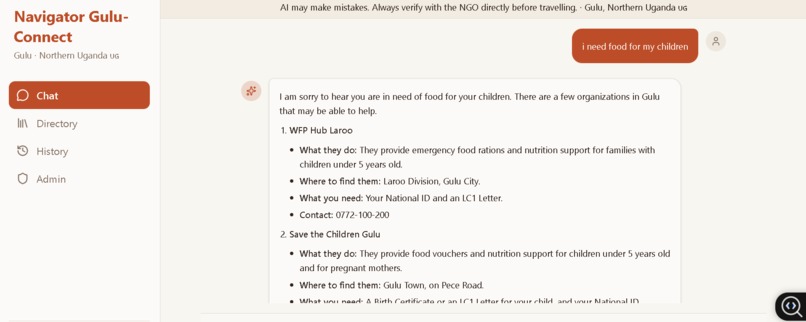
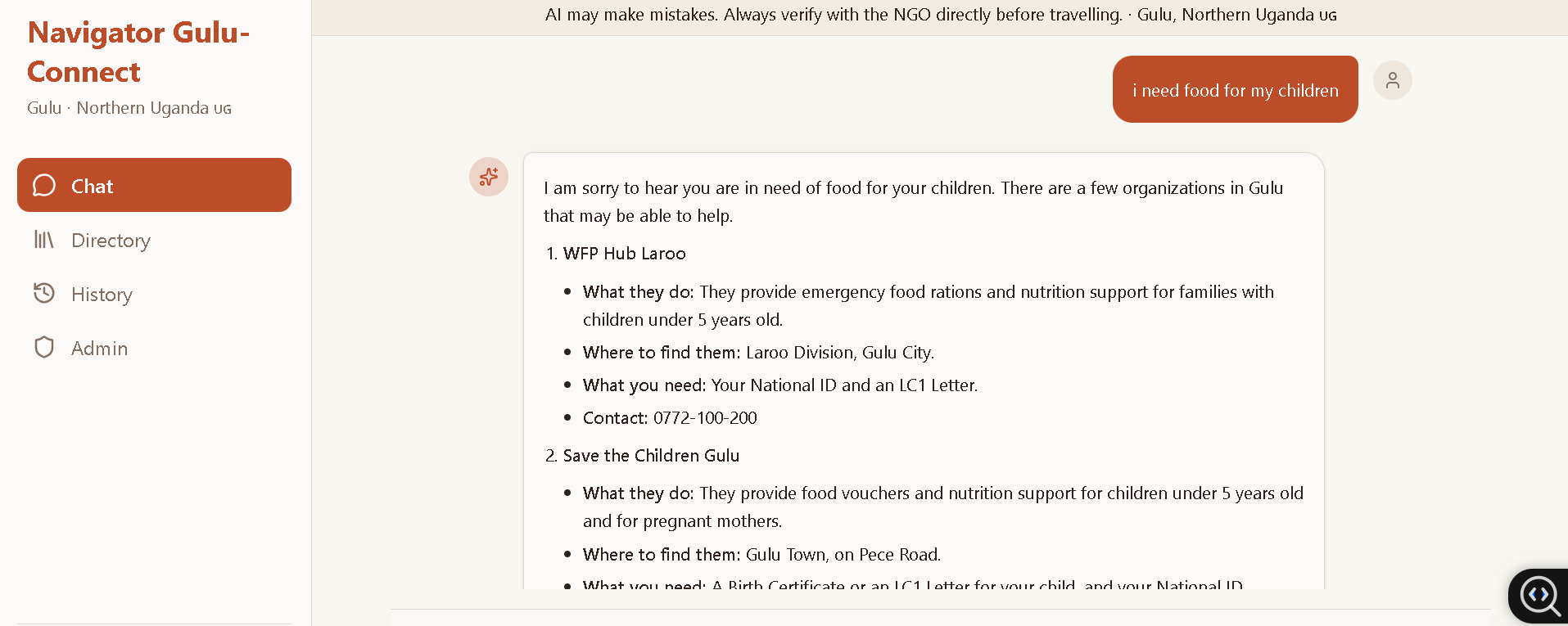
image showing the chat bot
-
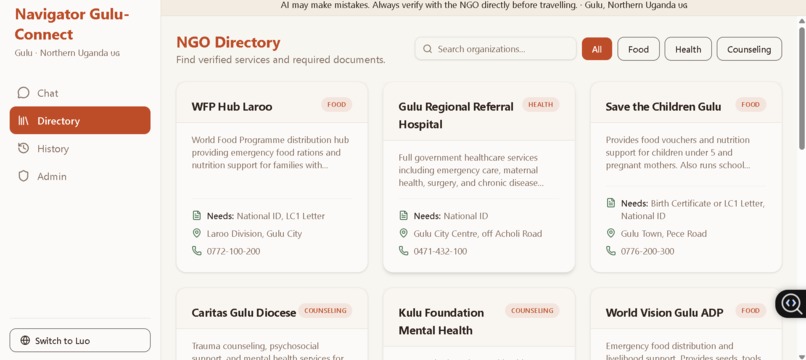
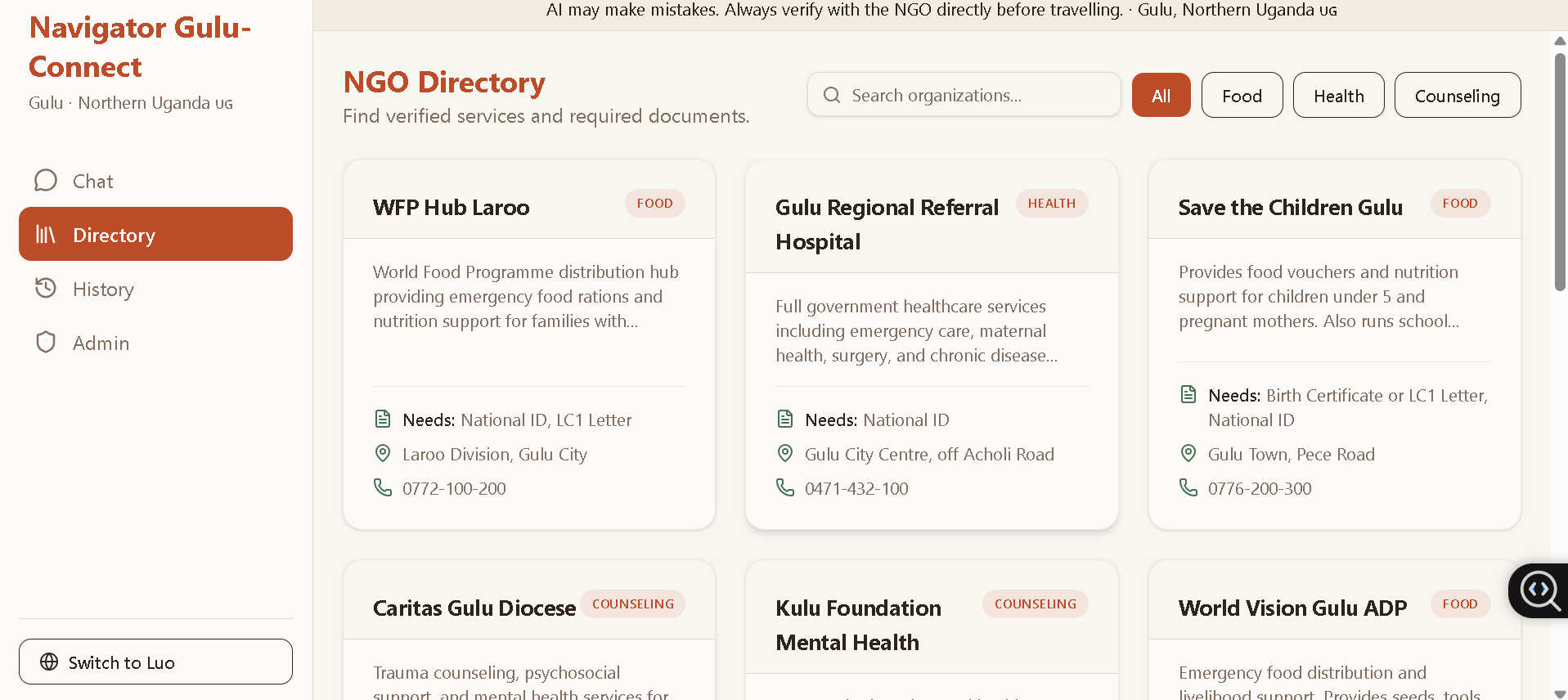
image showing the directory
-
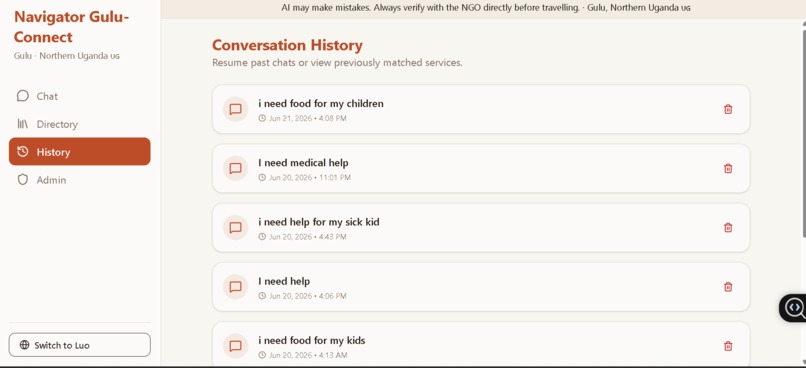
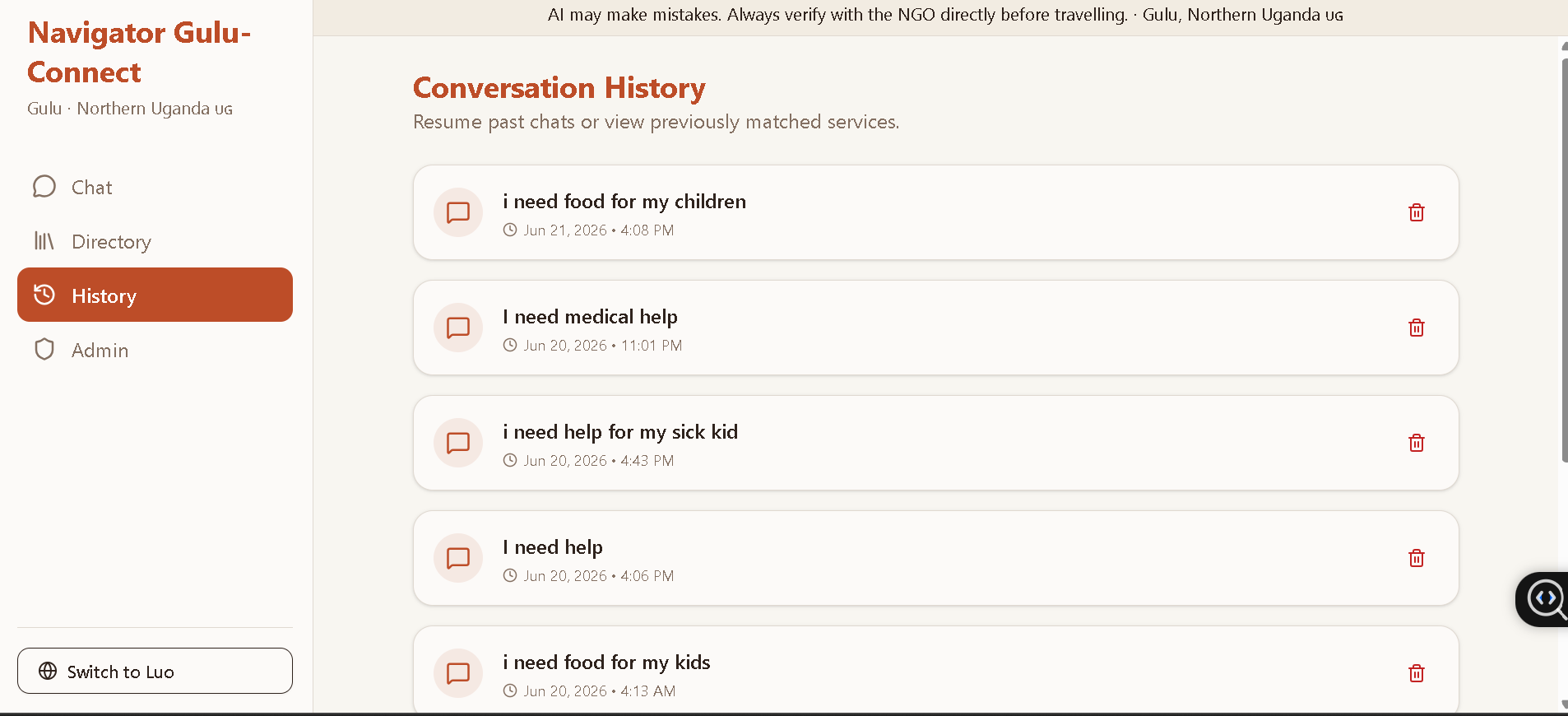
image showing the chat history
-
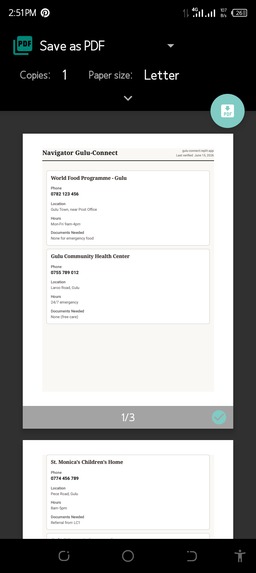
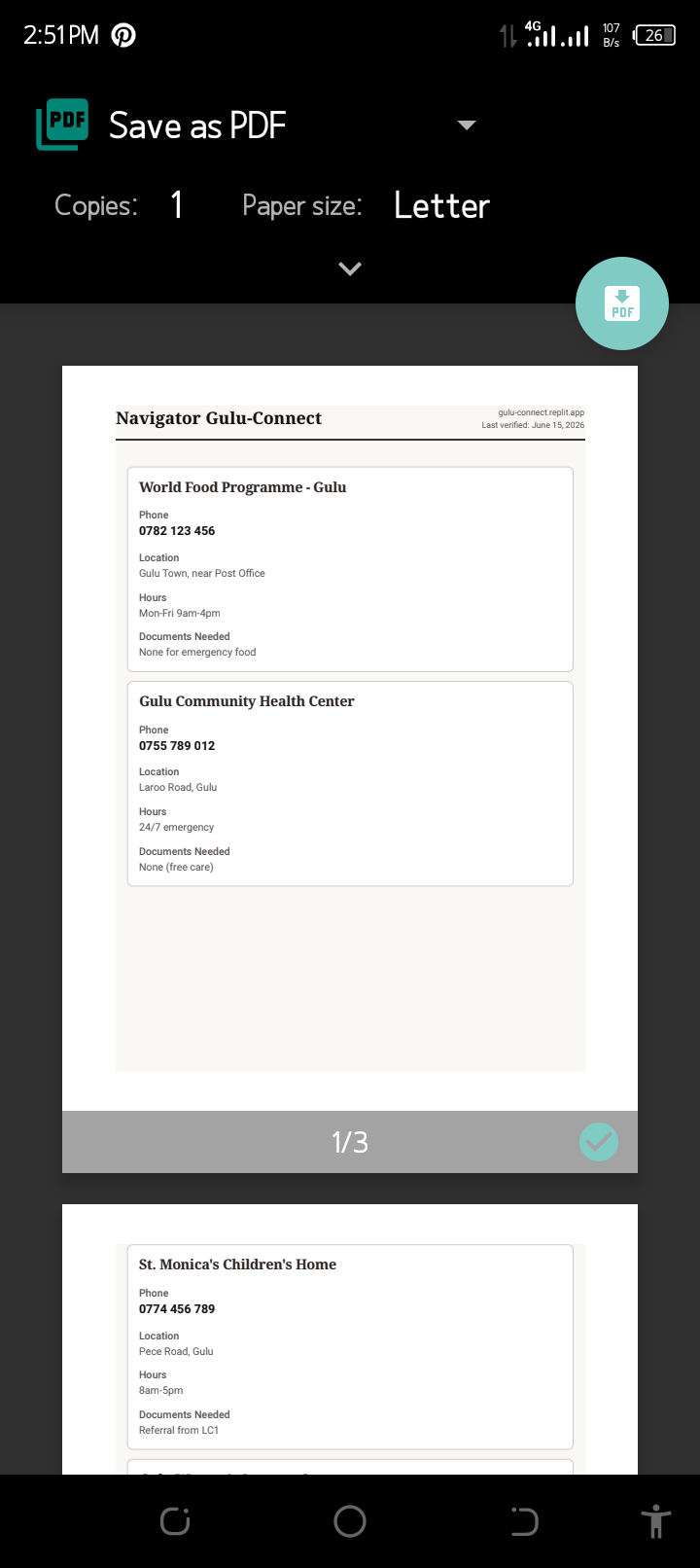
printed results
-
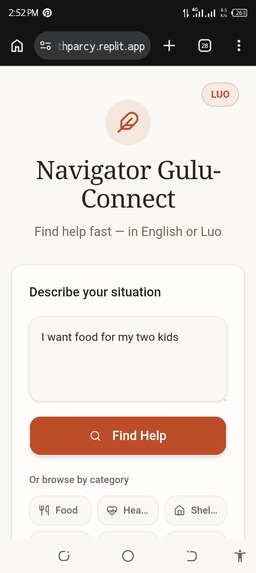
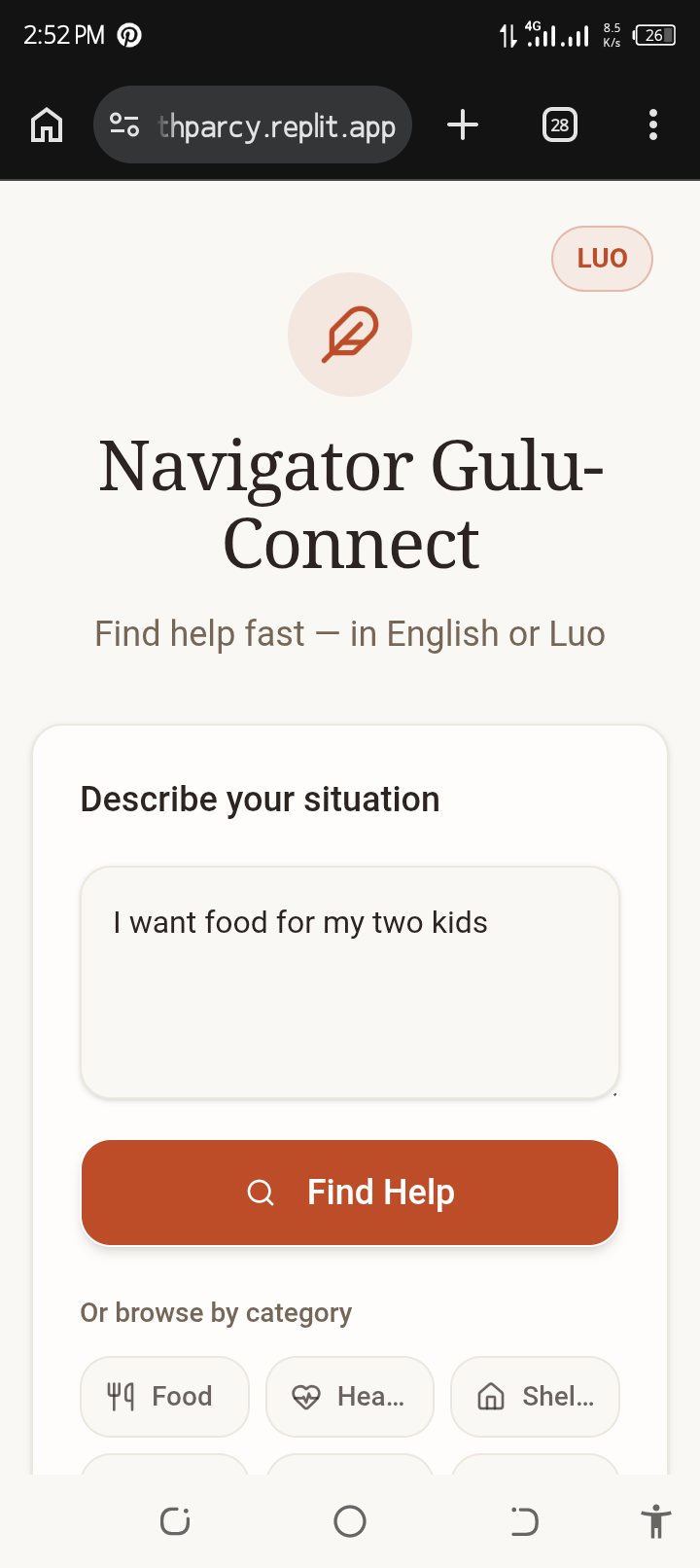
1mage showing the description page
Inspiration
Our inspiration came from a single mother of 2 in Gulu, Uganda, who lost her informal market job and had just 5,000 UGX for transport. Her children hadn't eaten in 24 hours and she couldn't afford to visit the wrong NGO office. We realized that information about food aid, healthcare, and counseling is scattered across WhatsApp groups, paper noticeboards, and word-of-mouth forcing vulnerable families to waste 2-3 days walking between offices, only to be told they lack documents or services ended. A 2023 Gulu District NGO Forum report found that 67% of first-time aid seekers visited at least 3 wrong offices before finding help. We built Navigator Gulu-Connect to turn that 3-day scavenger hunt into a 60-second clear path forward.
What it does
Gulu-Connect helps Luo-speaking single mothers, unemployed youth, elderly caregivers, and displaced families in Northern Uganda find verified food aid, healthcare, and counseling within minutes not days. Users describe their crisis in plain English or Luo, and our AI translates their intent, matches it to a curated database of verified local NGOs and returns exactly 3 actionable options with required documents and walking directions. Within 60 seconds, a stressed person moves from confusion to a clear, confident next step.
How we built it
We built a cross-platform mobile app using React Native and Flutter with a Progressive Web App for low-data access. The backend runs on Node.js and Python with FastAPI, powered by PostgreSQL and Firebase for databases, and Redis for caching. For AI, we integrated OpenAI GPT and Gemini APIs alongside fine-tuned Hugging Face models for Luo-English intent matching. We used Africa's Talking API for USSD and SMS fallback for feature phones, Google Maps and OpenStreetMap for directions, and mobile money APIs for future transport assistance. The app is deployed on AWS and Google Cloud with Docker and Kubernetes, monitored using Sentry, Prometheus, and Grafana.
Challenges we ran into
Handling stress-induced vague queries like "I need help" was a major challenge simple dropdown menus failed completely. Language mismatch was another hurdle, as keyword search couldn't connect "Yam pe" (No food) with "Emergency Food Relief." Ensuring accurate eligibility interpretation required translating complex NGO rules into plain language without oversimplifying. We also had to design for 2G networks, low literacy, and offline environments while maintaining a 60-second response time. Training models for Luo-Acholi-English code-switching with limited training data pushed us to use few-shot prompting and continuous feedback loops.
Accomplishments that we're proud of
We're proud of turning a 2-3 day stressful hunt into a 60-second clear path forward saving users time, money, and hope. Our AI successfully bridges language gaps, interprets ambiguous crisis descriptions and translates complex eligibility rules into plain, actionable guidance. We built a system that works on 2G networks, supports feature phones via SMS and returns only 3 options to prevent decision paralysis under stress. Most importantly, we're solving a real problem for the most vulnerable people who previously gave up searching altogether now have a trusted, immediate resource.
What we learned
We learned that AI isn't just a search upgrade it's an interpreter, eligibility guide, and stress-reducer all in one. Localization, offline support, and simplicity matter more than feature bloat. We discovered that under stress, users don't want 10 options they want exactly 3 clear choices with everything they need to act. We also learned that trust is everything: users need to know the information is verified and recent, which is why we built the "last verified" date and auto-hide system for outdated NGOs.
What's next for Navigator Gulu-Connect
We're scaling from 10 to 50+ NGOs across all of Northern Uganda, adding voice input in Acholi/Luo for low-literacy users, and launching USSD and SMS integration for feature phones. We're partnering with NGOs for real-time availability updates, building a community feedback loop so users can rate their experiences and integrating mobile money for transport assistance to critically urgent cases. Finally, we're adapting the model for other conflict-affected regions including South Sudan and the DRC anywhere information is the barrier between a family and their next meal.


Log in or sign up for Devpost to join the conversation.