Inspiration
High-velocity IT Service Management is appealing in theory, but achieving it in real life is challenging.
Today, most ITSM teams face constant pressure to resolve issues quickly, meet increasingly stringent SLAs, and keep up with evolving business needs. Meanwhile, their processes are getting more complicated. Tickets move between teams, workflows change without official updates, and small manual steps can add up to big delays.
When problems arise, teams often realize work is moving slowly, but don’t know why. Teams can track ticket counts and SLA breaches, but they often lack a clear view of how work moves through the system.
- Where do tickets get stuck?
- Where do they loop back?
- Which handoffs slow things down the most?
To answer these questions, teams usually have to dig through ticket histories, export data, or depend on someone’s experience and intuition. This approach doesn’t scale and leads to reactive, not proactive, improvements."Navigator for JSM" was created to address this gap.
Our goal was to give ITSM teams real visibility into how their workflows actually operate each day, so they can work faster and with more confidence.
What it does
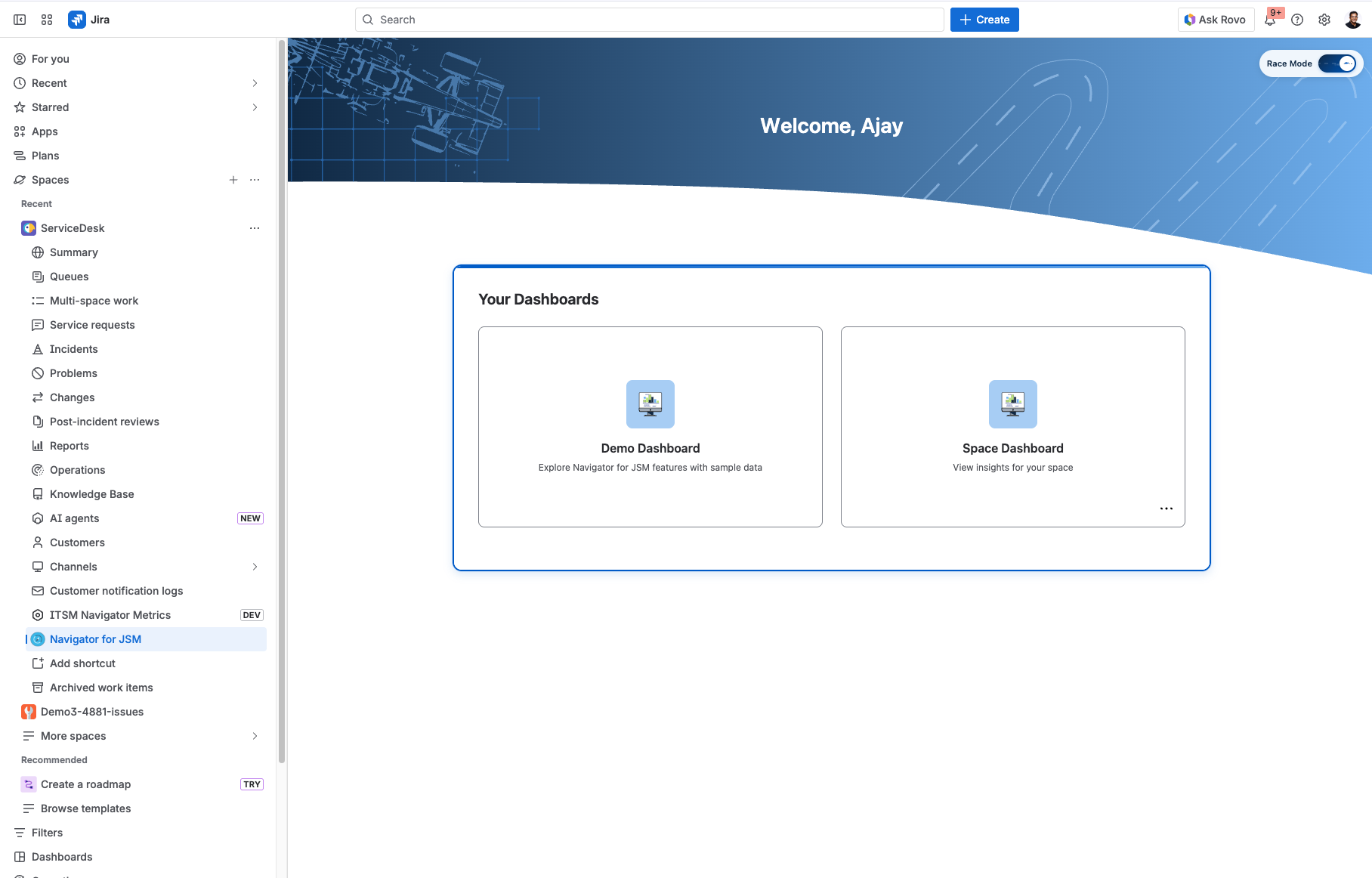
Navigator for JSM is a process intelligence “Runs on Atlassian” Forge app built specifically for Jira Service Management. Navigator for JSM analyzes ticket activity to show how work moves across statuses, teams, and handoffs. There’s no need for data exports or complicated setup.
With Navigator for JSM, teams can:
- See the actual paths tickets take through their workflows.
- Identify loops, rework, and long waiting states.
- Understand which parts of the process slow down resolution the most.
- Focus attention on tickets that are dragging down overall performance.
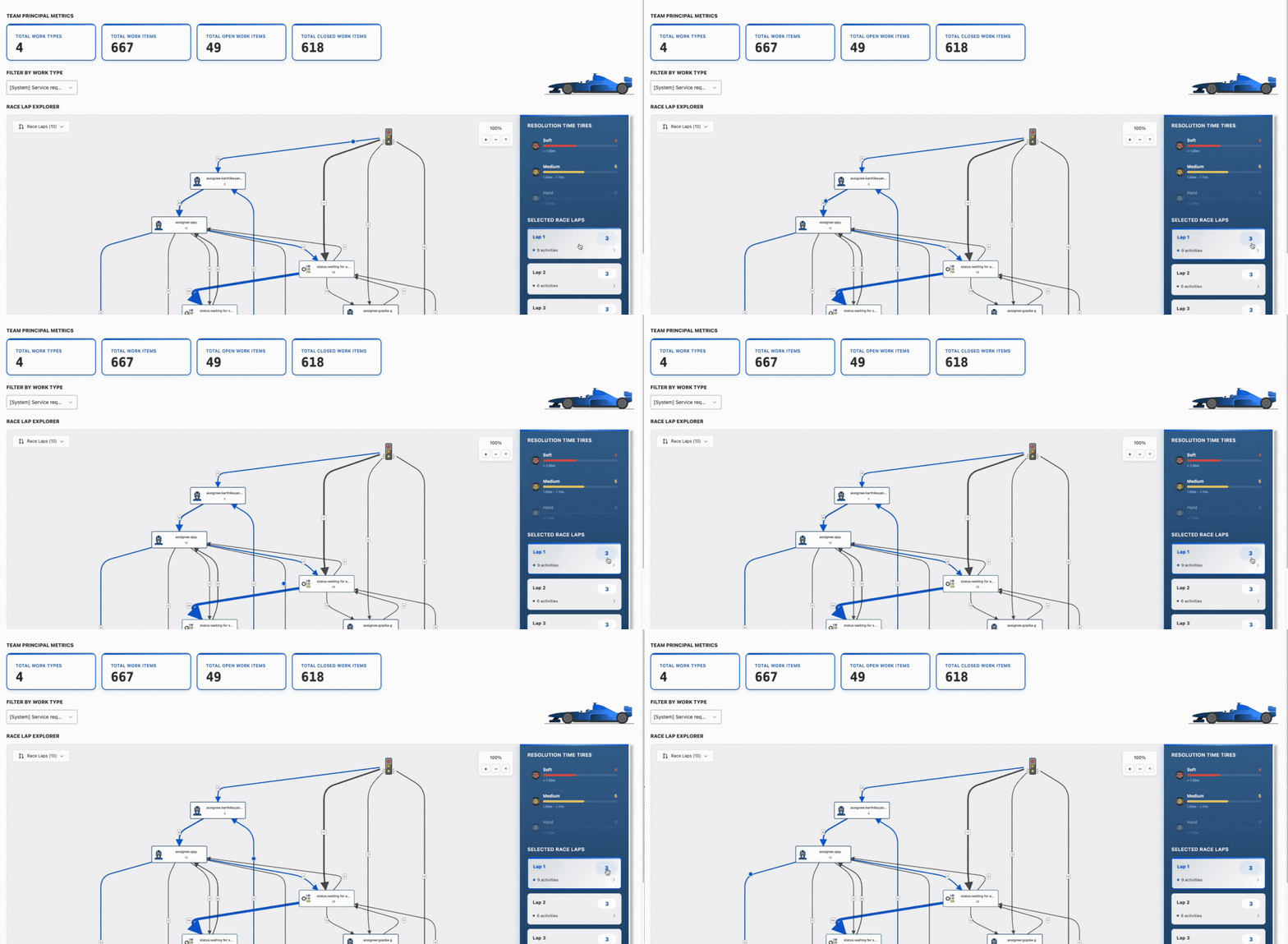
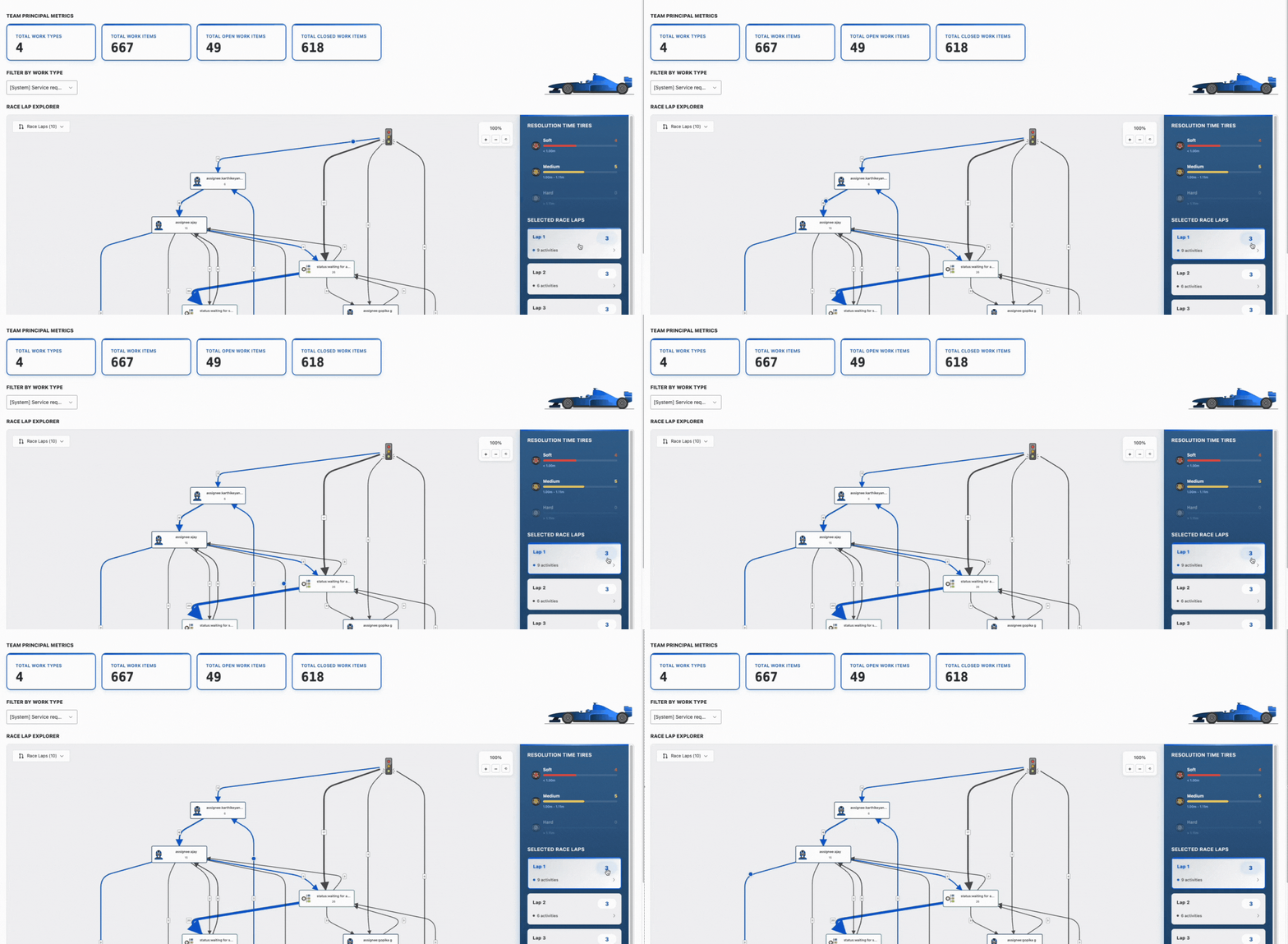
The Race Lap Explorer (inspired by the Codegeist Williams Racing edition) visualizes workflows as execution paths, making it easy to spot inefficiencies.
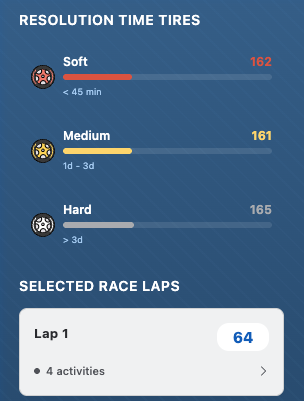
The Resolution Time Tires view groups tickets by how quickly they are resolved, helping teams focus on the slowest-moving work.
Instead of guessing where problems are, teams can identify them clearly and right away.
How we built it
We built Navigator for JSM, entirely on the Atlassian Forge platform to ensure it feels native, secure, and closely integrated with JSM. We process JSM issue events and histories directly, using an event-driven approach to gradually map ticket movement over time.
Key parts of the implementation include:
- Forge Runtime and JSM Product APIs for data access.
- Custom UI for interactive visualizations like the Race Lap Explorer
- Forge Async Events to process large volumes of ticket activity efficiently
- Forge SQL for fast querying and aggregation
- Rovo to summarize patterns and action proposals. (in the works)
The system is built to handle ticket volume. In our internal tests, we analyzed tens of thousands of issues in just minutes, all within the Atlassian Forge (Runs on Atlassian) platform.
Challenges we ran into
One of our biggest challenges was modeling real-world workflows.
JSM workflows often change naturally over time. Automations, bulk updates, and unusual cases introduce noise, making it harder to spot important transitions. We spent a lot of time improving how we detect and understand workflow paths.
Learning to work within Forge’s limits was another challenge. We had to make careful design choices early on because of performance, storage, and execution patterns. Visualizing large and complex workflows was also difficult. We needed to balance showing all the details with keeping things clear, so users could understand the information without feeling overwhelmed. Not every anomaly is helpful. We kept refining the product to ensure the insights we provided were truly useful, not just interesting from a technical perspective.
Accomplishments that we’re proud of
- Delivering a plug-and-play solution with no ETL or manual setup
- Making invisible workflow issues visible in a way that teams can quickly understand
- Turning raw ticket activity into clear, navigable process views
- Achieving strong performance entirely on Forge
- Building an experience that feels like part of JSM, not an external analytics tool
What we learned
We learned that visibility is the key to making improvements. When teams can see what’s really happening, their conversations become more objective and productive. We also found that visuals are more important than raw numbers alone. People trust what they can see and explore on their own. Working within platform limits led us to make better design choices, and early user feedback helped us focus on insights that really matter in daily work.
Most importantly, insight is only valuable when it leads to clear action.
What’s next for Navigator for JSM
As with our App roadmap, we want to make the product more actionable. We plan to integrate Rovo capabilites so that insights not only highlight problems but also suggest clear next steps, such as automation opportunities, workflow simplification, or workload redistribution. We are also exploring predictive signals to spot potential bottlenecks before they cause SLA breaches. As Forge adds new features like Containers and Forge LLMs, we plan to expand our analysis and support even larger JSM environments.
Our long-term goal is to help ITSM teams make faster, better decisions by giving them clear, actionable insights into how work really flows. We see JSM Navigator becoming an essential tool that not only finds process issues but also recommends and supports improvements, guiding teams toward operational excellence as their needs grow.
Built With
- custom-ui
- forge
- javascript
- resolver
- sql


Log in or sign up for Devpost to join the conversation.