Inspiration
I once watched a friend postpone an MRI for a sports injury because the hospital refused to quote a price. That delay caused a cascade of complications, which is proof that information asymmetry literally hurts people. Naviah.ai is my answer to that injustice.
I wanted to solve a real-world problem that affects millions: healthcare in the U.S. is both expensive and opaque, especially for people without insurance. The lack of price transparency forces patients to make decisions blindly, with serious financial and health consequences.
What it does
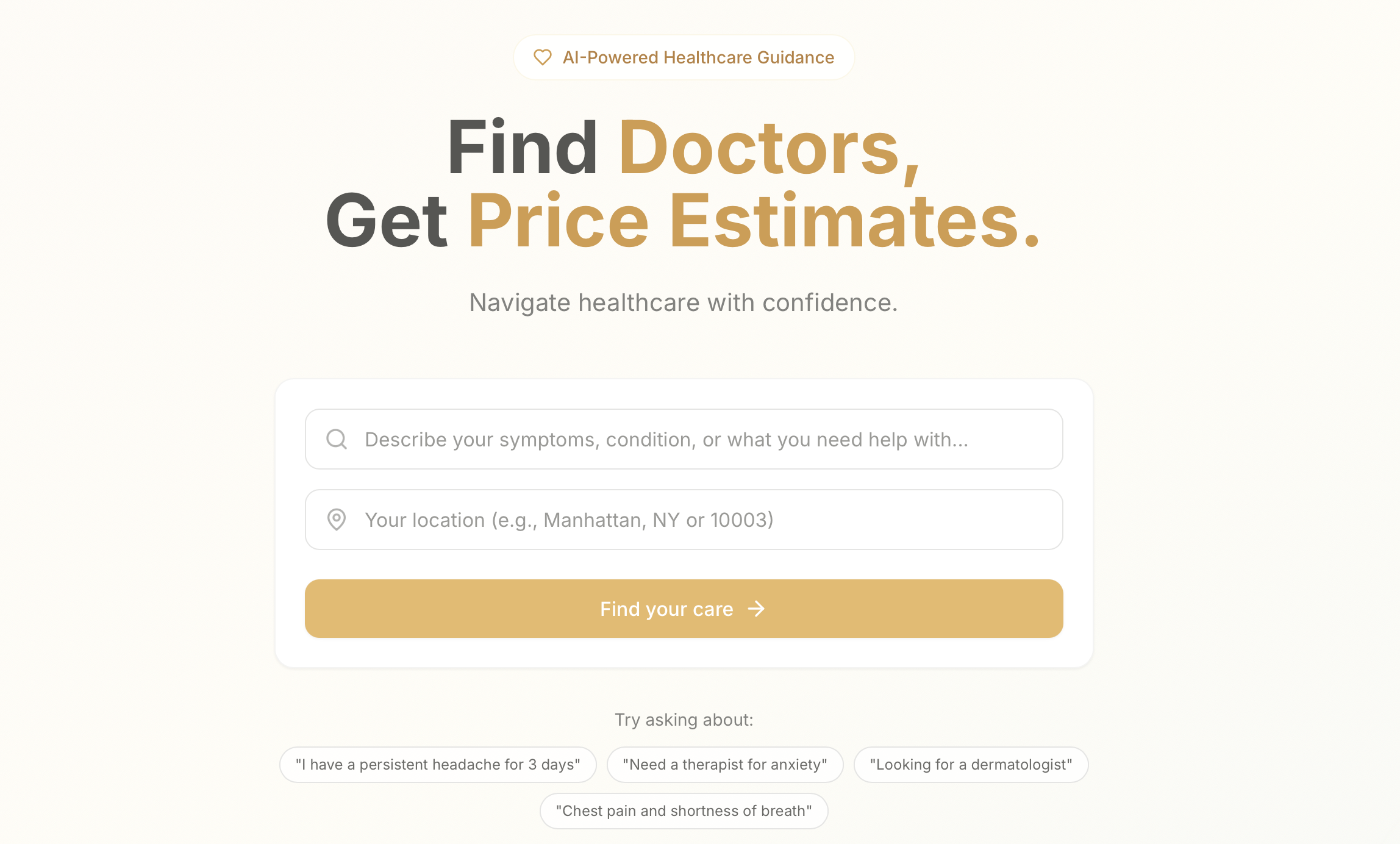
I wanted to create something radically simple and useful: a smart assistant that helps users find care they can actually afford, starting with real price estimates and reliable provider recommendations.
How I built it
In building a healthcare recommendation website, providing accurate information is the top priority. Since 2022, the U.S. government has been working on price transparency in healthcare, so I could find many public datasets available, albeit fragmented. I used Python to create a data collection and preprocessing pipeline to standardize and store the data in Supabase.
Then it was time for building the reasoning layer. Again, following the hippocratic principle, we must do no harm; minimizing risk is more important than maximizing utility in healthcare. There were multiple choices for mitigating hallucination, and I chose the confidence based triage: the AI agent will ask questions until it has enough information to provide you recommendations. I used OpenAI API and Langchain to implement this part. Also, we got rid of any chance of hallucinating the price information by combining deterministic SQL retrieval with an LLM that maps symptoms to likely procedures.
On the frontend, I used Bolt to build a clean, conversational UI. It provided a seamless connection with the backend.
Challenges I ran into
The biggest constraint was time: I only had 30 days to come up with an entire website, and I had a little to no experience in web development, especially the frontend.
On the data side, one of the biggest surprises was that compliance does not equal usability. While hospitals are legally required to publish their pricing data, many post it in obscure formats: gigantic spreadsheets, cryptically named files, or even corrupted JSON. Extracting usable data from these files felt like digital archaeology.
Another major challenge was safely bridging the gap between user-reported symptoms and medical procedures. A phrase like “shortness of breath” could map to dozens of different CPT codes depending on the context. Designing an AI that could handle such ambiguity responsibly, while avoiding false confidence, required a careful balance between probabilistic reasoning and hard constraints.
I also had to be very mindful about HIPPA regulations. The website must not collect Personal Health Information (PHI), which meant I had to make sure personal information and health-related information were not associated with each other when they were stored.
Perhaps the most humbling challenge was accessibility. The people who need affordable healthcare the most—the uninsured, elderly, or low-income patients—are often the least equipped to navigate a complex web interface. This realization pushed me to rethink user interaction entirely, eventually leading me to embrace conversational AI as the interface.
Accomplishments that I am proud of
Despite these challenges, I shipped a complete web product in just less than a month, featuring a robust pipeline that standardizes messy CMS and hospital data into a clean PostgreSQL layer, an LLM-powered reasoning engine to map symptoms to procedures safely, and a provider recommendation system that contextualizes care options by price, location, and treatment type, all delivered through an intuitive Bolt-powered interface.
In order to generate organic traffic, I also built a blog engine that fully automatically generates helpful based on the underlying database and Google Trends. These posts cover common procedures, pricing explanations, and provider insights, giving users bite-sized actionable knowledge right when they need it.
Above all, I’m proud that the system respects the user’s uncertainty, offers clarity without overstepping, and empowers people with the knowledge they need to make informed healthcare decisions.
What I learned
This project taught me how to ship a complete, production-grade web application from scratch. I gained a deeper appreciation for system design, not just in terms of architecture, but in building systems that are safe, scalable, and useful in the real world. Healthcare, unlike many other industries, has little tolerance for ambiguity. A recommendation system in this domain needs to know when to say, “I’m not sure,” and be okay with that. Designing for that kind of humility in AI was a valuable and sobering experience.
What's next for Naviah.ai: Navigating Healthcare with Confidence
Naviah.ai isn’t just a technical project. It’s a public utility in the making. I want to keep building toward a future where everyone, regardless of income or insurance status, can make informed healthcare decisions without fear or confusion.
The next phase of the project includes several key features. First, I’m working on enabling insurance-aware appointment booking, powered by outbound AI phone agents that can call clinics on the user’s behalf. Second, I plan to incorporate medication tracking and interaction checks, using drug interaction knowledge graphs to flag potential risks. Finally, I want to build an AI medical bill negotiator that can detect potential price gouging by comparing a patient’s bill with our database, and even initiate negotiations on their behalf.
This is just the beginning. With Naviah.ai, I hope to restore agency to patients who have long been left in the ambiguity and obfuscation.
Built With
- bolt
- elevenlabs
- fastapi
- gemini
- langchain
- netlify
- openai
- python
- react
- serpapi
- supabase
- tailwind
- typescript
- vite


Log in or sign up for Devpost to join the conversation.