-
-
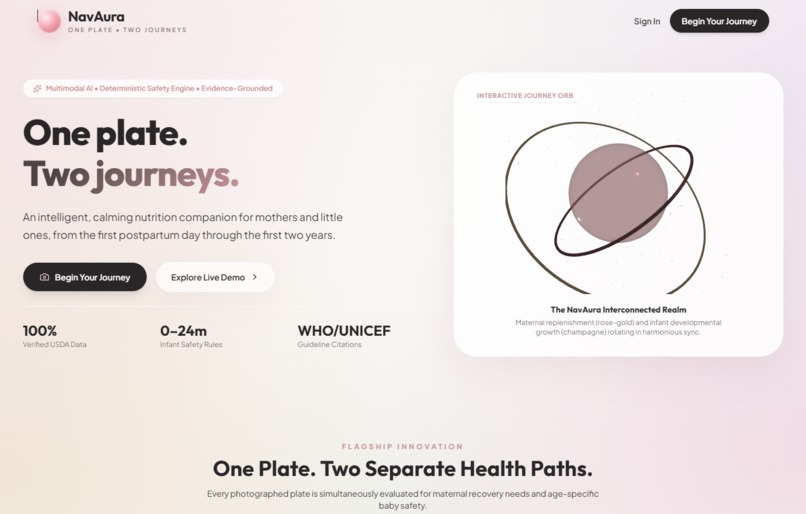
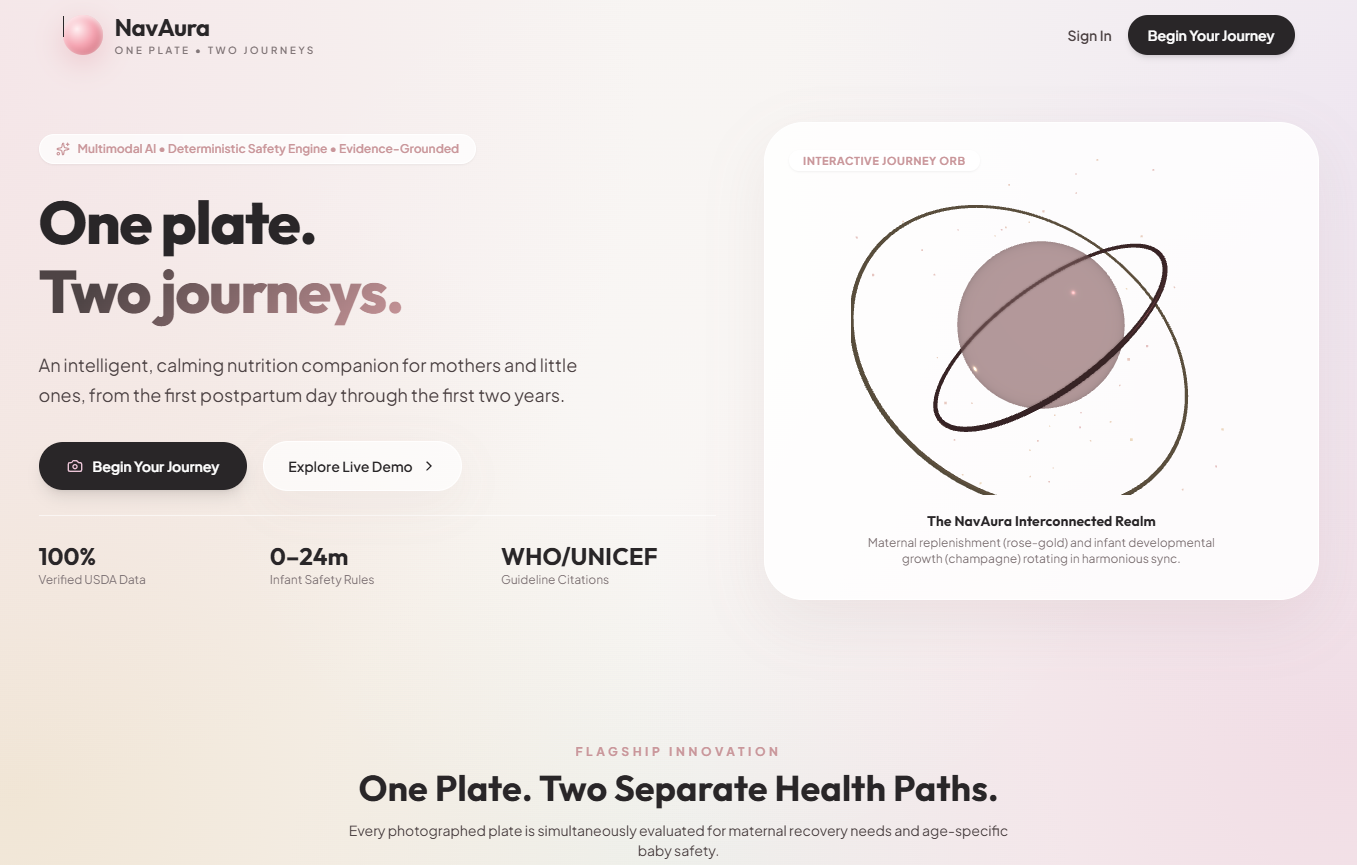
Landing Page
-
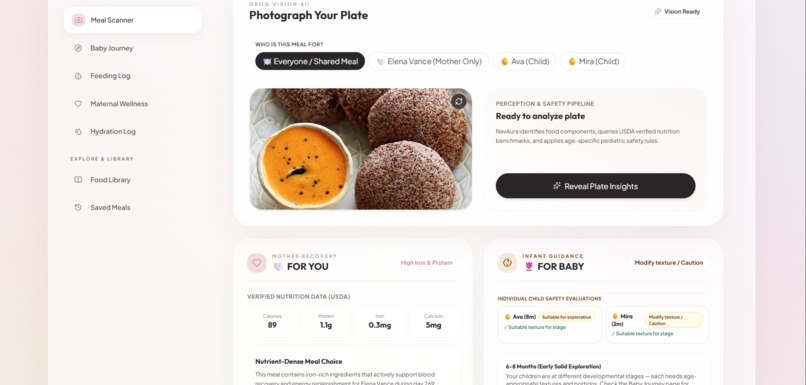
AI Meal Scanner-1
-
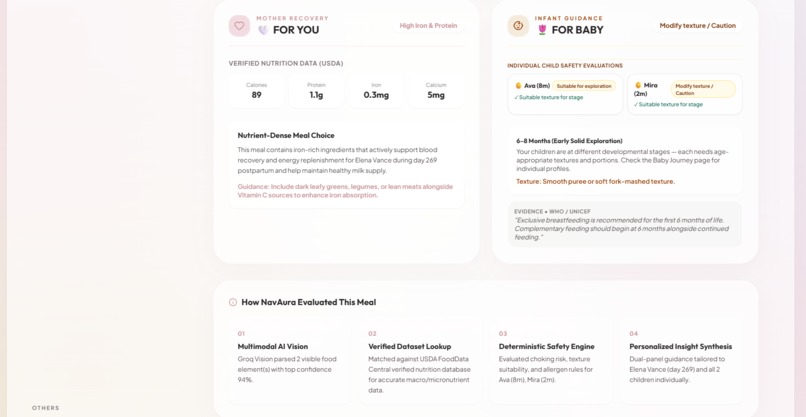
AI Meal Scaneer-2
-
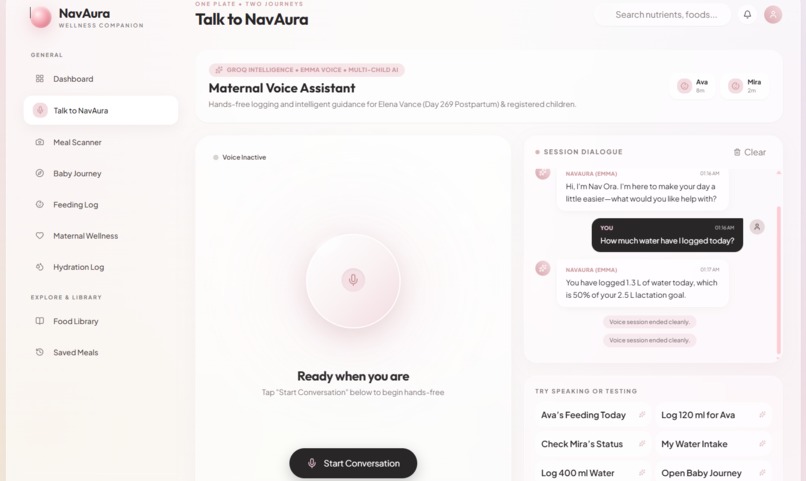
NavAura Voice Assistannt
-
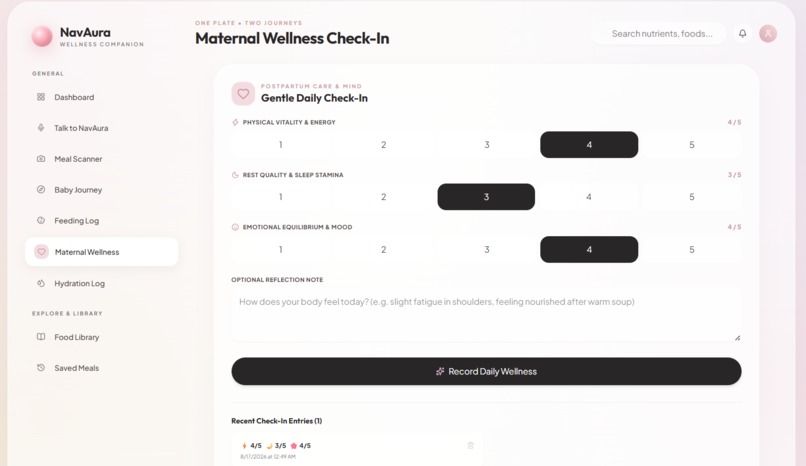
Maternal Wellness
-
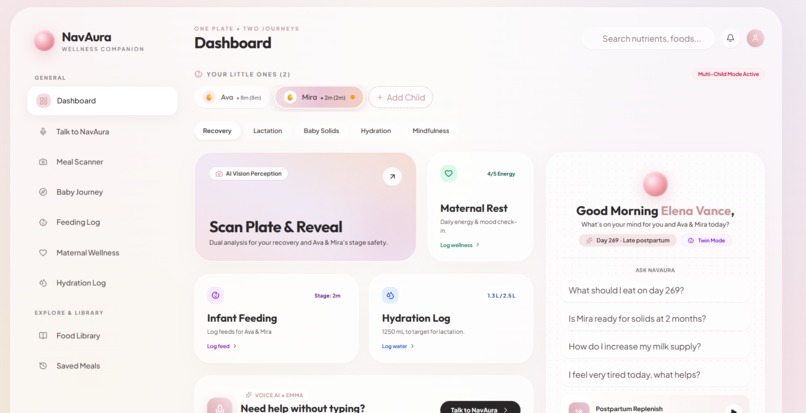
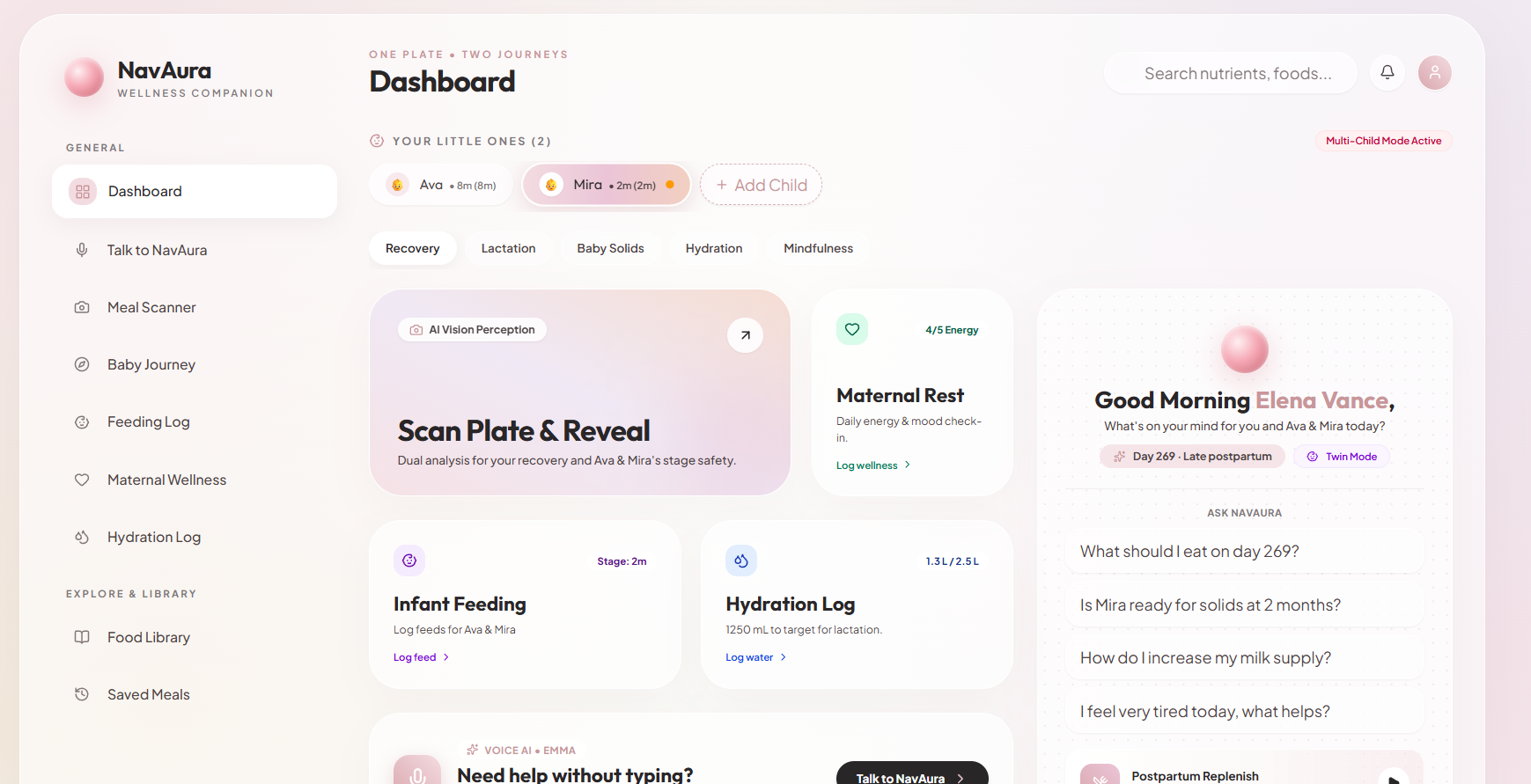
Dashboard
-
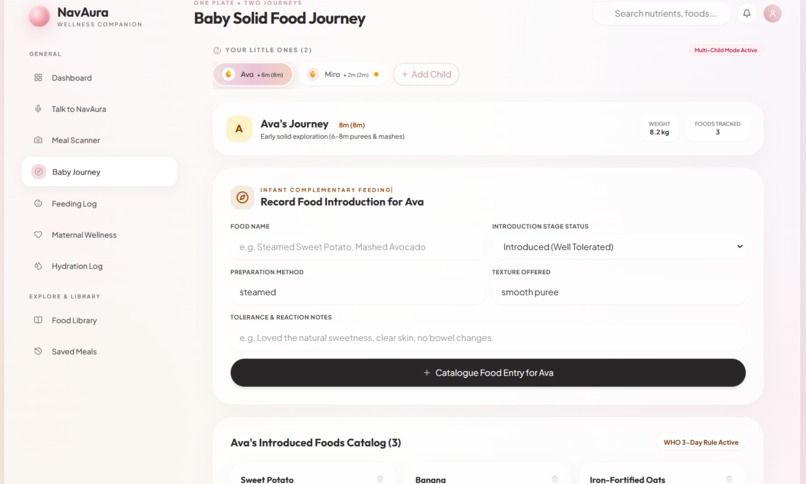
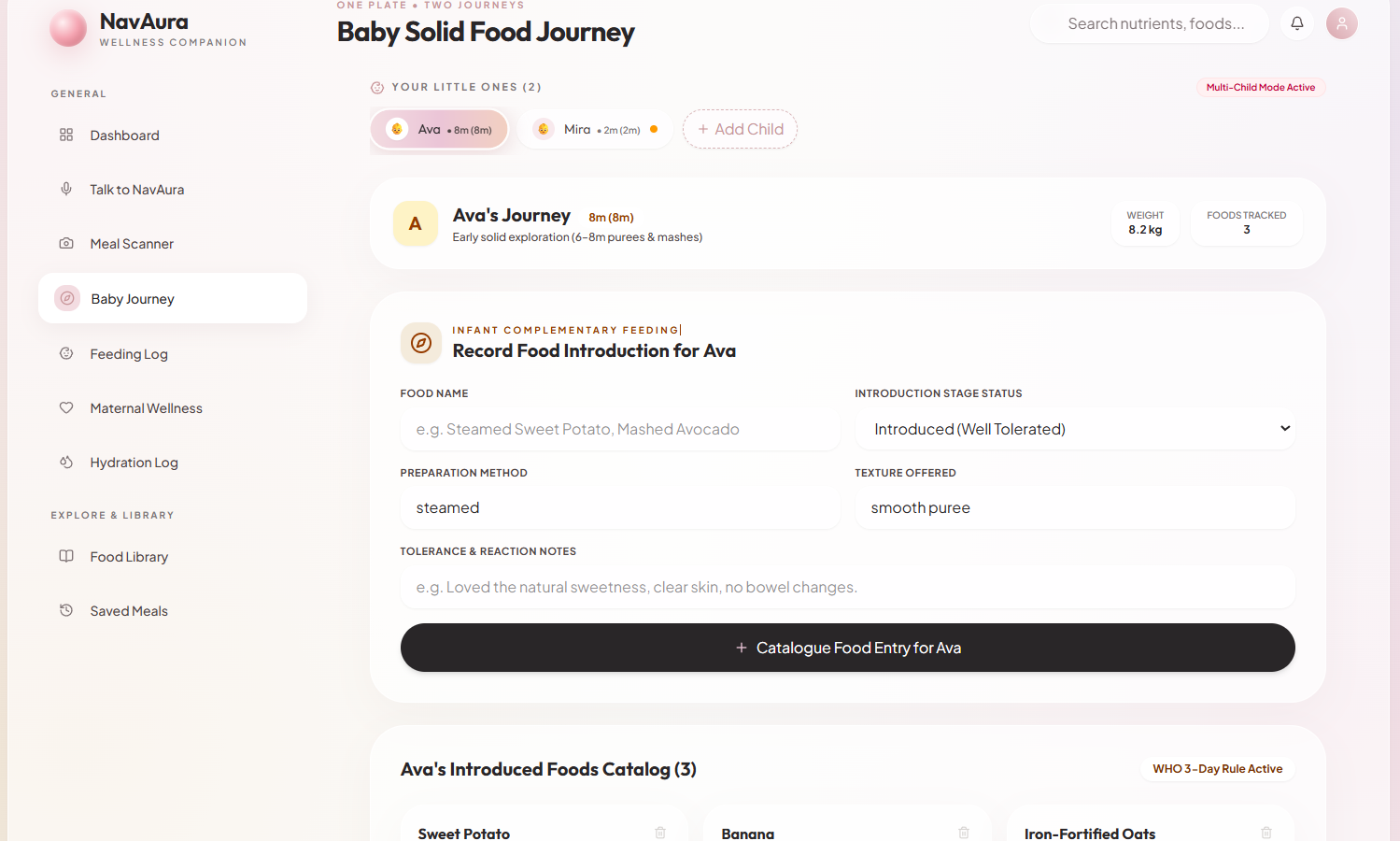
Baby Journey
-
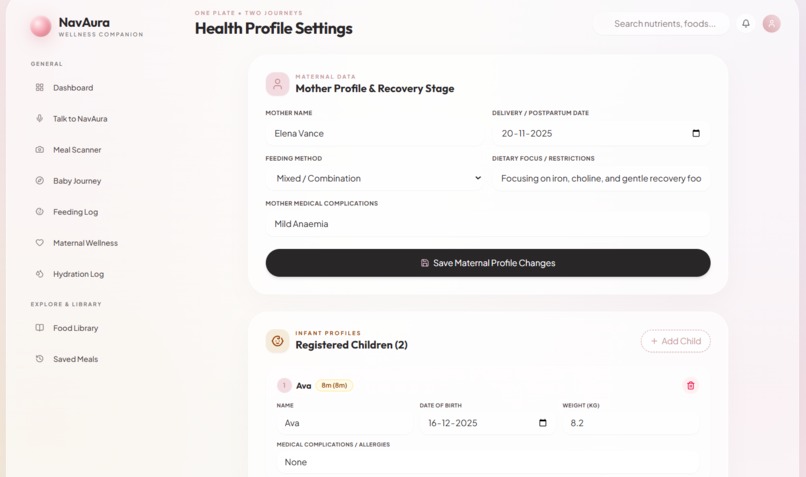
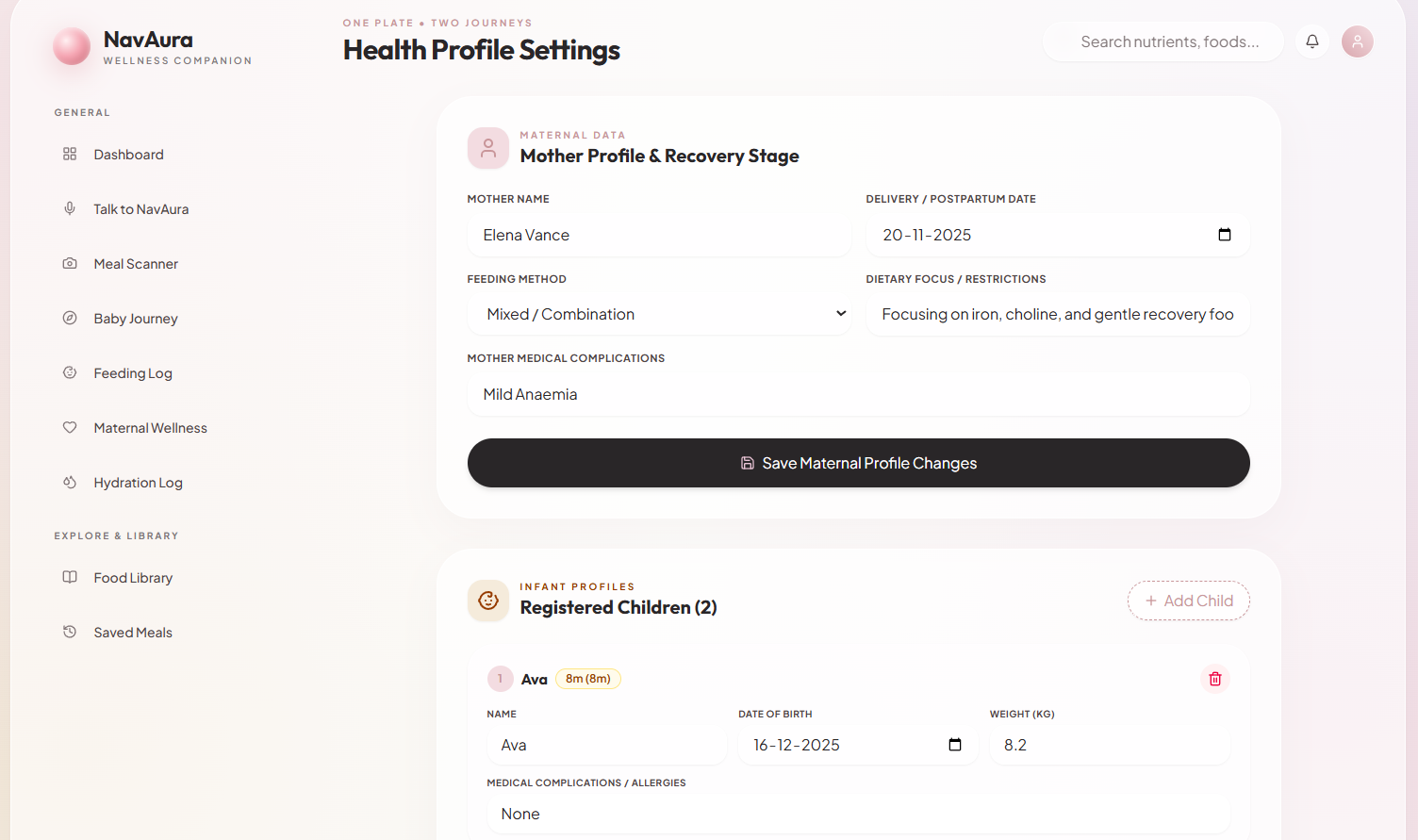
Profile Settings
-
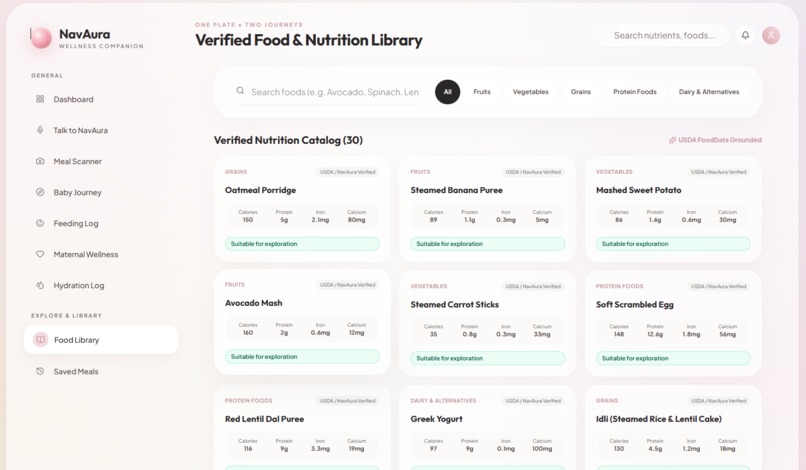
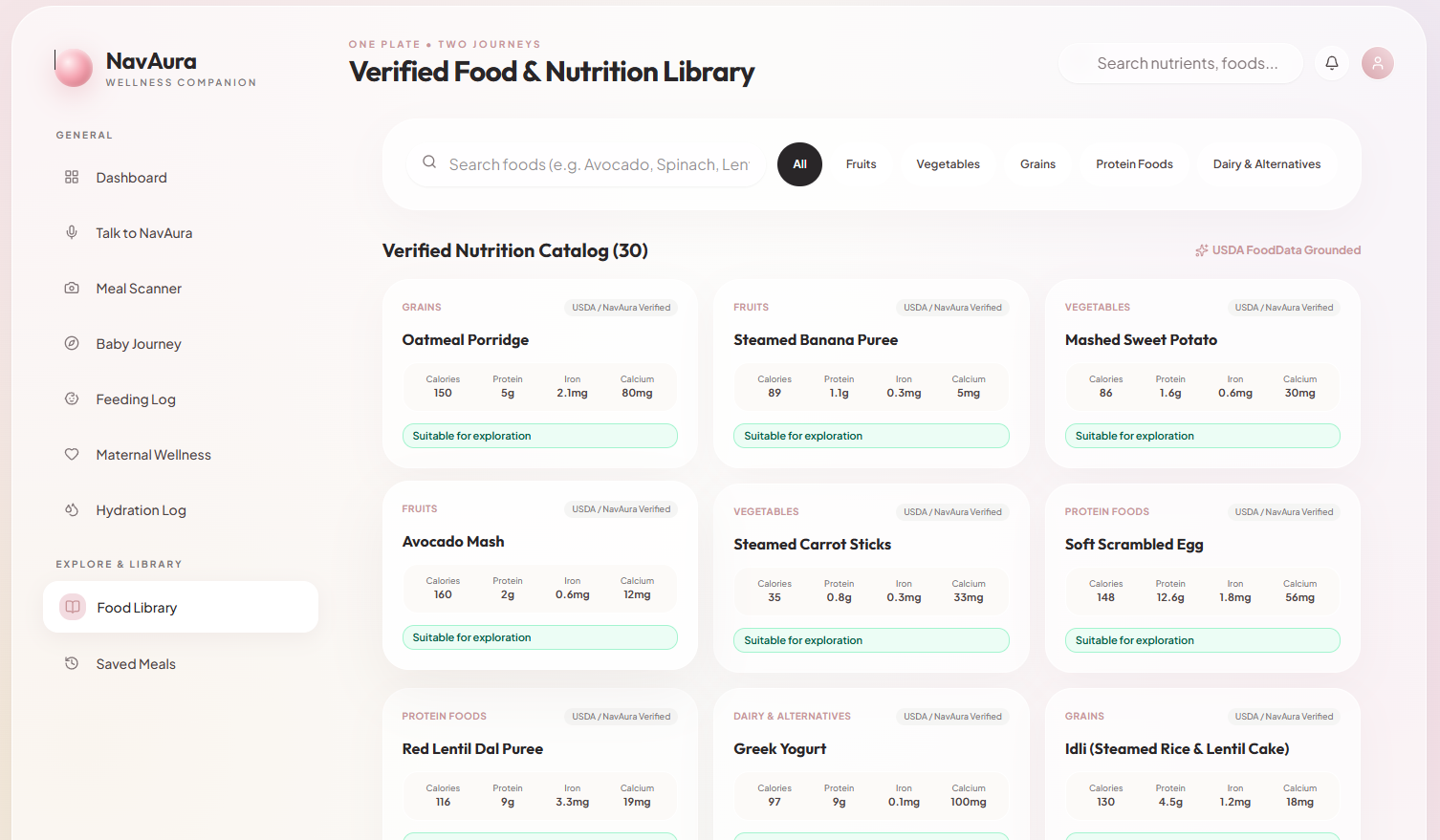
Food Library
-
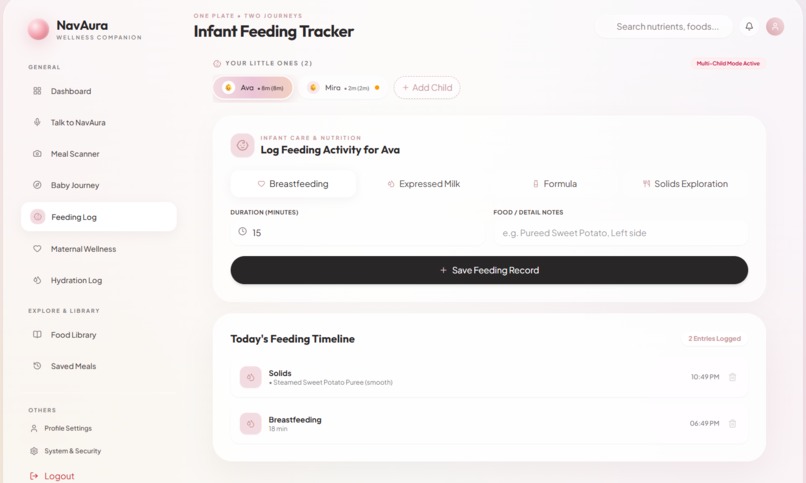
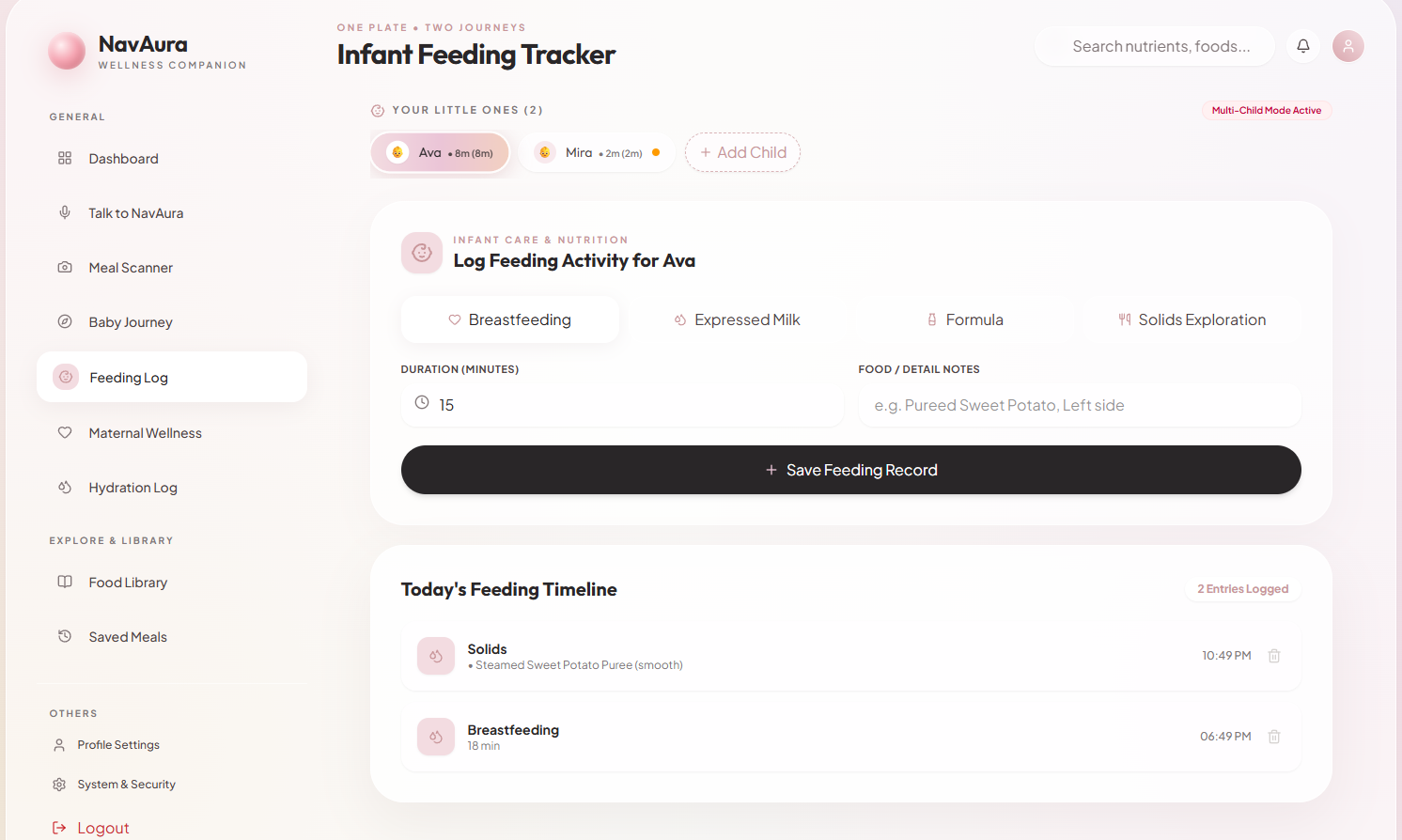
Feeding Log
-
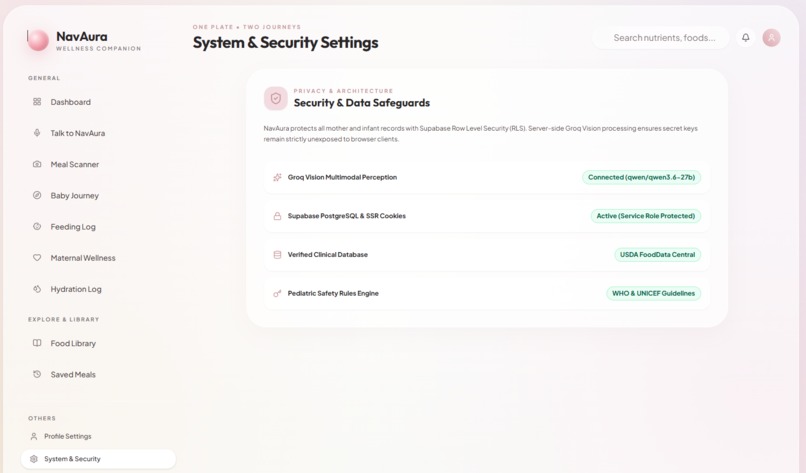
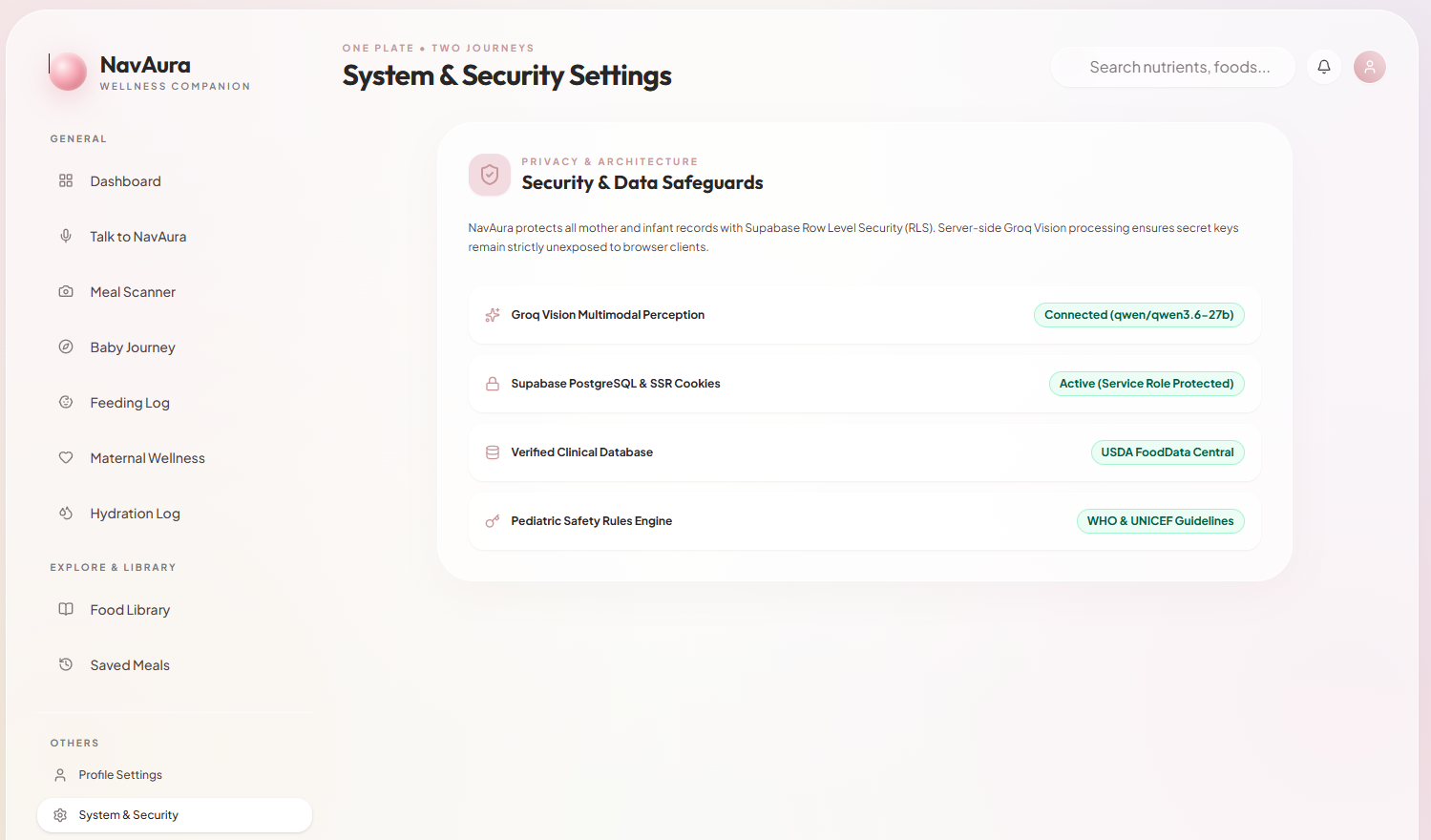
System & Security
Inspiration
NavAura began with something very ordinary and something that stayed with us.
We watched a new mother in our own family navigate the first few weeks after giving birth. She was exhausted, constantly thinking about whether she was eating enough, drinking enough water, feeding her baby correctly, remembering feeding times, and understanding what was appropriate as her baby grew.
Everyone around her had advice.
But very little of it was actually personalized.
What should she eat today?
Is this meal appropriate while breastfeeding?
When should the baby feed next?
What changes when the baby starts solids?
What if there is more than one child?
What if the mother has dietary restrictions or health considerations?
These questions become overwhelming when someone is already sleep-deprived.
That made us realize something important:
Maternal and infant wellness should not feel like another task on a mother's to-do list.
We wanted to build something that felt less like a clinical dashboard and more like a calm companion, something a mother could open at 2 AM and simply ask, "What do I do now?"
That idea became NavAura.
What it does
NavAura is an AI-powered maternal and infant nutrition companion designed to support mothers from the earliest postpartum days through the first two years of their child's life.
Instead of treating the mother and baby as separate problems, NavAura creates a connected wellness experience for both.
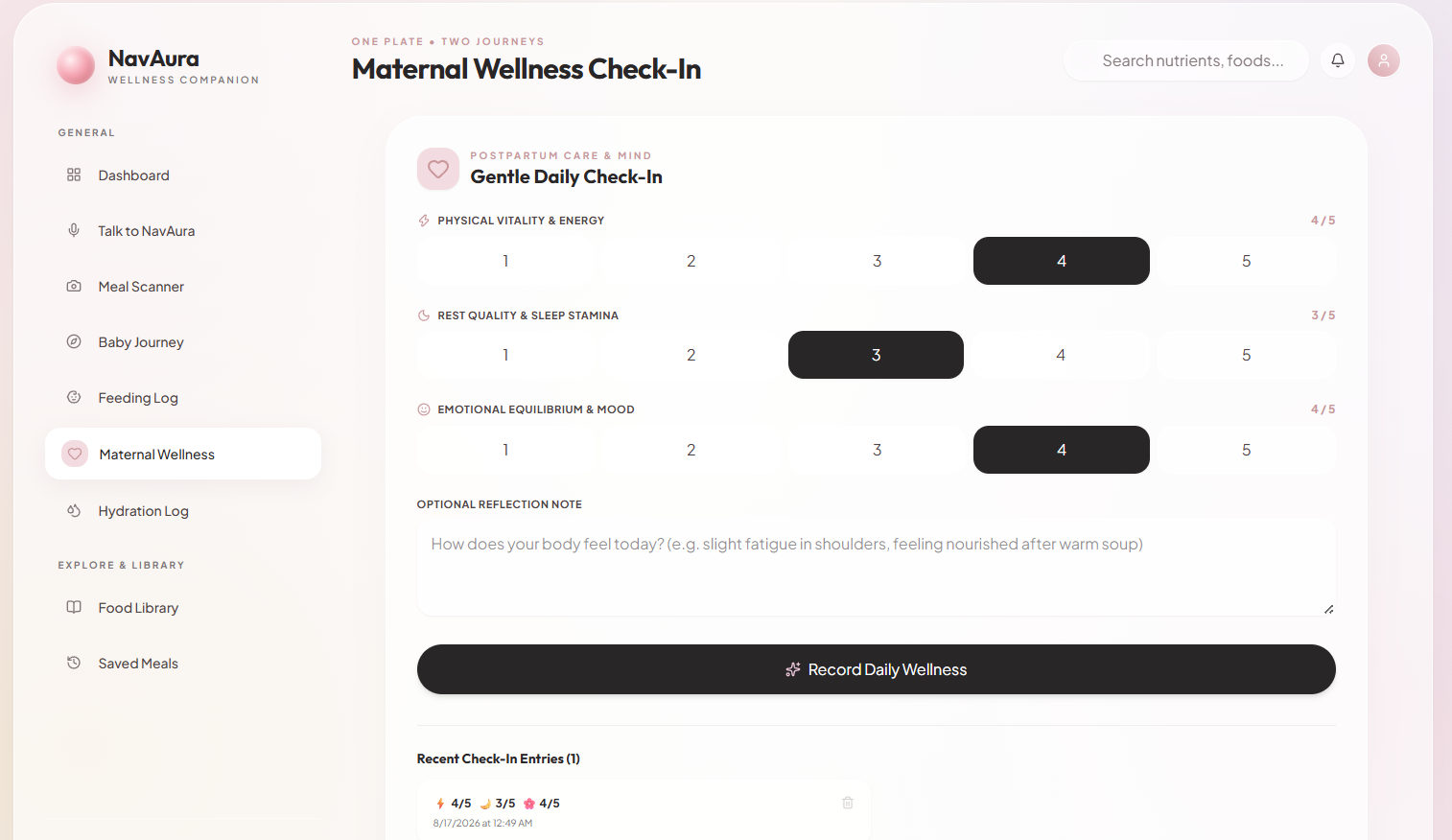
🤱 Maternal Wellness
NavAura creates a personalized maternal profile based on factors such as:
- Postpartum stage
- Feeding method
- Dietary preferences and restrictions
- Hydration
- Maternal wellness information
- Relevant complications or considerations
It then provides personalized nutrition, hydration, recovery, and wellness guidance.
👶 Baby Journey
NavAura tracks each child's journey individually.
For every child, the application can maintain:
- Age and developmental stage
- Feeding information
- Feeding logs
- Nutrition progression
- Solid-food introduction
- Baby-specific considerations
- Daily journey information
Multiple children are supported, meaning twins, triplets, or families with children at different developmental stages do not have to share one generic profile.
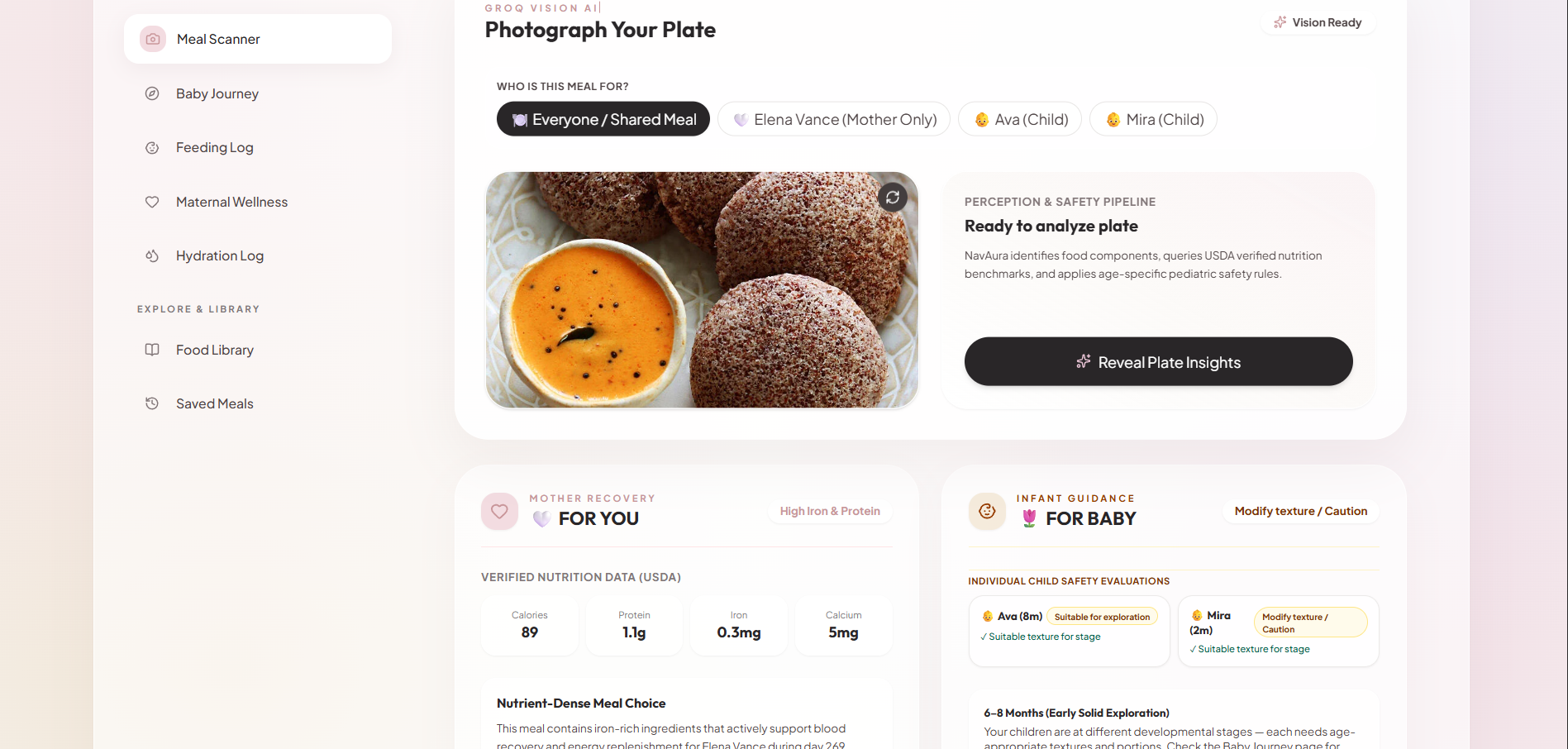
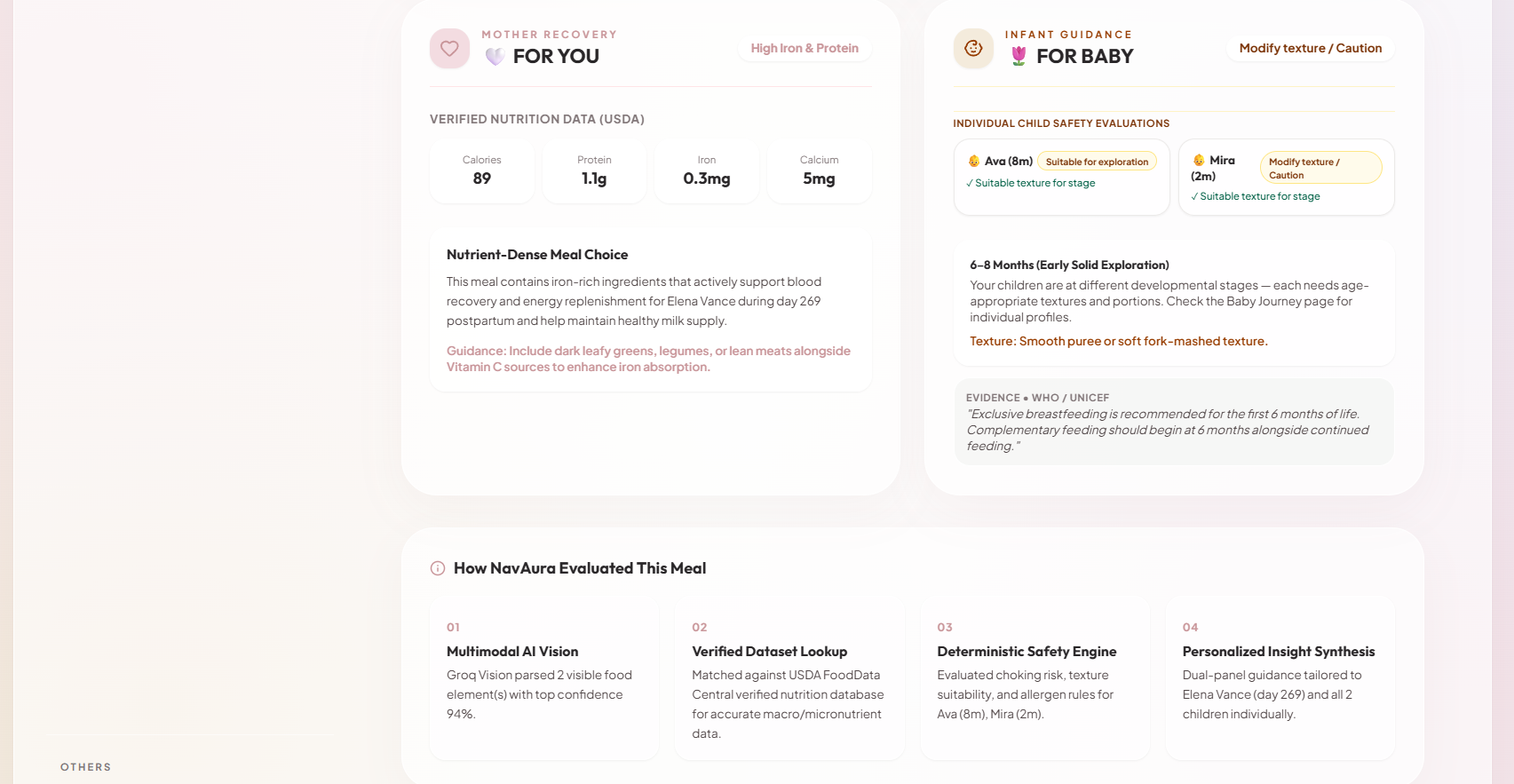
🍽️ AI Meal Scanner
A mother can upload a photograph of her meal and receive an AI-powered analysis.
The system evaluates the meal in the context of the mother's profile rather than treating the image as an isolated food-classification problem.
The goal is to answer the question that actually matters:
"Is this meal useful for me, right now?"
🧠 Personalized AI Companion
NavAura includes a conversational AI companion that understands the user's stored context.
Instead of repeatedly asking the mother to explain her situation, the AI can use her profile, postpartum stage, children, feeding information, and other relevant context to generate more personalized responses.
When multiple children are present, the AI considers each child individually rather than collapsing them into a single generic recommendation.
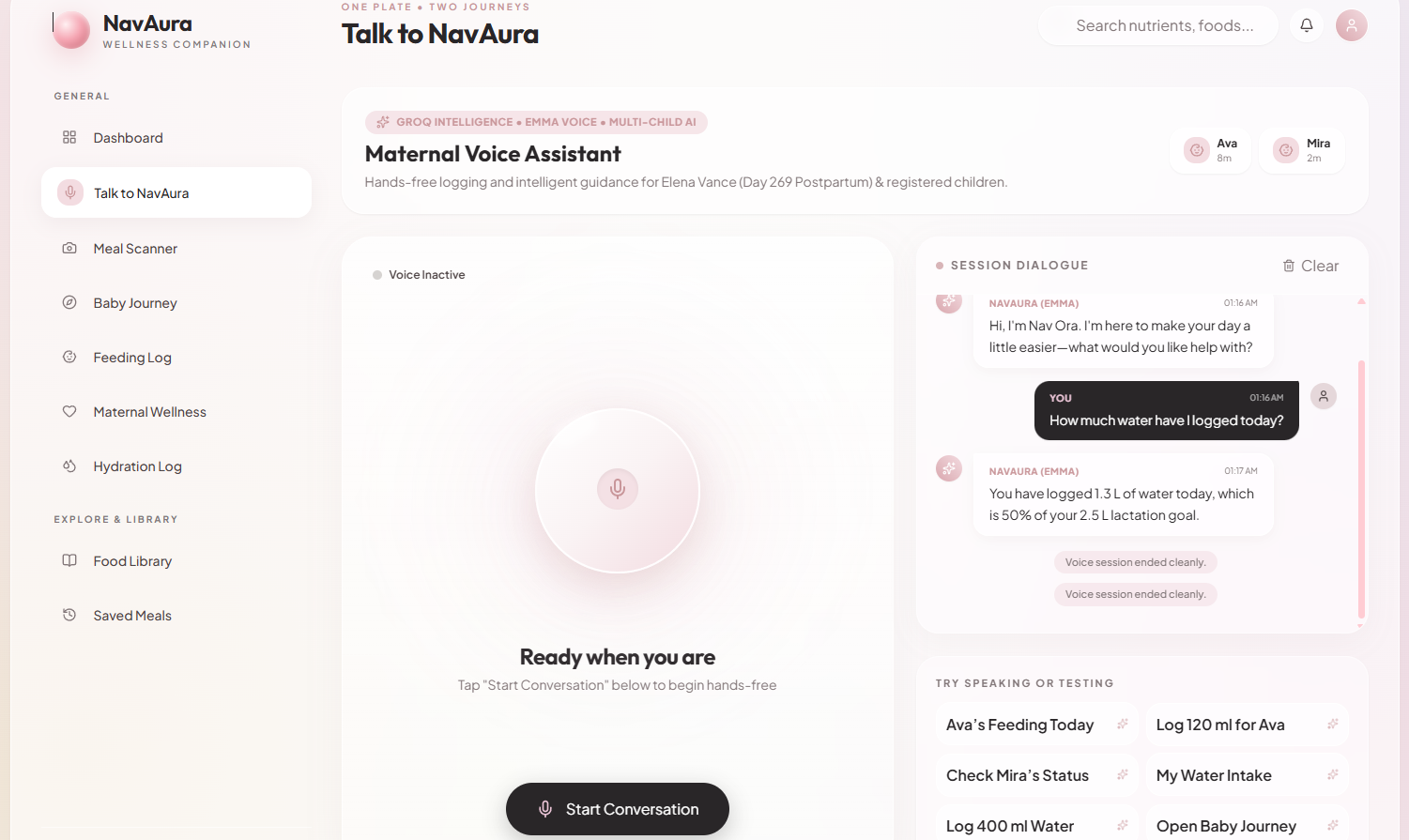
🎙️ Voice AI
Because typing is not always convenient especially while holding or feeding a baby, NavAura also includes an optional voice-AI experience.
A mother can choose to speak naturally instead of typing.
The voice architecture combines:
Speech → Voice AI → Context-aware reasoning → Spoken response
The voice experience is intentionally designed to feel warm, calm, conversational, and reassuring rather than like a traditional customer-service bot.
📊 Personalized Dashboard
The dashboard brings the mother's and children's journeys together through:
- Maternal recovery insights
- Hydration tracking
- Lactation-related guidance
- Baby feeding information
- Baby journey tracking
- Personalized recommendations
- AI assistance
- Saved/bookmarked guidance
The experience changes as the family changes.
How we built it
NavAura was designed as a full-stack AI application rather than a static AI demo.
Frontend
We built the application using:
- Next.js
- React
- TypeScript
- Responsive modern UI components
- Interactive dashboards
- Dynamic personalized cards
- Mobile-friendly layouts
The visual language was intentionally designed around softness and calmness using pastel pink, rose tones, warm neutrals, soft gradients, rounded surfaces, and gentle visual hierarchy.
The goal was to make a health-oriented application feel comforting rather than clinical.
Backend & Data
We use Supabase for the application's backend infrastructure, including:
- Authentication
- PostgreSQL database
- User profiles
- Maternal information
- Child profiles
- Feeding information
- Personalization data
- Application data storage
- Secure access policies
User-specific data is separated using authentication and database-level access controls.
AI Layer
NavAura uses Groq for fast AI inference and conversational reasoning.
The AI receives relevant contextual information from the user's profile so that responses can be personalized to the current maternal and child journey.
For example, the reasoning layer can distinguish between:
- A mother in the immediate postpartum period
- A breastfeeding mother
- A mother introducing complementary foods
- A toddler approaching the later stages of the 0–2 year journey
- A family managing multiple children simultaneously
Voice Layer
For optional voice interaction, NavAura integrates Vapi.
The voice pipeline connects:
Speech Recognition → AI Reasoning → Voice Synthesis
This allows the user to interact with NavAura conversationally while keeping voice interaction optional.
Food Analysis
The meal scanner accepts an uploaded food image and sends it through the AI analysis pipeline.
The resulting analysis is then combined with the user's maternal context to produce a more meaningful interpretation.
Personalization Engine
A dedicated personalization layer combines:
[ \text{User Context} + \text{Child Context} + \text{Meal Data} + \text{Developmental Stage} ]
to generate context-aware recommendations.
This means the same food or question can produce different guidance depending on who is asking and where they are in their journey.
Deployment
NavAura is deployed as a production web application using Vercel, with its backend services and persistent data connected through Supabase.
Challenges we ran into
Building NavAura was significantly more complicated than building a simple chatbot.
The biggest challenge was realizing that personalization creates state.
A real mother may have:
- Different dietary needs
- A changing postpartum stage
- One child
- Multiple children
- Children at different developmental stages
- Different feeding patterns
- Different daily routines
A simplistic AI prompt cannot reliably represent this complexity.
We therefore had to design the application around structured user and child profiles rather than simply sending isolated questions to an LLM.
Another challenge was making the AI useful without making it feel intrusive.
We wanted NavAura to remember relevant context, but we also needed to think carefully about privacy and sensitive maternal and infant information.
We implemented authenticated data access and separated user-specific information rather than treating the application as a public AI chatbot.
We also faced the practical challenge of AI reliability.
During development, we encountered model availability and latency issues. This pushed us toward a more resilient architecture and ultimately toward fast inference through Groq.
The voice layer introduced another challenge: conversational interaction has very different UX requirements from text.
A voice assistant cannot simply read a paragraph of information aloud.
It needs to be:
- concise
- natural
- reassuring
- interruptible
- conversational
- useful without overwhelming the user
Designing for that interaction model became an important part of NavAura.
Accomplishments that we're proud of
We are especially proud that NavAura evolved beyond a prototype into a deployed, connected full-stack application.
Some of the things we're most proud of are:
- 🌸 Supporting the maternal journey from the immediate postpartum period through the baby's first two years
- 👶 Supporting multiple children, including children at different developmental stages
- 🧠 Building context-aware AI rather than a generic chatbot
- 🍽️ Creating an AI-powered meal analysis workflow
- 🎙️ Adding an optional voice interaction layer
- 💧 Combining maternal wellness and infant nutrition into one connected experience
- 🔐 Building authentication and user-specific data storage with Supabase
- ⚡ Using Groq for fast AI inference
- ☁️ Deploying the application as a live production website
- 🎨 Designing the experience around emotional comfort rather than a traditional clinical interface
Most importantly, we are proud that the project began with a real human observation and turned into something people can actually interact with.
What we learned
The biggest lesson was that building an AI product is not the same as adding an AI API to a website.
The difficult part is everything around the model.
We learned how to:
- Design AI around structured user context
- Build persistent personalization
- Handle multiple related entities such as mothers and children
- Connect AI inference with a real backend
- Design database structures for evolving user journeys
- Think about privacy when handling sensitive information
- Build fallback behavior around external AI services
- Design voice interactions differently from text interactions
- Deploy and test a full-stack AI application
- Balance technical complexity with a simple user experience
We also learned that technology should disappear into the background when the problem is deeply human.
A new mother shouldn't need to understand what model is running behind NavAura.
She should simply be able to ask:
"What should I do?"
and receive an answer that understands her situation.
What's next for NavAura
NavAura is currently focused on the maternal and infant journey through the first two years, but we see it becoming much more than a nutrition companion.
Future versions could include:
- 📈 Long-term maternal and child wellness trends
- 🧬 More advanced evidence-based personalization
- 🌍 Localization for different countries, cultures, cuisines, and nutritional guidelines
- 📱 A dedicated mobile application
- 🩺 Clinician-reviewed educational pathways
- 🧑⚕️ Optional healthcare-professional collaboration
- 📊 More sophisticated growth and developmental tracking
- 🔔 Intelligent, non-intrusive reminders
- 👨👩👧 Shared caregiver experiences
- 🌐 A globally adaptable maternal wellness knowledge layer
Our long-term vision is simple:
NavAura should grow with the family.
From the overwhelming first days after birth, through feeding changes, sleepless nights, first foods, developmental milestones, and everything in between.
Because motherhood already asks enough of a woman.
Technology should make the journey feel a little lighter.
Built With
- ai
- api
- artificial
- css
- generative
- github
- groq
- html
- intelligence
- javascript
- llm
- next.js
- node.js
- postgresql
- react
- rest
- supabase
- tailwind
- typescript
- vapi
- vercel
- voice-ai-agent


Log in or sign up for Devpost to join the conversation.