-
-
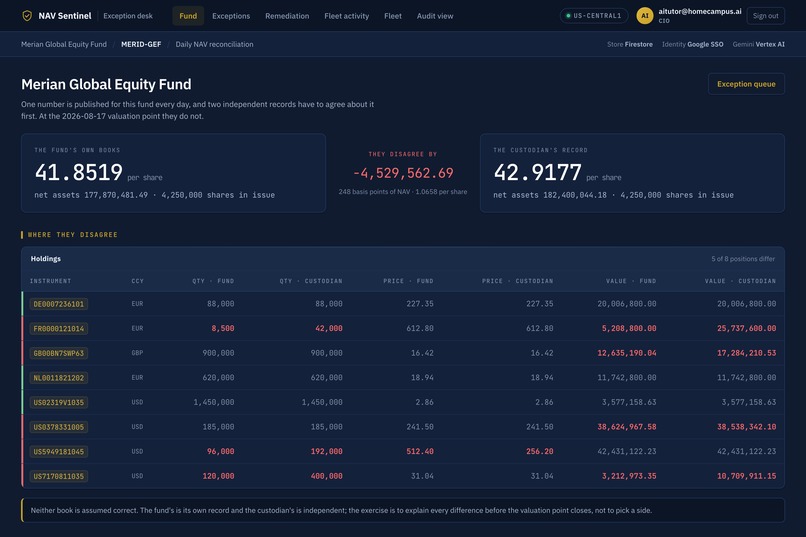
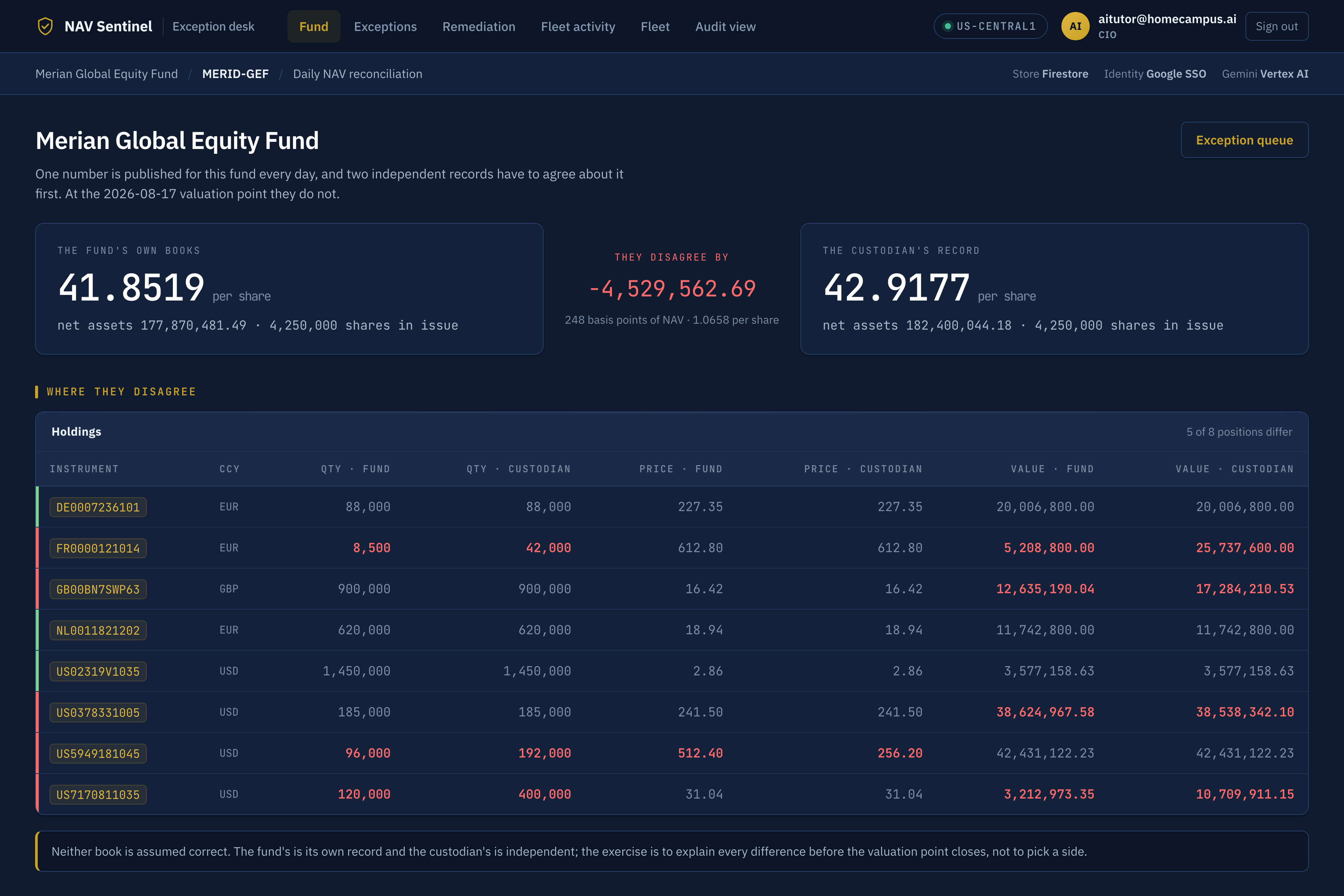
The published NAV and the 248bps disagreement
-
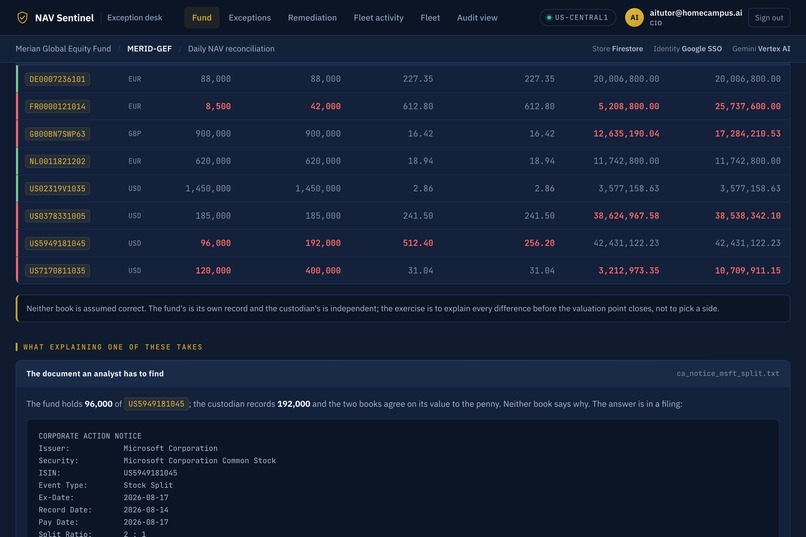
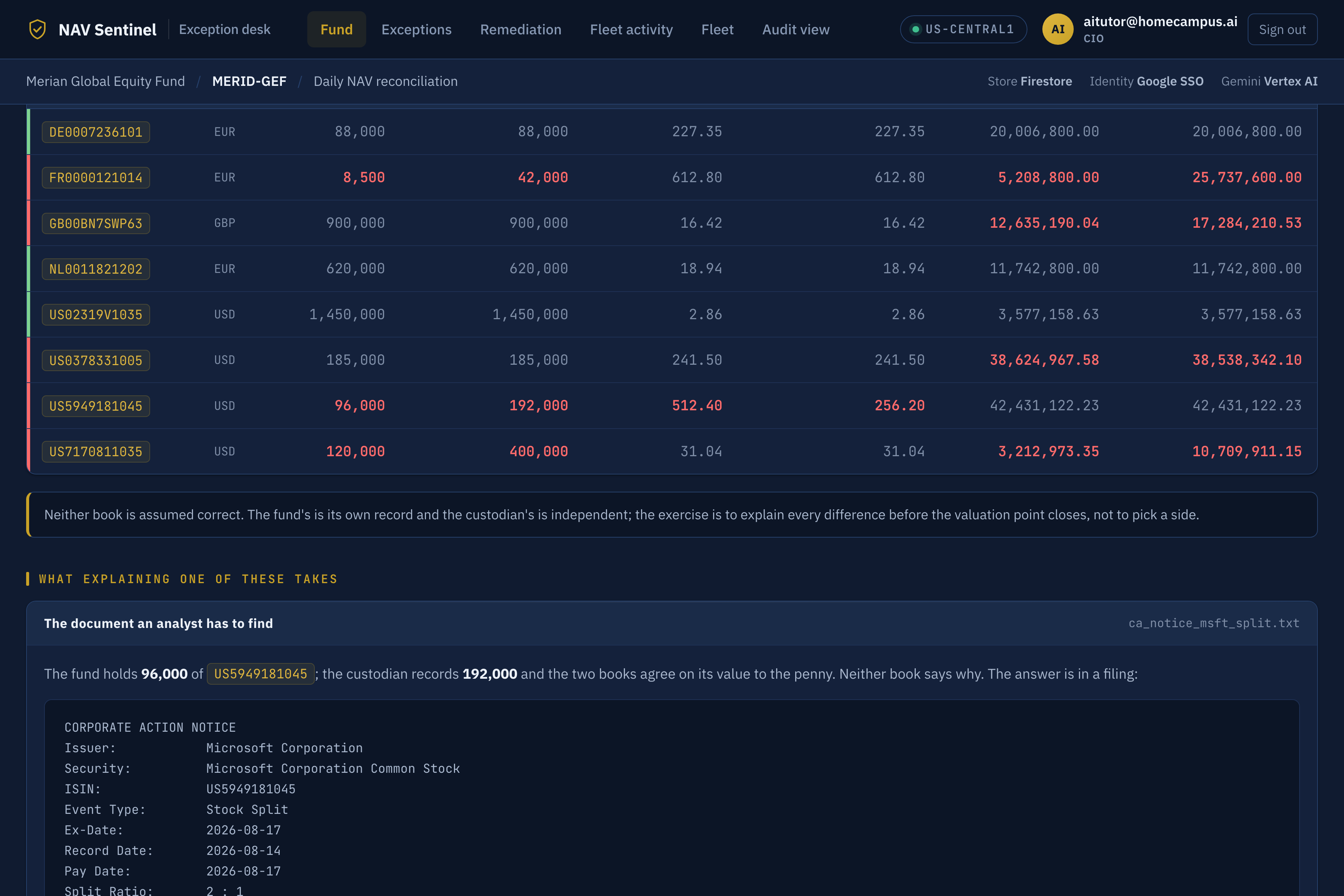
Five of eight positions differing
-
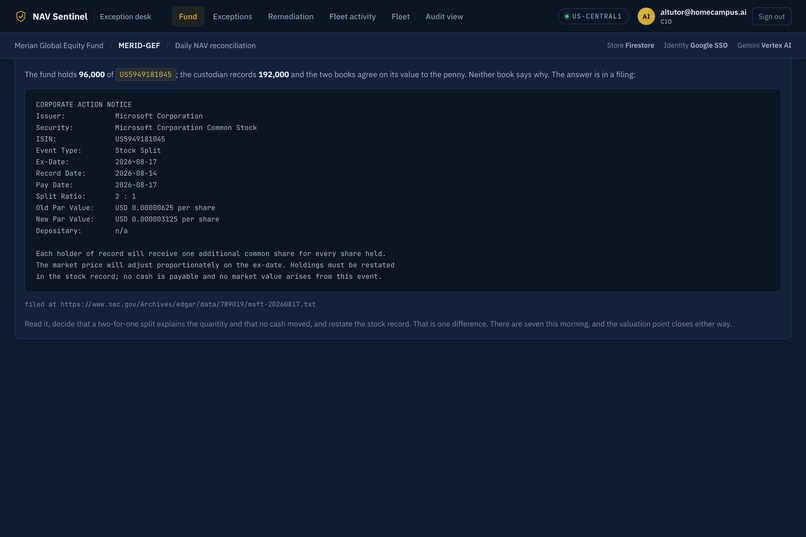
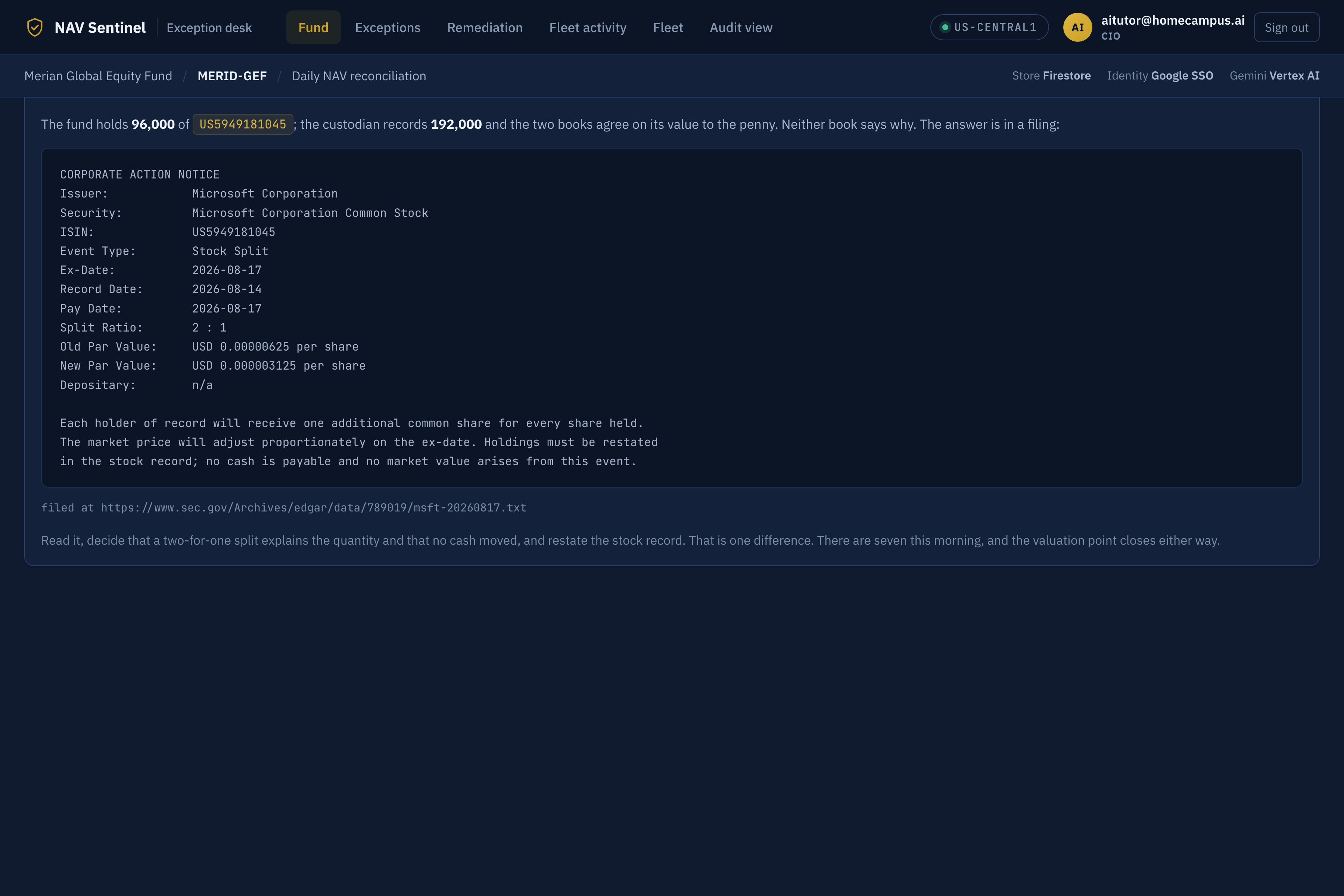
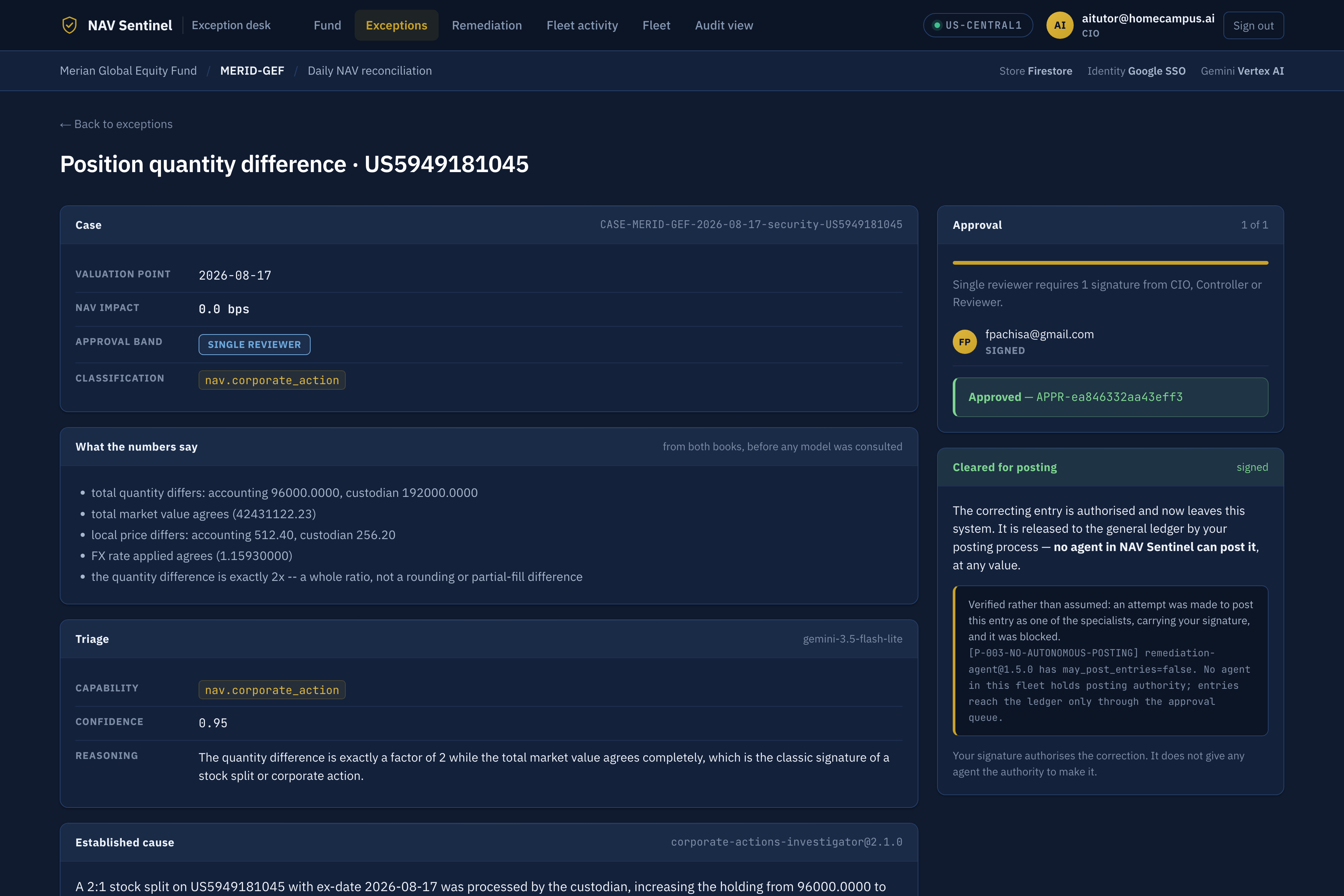
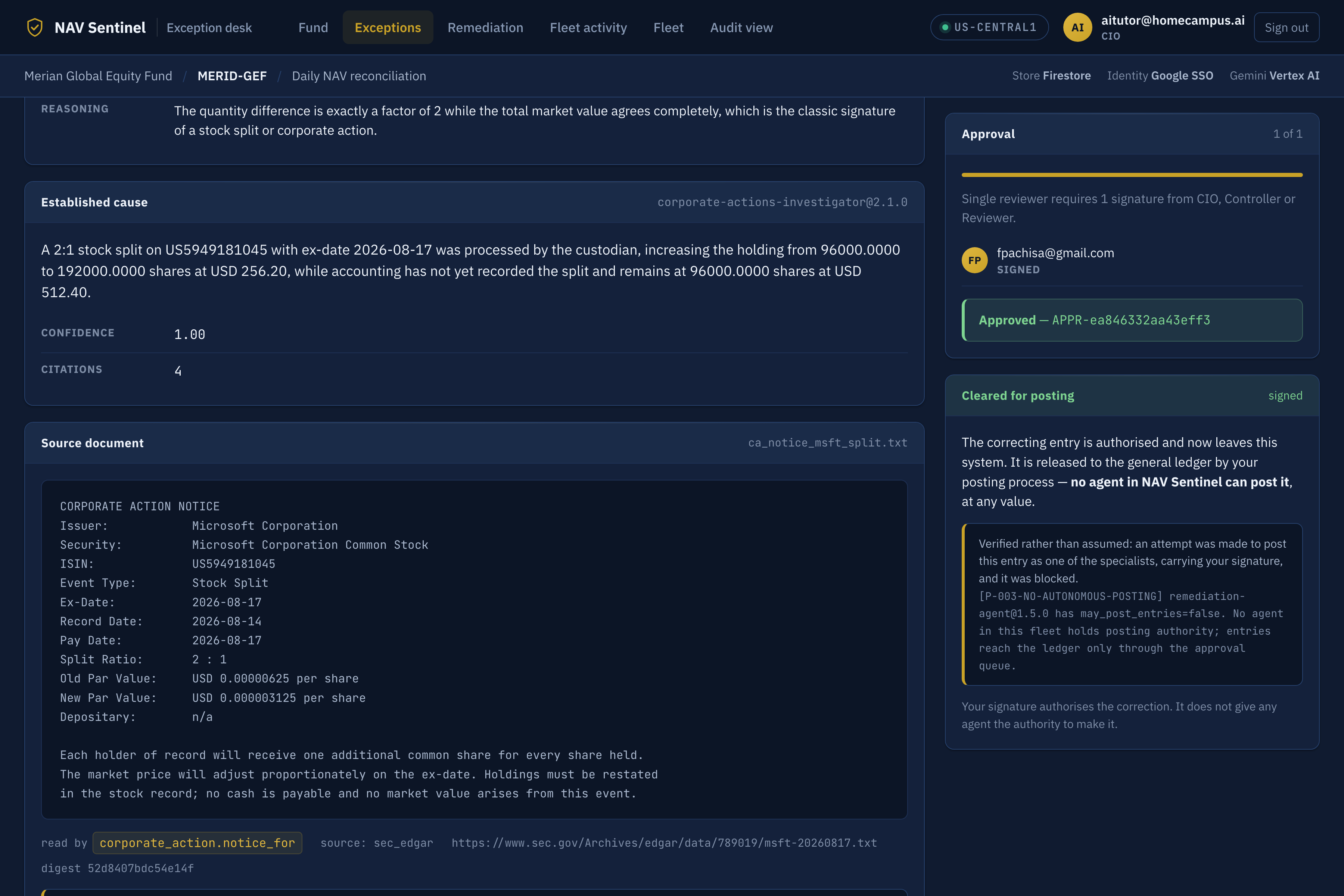
The corporate-action filing — why this stayed manual
-
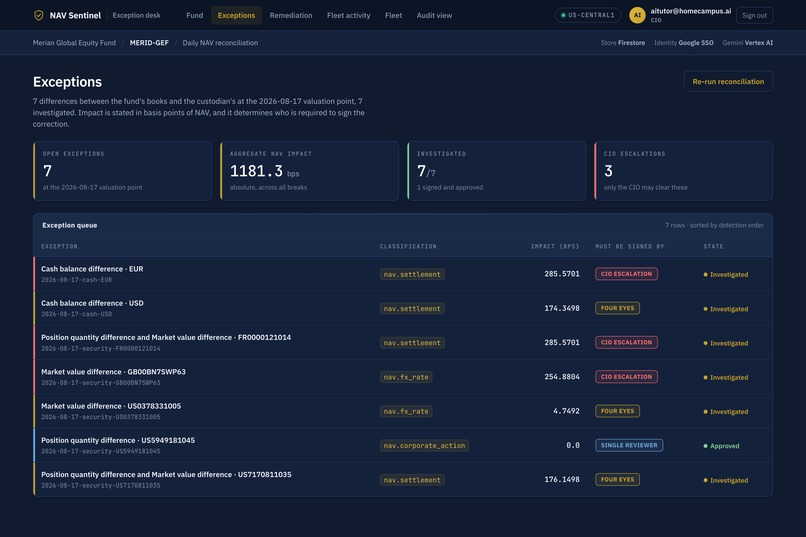
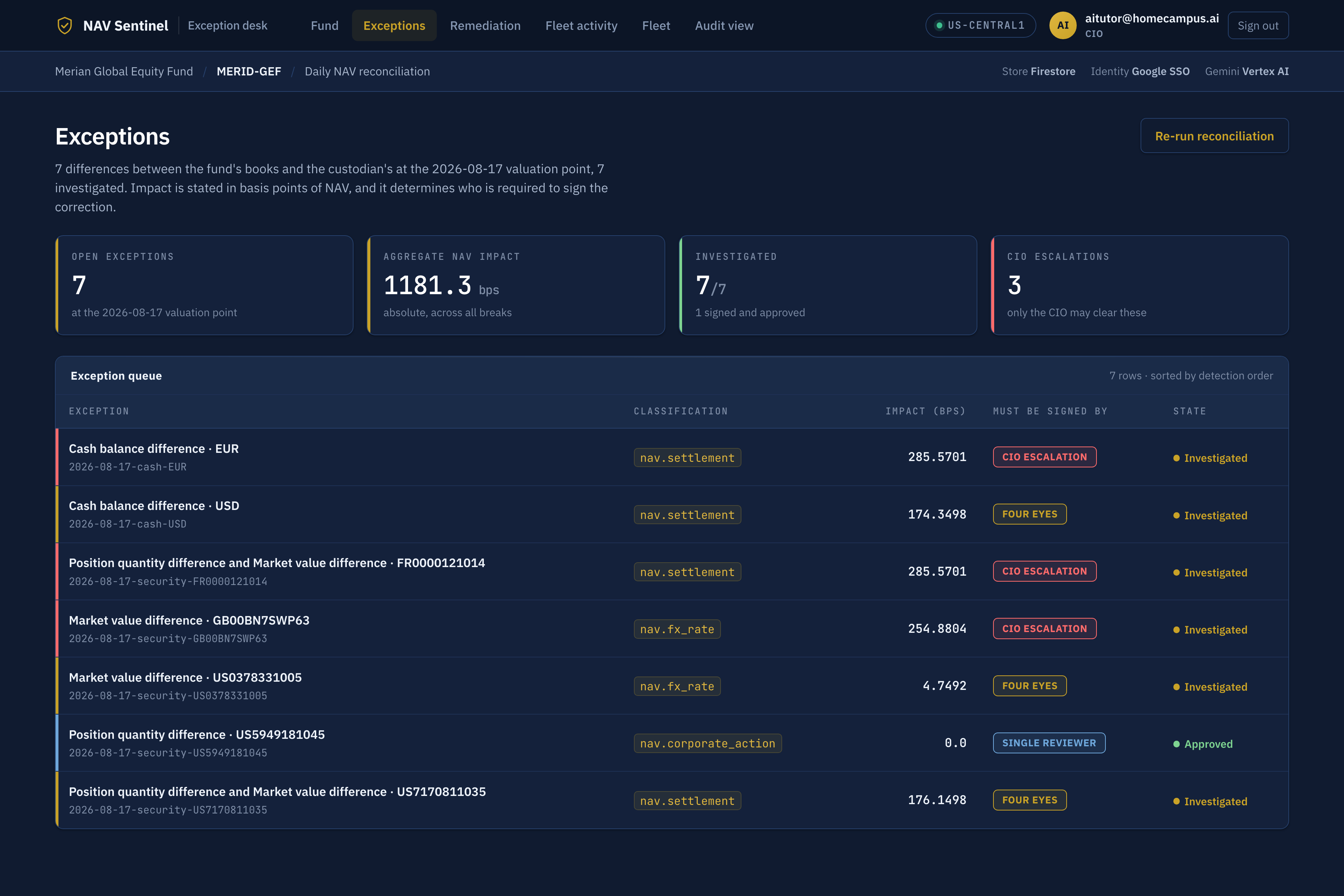
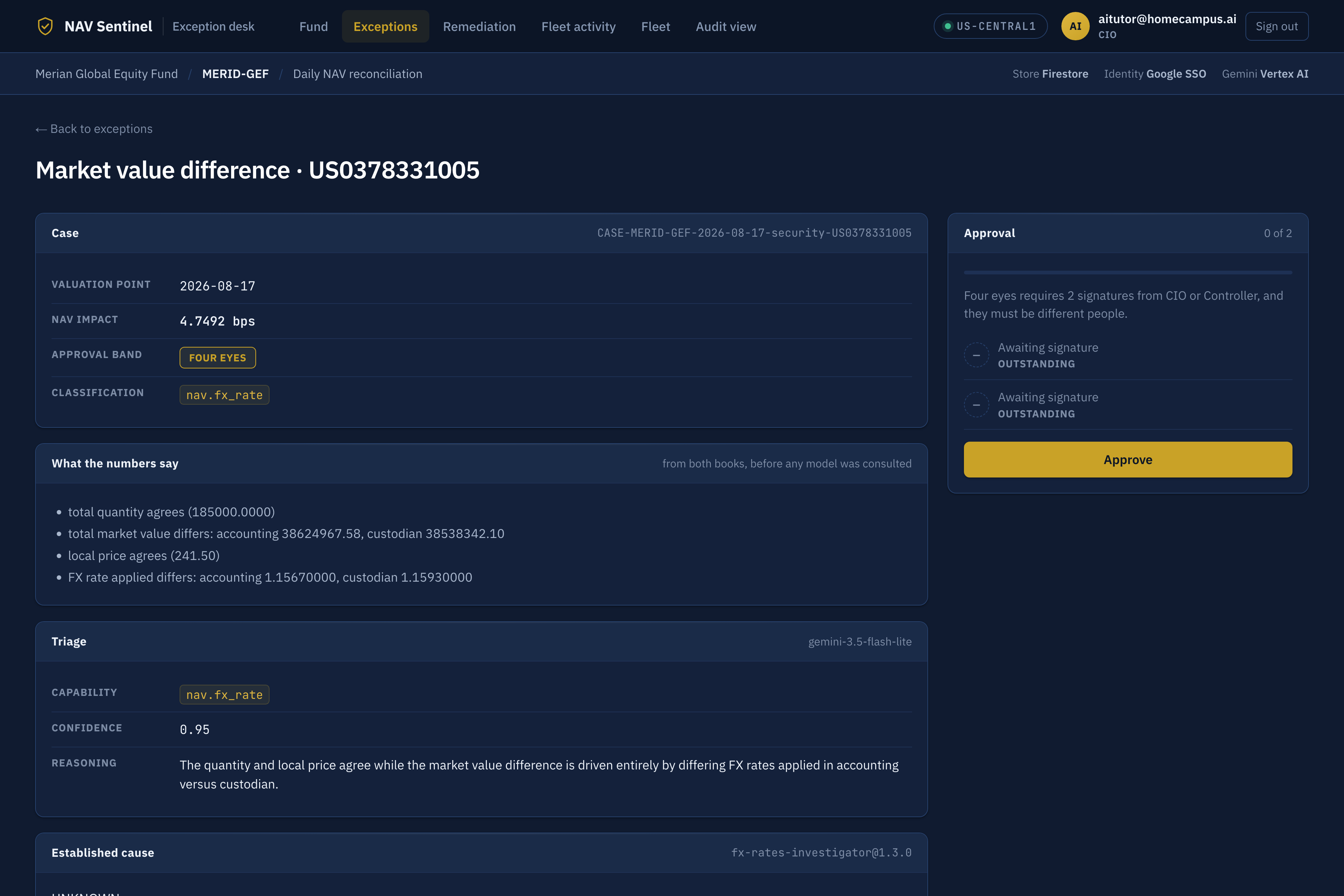
Seven breaks, banded into the approval each needs
-
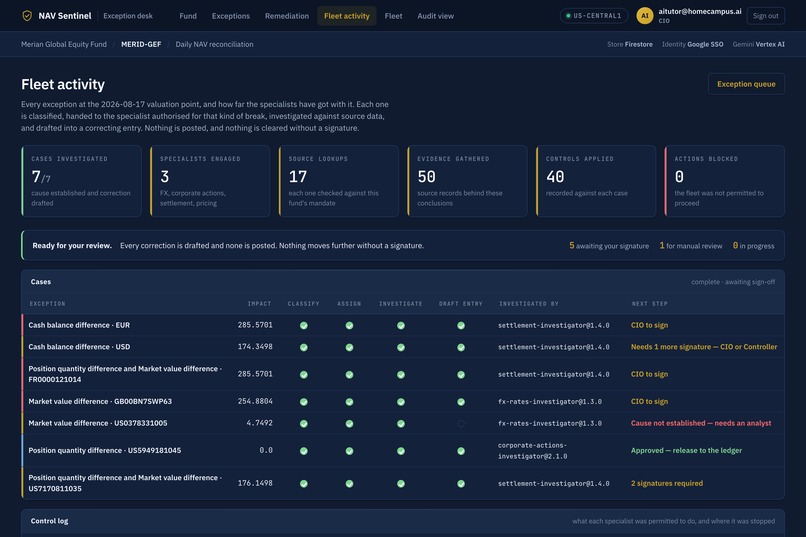
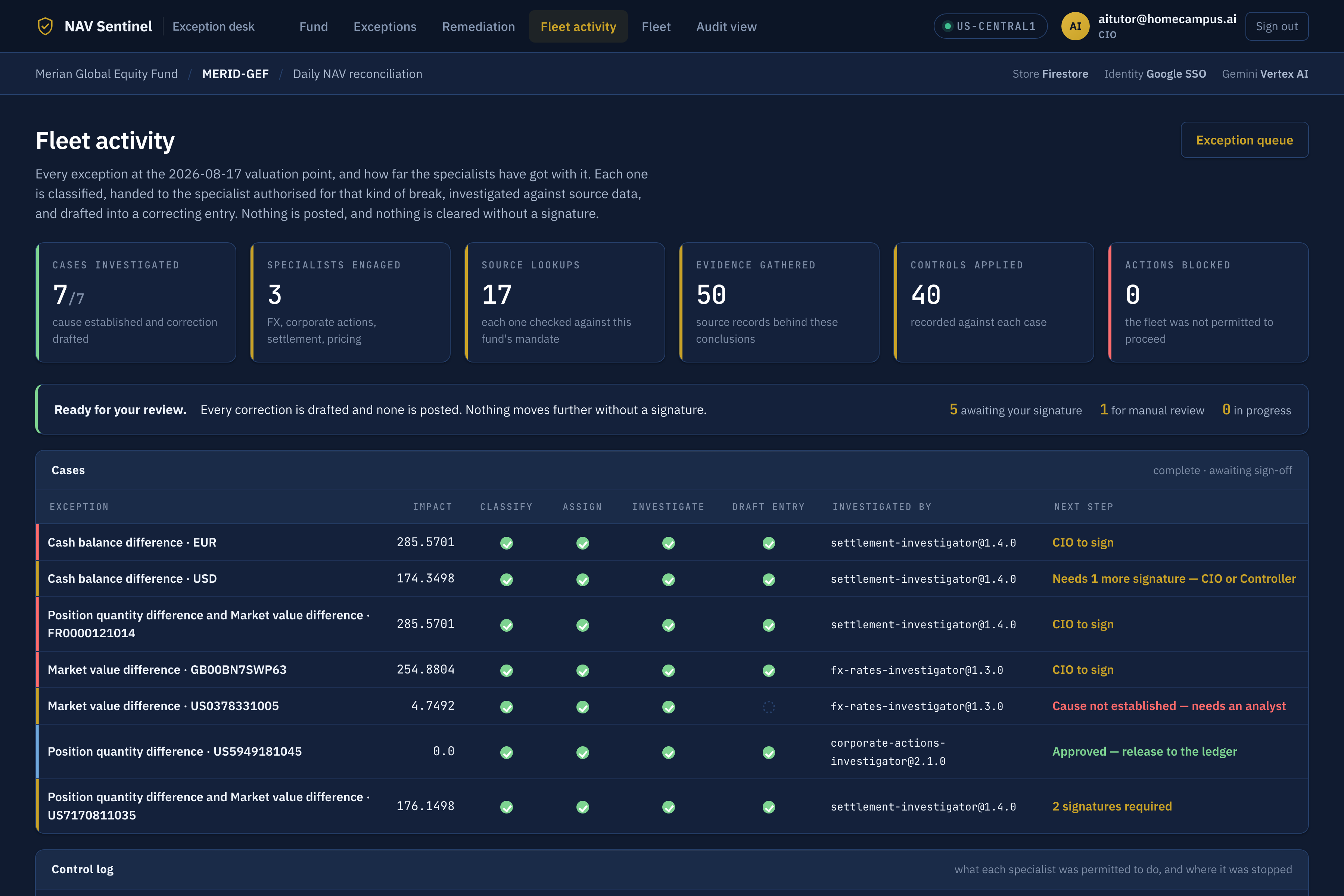
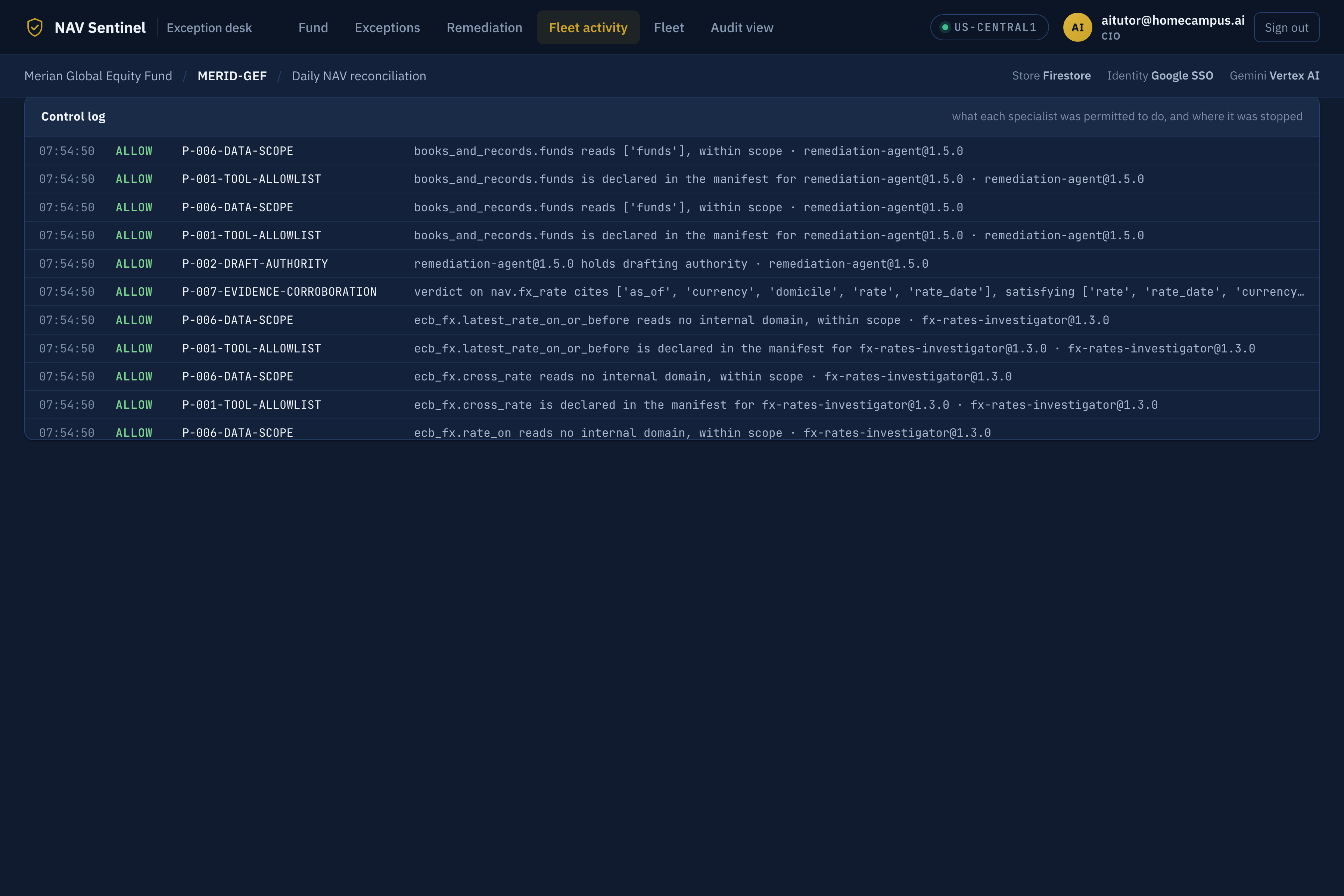
Counters, per-case stages, control log
-
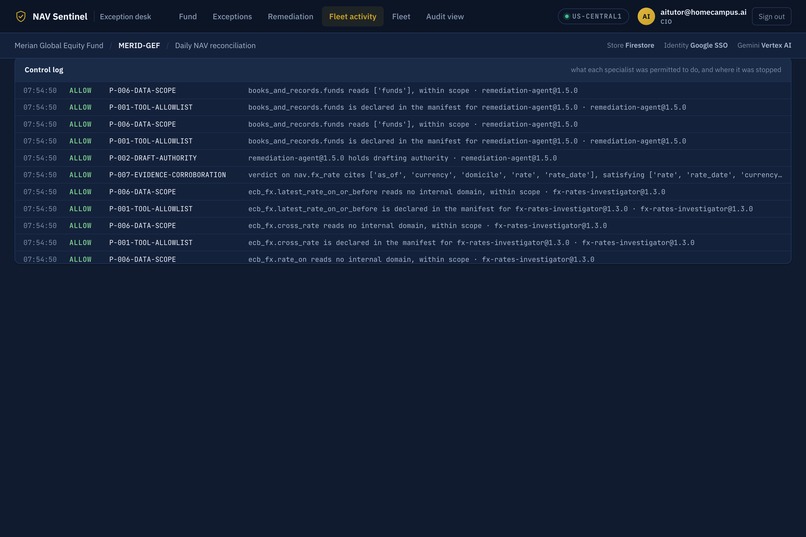
Policy decisions with ids
-
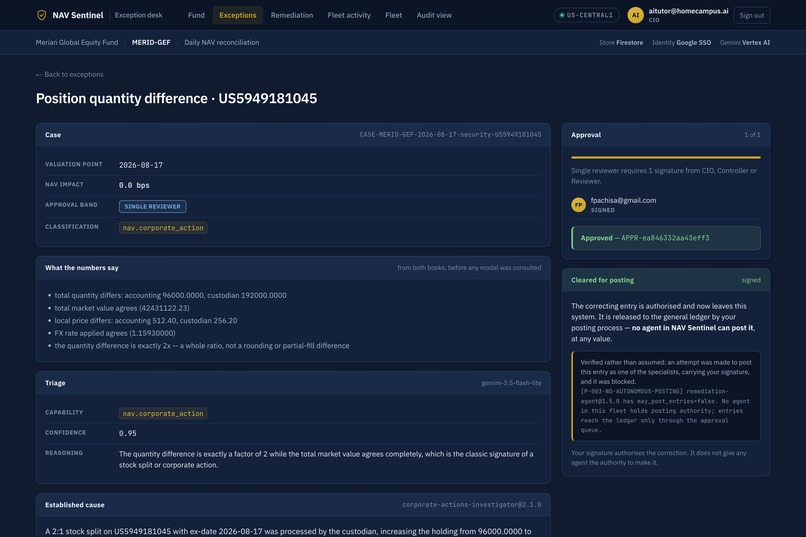
Established cause, citations, digest
-
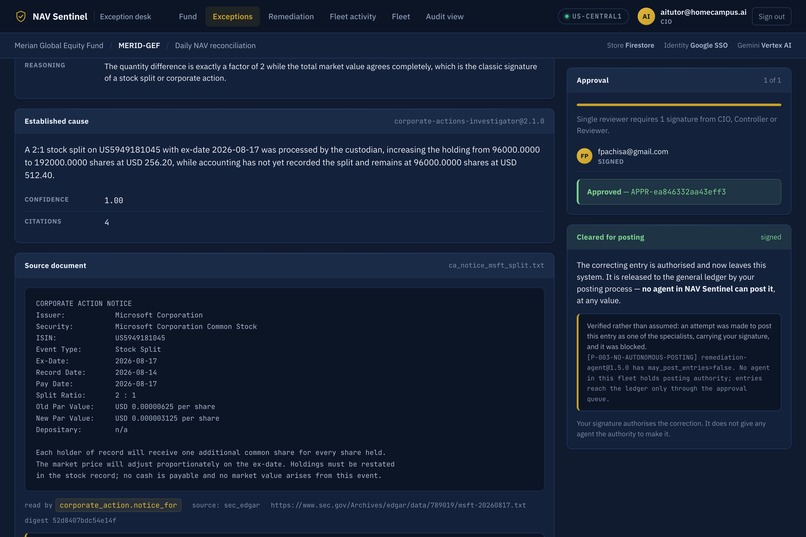
Cleared for posting, and the P-003 refusal
-
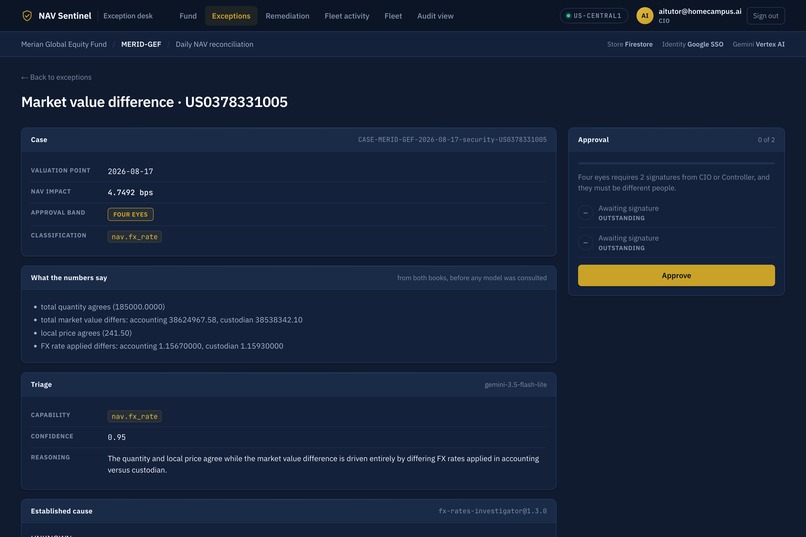
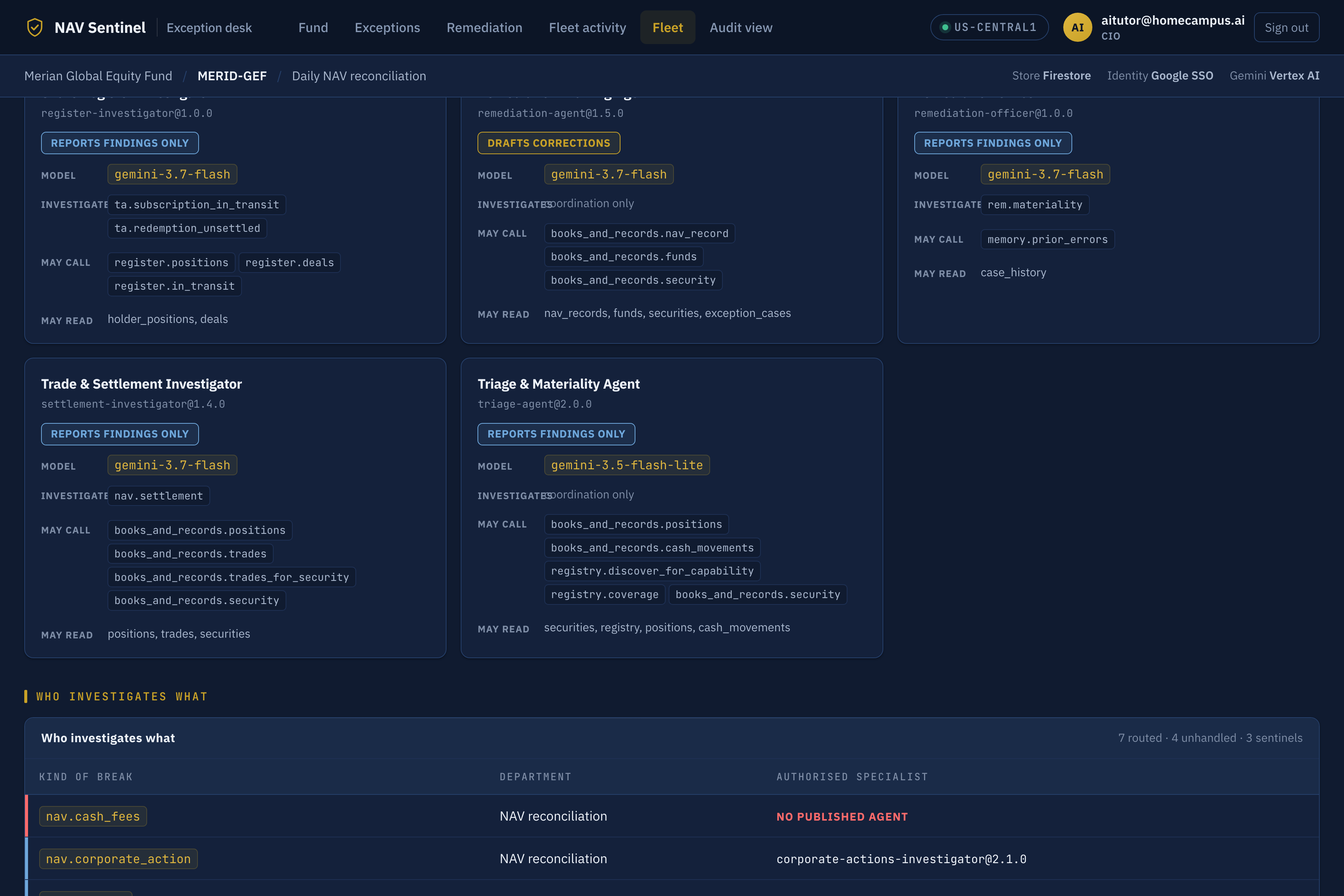
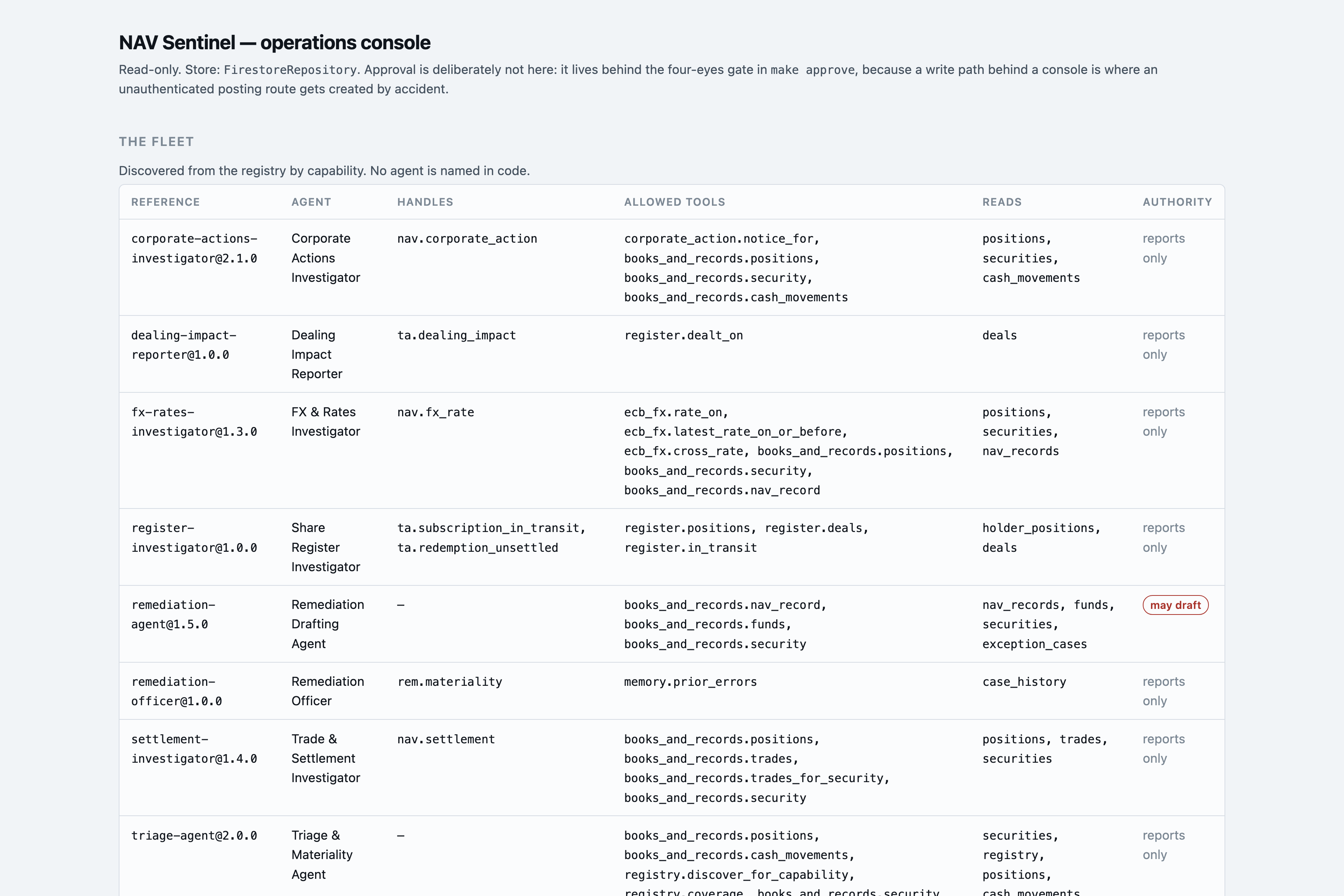
The fleet declining to guess
-
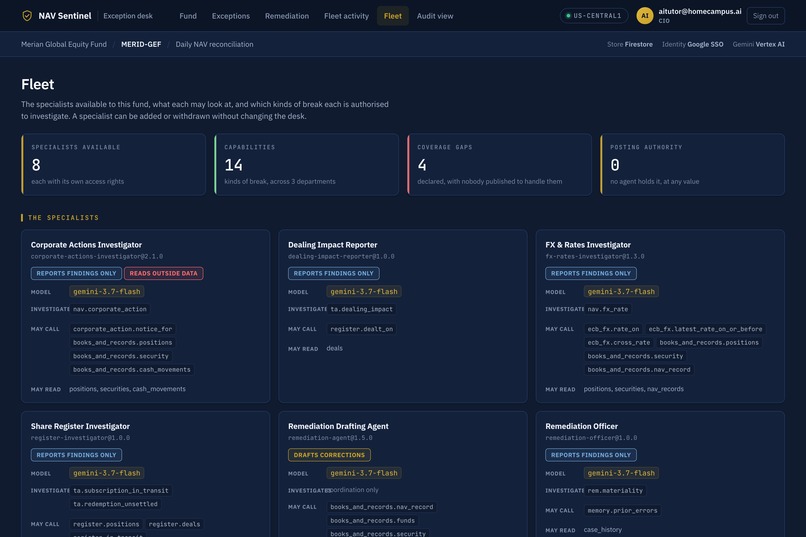
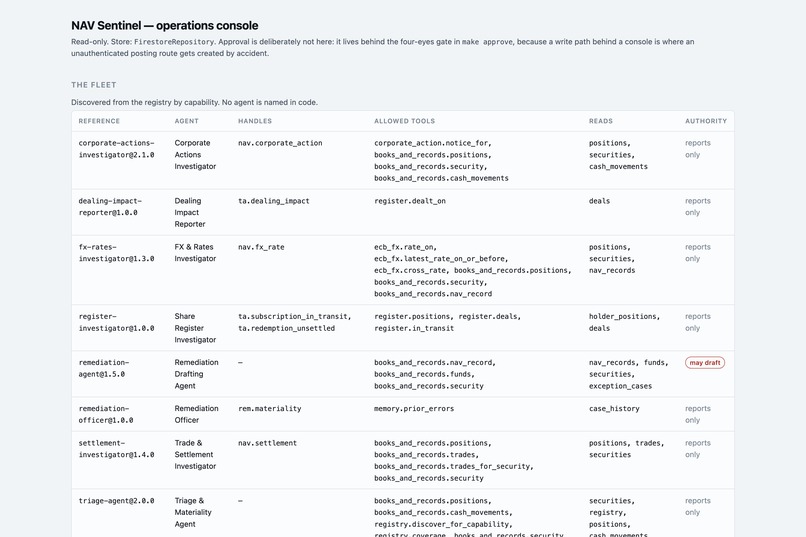
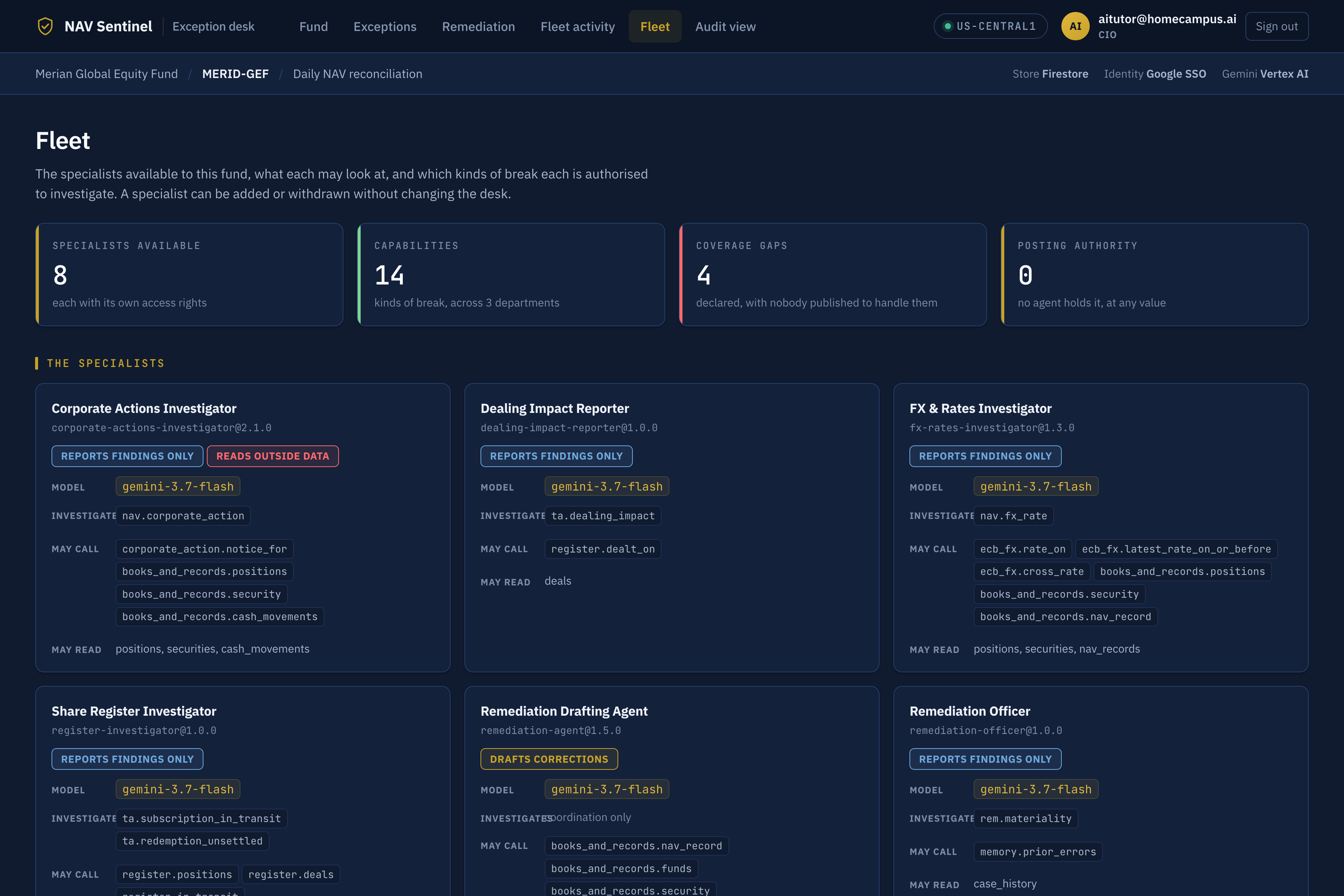
Three departments, four gaps
-
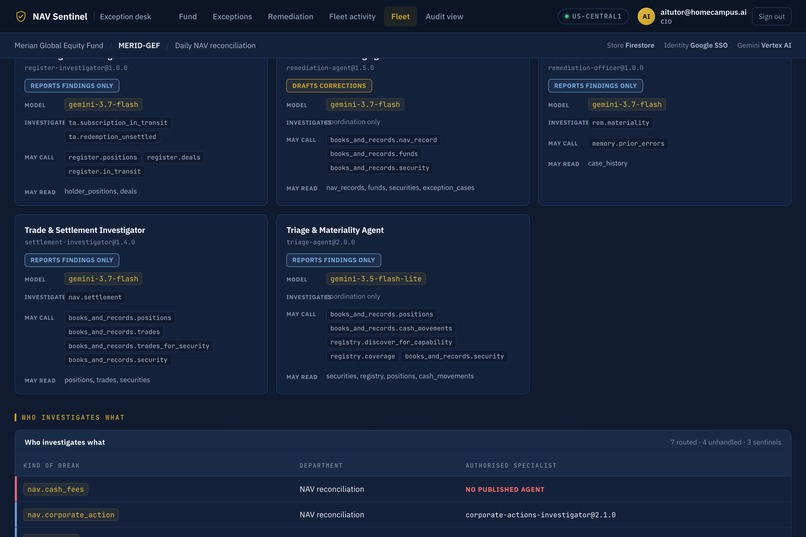
Three departments, four gaps
-
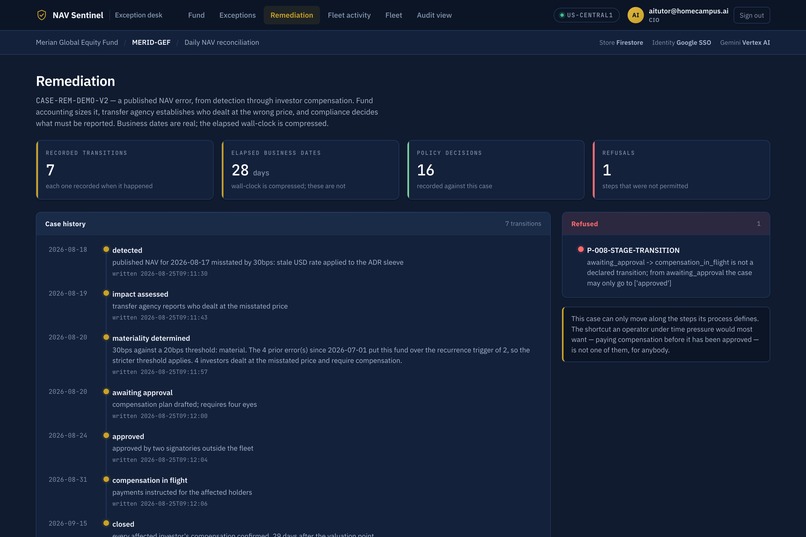
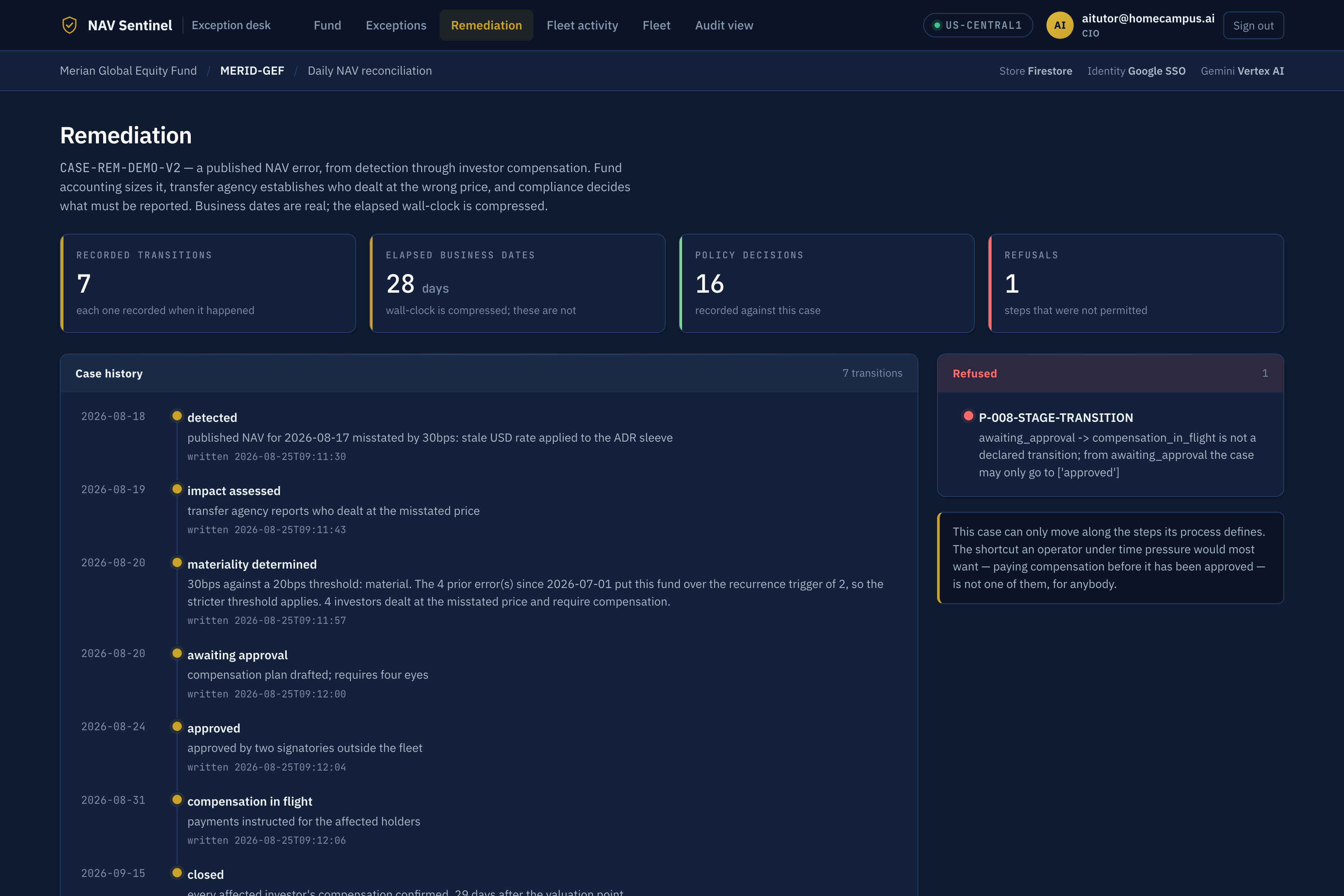
28 business days, three departments
-
Every decision, denials included
-
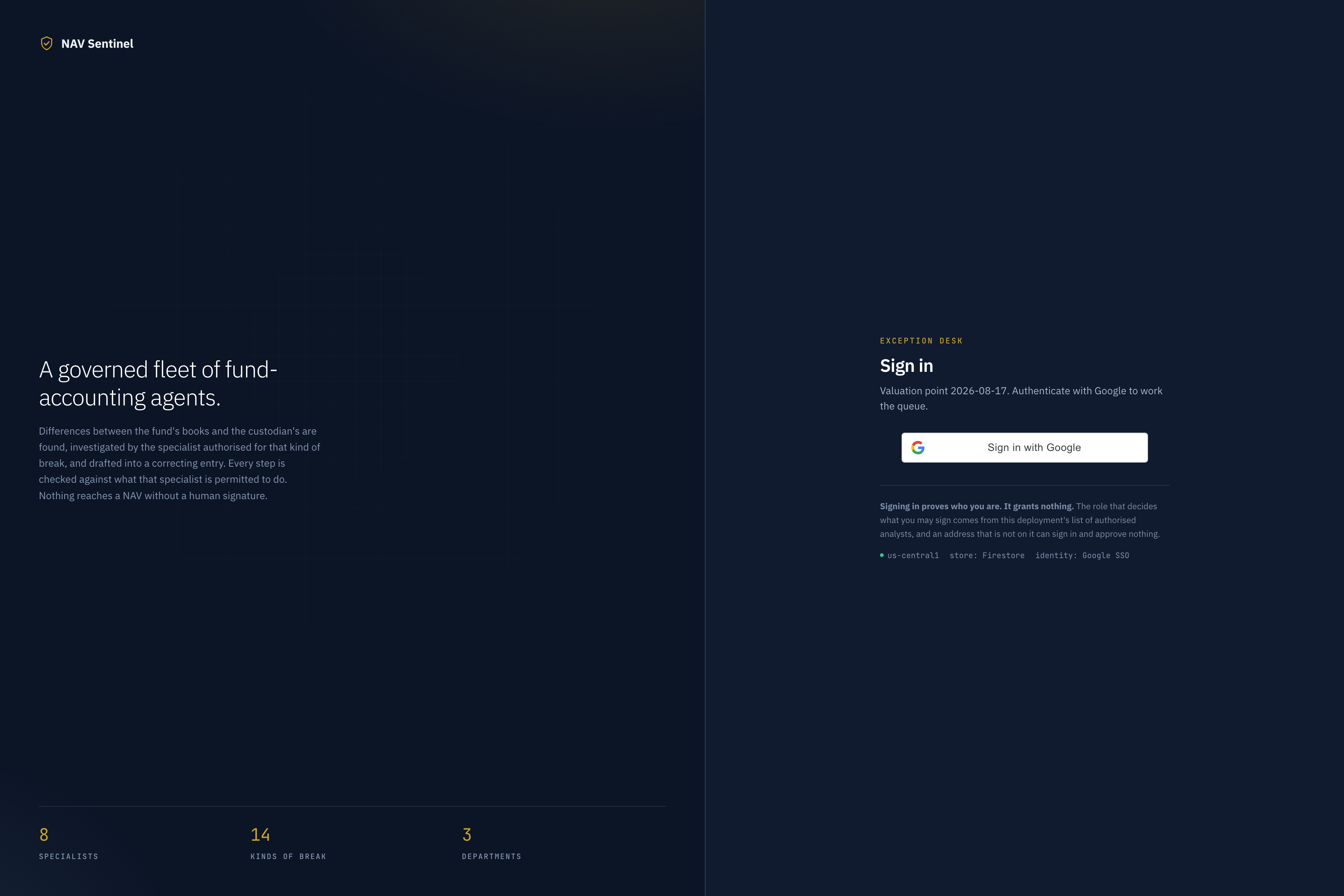
Sign in with Google
Inspiration
Every fund is reconciled twice a day — once by the fund accountant, once by the custodian. When the two books disagree, someone has to explain the difference before the NAV can be struck, and the window is measured in hours. The work is skilled, repetitive and almost entirely manual: pull the break, guess the cause, chase evidence across a price feed, an FX table, a corporate-action notice and a trade blotter, write the correcting entry, then find someone senior enough to approve it.
Two things had to become true before this could be automated, and only one of them was ever an engineering choice.
The first is capability, and it is genuinely recent. Explaining a break means reading a notice written for a person, reasoning about which of several causes fits, deciding what evidence would settle it, and producing a balanced journal entry against it. Deterministic automation has been aimed at this for years: it clears the easy cases and leaves behind exactly the ones that need judgement. An agent that can read the unstructured source, choose which tools to call, and cite what it actually used is what changes that — and that is a 2026 capability, not a 2023 one.
The second is permission. No fund administrator will let an autonomous process near a NAV without verified identity, enforced separation of duties, screening of anything ingested from outside, and an audit trail that survives a regulator asking why eighteen months later.
So this builds both: a fleet that can now do the work, and the control plane that makes it deployable.
What it does
NAV Sentinel runs a fleet of specialist agents over a fund's daily reconciliation, and a control plane that governs them.
- Detects breaks between the accounting and custodian books with deterministic tolerance rules. No model — deciding whether two numbers differ is arithmetic, and a model here would add cost and non-determinism to a decision that needs neither.
- Triages each break, computes its NAV impact in basis points, and asks the Agent Registry which specialist is authorised to investigate that root-cause family.
- Investigates through the specialists the registry will route to — corporate actions, FX and rates, settlement — each with its own identity, its own read-only tool allowlist, and evidence cited from named sources. Pricing and cash-and-fees are declared capabilities with no published investigator, on purpose: a break classified as either escalates to a human rather than being handed to whichever agent looked closest. Coverage gaps are a fact about any fleet; routing around them loudly is the part worth building.
- Drafts a balanced correcting entry with the evidence chain attached.
- Routes for approval by materiality. Nothing posts autonomously, at any size.
And when a break turns out to be a NAV error rather than a same-day difference, it stops being a one-day job. A misstatement above tolerance opens a case that runs for weeks and crosses departments: fund accounting restates, transfer agency works out which investors dealt at the wrong price and what they are owed, compliance decides whether the regulator must be told, and the case moves through a stage machine that will not let it skip a step. That multi-week, multi-department case is the centre of the project, and it is why the state has to be durable: the case outlives the process that opened it.
How we built it
Agent framework: Google ADK (google-adk 2.7.1). Every agent is an ADK agent with a
declared toolset.
Model: Gemini on Vertex AI — gemini-3.7-flash for investigation and drafting, and
gemini-3.5-flash-lite for triage classification, because every break passes through triage and
cost per call matters there in a way it does not for a once-per-case investigation.
On Google Cloud: Cloud Run (the service and the browser desk), Firestore (case files, governance decisions, approvals — native mode), Pub/Sub with OIDC push authentication and a dead-letter topic, Vertex AI, Model Armor for screening untrusted ingested text, Cloud Trace via OTLP, Cloud Build and Artifact Registry. Authentication is a verified Google account; the service holds no passwords and never sees one.
The design decision the whole thing rests on: agents are not trusted to obey their prompts. Every tool call passes through a policy gateway that can refuse it, and ten policies are enforced in code — tool allowlist, draft-only authority, no autonomous posting, approval routing by materiality, untrusted-ingest screening, data scope, evidence corroboration, legal stage transitions, delegation depth, and whether any published agent is authorised for a capability at all. A refusal is recorded as a governance decision with the policy id attached, so the audit trail contains the things the fleet was stopped from doing, not only what it did.
Approvals are signatures by named people. Four-eyes requires two distinct principals holding controller or CIO, checked at grant time, against a Google-verified identity. The role comes from the deployment's analyst table and is looked up on every request, so authentication grants nothing on its own and removing someone ends their session immediately.
Extensibility was a design goal, not an afterthought. The control plane knows nothing about
fund accounting. Processes plug in through a ProcessPack seam, and there are three of them —
NAV reconciliation, transfer agency, and the remediation office. A static check enforces the
layering, so a process cannot reach into the platform's internals and no process can import
another. Adding a fourth department means adding a pack, not editing the core.
Challenges we ran into
A bug that only existed once deployed. /console returned 500 in Cloud Run and worked
perfectly on my machine: Invalid database id %28default%29. I was confidently wrong twice
about the cause before finding it — a patch-level difference in google-api-core between my
laptop and the image.
Controls that report success in states where they never ran. This turned out to be the defect family that mattered. A helper returned "0 investors affected" for a case it had never actually examined, which closed a material NAV error with nothing paid to anybody. A governance record reached nothing durable — one trace span and zero persisted decisions for a 28-day case. Most recently: Google sign-in verified the token, checked the audience, attached the right role, set a correctly signed cookie — and the next request threw it away, so nobody could ever get in. Every test was green, because every test took the path that worked.
Accomplishments that we're proud of
- A case that genuinely runs for weeks across three departments, and can be read back in full by a fresh process from Firestore — not a session, not a cache.
- The audit trail records refusals, not just actions. You can ask what the fleet was prevented from doing.
- 1074 offline tests that run in about ten seconds and need no cloud credentials, plus a documented list of the project's known defects in the README. The honest ones are the useful ones.
- The control plane is genuinely process-agnostic, proven by three processes rather than asserted in a design doc.
What we learned
That the hard part of an enterprise agent fleet is not the agents. It is the boring institutional machinery around them — identity, separation of duties, durable state, provable refusals — and that machinery is what decides whether any of it is deployable. I also learned, repeatedly, that a passing test suite is a claim and not evidence.
What's next for NAV Sentinel
Expand the functionality to various other back office processes in the investment management industry and beyond.

Log in or sign up for Devpost to join the conversation.