Inspiration
Managing money can be stressful, especially when people have multiple bills, different payment dates and savings goals to think about. Traditional budgeting tools often require users to manually organise their finances, which can be confusing and time-consuming.
For the NatWest challenge, we wanted to create something that puts the customer first. We focused on making financial planning simpler, more accessible and more personalised.
Our idea was to build on NatWest's existing Cora assistant and Pots concept, allowing customers to manage their money through natural conversations rather than complicated forms and calculations.
What it does
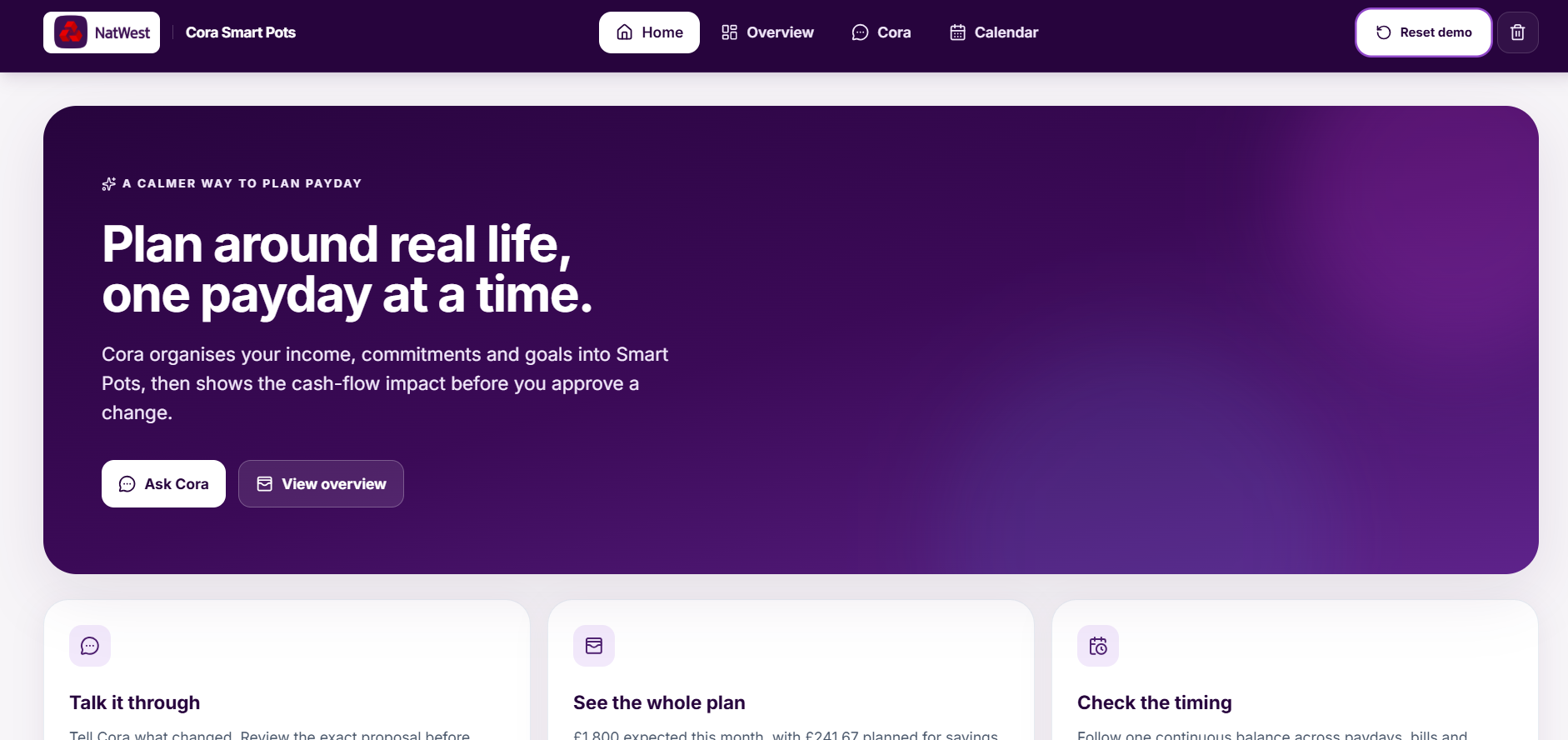
NatWest Finances Assistant, featuring Cora Smart Pots, is an AI-powered financial planning prototype that helps customers organise their income, manage expenses and work towards savings goals.
Users can tell Cora how much they earn, when they get paid and what their regular expenses are. The assistant uses this information to create a personalised budget, automatically recommending how their income should be divided into different Pots for bills, groceries, transport, emergency savings and personal spending.
The application includes an interactive pie chart showing how money is distributed, alongside a financial calendar displaying upcoming income, expenses and projected balances.
Customers can also create savings goals by explaining what they want to achieve. For example, someone could ask Cora to help them save £1,000 for a holiday in six months. The system calculates suitable contributions based on upcoming paydays and their existing financial commitments.
One of the main features is the ability to adapt when circumstances change. If a customer receives less income than expected or has an unexpected expense, Cora can propose an adjusted financial plan that prioritises essential spending.
The aim is to help customers understand their finances, prepare for difficulties and build greater long-term financial resilience.
How we built it
We built the application using React, Vite and TypeScript, with Tailwind CSS for styling and Recharts for interactive financial visualisations.
For the AI functionality, we integrated Anthropic's Claude API through a Node.js and Express backend. Claude interprets natural-language requests, understands financial information and helps customers make changes to their plans.
We separated the AI functionality from the financial calculations. Our custom calculation engine handles budgeting, recurring payments, savings contributions and balance forecasting. This ensures that important financial figures are calculated consistently rather than relying on AI-generated estimates.
We also used local storage to preserve financial information and conversation history within the prototype.
The interface was designed around NatWest's visual identity, with an emphasis on clarity, accessibility and ease of use.
Throughout development, we used AI coding assistants, including Codex and Claude Code, to accelerate implementation and troubleshoot issues within the hackathon's limited timeframe.
Challenges we ran into
One of our biggest challenges was ensuring that the AI assistant could understand conversations over multiple messages.
Initially, Cora could understand financial information but struggled to remember the context of follow-up questions. For example, if a user asked to save a certain amount and then provided a deadline in their next message, the assistant sometimes treated the date as a completely new request.
Another challenge involved keeping the financial calculations consistent across the different sections of the application. We needed to ensure that the Pots, savings goals and calendar all reflected the same information whenever a customer changed their income or expenses.
Savings goals were particularly challenging because we had to distinguish between the total amount someone wanted to save and what they could realistically contribute from each payday.
We also encountered issues with recurring payment dates, balance forecasting across different months and making the interface simple enough for everyday users.
With only six hours available, we had to balance developing useful functionality with testing, fixing bugs and preparing the final demonstration.
Accomplishments that we're proud of
We're particularly proud of creating a functional financial planning experience within such a short amount of time.
Rather than building a basic chatbot that only gives financial advice, we developed an application where conversations can lead to actual changes in the customer's financial plan.
Our Smart Pots system connects income, expenses and savings goals through a shared calculation engine, allowing customers to see how their decisions affect their finances.
We're also proud of the financial calendar, which forecasts balances across multiple months and helps customers understand upcoming commitments.
Most importantly, we focused on making the experience approachable. Customers shouldn't need extensive financial knowledge to understand where their money is going or how to prepare for future expenses.
What we learned
This hackathon reinforced the importance of starting with a real customer problem rather than choosing technology first.
We learned that building an AI-powered financial application requires more than connecting a language model to a user interface. Financial information needs to be accurate, understandable and consistent, particularly when customers may rely on it to make decisions.
We also gained experience with AI integration, state management, financial calculations and coordinating development using AI coding tools.
Working under a strict time limit taught us how important it is to prioritise essential functionality, test continuously and avoid adding unnecessary complexity.
What's next for NatWest Finances Assistant
Our long-term vision is for Cora Smart Pots to become an integrated feature within the NatWest banking experience.
With access to secure banking integrations, the system could use actual balances and transaction information to provide more accurate financial forecasts and personalised recommendations.
We would also like to develop smarter financial predictions that help customers prepare for unusual expenses, changes in income and periods of financial difficulty.
Another priority would be expanding accessibility, including voice-based interactions and simpler financial explanations for customers who may find traditional banking interfaces difficult to navigate.
We would also conduct real user testing to understand how different customers interact with the system and identify where it could be improved.
Ultimately, we want NatWest Finances Assistant to help people do more than track their spending. We want it to help customers feel more confident, prepared and in control of their financial future.
Built With
- claude
- express.js
- lucide
- node.js
- react
- recharts
- tailwind
- typescript
- vite
- zod
