-
-
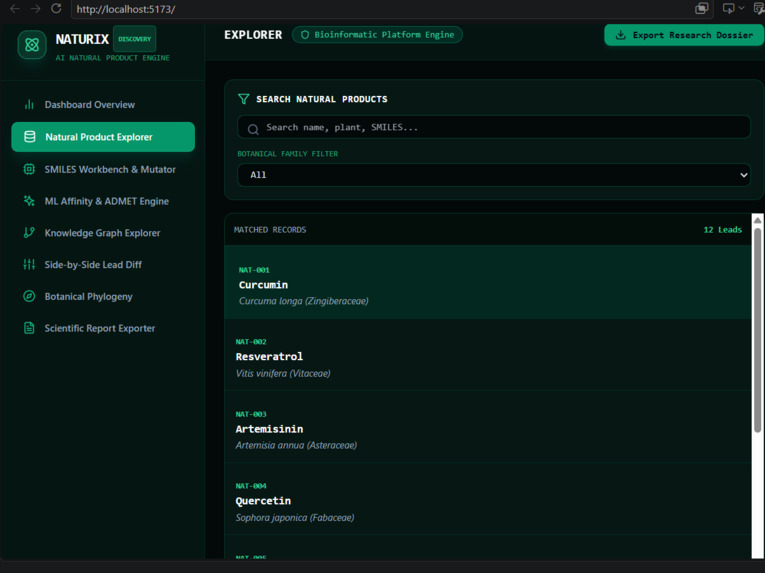
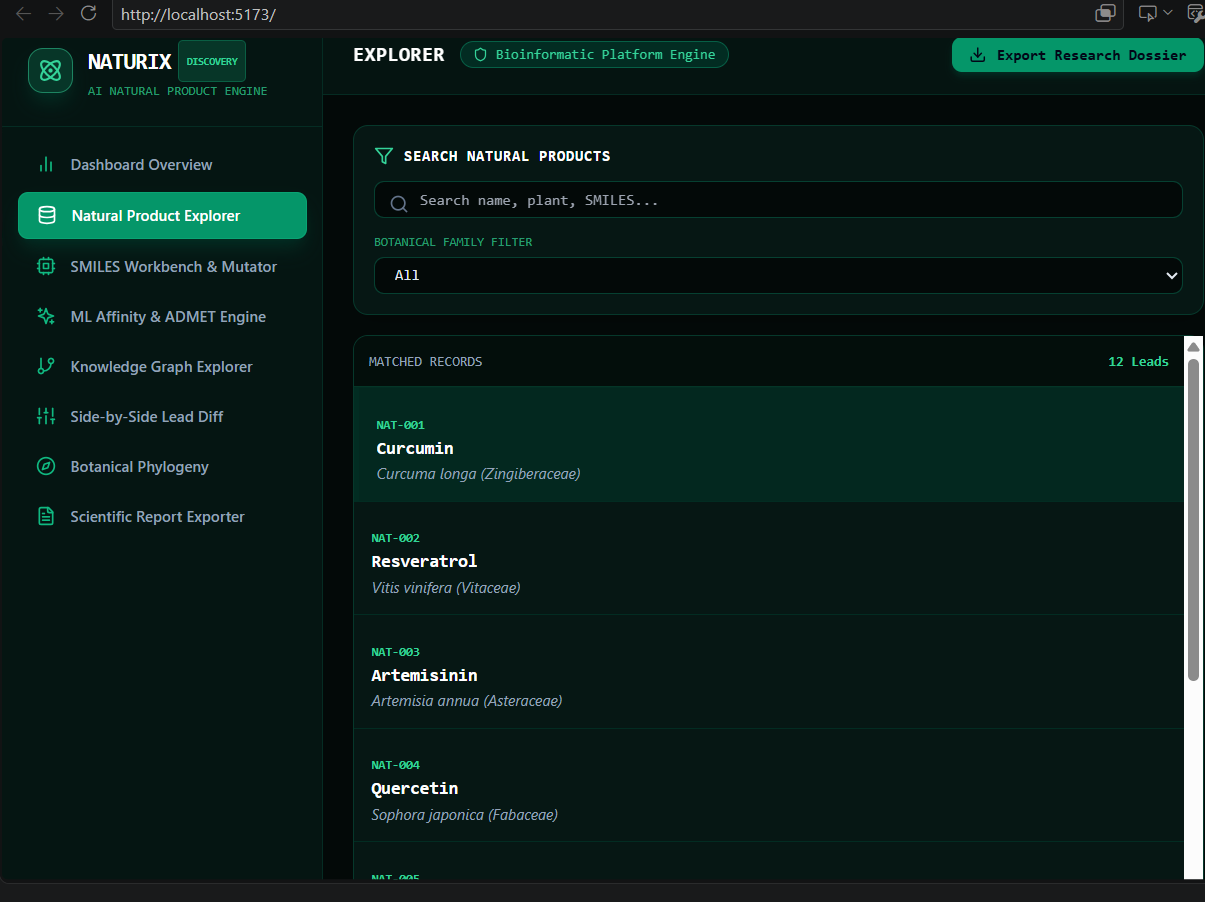
Natural Product Explorer with 2D SMILES graph canvas, Lipinski metrics, and botanical metadata.
-
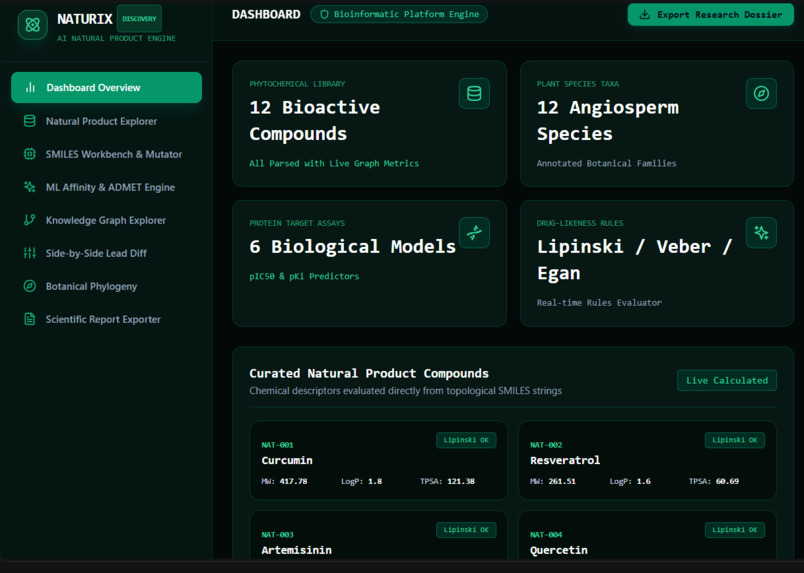
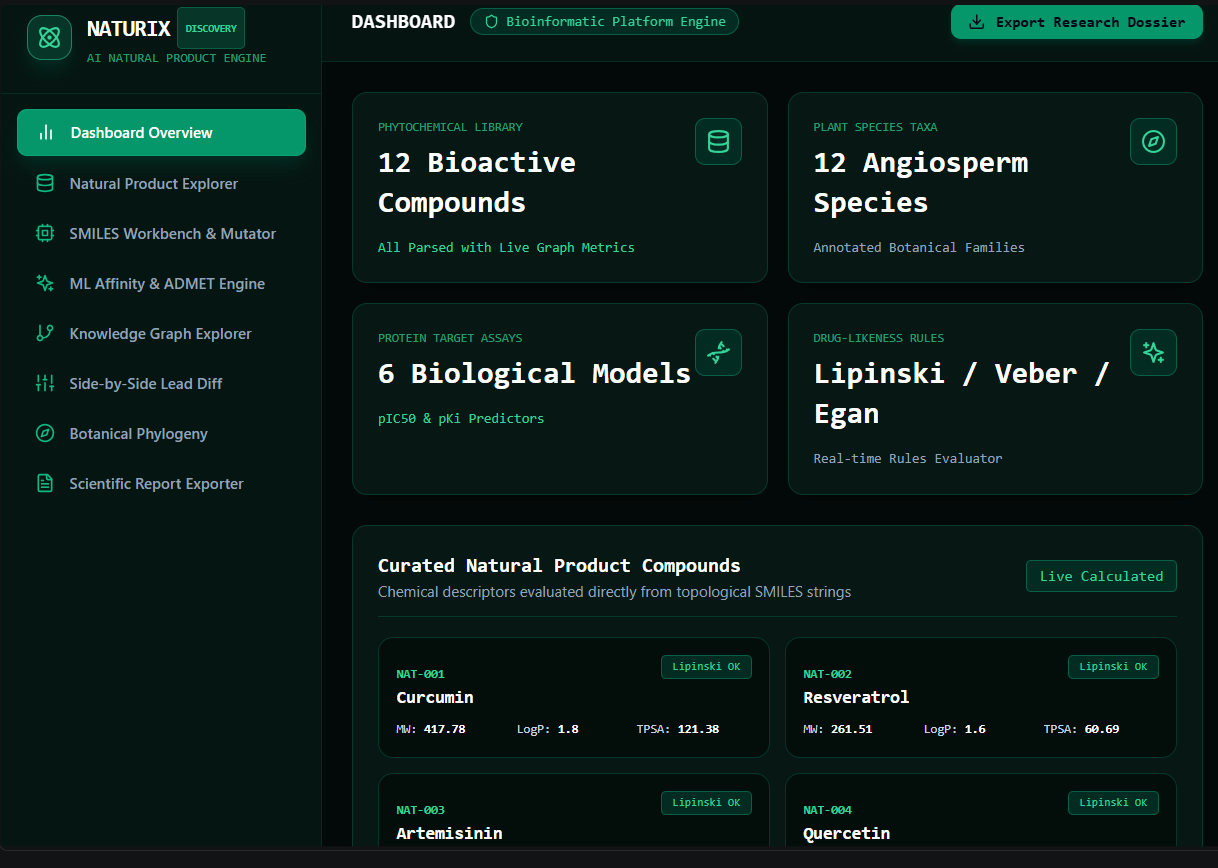
Main Dashboard showing database statistics, compound metrics, and drug-likeness evaluations.
-
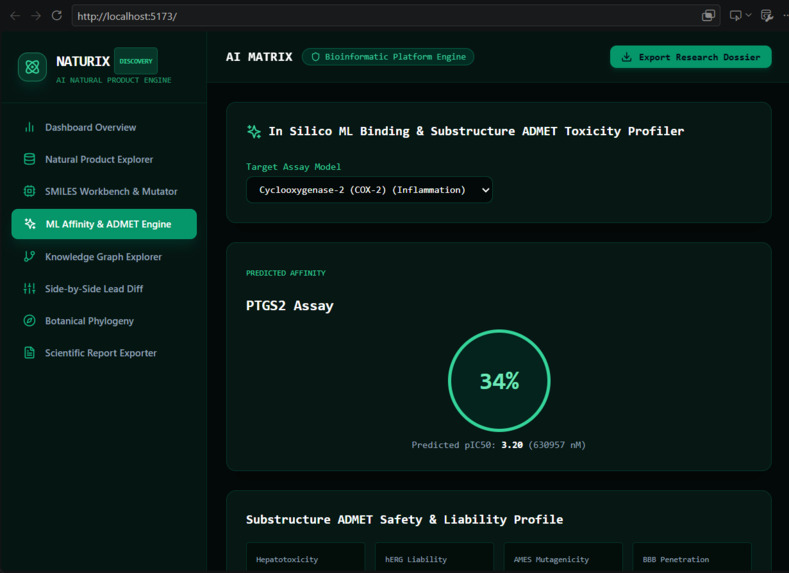
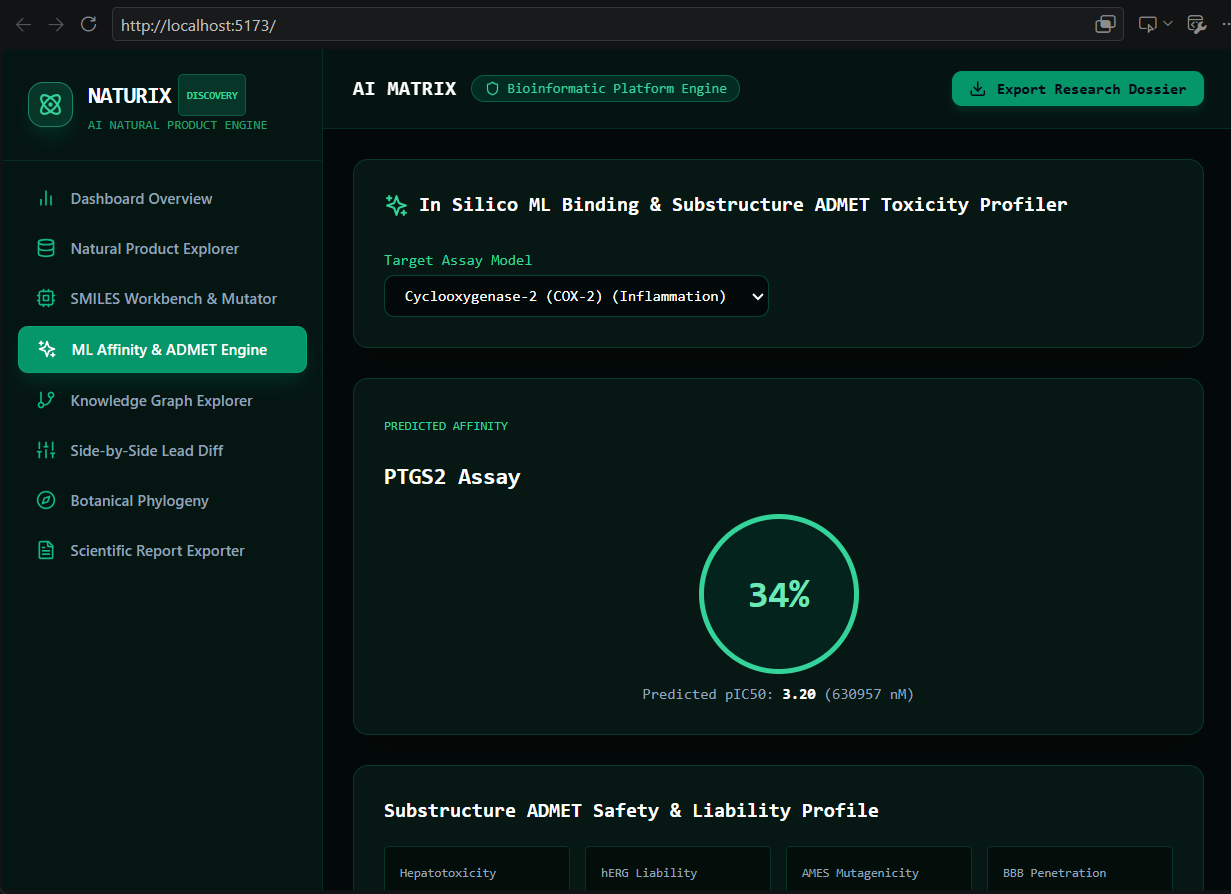
In Silico ML binding affinity prediction ($pIC_{50}$) with SHAP feature attribution and ADMET safety profiling
-
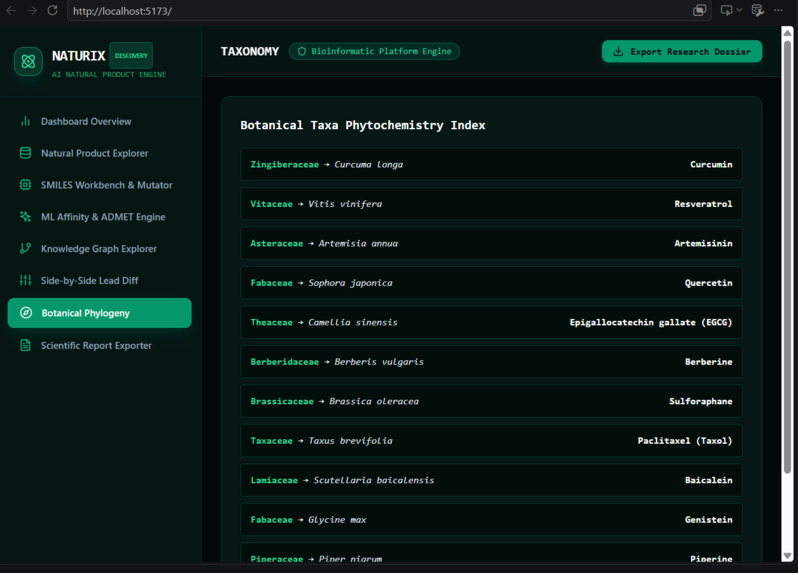
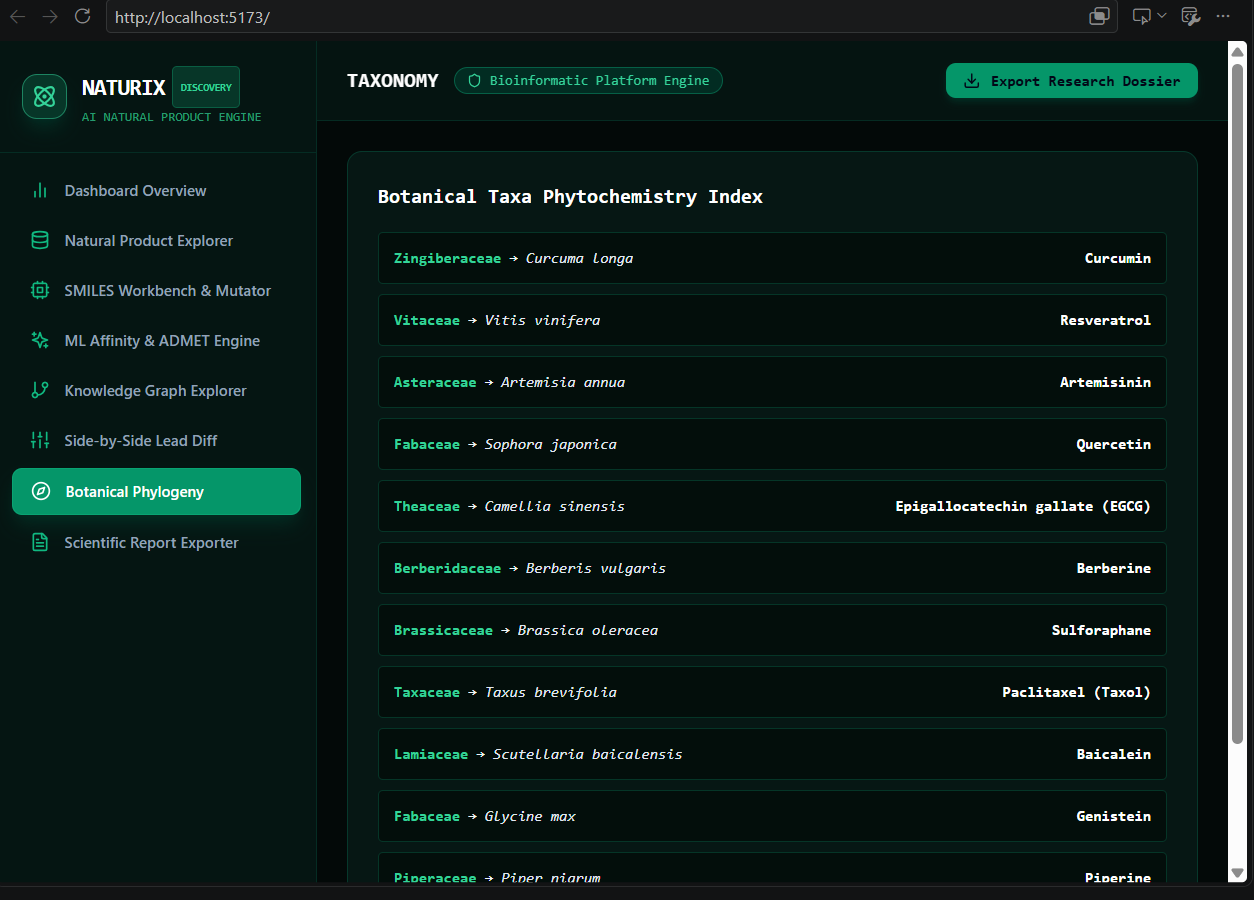
Botanical Phylogeny index categorizing active phytochemicals by plant species and families.
-
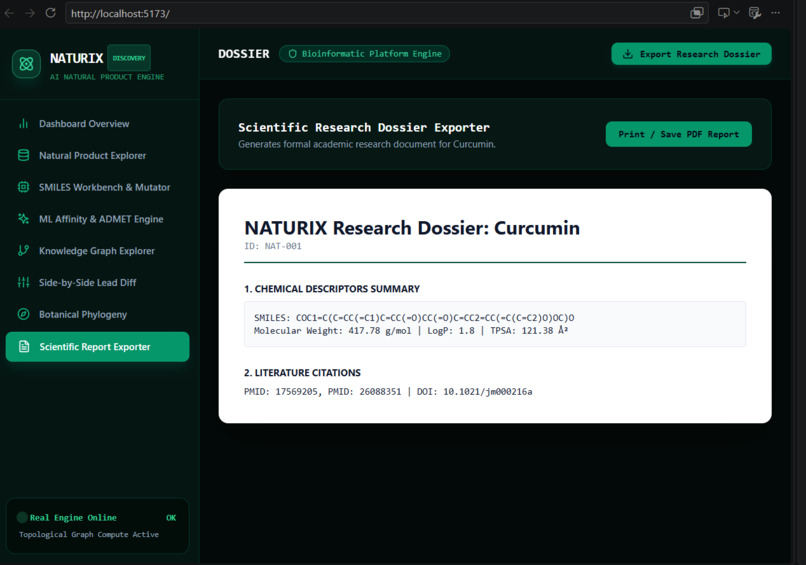
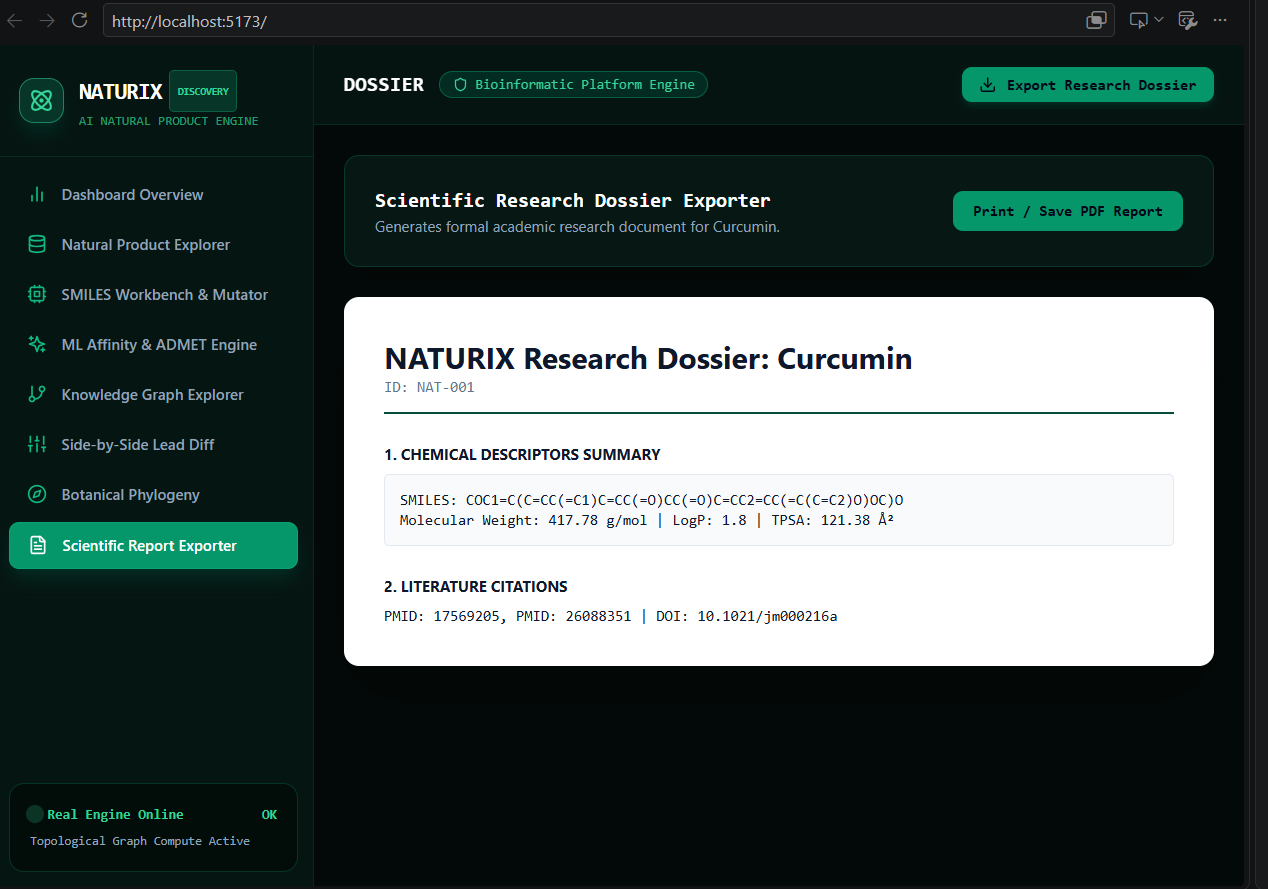
Auto-generated printable Scientific Research Dossier for exportable drug discovery documentation.
-
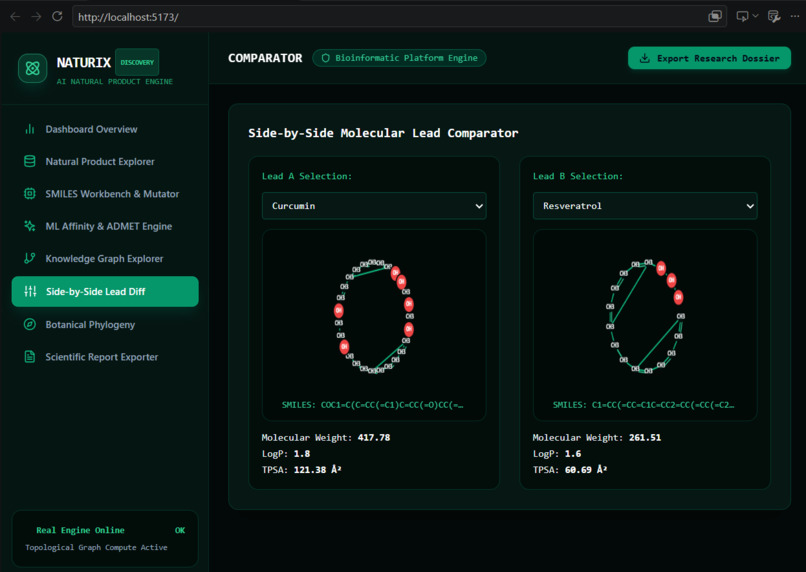
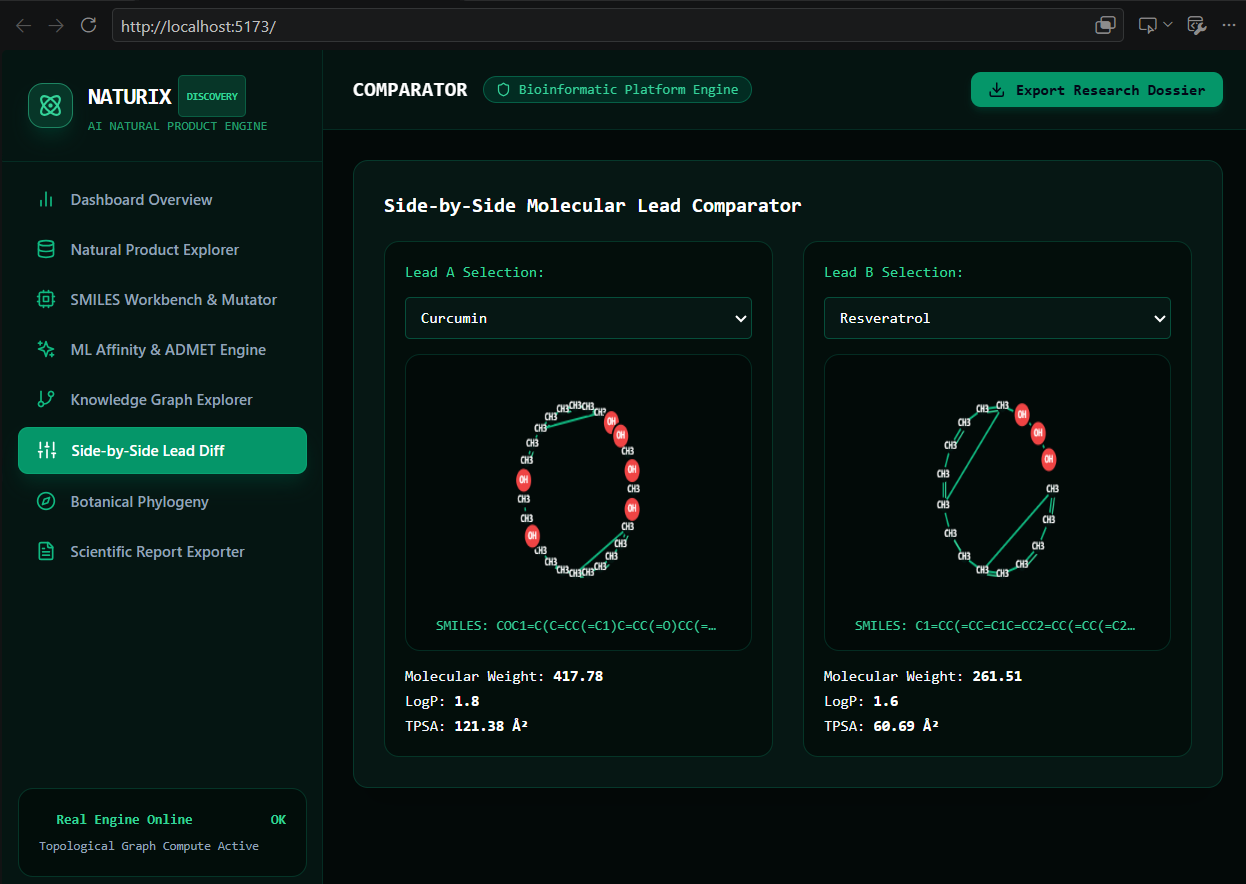
Side-by-Side Molecular Lead Comparator for structural and descriptor differential analysis.
-
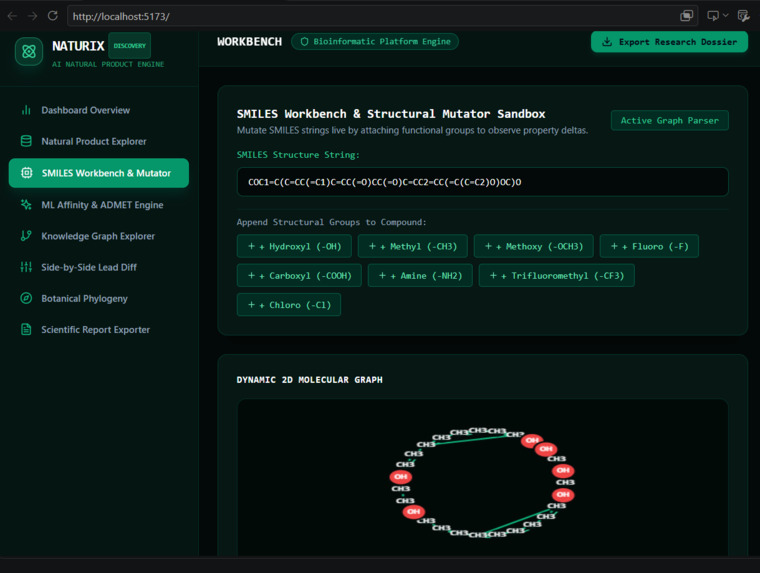
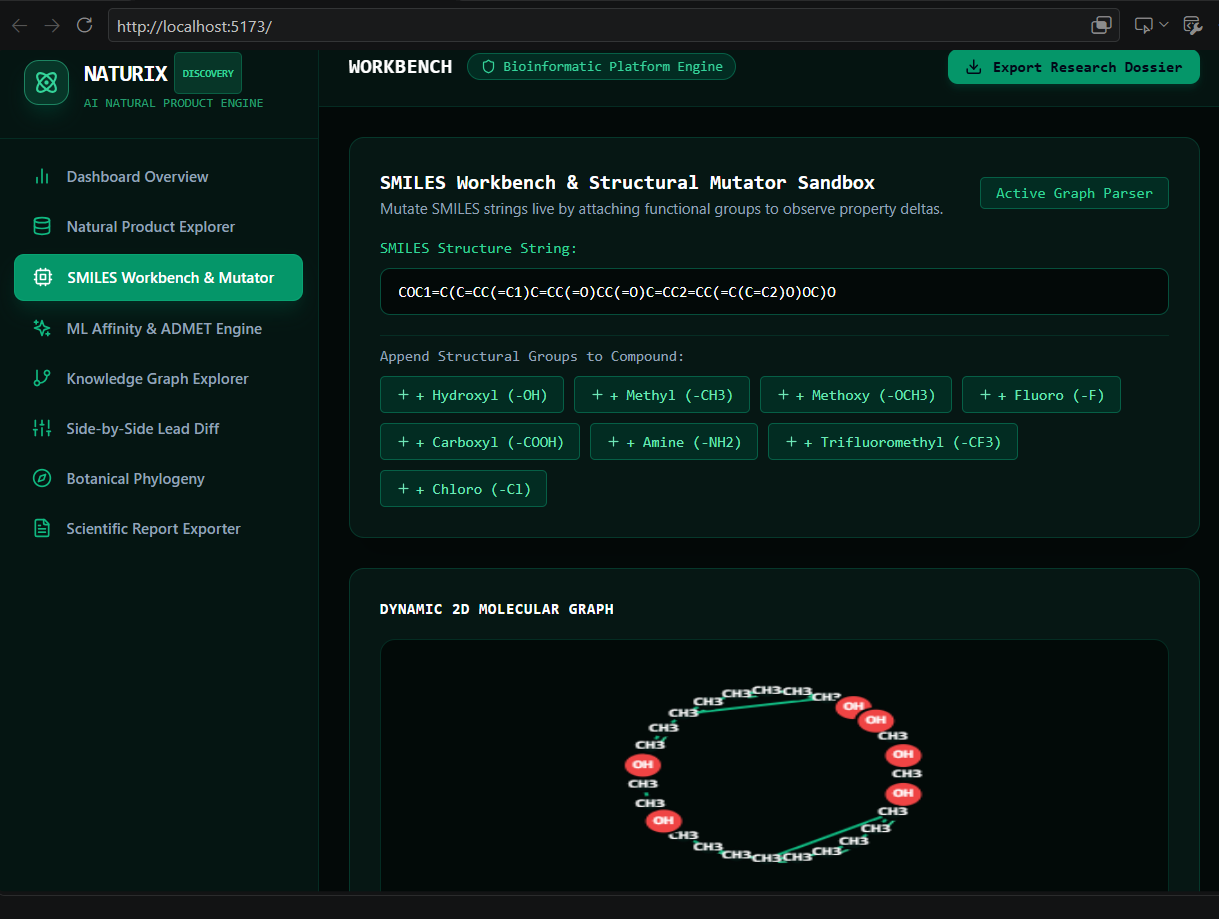
Interactive SMILES Workbench & Structural Mutator Sandbox with real-time property updates.
-
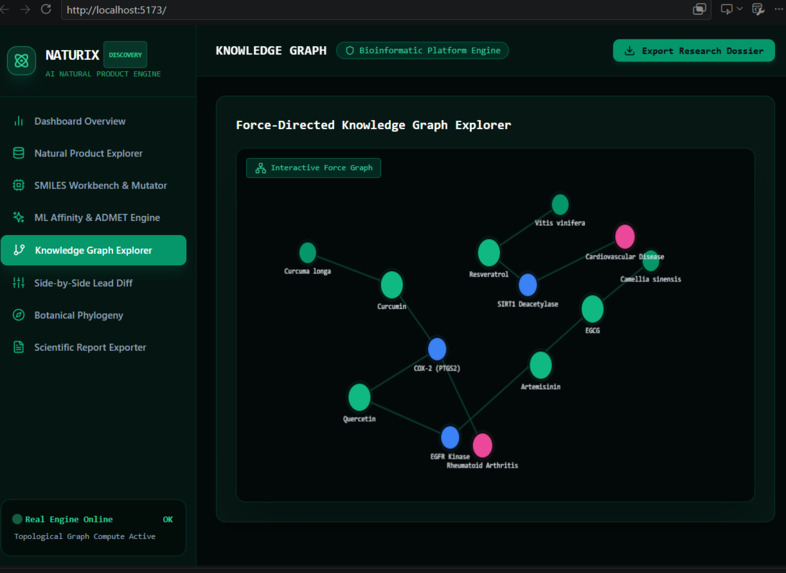
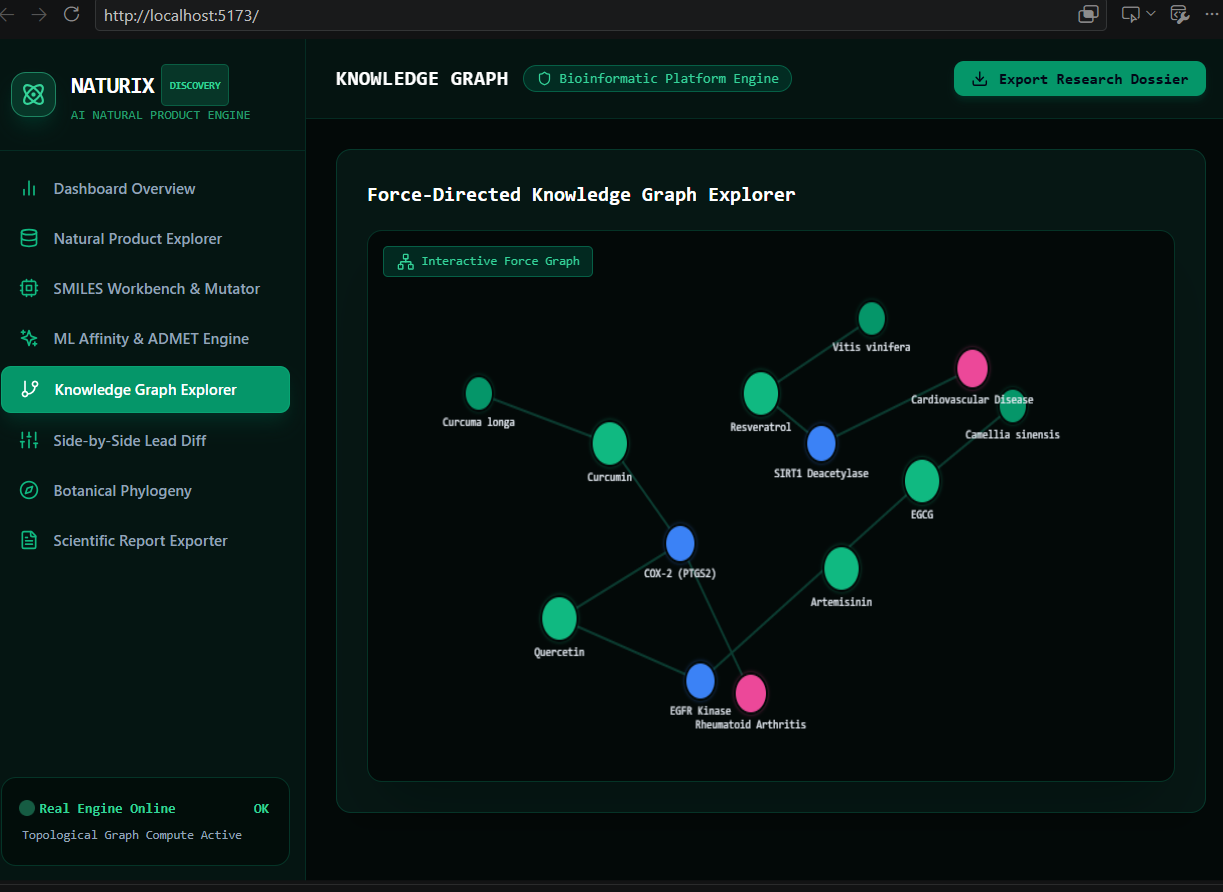
Interactive force-directed Knowledge Graph mapping plants, compounds, targets, and disease pathways.
Inspiration
Natural products have historically formed the foundation of modern pharmacology, yet traditional drug discovery from botanical sources remains slow, costly, and fragmented. We created NATURIX to bridge ancient ethnobotanical wisdom with modern computational biology—delivering an intuitive platform that accelerates phytochemical discovery and lead optimization.
What it does
NATURIX is a modular, web-based bioinformatics platform engineered for phytochemical drug discovery:
- Cheminformatics Mutation Workbench: Live SMILES string parsing, HTML5 Canvas 2D structural graph rendering, Lipinski/Veber/Egan rule calculation, ECFP4 64-bit circular fingerprints, and real-time functional group mutations.
- In Silico ML Bioactivity & ADMET Predictor: Predicts target binding affinity ($pIC_{50} = -\log_{10}(IC_{50})$) and molar concentrations using Machine Learning heuristics, alongside SHAP feature attributions and substructural ADMET toxicity profiling (hERG, AMES, BBB permeability).
- Interactive Knowledge Graph: Renders relational force-directed networks mapping Plant Species $\rightarrow$ Phytochemicals $\rightarrow$ Target Proteins $\rightarrow$ Disease Indications.
- Lead Comparator & Dossier Exporter: Side-by-side molecular comparisons and automatic generation of printable academic research reports.
How we built it
- Frontend & Architecture: Built with React (Vite) using a feature-decoupled modular architecture (
cheminformatics,prediction,explorer) for clean multi-contributor workflow. - Styling & UI: Modern dark-mode interface styled with Tailwind CSS and Lucide-react icons.
- Algorithms & Visualization: Custom client-side topological graph parsers and interactive HTML5 Canvas renderers for 2D molecular structures and force-directed networks.
Challenges we ran into
- Developing a custom, dependency-free SMILES parser in JavaScript to handle ring closures, aromaticity, and implicit hydrogen valences on the client side.
- Maintaining smooth 60 FPS Canvas UI performance while performing real-time mathematical evaluations ($LogP$, $TPSA$, $pIC_{50}$).
- Decoupling codebase architecture so three team members could simultaneously work on separate modules without merge conflicts.
Accomplishments that we're proud of
- Successfully creating a fully integrated end-to-end drug discovery suite that operates entirely in the browser.
- Achieving real-time interactive chemical mutation with instant property recalculations.
- Architecting a clean modular codebase ready for seamless deployment on Vercel.
What we learned
- Applied algorithms in cheminformatics, molecular graph theory, and pharmacokinetic drug-likeness rules.
- Integrating explainable AI (SHAP attributions) into biological affinity predictions.
- Best practices in multi-contributor React architecture and collaborative Git workflows.
What's next for Naturix
- Integration of 3D molecular docking visualization using Mol* / PDB renderers.
- Connecting live PubChem and ChEMBL REST APIs for expanded phytochemical datasets.
- Implementing automated retrosynthesis route prediction for mutated derivatives.
Built With
- bioinformatics
- cheminformatics
- html5
- javascript
- node.js
- react
- tailwind-css
- vite
