-
-
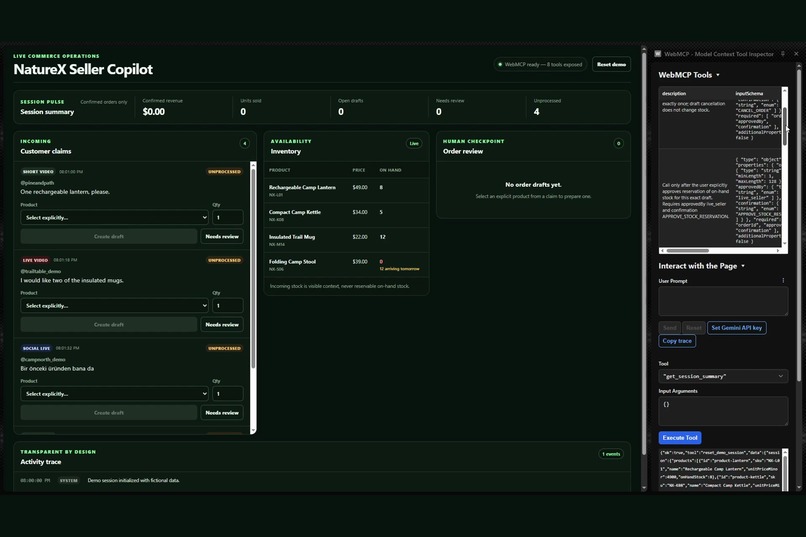
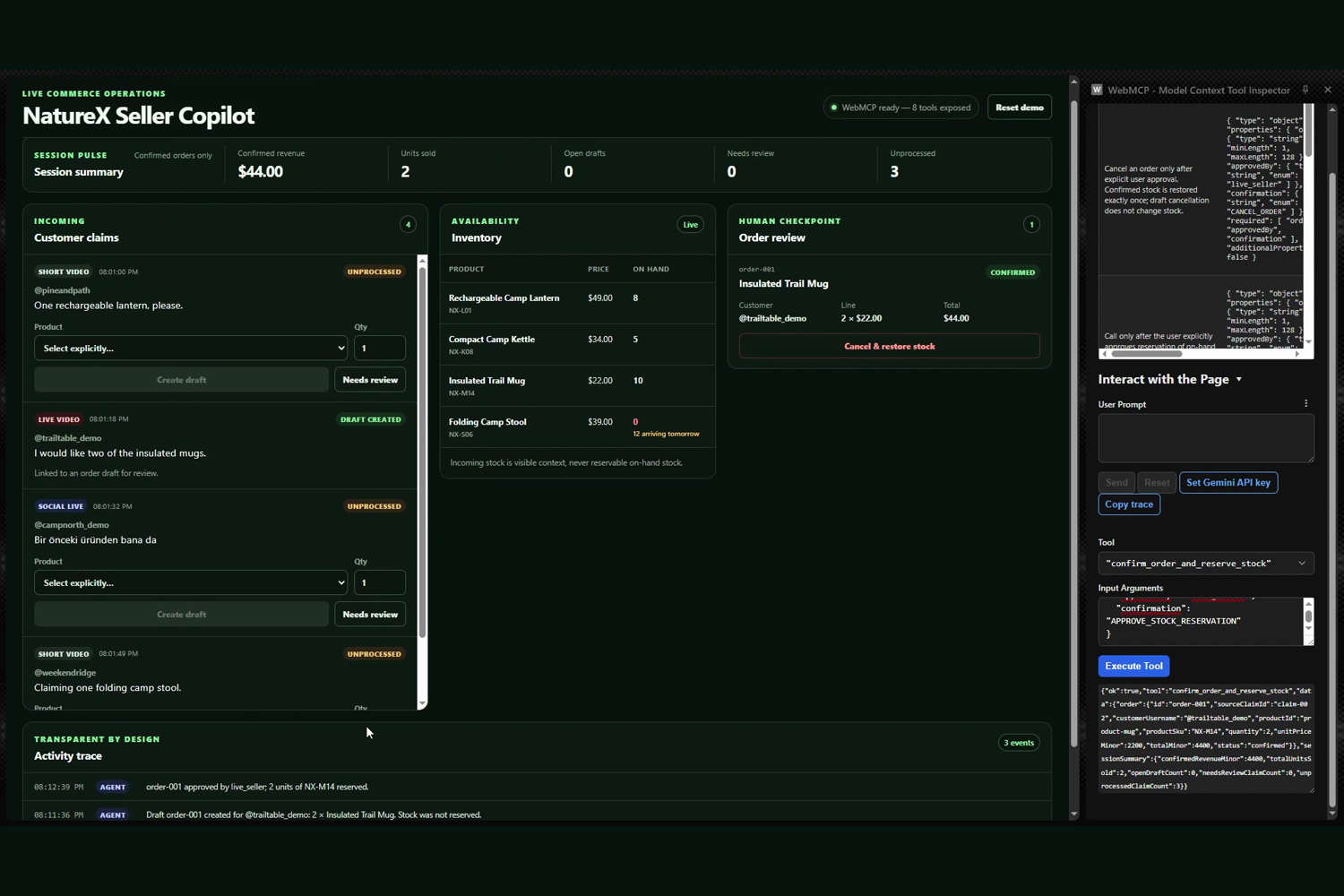
NatureX-01-WebMCP-Tools
-
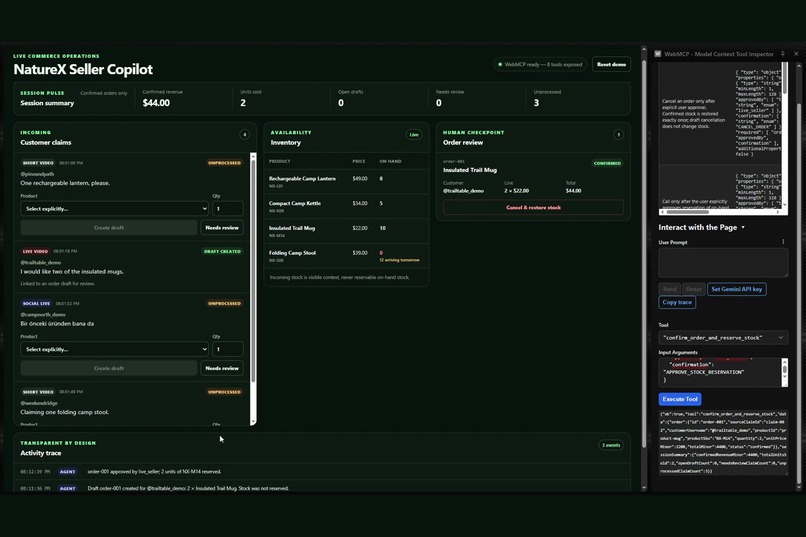
NatureX-02-Human-Approved-Order
-
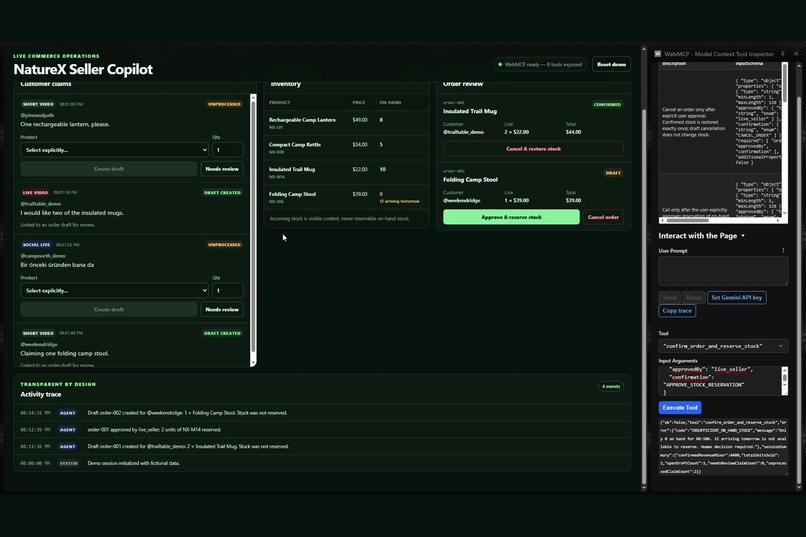
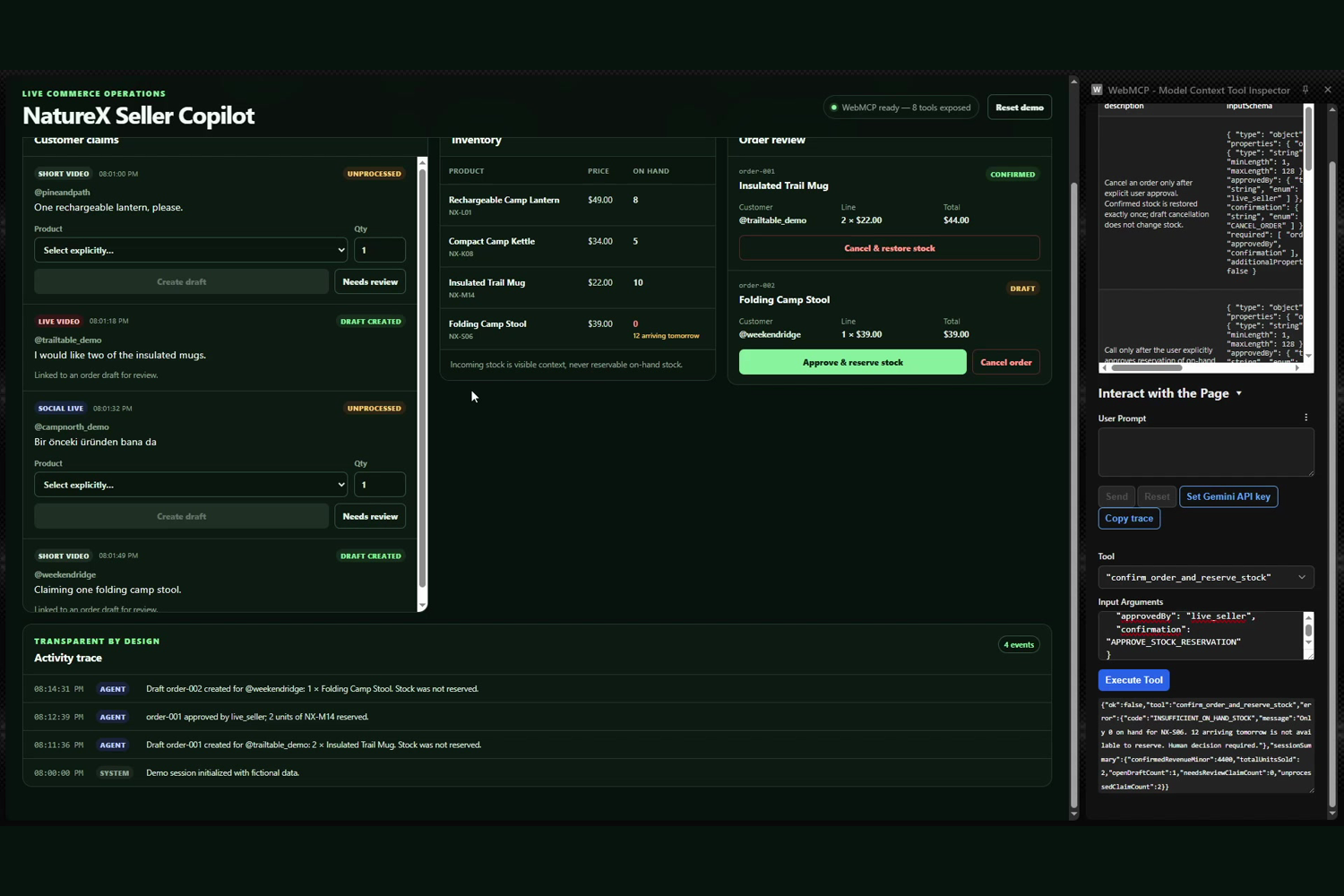
NatureX-03-Insufficient-Stock-Safety
Inspiration
NatureX Seller Copilot comes from a problem I deal with in real life.
I sell products through live streams. During a live sale, I need to present the product, talk to viewers, read comments, notice who wants to buy, remember the product and price, keep track of stock, and manage orders at the same time.
In my current workflow, when someone comments a product code or says “aldım” — Turkish for “I’ll take it” — I may write the username, product and price down manually so I do not lose the order.
It works, but during a busy live stream it becomes very easy for the seller to lose focus or miss something.
That is where the idea for NatureX came from.
When I discovered WebMCP, I started wondering: instead of asking AI to replace the seller, what if the application could give an AI agent clear tools to help with the operational work while the seller stays focused on the live audience?
That became NatureX Seller Copilot.
What it does
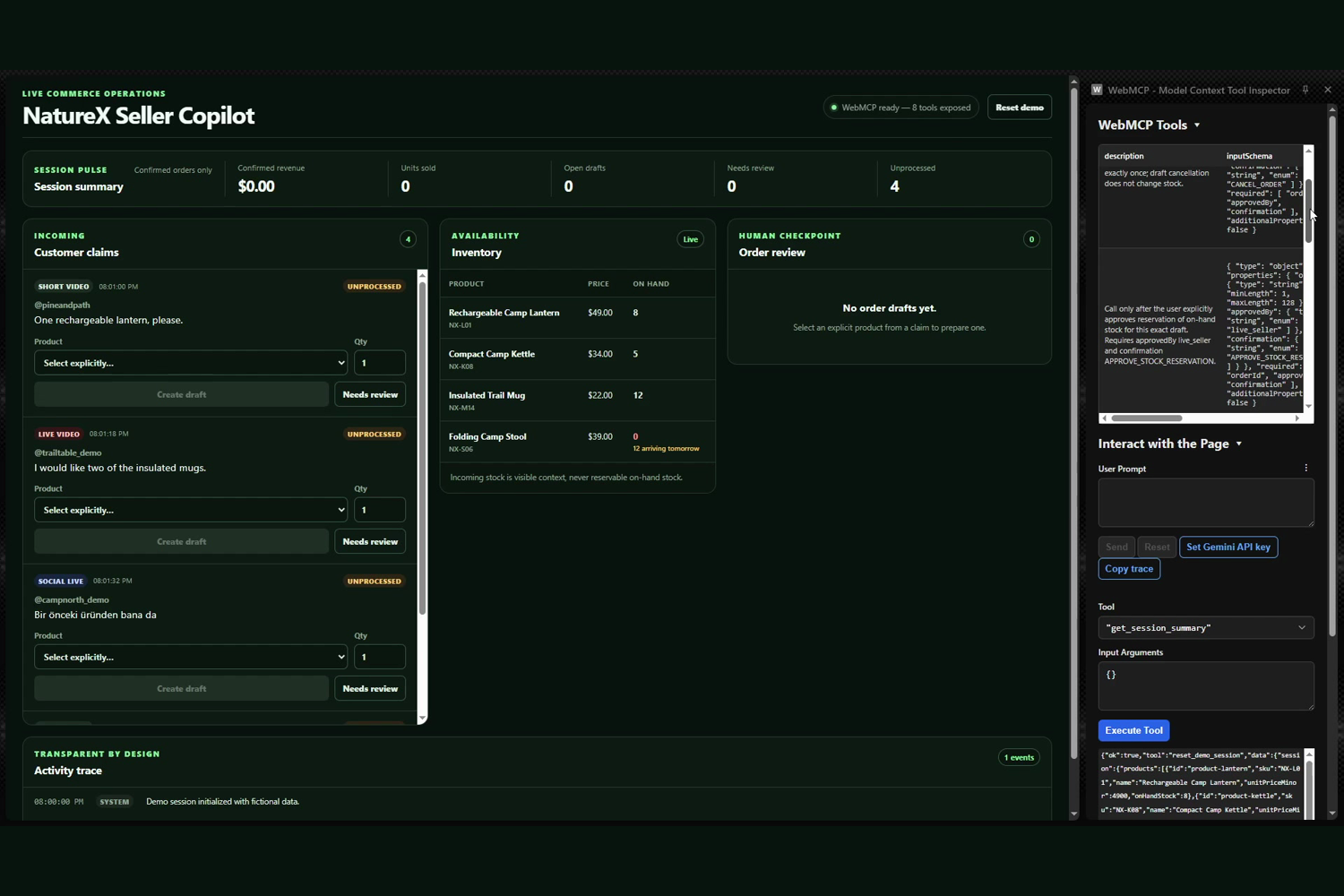
NatureX Seller Copilot is a live-commerce control dashboard designed to be used by both a human seller and an AI agent.
The seller can use the normal interface, while WebMCP exposes structured tools that allow an AI agent to understand and assist with the live-selling workflow.
The prototype focuses on tasks such as:
- checking the current live-sale state
- reviewing pending customer claims
- managing order decisions
- checking inventory
- identifying low-stock products
- viewing sales information
- handling products that are temporarily out of stock but expected to be restocked
The main idea is simple: the seller keeps selling, while the copilot helps manage what is happening behind the scenes.
How we built it
I am building the challenge project as a separate web prototype based on the real workflow behind NatureX.
The important design decision is that the visual dashboard and the WebMCP tools should not have two different sets of business rules.
Whether the seller acts through the interface or explicitly authorizes a WebMCP-assisted stock reservation, both paths go through the same underlying application logic.
WebMCP gives the agent explicit tools instead of forcing it to guess which buttons to click on the screen.
The tool set is intentionally small and focused on real live-commerce operations such as session state, customer claims, stock, order resolution, sales information, and incoming-stock context.
Challenges we ran into
One challenge is deciding what the AI should be allowed to do and what should remain under human control.
Live commerce moves quickly, but an automated decision can still affect a real customer and real inventory. Because of that, I do not want the AI to simply “do everything.”
Another challenge is inventory.
For example, during a live sale a product can reach zero stock even though more units are arriving the next day. In my real workflow, automatically cancelling every order in that situation would not always be the right decision.
The system therefore needs to understand the difference between a product that is truly unavailable and one that is temporarily waiting for restock.
A third challenge is designing WebMCP tools that are useful without creating too many overlapping tools that confuse the agent.
Accomplishments that we're proud of
What I like most about this project is that it did not start as an AI demo.
The problem existed before the hackathon.
I already wanted to build NatureX because managing live sales manually creates a lot of repetitive work while the seller is trying to stay engaged with viewers.
WebMCP gave me a new way to think about that problem.
Instead of building a separate chatbot beside the application, I can make the application itself understandable and usable by an AI agent.
I am also proud of the human + agent approach: the seller is still in control, but does not have to handle every small operational task alone.
What we learned
Before this challenge I was not familiar with WebMCP.
The biggest thing I learned is that making an application useful to an AI agent is not only about adding AI to the interface.
The application needs clear actions, clear data, predictable business rules and carefully designed tools.
I also learned that sometimes the best role for AI is not to replace the user.
In this project, AI is more useful as a second pair of hands for the seller.
That idea is something I can use far beyond this challenge.
What's next for NatureX Seller Copilot
This hackathon project is a small prototype of a much larger idea.
My long-term vision for NatureX includes live-stream management, comments, customer orders, inventory, payments, shipping preparation, label printing and sales analytics in one system.
I would like to explore how the same WebMCP approach could eventually make those parts agent-accessible as well.
The end goal is not an autonomous store.
It is a live-commerce workspace where the human seller can concentrate on people, products and the broadcast while software and AI quietly handle more of the repetitive operational work.
Built With
- ai-agents
- chatgpt
- css3
- github
- html5
- human-in-the-loop
- javascript
- live-commerce
- openai
- react
- typescript
- vite
- webmcp

Log in or sign up for Devpost to join the conversation.