-
-
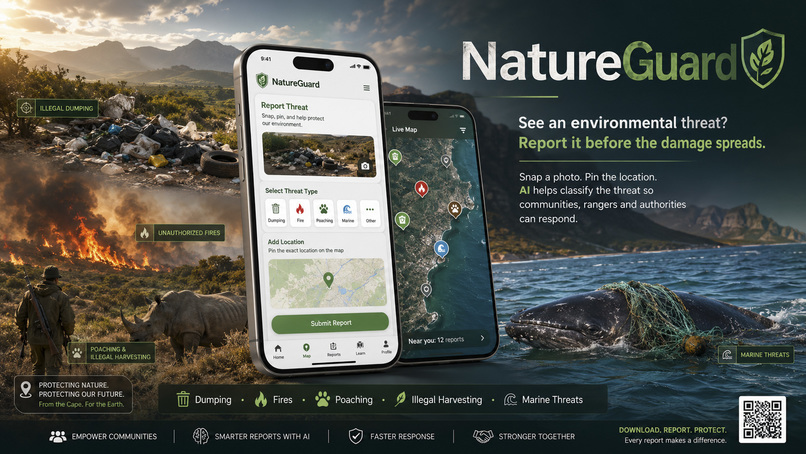
NatureGuard Environmental Protection App
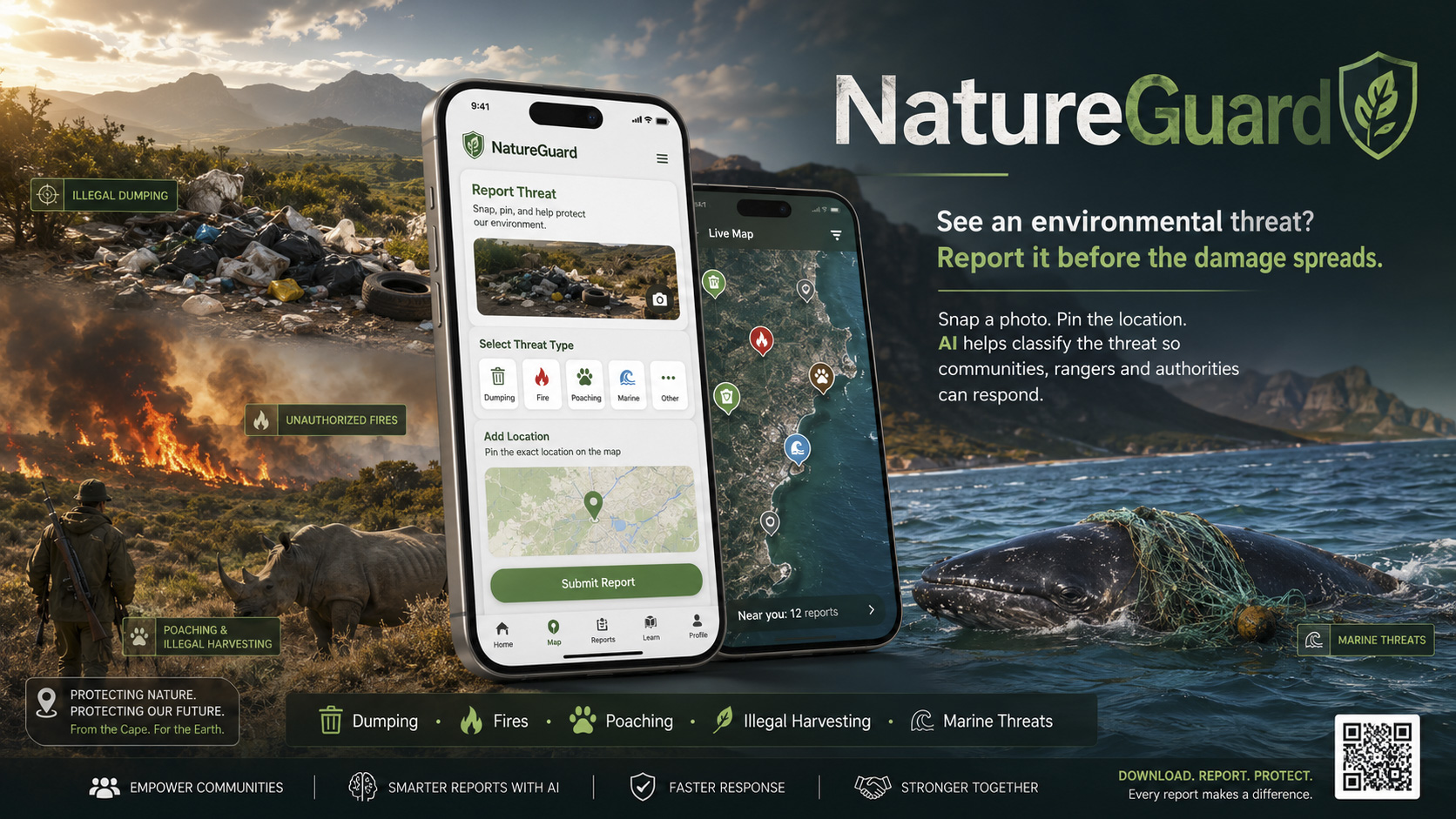
NatureGuard: Turning Concern into Environmental Action
Inspiration
I live in the Western Cape of South Africa, one of the world’s most beautiful tourism destinations. It is home to dramatic coastlines, mountains, wetlands, wildlife, and the unique Cape Floristic Region.
It pains me to see this natural heritage threatened by pollution, illegal dumping, destruction of sensitive habitats, wildlife poaching, the unlawful harvesting of rare indigenous plants, and increasingly destructive wildfires.
Many people care deeply when they witness environmental harm. They may take a photograph or talk about it on social media, but then encounter a practical problem:
Who should they report it to?
Environmental responsibility is often fragmented across municipalities, conservation agencies, emergency services, wildlife organisations, park authorities, and national departments. A concerned citizen may not know what type of violation they are looking at, how urgent it is, what evidence is useful, or which authority is responsible.
That uncertainty creates friction at exactly the moment when action matters most.
I decided to build NatureGuard: an AI-assisted environmental reporting application that helps turn an ordinary photograph into a structured, location-aware evidence report.
Although NatureGuard was inspired by the environmental challenges I see in South Africa, the underlying problem exists everywhere. My goal is to create a platform that can begin locally and eventually scale globally.
What NatureGuard Does
NatureGuard allows a user to photograph or upload evidence of possible environmental harm, including:
- Pollution and illegal dumping
- Wildlife injury, distress, or suspected poaching
- Destruction of natural habitats
- Illegal harvesting of protected plants
- Water contamination
- Coastal and marine damage
- Wildfire risks and fire-related destruction
The application combines the image with location data and the user’s own observations.
GPT-5.6 then assists by producing a bounded, provisional evidence brief. It can help identify the likely incident category, describe visible evidence, highlight possible risks, and organise the information into a clearer report.
The application is deliberately designed not to present AI analysis as a final legal or scientific determination. The user remains responsible for confirming the report, and human authorities remain responsible for investigation and enforcement.
NatureGuard also helps guide the user towards the most appropriate reporting pathway based on the type and location of the incident. Rather than expecting citizens to understand a complex network of agencies, the platform aims to make environmental reporting more accessible and actionable.
How I Built It
NatureGuard is a mobile-first web application built with:
- Next.js and TypeScript
- OpenAI GPT-5.6 through the Responses API
- Firebase Authentication
- Firebase and private evidence storage
- Geolocation and map-based incident context
- Vercel for deployment
- Codex for AI-assisted software development and verification
The reporting experience was designed around the way a person would realistically use the application in the field:
- Capture or upload an image.
- Attach or confirm the location.
- Add a short eyewitness description.
- Request an AI-assisted evidence analysis.
- Review and correct the provisional findings.
- Create a structured report.
- Receive guidance on the appropriate reporting route.
- Retain a receipt and reference for follow-up.
I also created a public demonstration path so judges and other visitors can explore the core concept without needing to submit real environmental evidence.
Synthetic demonstration images are used to protect privacy and prevent the demo from depending on real victims, locations, or active incidents.
How I Used Codex
Codex played an important role in helping me transform NatureGuard from an early application concept into a more structured and competition-ready product.
I used Codex to help:
- Upgrade and review the Next.js architecture
- Strengthen Firebase authentication and trust boundaries
- Separate public demonstration functionality from authenticated reporting
- Improve the mobile reporting experience
- Implement private evidence handling
- Create more reliable and idempotent report creation
- Review API routes and production behaviour
- Diagnose deployment and dependency problems
- Improve documentation and judge-testing instructions
- Verify the application before submission
Codex was not simply used to generate isolated pieces of code. It acted as a development partner across architecture, implementation, debugging, security review, and documentation.
I retained control over the important product decisions, particularly those involving privacy, user consent, environmental safety, and the boundary between AI assistance and human authority.
How I Used GPT-5.6
GPT-5.6 provides the intelligence behind the evidence-assistance workflow.
It analyses the image together with the user’s written observations and produces a structured response that may include:
- A likely environmental incident category
- A description of visible evidence
- Potential environmental or wildlife risks
- Indicators that may require urgent attention
- Missing information that the user should consider adding
- A clearer summary for inclusion in a formal report
One of my most important design decisions was to keep the model’s role carefully bounded.
GPT-5.6 does not declare that a crime has occurred, identify a species with absolute certainty, replace an environmental specialist, or dispatch an emergency response. Its role is to help a concerned person create a more useful and organised report.
This distinction is essential when AI is used in environmental, legal, or public-safety contexts.
Challenges I Faced
Creating useful AI analysis without overstating certainty
Environmental photographs can be ambiguous. A single image may not show the full context, scale, ownership, legality, or urgency of an incident.
I had to design prompts and interface language that made the AI useful while ensuring its conclusions remained provisional and reviewable.
Protecting sensitive evidence
Environmental reports may contain precise locations, private property, identifiable individuals, injured wildlife, or evidence of illegal activity.
This meant privacy could not be added as an afterthought. NatureGuard needed clear separation between public demo content and private user-submitted evidence.
Routing reports to the correct authority
Different regions have different environmental agencies and reporting structures. Even within South Africa, responsibility may differ between municipalities, provincial conservation bodies, national departments, emergency services, and specialist organisations.
The long-term routing system therefore needs to be location-aware, configurable, and capable of expanding country by country.
Designing for real-world mobile use
A person reporting an incident may be outdoors, under stress, using a phone with limited connectivity, or trying to document a rapidly changing situation.
The reporting flow needed to minimise unnecessary steps while still collecting enough information to make the report useful.
Resolving production issues under deadline pressure
During final production testing, I encountered a server-side dependency conflict involving Firebase App Check, jwks-rsa, and an incompatible ESM version of jose.
The issue caused authenticated API routes to fail in production. I traced the problem to an open upstream compatibility defect, applied a targeted dependency override, deployed the fix, and confirmed that the affected endpoints were responding correctly again.
This was a valuable reminder that building a working AI product requires much more than the model itself. Authentication, storage, deployment, security boundaries, dependencies, and failure handling are equally important.
What I Learned
The most important lesson was that people often do not lack concern—they lack a clear path from concern to action.
A photograph alone is not necessarily useful evidence. It becomes far more valuable when it is combined with location, time, eyewitness context, classification, structured observations, and an appropriate reporting destination.
I also learned that responsible AI design is not about making the strongest possible claim. It is about helping the user understand what is known, what is uncertain, and what should happen next.
GPT-5.6 was most valuable when used as an evidence-organisation and decision-support tool, rather than as an unquestionable authority.
Finally, I learned how powerful Codex can be when used throughout the complete development lifecycle—not only to write code, but to inspect architecture, diagnose production defects, improve documentation, and challenge unsafe assumptions.
What Comes Next
NatureGuard was inspired by the Western Cape, but it was designed with a much larger future in mind.
The next stages include:
- Expanding the directory of environmental authorities
- Adding region-specific reporting requirements
- Improving low-connectivity and offline capture
- Supporting multilingual reporting
- Introducing verified conservation and municipal partners
- Providing secure status updates and case follow-up
- Improving species and habitat assistance with specialist datasets
- Identifying recurring environmental hotspots while protecting reporter privacy
- Expanding the platform to additional countries
My long-term vision is for NatureGuard to become a global bridge between citizens who witness environmental harm and the organisations capable of responding to it.
One person with a mobile phone may not be able to stop pollution, poaching, habitat destruction, or wildfire alone.
But they can capture evidence.
They can raise the alarm.
And with the right tools, they can help ensure that environmental harm is no longer ignored simply because nobody knew whom to contact.


Log in or sign up for Devpost to join the conversation.