-
-
Overview
Inspiration
We are the people on the ground face to face with extreme weather events. Every dry season we ask ourselves, when will ther ebe the next forest fire? Seeing the possibilities now available with accessible opensource AI, cheaper DIY IoT devices, high resolution satelite data, and a myriad of projects to build upon we have decided to enter this hackathon to kickstart our "industry 4.0" tech-powered biodiversity conservation & reforestation efforts with our community of over 800+ rural indigeneous Maya Q'eqchi' people. Our inspiration of organization and movement comes from the platform co-ops from around the world that have proven to be a viable way of sharing what we build with our neighbors in LatAm and the globe.
What it does
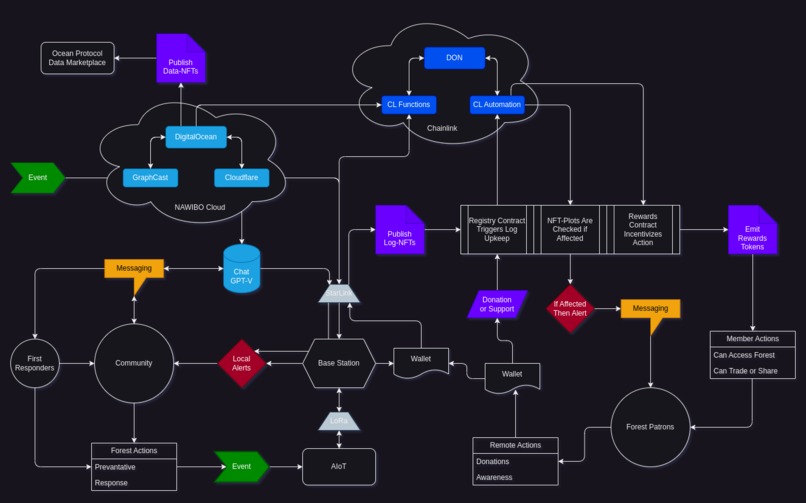
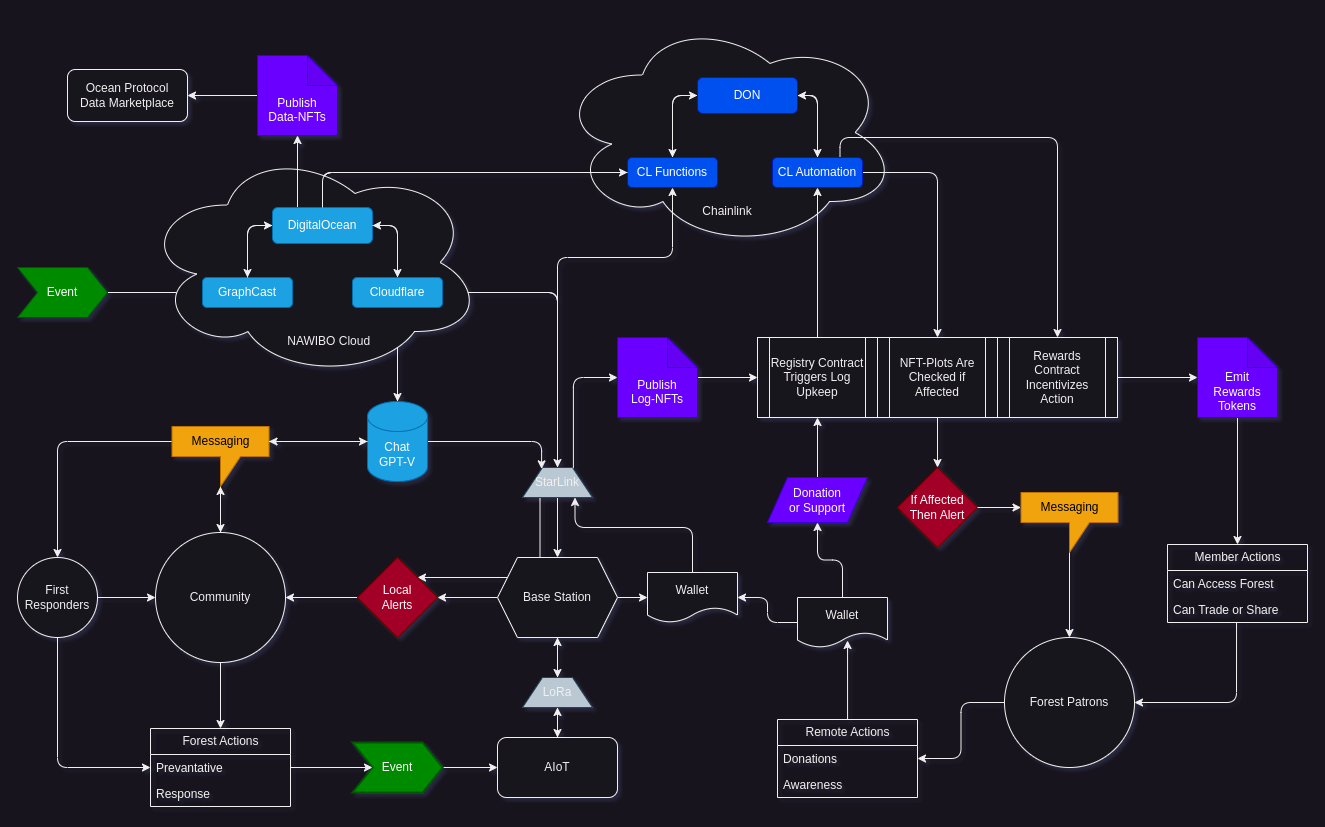
We've designed low power IoT devices with built in AI at the sensor and microcontroller level to be our 24/7 eyes on the ground against poachers, illegal loggers, and destructive forest fires. These connect remotely on at distances of up to 10km in the dense mountainous rainforests that we caretake and protect. The base station located in our village connects to the internet via starlink satelite connection to our cloud node.
This cloud node is hub to these spokes that habitate on the edge of our forests. From here we make calls to Deepmind's new SOTA weather model called GraphCast on Google Earth Engine to periodically monitor every 6-12 hours new reports for humidity drops, temperature rises, and adverse winds that are telltale signs of potential fires. This is paired with on the ground inputs received from our AIoT systems to provide 24/7 coverage.
Chainlink's DON comes into play when an event is registered. If on the ground, the realtime AIoT system publishes an NFT with the event details and immediately alerts the village through the base stations speaker system from canned alert categories using onboard and offline TTS services available on the base station. If adverse conditions are detected in advance by the GraphCast model, an event is also registered onchain as a NFT through DON, and an SMS, Email & Whatsapp messages are sent to community leaders and first responders. These contain first step instructions in spanish generated by ChatGPT-Vision parsed from the GraphCast alert & latest AIoT data as JSON output regarding the incident. Continual remote support of the situation is provided by GPT-V as our people can take images and describe through voice & text what's happening on the ground to further create intelligent environmental awareness.
All interactions with the system are logged onchain through Chainlink's DON to provide a clear center and chain of information, custody, and action to avoid issues before issues potentially arise. Furthermore, social incentives and monetary rewards are provided to those first responders, remarkable heros in the strife, or people who contribute from afar with donations. We segment the forest and reforestation buffer zones using 10m squared plots (1 pixel @ Sentinel 2 resolution) as NFTs. Our goal is to allow people everywhere to sponsor these plots of rich biodiverse primary karstic rainforest. Thus, if you sponser a 10m2 plot, we will reforest another 10m2 plot to further combat the surrounding desertification from clear cut slash and burn practices, extensive overgrazing, and rampant palm oil plantations that surround us and present major risks. The health and growth processes over years of life on these 2 plots are mirrored in each respective dynamic NFT, and visualized and geolocalized data on our frontend. Chainlink's DON allows us to tie in onchain events from our system to individual plots and thus alert sponsors of the risks and activities involved with their slice of paradise. We hope to provde social incentives through a non monetary token that is earned supporting the project in multiple ways and is reedemable as an "access" pass to the community and reserve as a new form of sustainable tourism. Call it Proof of Forest Action (PoFA).
How we built it
ESP32 based with readily available LoRa radios as low powered edge AIoT nodes using tinyML with up to 1 year of rechargable battery life. Paired with a solar powered RaspberryPI 3B+ LoRaWAN Gateway working with Chirpstack & Mosquito MQQT broker software stack with Piper TTS connected to starlink dish also on solar & battery. This connects to our Cloudflare & Digital Ocean services running a minimal routing backend stack mostly in python with a influxDB & Neo4j storage running on ZFS. GraphCast weather model runs on Google Earth Engine and communicates via REST API to our cloud node. OpenAI's whisper, CLIP, and GPT-V are connected via the standard API using Langchain that's running on our cloud node as a union between all AI models. Twilio is used for the SMS, Email, & Whatsapp communication. We use QuickNode for our Chainlink Oracle Node and Avalanche RPC connectivity. Smart contracts are ERC-721's deployed to Celo's carbon neutral blockchain, inline with our carbon negative ethos. Frontend is through Gradio & Builder.IO in NextJS using scaffold-eth2 as a base. We are exploring Avalanche subnets as a way to create a common unified forest network built on blockchain.
Challenges we ran into
Well, a lot. Time mostly. Didn't help that I'm the only dev in 800+ people involved with our 16+ year forest conservation project.
We did not have the chance to source (from China/US) key components for the AIoT that we have identified as critical and are not regionally available in rural Guatemala. Therefore we could not deploy or run tests regarding this sector. However we did validate ideas and product viability and cost/benefit ratio and are very happy to immediately source components from key suppliers to start. In the mean time we used synthetic data to fill the sensor void.
Connecting the AIs, a lot of deep dives into the technical such as RAG, memory, quantization, fine tuning viability, and a lot of prompt tuning and prompt engineering. We explored a lot into AI, even went as far as looking at LLaVa multimodal models to run offline on an old upcycled enterprise laptop we could buy on ebay to cut away all cloud costs and keep it 100% local. Yeah, we don't have starlink either ($600 upfront is half a years wage for many), so no connectivity, reliability or latency tests are available. There's only spotty 2G where the village is, and no cell coverage in the forest zone.
Connecting DON with a custom NFT contract that mints data & incident NFTs was hard to pickup quickly. Though, thankfully Chainlink has excellent documentation and readily available examples. Also couldn't work out the tokenomics in code for the action-response-recognition smart contracts for rewards+incentives. We used CityDAO repos as a base for sponsor frontend and NFT plots smartcontracts. As well as Briojas/IoT-Chainlink-MQTT-Client repo for the base test connection between our AIoT sensor system and DON.
Overall, we made it only to concept phase and minimal testing. Another 30 days should be enough to progress further :)
Accomplishments that we're proud of
We've built and designed this in the last month. Real world utility of 3 different high powered technology that we can bring to the people on the forefront of conservation through opensource innovation. And the fact I'm only one pulling this off for my community, I only just imagine if many across Latin America or around the world can continually build and improve on this as a global platform cooperative centered on forest & biodiversity conservation. Hope, is what we're proud of.
What we learned
YES, we can do it. Leapfrog all the talk, and as a rooted organization jump over the nay-sayers to introduce a new Proof of Forest Action (PoFA) model for direct action, information, and chain of people involved with what really matters. Thats is, using the new tools at hand to further overall human prosperity through symbiotic relationships between technology, humanity, and planet Earth.
What's next for Nature Without Borders
BUILD LIKE A MADMAN FLYING IN SPACE.
Built With
- ai
- cloudflare
- digitalocean
- don
- influxdb
- integrated-earth-data-applications
- iot
- llm
- neo4j
- next-js
- polygon
- python
- solidity
- twilio

Log in or sign up for Devpost to join the conversation.