Inspiration
Working with databases is powerful—but also frustrating for non-technical users. Writing SQL queries requires understanding schemas, relationships, and syntax, which creates a barrier for product managers, analysts, and even developers working with unfamiliar databases.
While tools exist to bridge this gap, most are either:
- tightly coupled to a specific database,
- rely on pre-trained models with limited adaptability,
- or require significant setup and training.
A simple question inspired NaturalQL:
“What if anyone could upload any database and instantly query it using plain English?”
We set out to build a universal, plug-and-play natural language interface for databases that adapts dynamically to any schema without requiring pre-training.
What it does
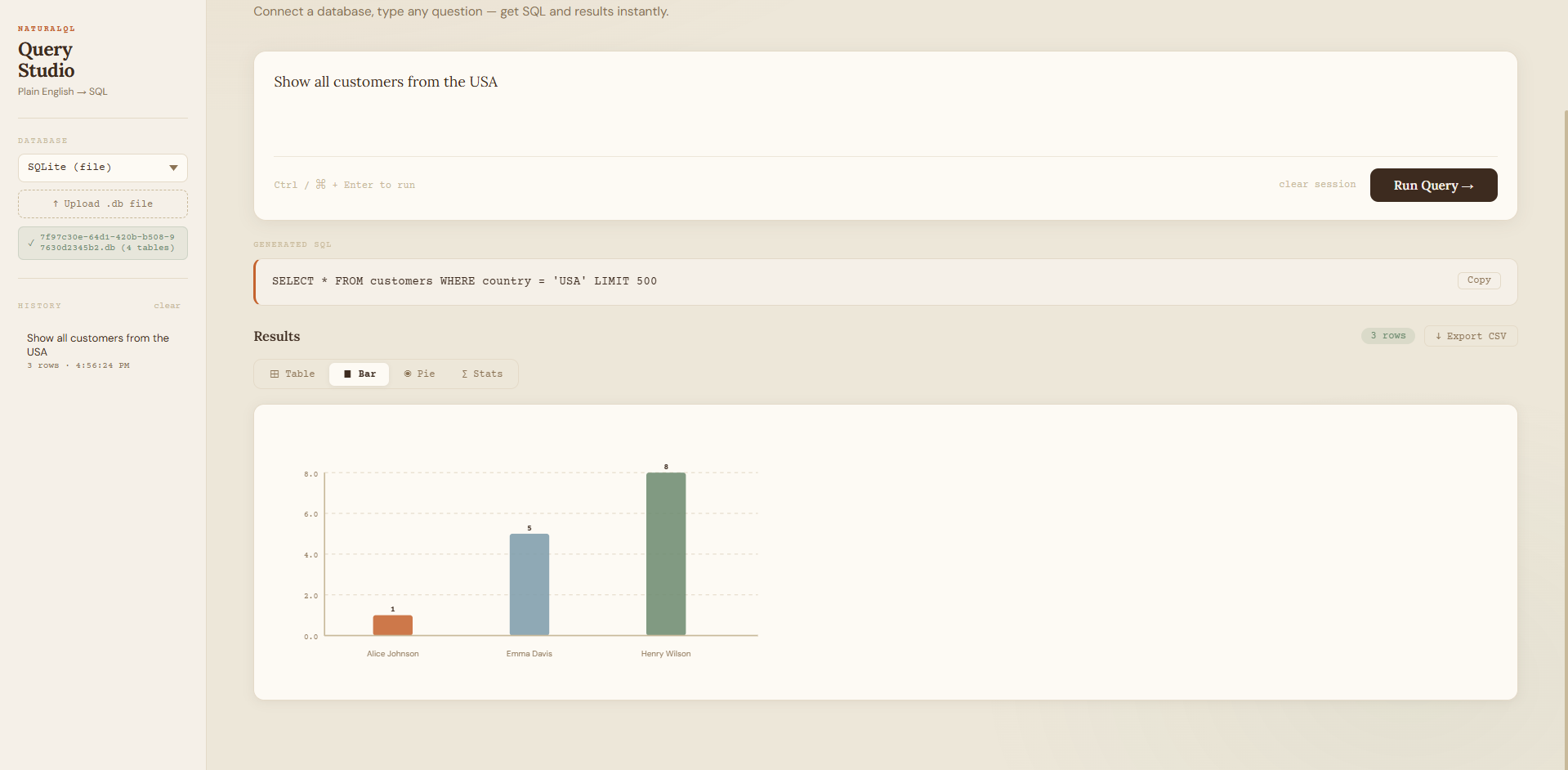
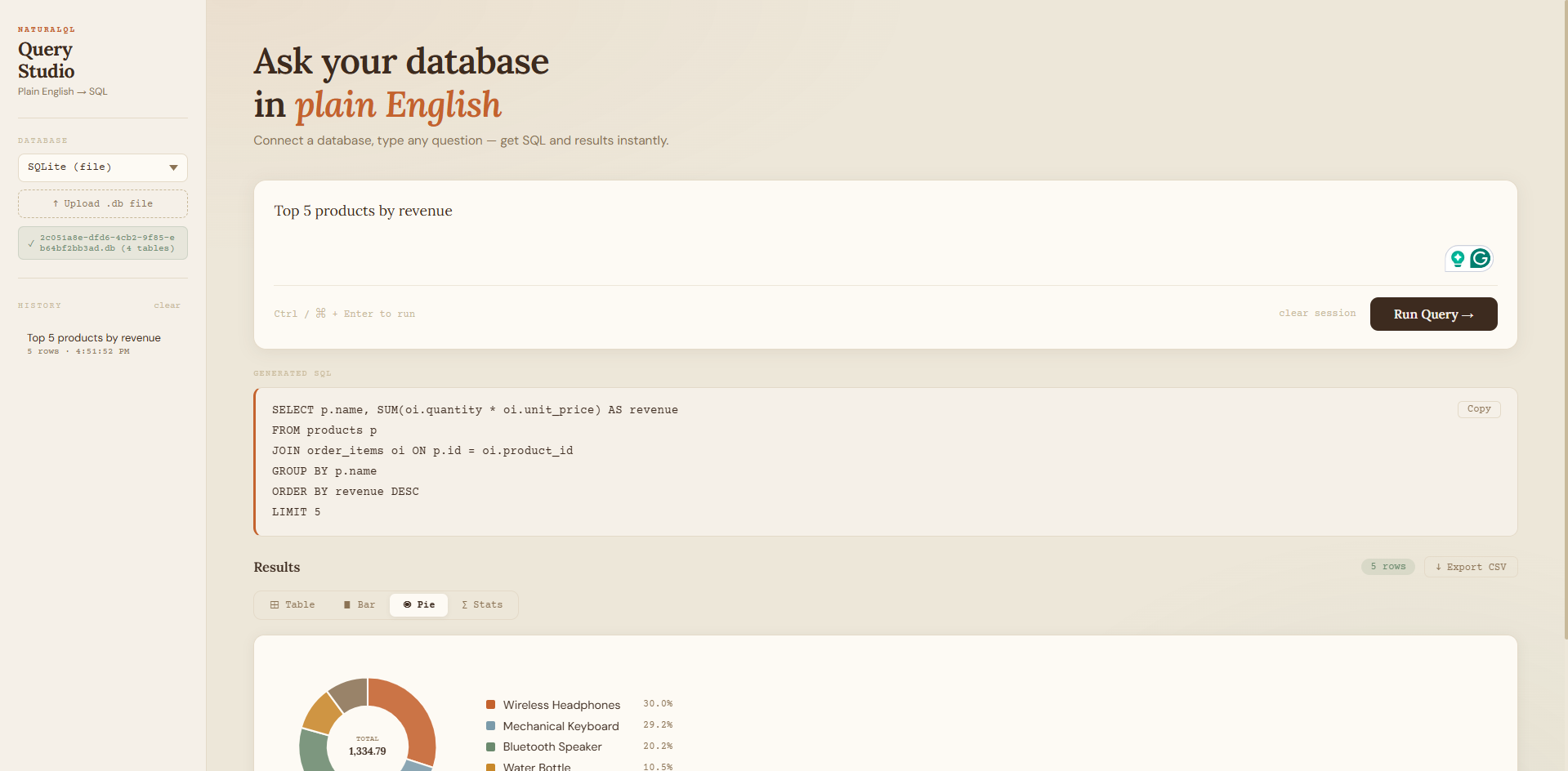
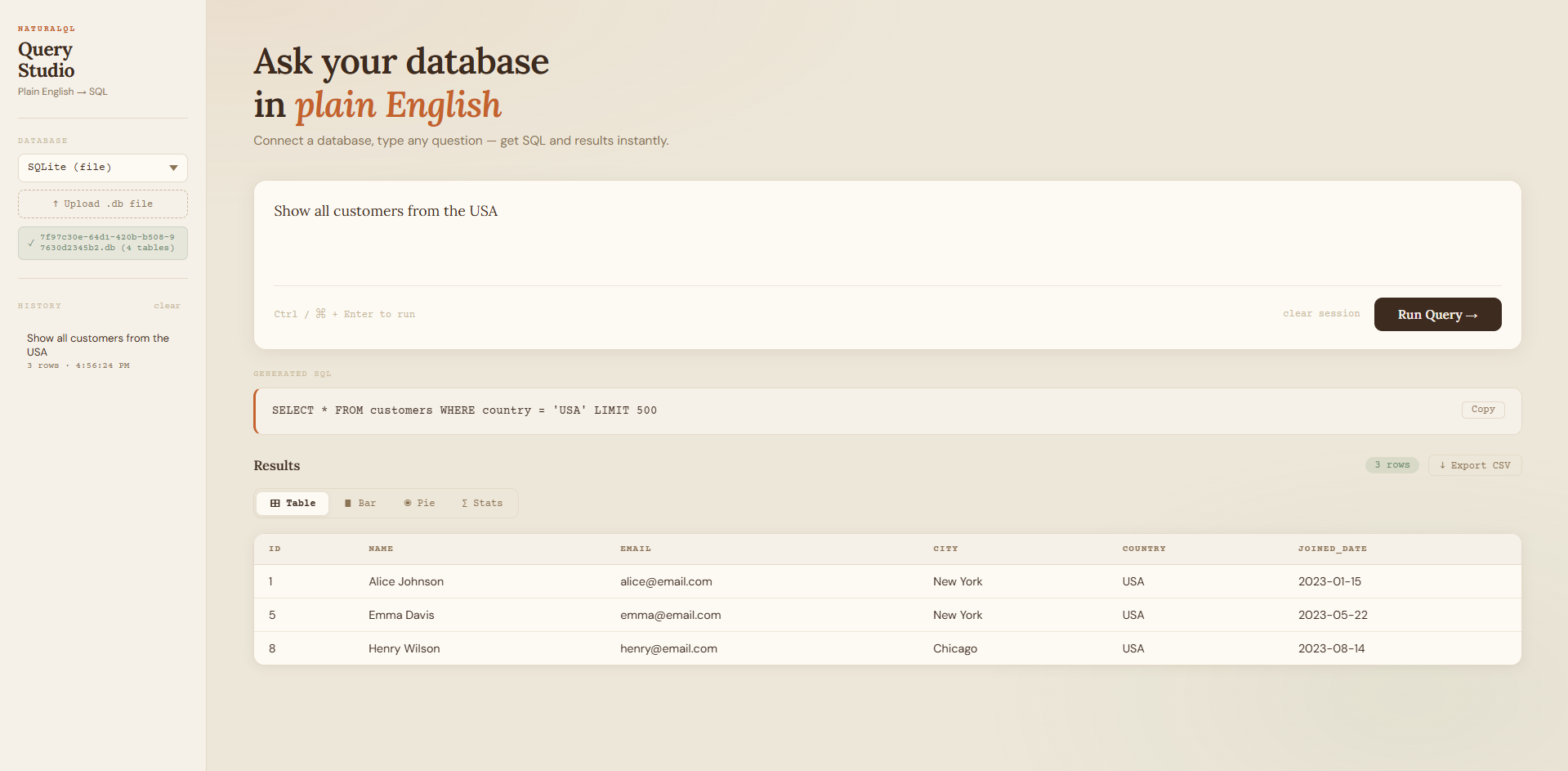
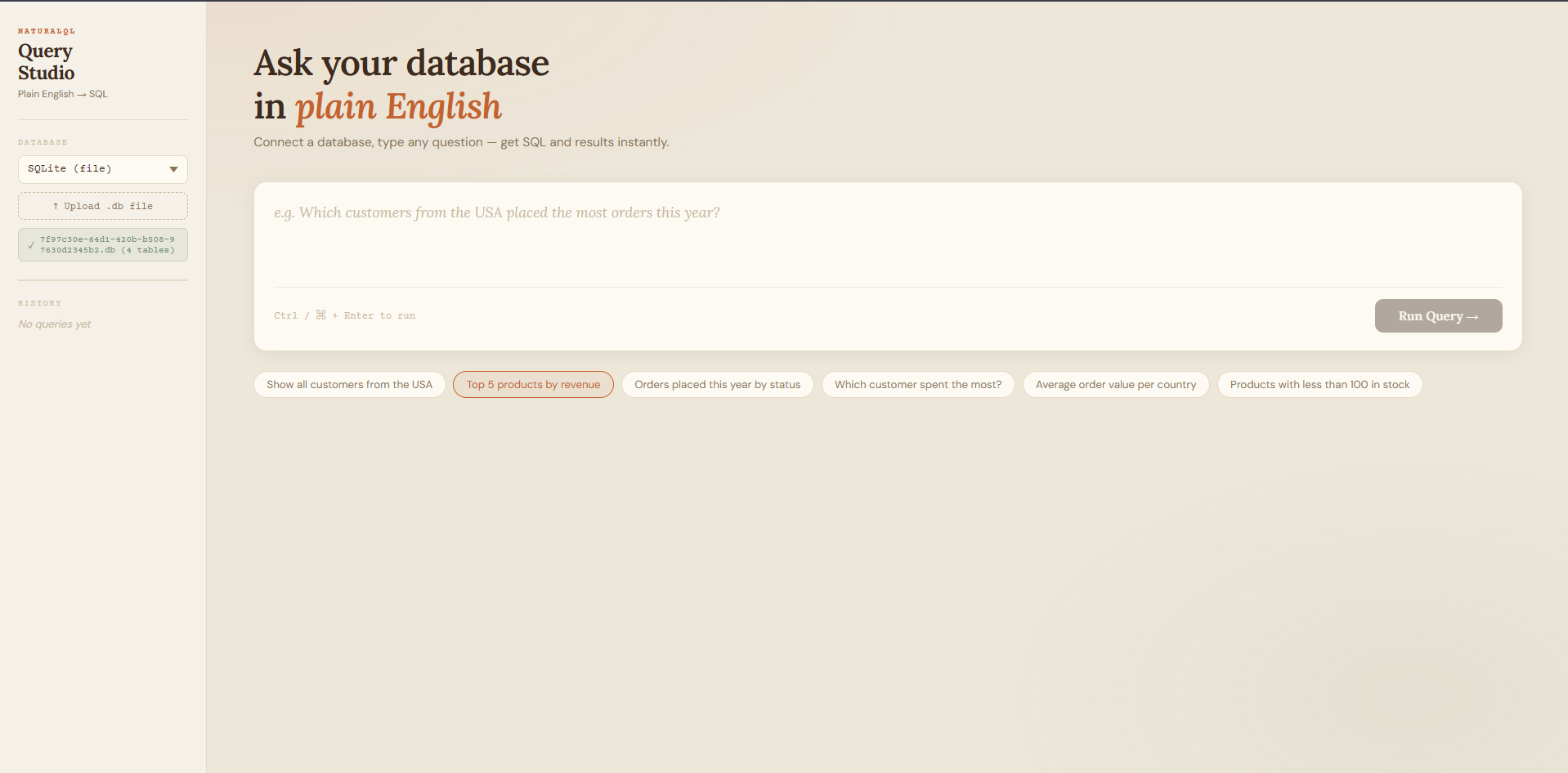
NaturalQL is an AI-powered system that converts natural language questions into executable SQL queries for any user-provided database.
Core capabilities
📂 Upload any dataset or database
- CSV → automatically converted into tables
- Works with SQLite, PostgreSQL, and MySQL
🧠 Schema-aware query generation
- Automatically extracts tables and columns
- Builds context dynamically for accurate SQL generation
💬 Natural language → SQL
- Example:
- “Total sales by customer”
→SELECT customer_id, SUM(amount) FROM orders GROUP BY customer_id
🔐 Safe query execution
- Only allows read operations (SELECT)
- Blocks destructive queries (DROP, DELETE, etc.)
📊 Visualization-ready output
- Structured results for tables and charts
How we built it
We designed NaturalQL as a modular AI system, not just an LLM wrapper.
🧱 Backend
- :contentReference[oaicite:0]{index=0} for API development
- Structured architecture:
routes/→ API endpointsservices/→ orchestration enginecore/→ LLM + prompt logic + validationdb/→ database abstraction layer
🗄️ Database Layer
We built a custom DB abstraction system supporting:
- SQLite (default)
- PostgreSQL
- MySQL
A factory pattern dynamically selects the database at runtime.
🧠 AI / NLP Layer
- LLM powered via Groq (LLaMA models)
- No fine-tuning used—instead:
- schema extraction
- context-aware prompting
- few-shot learning via stored examples
🎨 Frontend (in progress)
- React + Vite for fast development
- Tailwind CSS for UI
- Recharts for visualization
Challenges we ran into
🧩 Dynamic schema handling
Every database has a different structure. Building a system that adapts without prior knowledge required designing a schema parser and context generator.
🧠 LLM accuracy
LLMs can hallucinate column or table names. We mitigated this by:
- restricting prompts to the actual schema
- enforcing strict rules
- validating generated SQL
🔐 SQL safety
Executing arbitrary SQL is risky. We implemented:
- strict SELECT-only enforcement
- keyword filtering for dangerous operations
🔄 Python module structure issues
We faced multiple import errors due to incorrect module paths. This was solved by enforcing consistent package-based imports (app.*) and proper project structure.
🌐 Multi-database support
Each database has different connection methods and schema formats. We handled this using a unified interface and factory design pattern.
Accomplishments that we're proud of
- ✅ Built a database-agnostic NL → SQL system from scratch
- ✅ Designed a clean, scalable backend architecture
- ✅ Implemented multi-database support
- ✅ Created a schema-aware prompt engine
- ✅ Added secure SQL execution layer
- ✅ Enabled dynamic querying of user-uploaded data
Most importantly, we built the system without relying on external NL→SQL frameworks.
What I learned
🧠 AI Engineering
- Prompt design significantly impacts output quality
- Schema grounding improves reliability of LLM outputs
🏗️ System Design
- Modular architecture simplifies scaling and debugging
- Abstraction layers improve flexibility
🗄️ Databases
- Different SQL systems require tailored handling
- Schema introspection is key for automation
⚙️ Backend Development
- Python package structure is critical in production systems
- Clean separation prevents technical debt
What's next for NaturalQL
We envision NaturalQL evolving into a full AI-powered data assistant.
🚀 Short-term
- File upload → automatic DB creation
- Interactive UI with charts
- Query history and feedback loop
🧠 Mid-term
- RAG-based schema retrieval for large databases
- Multi-user database sessions
- Query explanations (“why this SQL?”)
🌐 Long-term
- SaaS platform for business analytics
- Integration with:
- :contentReference[oaicite:1]{index=1}
- :contentReference[oaicite:2]{index=2}
- Voice-based querying
- Automated insights and reporting
🔥 Vision
NaturalQL becomes the “ChatGPT for databases”—a universal interface where anyone can explore data without writing SQL.

Log in or sign up for Devpost to join the conversation.