-
-
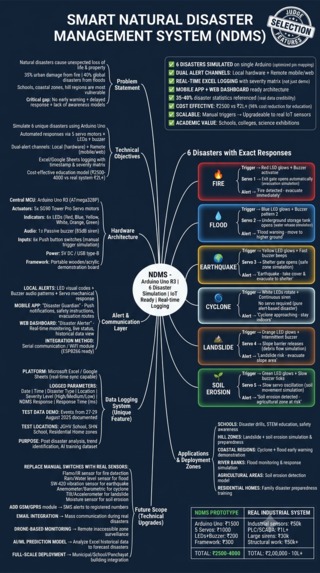
NDMS FLOW
-
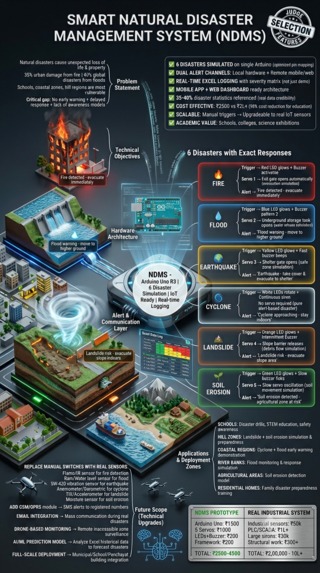
NDMS STRUCTURE
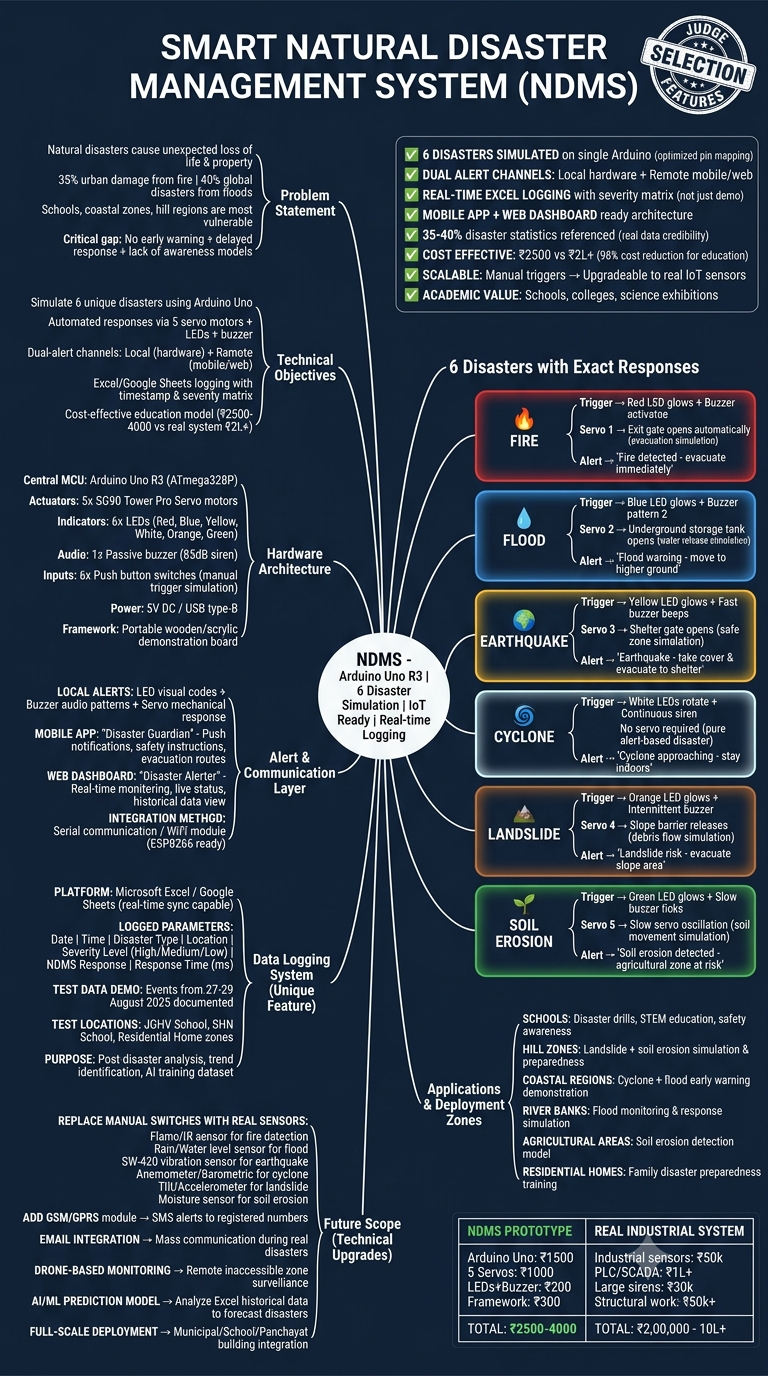
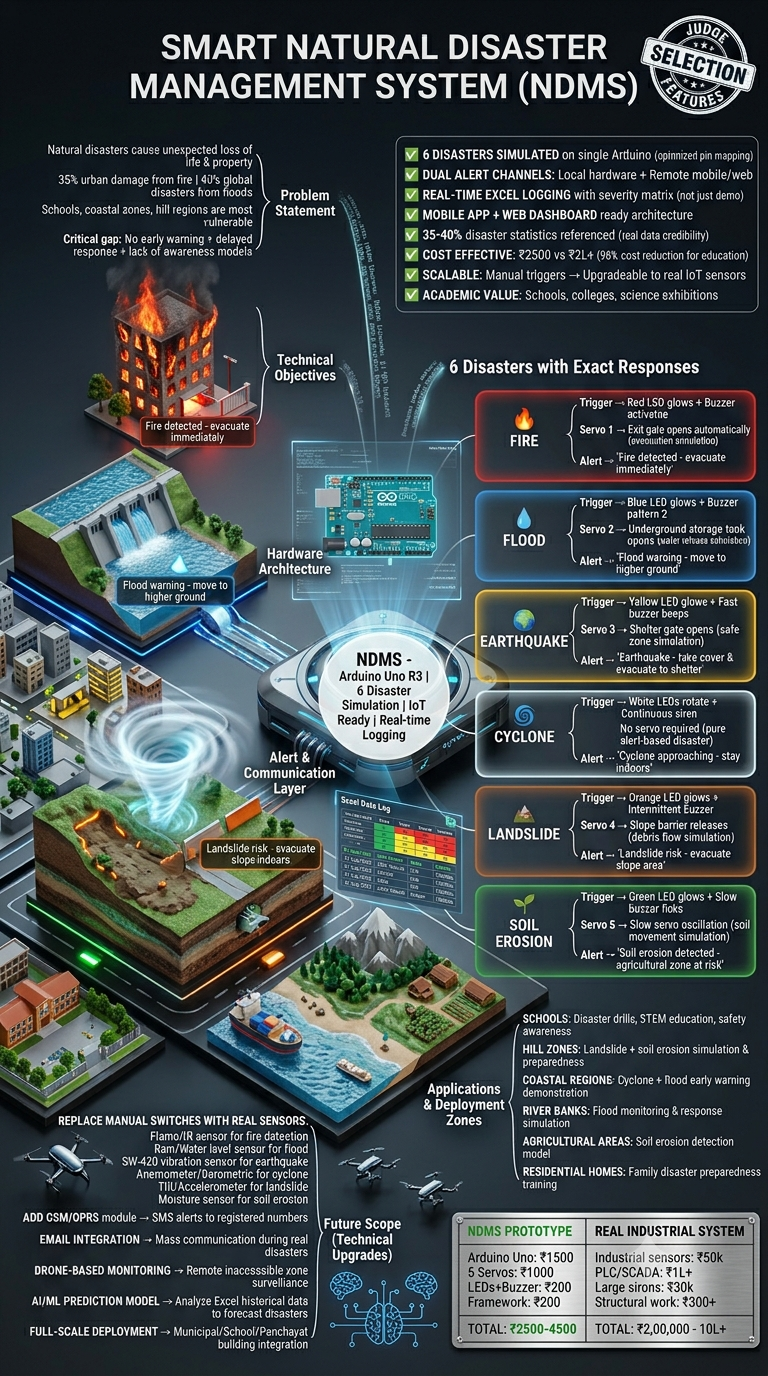
Smart Natural Disaster Management System (NDMS)
Introduction The Smart Natural Disaster Management System (NDMS) is a prototype created to simulate detection, alerting, and response to different types of natural disasters such as fire, flood, earthquake, cyclone, landslide, and soil erosion. The project is designed with Arduino Uno, servos, LEDs, buzzers, and simple switches that act as triggers instead of real sensors. The main purpose of this system is to demonstrate how technology and automation can play a vital role in disaster preparedness and management. This project not only provides a real-time demonstration but also encourages awareness and preparedness among communities, especially schools and homes.
Problem Statement Natural disasters occur unexpectedly and cause loss of lives, damage to property, and disruptions to society. In many cases, delay in response and lack of early warning systems worsen the impact. Schools, homes, coastal zones, and hill areas are particularly vulnerable. The problem is not only the occurrence of disasters but also the unpreparedness of people to respond quickly. Thus, there is a pressing need for an automated disaster management model that can simulate how quick responses can reduce damages, ensure safety, and give awareness to the public.
Objectives To design a functional demo NDMS system capable of simulating six different disasters.
To make use of Arduino Uno, servos, LEDs, and buzzers for effective disaster demonstrations.
To build awareness about how technology can save lives through automation.
To integrate mobile and web platforms for real-time alerts and record keeping.
To allow disaster data collection in Excel/Google Sheets, which supports documentation, analysis, and learning.
- Components Used The project uses easily available and low-cost electronic components: Arduino Uno R3: Central controller for managing all disaster operations.
LEDs: Used for visual alerts, each disaster has a unique LED indication.
Buzzers/Sirens: Provide sound alerts for immediate attention.
Servo Motors: Used to open/close gates, tanks, and barriers for floods, fires, earthquakes, and soil-related disasters.
Switches/Buttons: Used as manual triggers to simulate disasters instead of actual sensors.
Power Supply/USB Connection: Provides energy for Arduino and attached components.
- Disaster Simulations The project simulates six disasters, each with unique responses: Fire Simulation: When triggered, buzzer rings loudly, and the exit gate servo automatically opens to represent safe evacuation.
Flood Simulation: A servo motor opens a tank underground (triangle-shaped underground setup), allowing water to flow out, with LEDs glowing as a warning.
Earthquake Simulation: Buzzer and LEDs glow together, while another servo opens a shelter gate to simulate people moving to safe areas.
Cyclone Simulation: Uses siren sounds and rotating LEDs to simulate storm warnings.
Landslide Simulation: Servo motor releases slope barrier, demonstrating how soil/rocks might fall.
Soil Erosion Simulation: Servo simulates slow soil movement near rivers and agricultural zones.
- Servos Used Fire Exit Gate Servo → Opens exit gate in case of fire.
Flood Tank Servo → Opens underground water storage to control flood flow.
Landslide Barrier Servo → Releases slope barrier.
Soil Erosion Servo → Simulates soil movement near riverbanks.
Earthquake Shelter Servo → Opens a safe shelter space.
(Cyclone alert is based on siren + LED, so no servo is used here.)
- Applications The NDMS can be applied in: Schools → For teaching students about safety and preparedness.
Homes → To create awareness among families and children.
Hill Zone Regions → For landslide and erosion awareness.
River Banks & Agricultural Areas → For soil erosion understanding.
Coastal Regions → To simulate cyclone and flood risks.
- Mobile and Web Integration The project is not only hardware-based but also extended into IoT concepts: App Name: Disaster Guardian → A mobile app designed to send notifications, alerts, and safety instructions.
Website Name: Disaster Alerter → A web-based system that records, displays, and monitors disaster alerts in real-time. This integration ensures that alerts are accessible both locally (through Arduino hardware) and remotely (through mobile and web platforms).
- Data Records in Excel One unique feature of NDMS is maintaining disaster records in Excel or Google Sheets. Each disaster simulated is logged with: Date
Time
Disaster Type
Location
Severity Level
NDMS Response
This record-keeping adds reliability to the system and allows users to analyze trends, check past data, and prepare for future risks. For example, events from 27th to 29th August 2025 were documented with schools (JGHV School, SHN School) and home locations to make the project more realistic.
- Extra Points Fire incidents cause nearly 35% of local damages in urban areas.
Floods are responsible for nearly 40% of global disasters.
Earthquakes, cyclones, and landslides contribute to significant losses, especially in developing countries.
Documented data helps in educating people about these percentages in awareness programs.
- Cost of Model vs Real System Prototype/Model Cost: ₹2500 – ₹4000 (Arduino Uno, LEDs, buzzers, servos, small framework).
Real System Cost: Much higher due to the use of industrial-grade sensors, IoT systems, large-scale sirens, underground tanks, and structural mechanisms.
Cost-Effectiveness: The model is highly economical for education, awareness, and exhibitions, making it ideal for schools and science fairs.
- Limitations The system uses manual triggers instead of real working sensors.
Cannot be applied directly in real-life disaster zones.
Servos and buzzers have limited capacity and cannot handle large-scale systems.
Demonstrations rely on small setups (like pouring water before LED glows in floods).
- Future Scope Integration with real IoT sensors like flame detectors, rain sensors, seismic sensors, and gas sensors.
SMS and email alerts for mass communication during real disasters.
Drone-based monitoring for inaccessible regions.
AI predictive systems that analyze past records to predict future disasters.
Full-scale deployment in schools, colleges, and communities.
- Conclusion The Smart Natural Disaster Management System (NDMS) is a comprehensive demonstration of how technology and automation can be combined to reduce disaster risks. By simulating fire, flood, earthquake, cyclone, landslide, and soil erosion, the project educates people about disaster preparedness. The inclusion of mobile and web platforms enhances accessibility, while Excel-based record keeping makes it realistic and valuable for analysis. This project, though a demo, reflects the possibilities of future disaster management systems that can protect lives and property effectively.


Log in or sign up for Devpost to join the conversation.