-
-
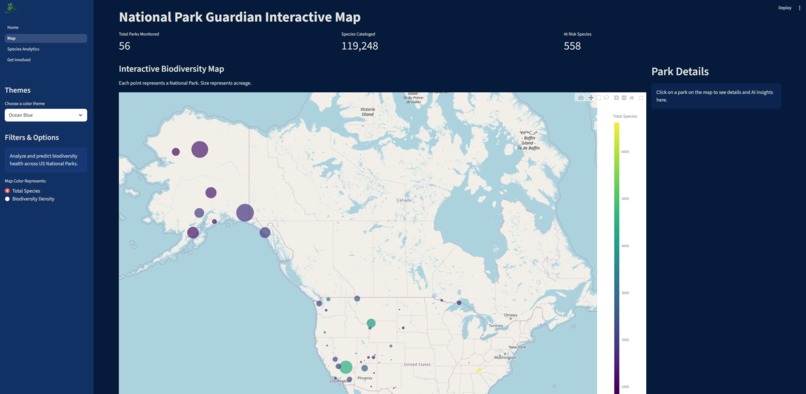
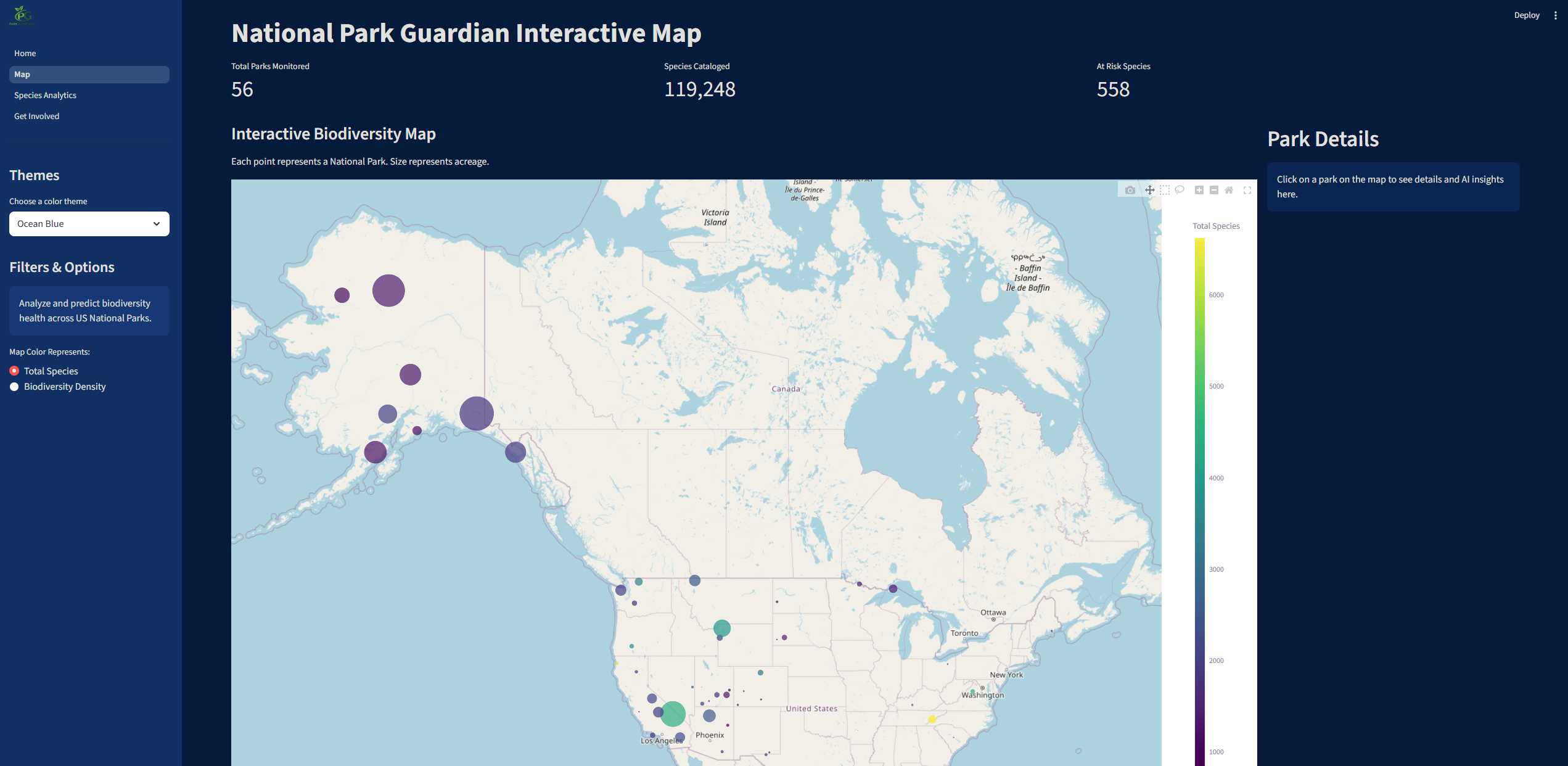
Screenshot of the Interactive Map
Inspiration
We were inspired by the lack of biodiversity in national parks, which are supposed to be a safe haven for all wildlife. According to the Outreach Network for Gene Drive Research, "over half of U.S. national parks are at a risk of biodiversity loss," in which invaive species are to blame. However, there are only management plans for 23% of harmful invasive species, meaning that there are no management plans for the remaining 77% of species, which is extremely harmful to the biodiversity of national parks.
To combat this, we decided on a small web app for park rangers that identifies the flora and fauna with the highest risk of endangerment. Then, park rangers and similar wildlife conservationists may use this information to prioritize habitat restoration in areas with species that are at risk of being endangered or extinct.
What it does
This web app provides:
- Home page that includes our about-us and our mission
- Interactive map of total number of species per national park
- Interactive map of biodiversity density per national park
- Clicking on nodes in the map will open a side panel on the right with both non-AI and AI information
- Call-to-action page that includes a sign-up area to submit an email
- Filter on the side panel on the left to choose certain species to include in the statistics
- Color theme chooser for user preferences
How we built it
We selected two datasets from Kaggle, which have high-quality information about wildlife and national parks. We then used the Python programming language to implement a web app service, employing the following Python libraries: scikit-learn, numpy, streamlit, plotly, folium, pandas. During the development, we utilized the help of Gemini 3 to help us research and troubleshoot technical problems.
Challenges we ran into
We encountered many challenges during our development process. First of all, we had to define our goals and find suitable resources to implement our ideas. After the initial stages of development, we ran into many problems during implementation. A specific example was when Streamlit, the library we use for UI and web design, was throwing errors due to misusage of its functions. Another instance was when our data preprocessing was throwing errors during the manipulation of our Pandas Data Frames. We resolved these issues by carefully reviewing our code's logic and revising our implementations.
Accomplishments that we're proud of
- Bulding an AI system into the web app
- Successfully integrating an interactive map that contains elements built on top of real map data
- Successfully running a web app using Streamlit, which saved a lot of coding compared to traditional implementations with JavaScript, HTML, and CSS.
- Found and used real, high-quality datasets from the internet which greatly increased the credibility and usability of our web app.
What we learned
We learned how to successfully implement a web application using several libraries. Rather than simply conceptual or technical terms about what libraries do, we got hands-on experience using utilities from pandas, scikit-learn, numpy, and plotly, which was new to both of us.
What's next for National Park Guardian AI
National Park Guardian AI could become International Park Guardian AI, and monitor national parks and wildlife conservatories around the world. Similarly, we could improve the efficiency of AI predictions. With enough time and a stronger AI, we could also implement real-time specialized solutions for local park rangers, such as a suggestion to add a certain plant to improve the synergy of ecosystems. Our dataset could also be linked to an API instead of a static data copy.
Built With
- kaggle
- numpy
- pandas
- plotly
- python
- scikit-learn
- sklearn
- streamlit
- vscode


Log in or sign up for Devpost to join the conversation.