-
Demo
National AI Lab
Learn by Doing. Guided by AI. Powered by Innovation.
1. Inspiration
Our inspiration comes from a simple question: What if students could learn complex subjects by interacting with them instead of just reading about them?
Traditional education often relies on textbooks, lectures, and expensive physical laboratory equipment. Many educational institutions cannot provide students with sufficient opportunities for practical experiments, hands-on training, and realistic simulations.
We wanted to bridge the gap between theoretical knowledge and practical experience by combining Artificial Intelligence, Hand Tracking, and 3D technologies.
Our goal is to create an intelligent learning environment where students can perform virtual experiments, explore complex technical systems, and receive personalized guidance from an AI Teacher.
We believe that every student should have access to interactive, practical, and intelligent education regardless of the availability of expensive physical equipment.
2. What It Does
National AI Lab is an AI-powered interactive learning and simulation platform that allows users to study different scientific and technical disciplines through hand gestures and intelligent virtual instruction.
The platform currently focuses on four main educational areas:
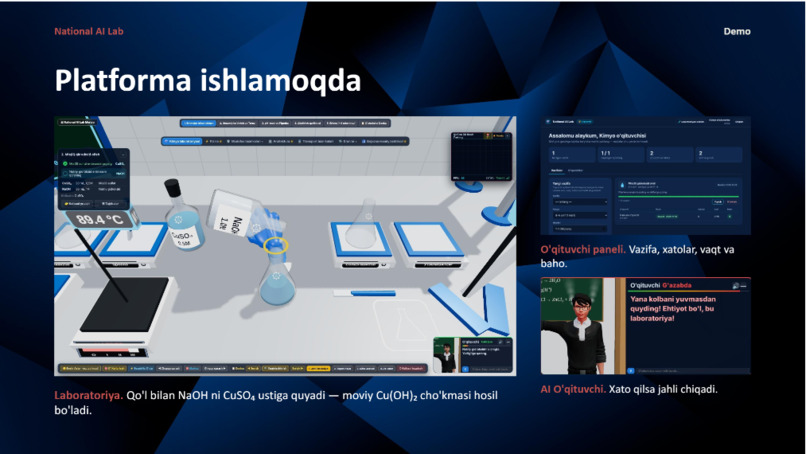
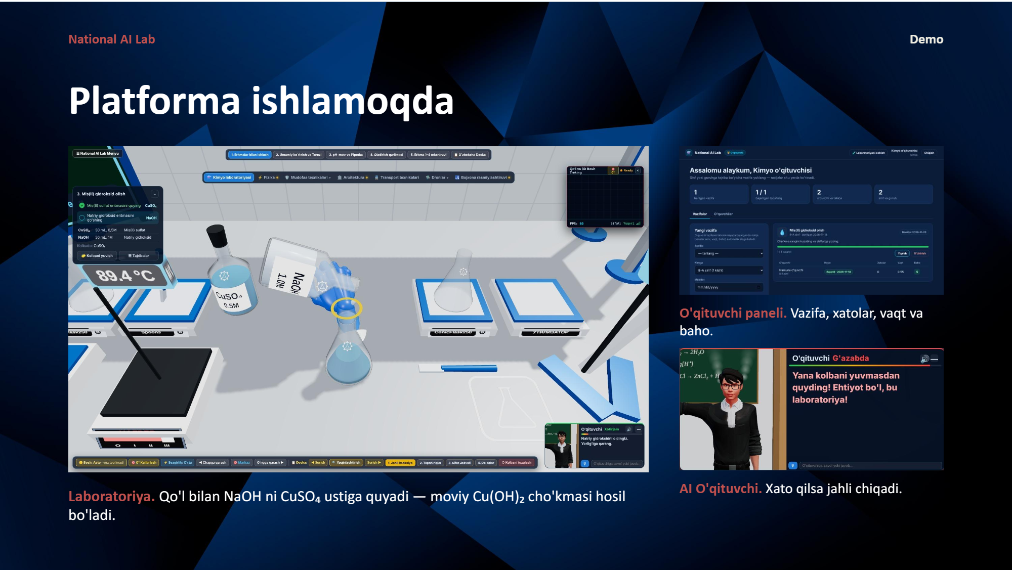
- Chemistry: Virtual chemical laboratories, interactive experiments, chemical reactions, laboratory equipment, and safety procedures.
- Physics: Interactive experiments involving mechanics, electricity, forces, motion, and physical phenomena.
- Geometry: Interactive 2D and 3D geometric objects, spatial visualization, measurements, and mathematical concepts.
- Military Technical Equipment: Educational exploration and interactive simulation of military technical equipment and mechanical systems.
AI Teacher
The integrated AI Teacher serves as a virtual instructor throughout the learning process. It:
- Explains theoretical concepts and practical procedures.
- Provides step-by-step instructions.
- Guides users through interactive exercises.
- Monitors user actions and identifies mistakes.
- Provides real-time feedback and recommendations.
- Evaluates practical tasks and theoretical knowledge.
- Generates performance assessments and learning progress reports.
Hand Tracking Interaction
Instead of relying only on a keyboard or mouse, users can interact with virtual objects using natural hand gestures.
This makes learning more engaging, intuitive, and practical.
The platform is designed to work through a web-based environment on computers and interactive displays, including Flipbox devices.
3. How We Built It
We developed National AI Lab by combining modern web technologies, interactive 3D environments, hand-tracking capabilities, and Artificial Intelligence.
Our development approach focuses on creating an accessible platform that does not require specialized VR headsets to provide interactive learning experiences.
The development process consists of several key components:
- Frontend: A modern web interface for accessing educational modules, interactive environments, and learning activities.
- Backend: Application logic, user management, learning processes, and communication between platform components.
- Hand Tracking: Gesture recognition technology that enables users to interact with virtual objects using their hands.
- 3D Visualization: Interactive three-dimensional models and virtual environments for scientific and technical simulations.
- Artificial Intelligence: An AI-powered teaching assistant that provides explanations, instructions, feedback, and assessments.
- Assessment System: Evaluation mechanisms that measure theoretical knowledge, practical performance, and learning progress.
We designed the platform with modular architecture in mind, allowing additional educational subjects, simulations, and AI capabilities to be integrated in the future.
4. Challenges We Ran Into
During development, we encountered several technical and educational challenges.
1. Natural Hand Interaction
Creating an intuitive interaction experience through hand gestures was challenging. We needed to make virtual object manipulation feel natural and responsive.
2. AI-Based Instruction
Designing an AI Teacher that provides understandable, relevant, and structured instructions required careful consideration of educational workflows and learning objectives.
3. Practical Assessment
Evaluating practical skills is more complex than checking multiple-choice answers. We needed to consider user actions, task completion, procedural accuracy, and mistakes.
4. 3D Visualization and Performance
Interactive 3D environments must remain responsive and accessible on different hardware configurations, including ordinary computers and interactive displays.
5. Multiple Educational Disciplines
Chemistry, physics, geometry, and military technical education have different requirements. Designing a flexible architecture that supports all these disciplines was another important challenge.
We approached these challenges by focusing on modular development, interactive simulations, and an integrated AI-assisted learning experience.
5. Accomplishments That We're Proud Of
We are proud to have developed the foundation of an AI-powered educational platform that brings together several technologies in one learning environment.
Our key accomplishments include:
- Developed an interactive web-based learning environment.
- Integrated hand-tracking-based interaction with virtual objects.
- Created the foundation for interactive 3D educational simulations.
- Designed an AI Teacher concept for personalized instruction and guidance.
- Established an approach for evaluating practical and theoretical knowledge.
- Brought multiple educational disciplines into a unified platform.
- Designed the solution to support both conventional computers and interactive Flipbox displays without requiring dedicated VR headsets.
Most importantly, we have demonstrated how AI can move beyond simply answering questions and become an active participant in the educational process.
6. What We Learned
Developing National AI Lab helped us understand that effective AI-powered education requires more than integrating an AI chatbot into a learning platform.
We learned that:
- Practical interaction significantly improves the learning experience.
- AI should guide users through the learning process rather than simply provide answers.
- Hand tracking can make digital learning environments more intuitive and engaging.
- Assessment should consider not only final answers but also the process and accuracy of practical activities.
- Different educational disciplines require specialized simulations and evaluation methods.
- Accessibility and hardware compatibility are essential for educational technology adoption.
We also learned the importance of combining software engineering, AI research, 3D development, and educational methodology to create a meaningful solution.
7. What's Next for National AI Lab
Our next goal is to transform National AI Lab into a comprehensive AI-powered educational ecosystem that can be adopted by schools, universities, training centers, and specialized educational institutions.
Our future development roadmap includes:
1. Advanced AI Teacher
- More natural AI-powered conversations.
- Voice-based interaction and explanations.
- Personalized learning paths.
- Adaptive teaching based on individual performance.
2. Expanded Educational Content
- More chemistry and physics experiments.
- Advanced geometry and mathematical simulations.
- Additional technical and engineering disciplines.
- Expanded military technical education modules.
3. Intelligent Assessment
- Real-time practical skill evaluation.
- Automatic identification of procedural mistakes.
- Individual student performance analytics.
- Detailed assessment reports for teachers and institutions.
4. Institutional Integration
- Teacher and administrator dashboards.
- Student management and learning analytics.
- Group-based learning and classroom management.
- Integration with existing educational management systems.
5. Scalability and Commercialization
- Subscription-based solutions for educational institutions.
- Licensing for schools, universities, and training centers.
- Institutional and government partnerships.
- Expansion into international education markets.
Our Long-Term Vision
We envision National AI Lab becoming a next-generation platform where anyone can learn, experiment, and develop practical skills through intelligent virtual environments.
We want to make high-quality practical education more accessible, affordable, and effective.
National AI Lab — Turning Knowledge into Experience, and Experience into Intelligence.

