-
-
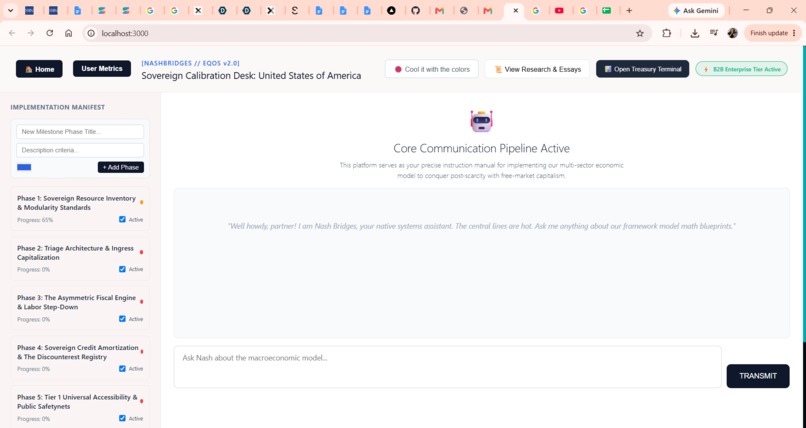
Nash Dashboard
-
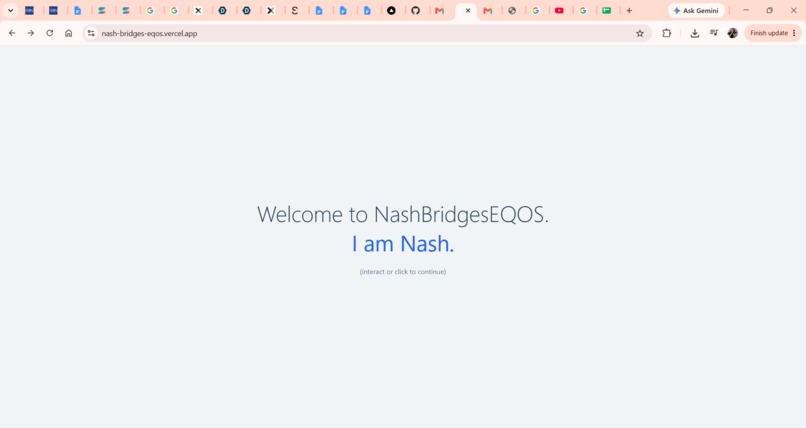
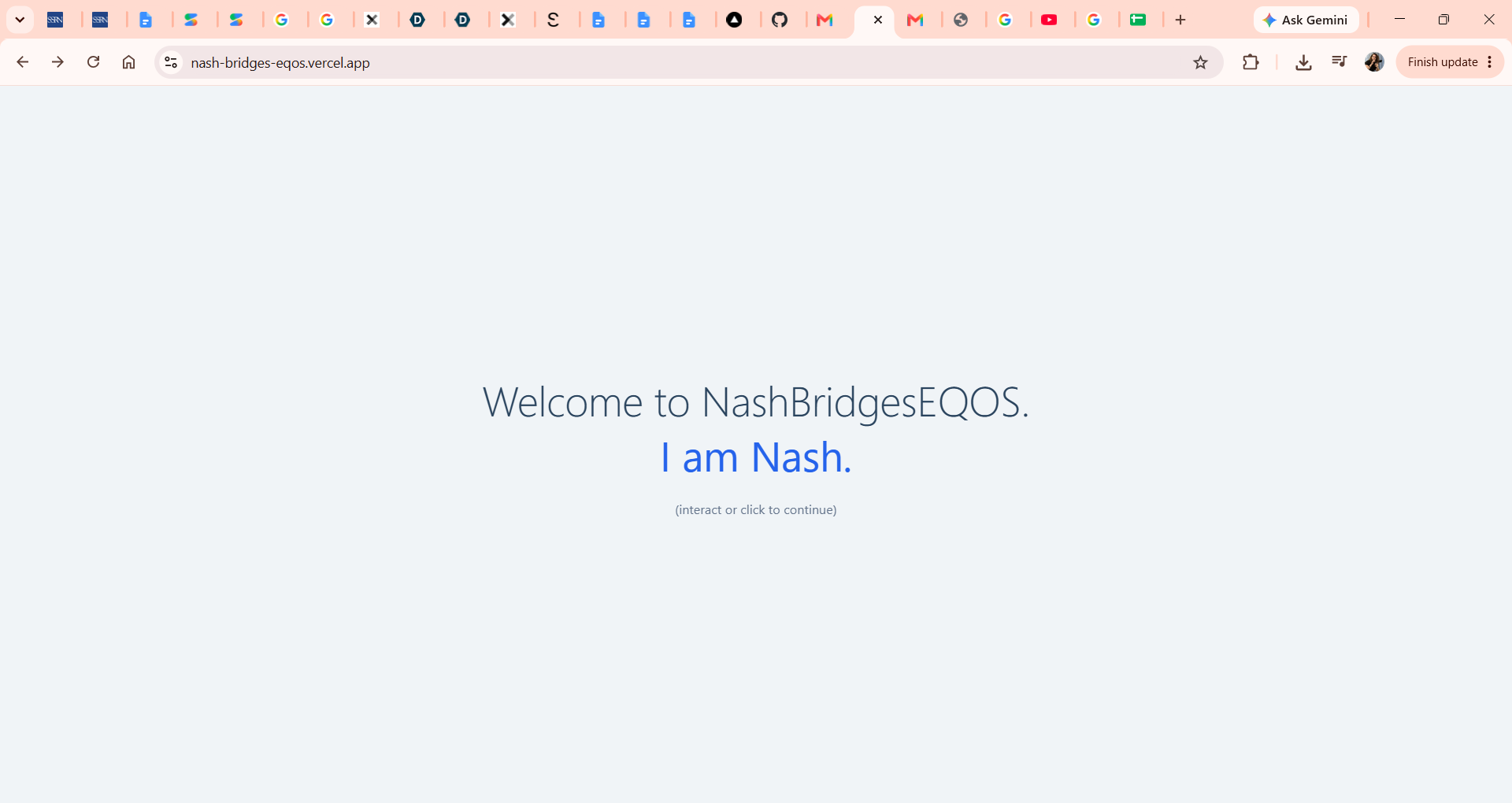
Nash Landing
Inspiration
In July I created a 48 page academic macroeconomic model that claims to solve post scarcity under free market capitalism. In general I've been conceptualizing how to realize post scarcity in America for the past 13 years. There are several notes in my phone where I would jot down my ideas. At the beginning of 2026, I wrote a formal 2 page conceptualization of the main reasons post scarcity is within grasp, and the primary mechanisms for how to allow it. At the time I had emailed my paper to a few prominent figures, and I was simply hoping the ideas would find their way onto the right persons desk. It was this July however, that I found out gemini AI was capable of applying conceptual ideas to existing economic formulas, and could help mathematically vet concepts. So I spent the entirety of July expanding and scrutinizing the paper, until it became the 48 page version it is today, complete with math, and instructions for running the DSGE simulation. The academic paper is available on SSRN now, at this link: https://papers.ssrn.com/sol3/papers.cfm?abstract_id=7221319
What it does
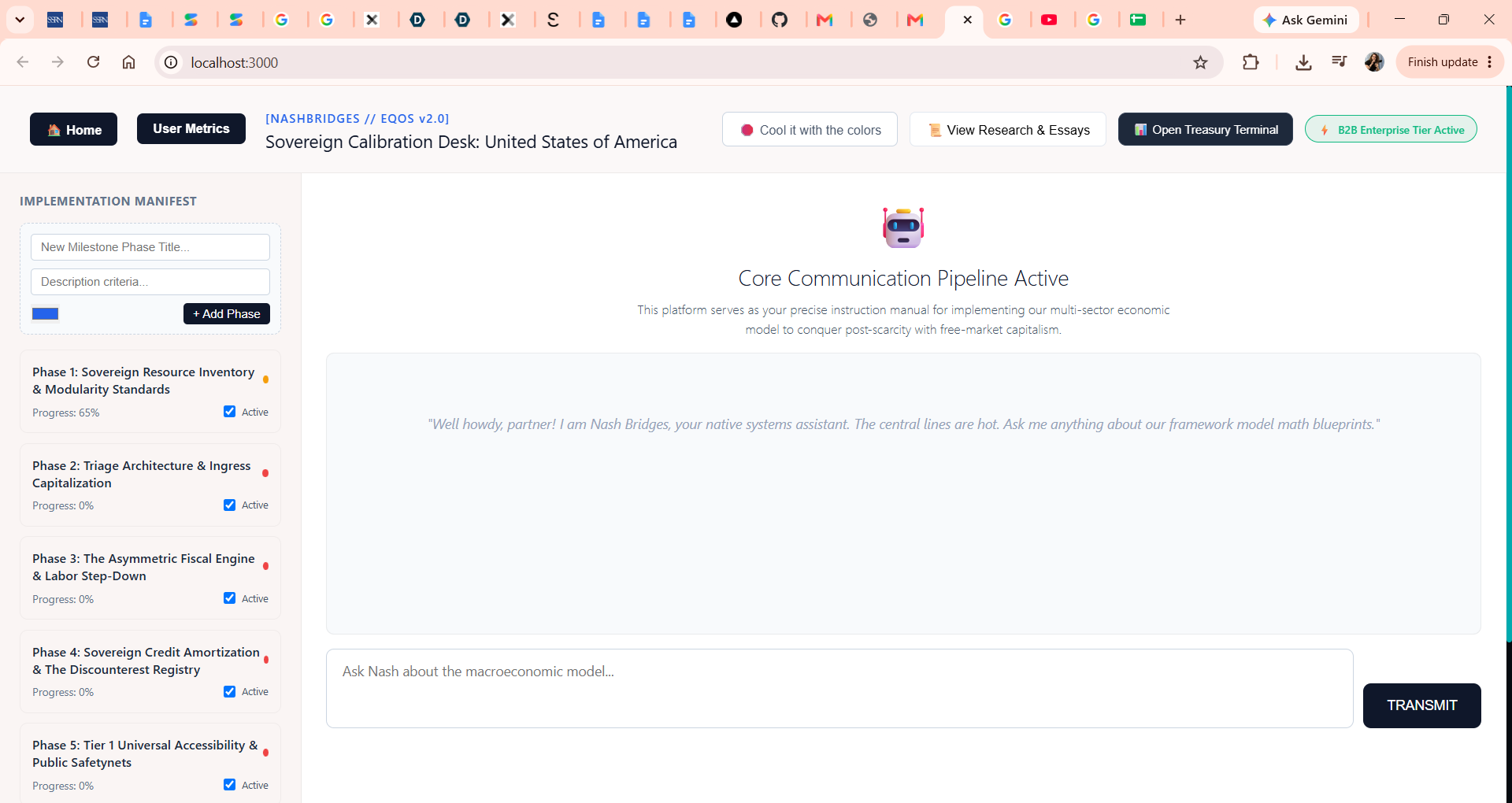
This app is called NashBridgesEQOS for a few reasons, and we have to explore this before divulging what the app does. First, gemini believes this paper is the macroeconomic realization of Nash Equilibrium, an economic and game theoretic concept identifying and realizing ideal situations, in this case for global and domestic stakeholders. Since the paper bridges Nash Equilibrium to the macroeconomic scale, I had to capitalize on the word play with Nash Bridges, which was the name of a show I watched on CBS when I was in middle school starring Don Johnson and Cheech Marin. Don Johnson played the main character Nash Bridges. The chat bot in NashBridgesEQOS is instructed to talk like Nash Bridges. Inside the app are two json files. One includes the 48 pages of the academic paper, and the other includes a 10 page essay which acts as the layman's explanation of the primary mechanisms that make the economic model possible. A user can ask the chat bot anything about how to use the app, or about the academic paper, and Nash will provide an answer based on the content of the paper. If the user asks a related question that is not explicitly laid out in the paper, like what is economics or what is post scarcity, Nash can search the internet to provide those answers. The app features a pop up modal where the user can read the entire academic paper and/or the entire layman's essay. The app includes a default milestone tracker that the user can use to track the implementation of the economic model. The milestones feature default subtasks with percentages associated with the portion of completeness that subtask represents for the whole milestone. The user can create, edit and delete custom milestones and custom subtasks, and the user can disable default milestones. The user can ask Nash to generate custom milestones that might be required for the user's specific nation that the default milestones didn't capture. The background color of the app is actually changing to various subtle opaque hues, and there is a button in the app where the user can disable the changing colors. The app also features premium features the user can unlock by purchasing the premium user license. The user clicks on a popup modal that asks if they would like to purchase the premium license, and then they are redirected to a stripe product link for Premium NashBridgesEQOS. Upon purchase completion, the user is redirected back to Nash, and the premium features are unlocked. The premium license is set to $1 for simple testing. The premium license modal has buttons for the judge to test where they can enable to the premium features without paying, and remove the premium features. There is also a user metrics modal in the app that pulls purchase data from the stripe product link, so it shows real time revenue and premium purchase counts and locations of purchase. The premium features include a budget creator and a fund finder. The first 2 default milestones are essentially defining a budget, and then finding funding for the budget. Unlocking the premium features allows the user to use Nash to search the internet for real regional prices and vendors for the work defined in the budget. The user can save the results from the budget creator to a note on milestone 1. The fund finder searches the internet for local investors that could fund a project the size of the determined budget. The premium features were also expanded to let a user define any project, even unrelated to the economic scope of NashBridgesEQOS, such as building a patio. This feature is testable, but among five personal improvements slated for follow up development. Among these slated improvements, one that is worth noting is Nash's response time. The typical response time hovers around 30 seconds, which is not ideal.
How we built it
I built this in intellij with react and javascript, with the assistance of gemini ai.
Challenges we ran into
Reducing Nash's response time eluded me. Trying to save the premium generated budget onto the correct milestone was a bit of a battle. There were also some things about understanding how react handles api calls while deployed locally that I didn't know, and it slowed down my development of the user metrics model that calls stripes api.
Accomplishments that we're proud of
The entire thing is exciting to me and I am proud of it. The competition pushed me to learn how to integrate AI into development, and I'm excited at the prospect of that. And funnily enough, I do have my own LLC that I am trying to grow, and getting set up with stripe and stripe's api was also exciting to learn. And then I have also been putting off improving my limited react skills for a while, and while gemini did the majority of the styling and component generation, there were several scenarios where gemini was not able to help, or got confused, or got tripped up by false flag errors and would start going down the wrong path to try and fix a problem, and this pushed me to improve my understanding of react and node.js. Finally, the idea that someone could have a fun time interacting with a quirky chat bot that talks like a character from a 90s era CBS show while gaining understanding of post scarcity in free market capitalism is incredibly cool to me.
What we learned
I learned the powerful doors that AI development unlocks, and it's current limitations that caution against over reliance on it. I learned that AI will try to hard code dummy responses if it is having a hard time trying to achieve a goal, and I learned you have to corner it and ask it to be honest about what it's doing, very similar to confronting a child about stealing candy. And then, more practically, I learned about react, vercel and stripe.
What's next for NashBridgesEQOS
Ultimately, I want the academic paper Nash is built around to eventually find it's way in front of institutions like the IMF or the World Bank for evaluation for pilot implementation so we can eventually make post scarcity a reality. The app should eventually be able to realistically assist nations in implementing this model in their nation. Future developments include:
- Reducing Nash's response time to sub 10 seconds
- Improving the accuracy and detail of the premium budget creator and fund finder features

Log in or sign up for Devpost to join the conversation.