-
-
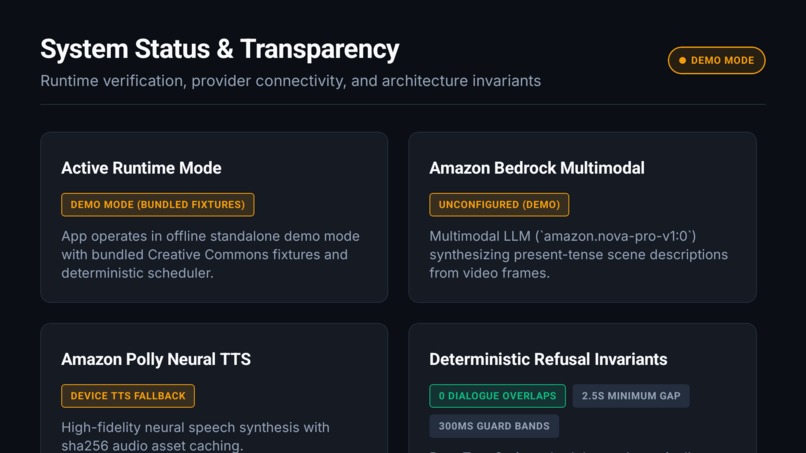
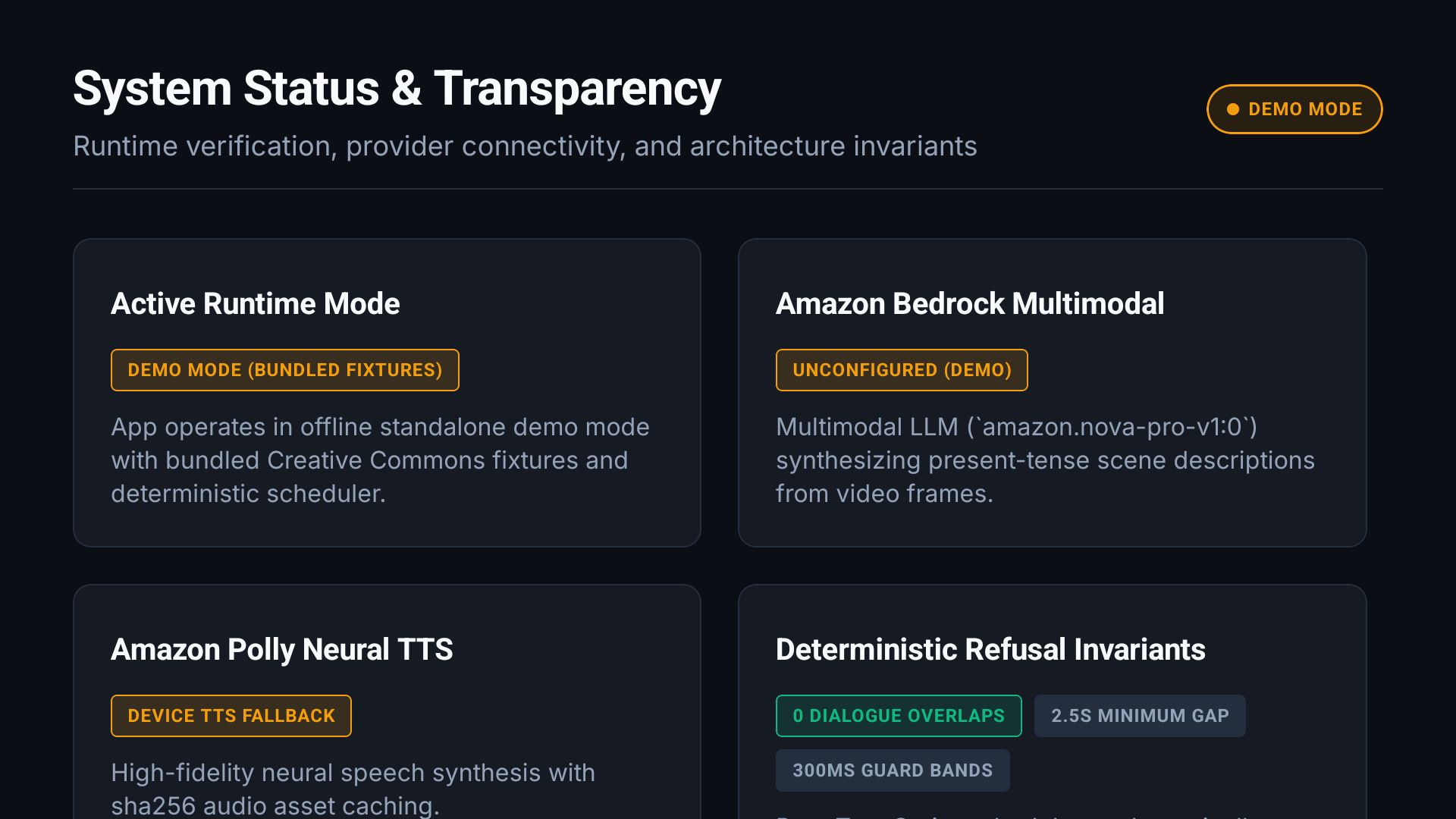
System Status. The LIVE toggle flips the running app to AWS Bedrock with no rebuild, and no credentials on the television.
-

Big Buck Bunny has no description track, and the app says so instead of inventing one.
-
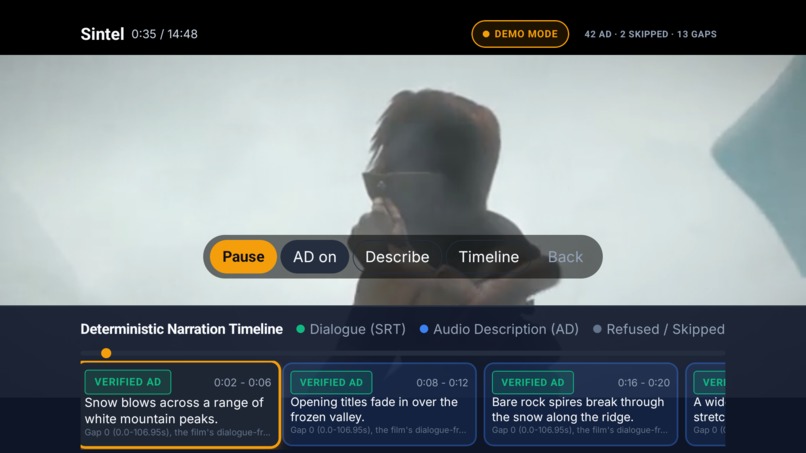
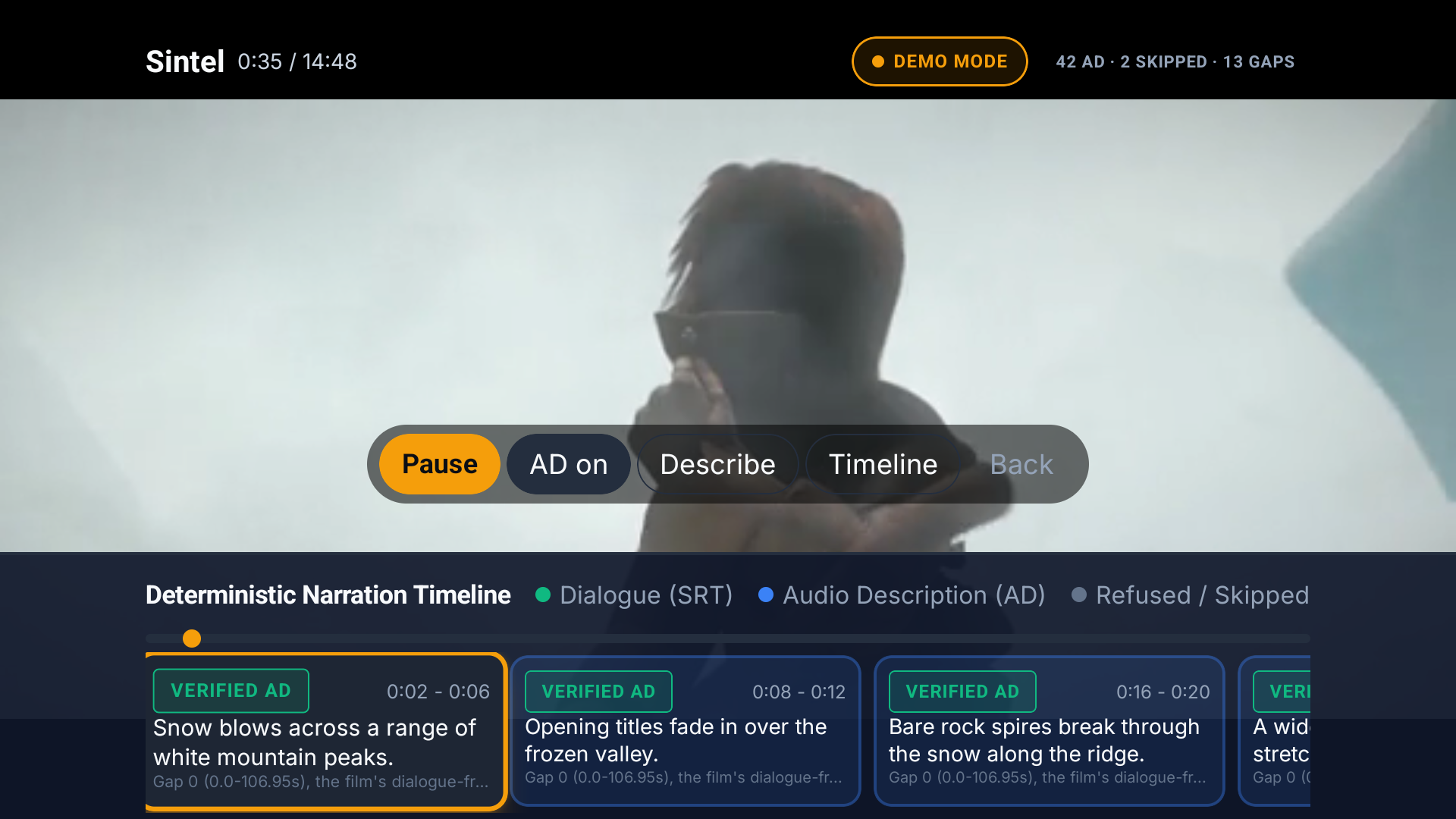
The timeline overlay: described gaps over real gaps, counted from the track at runtime, overlaps at zero.
-
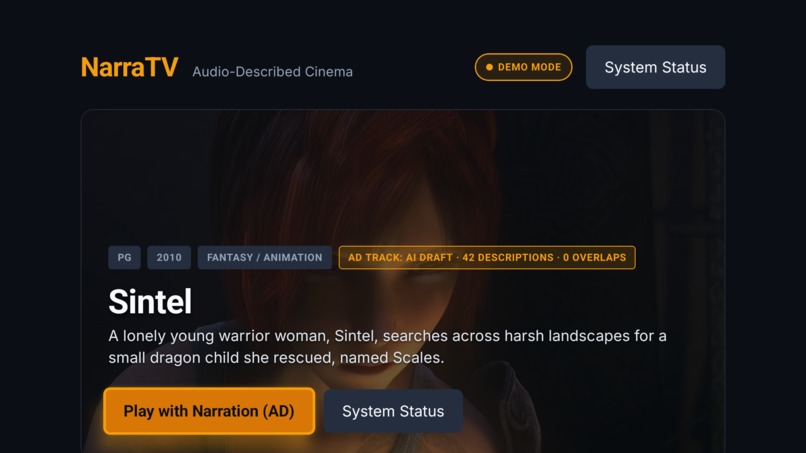
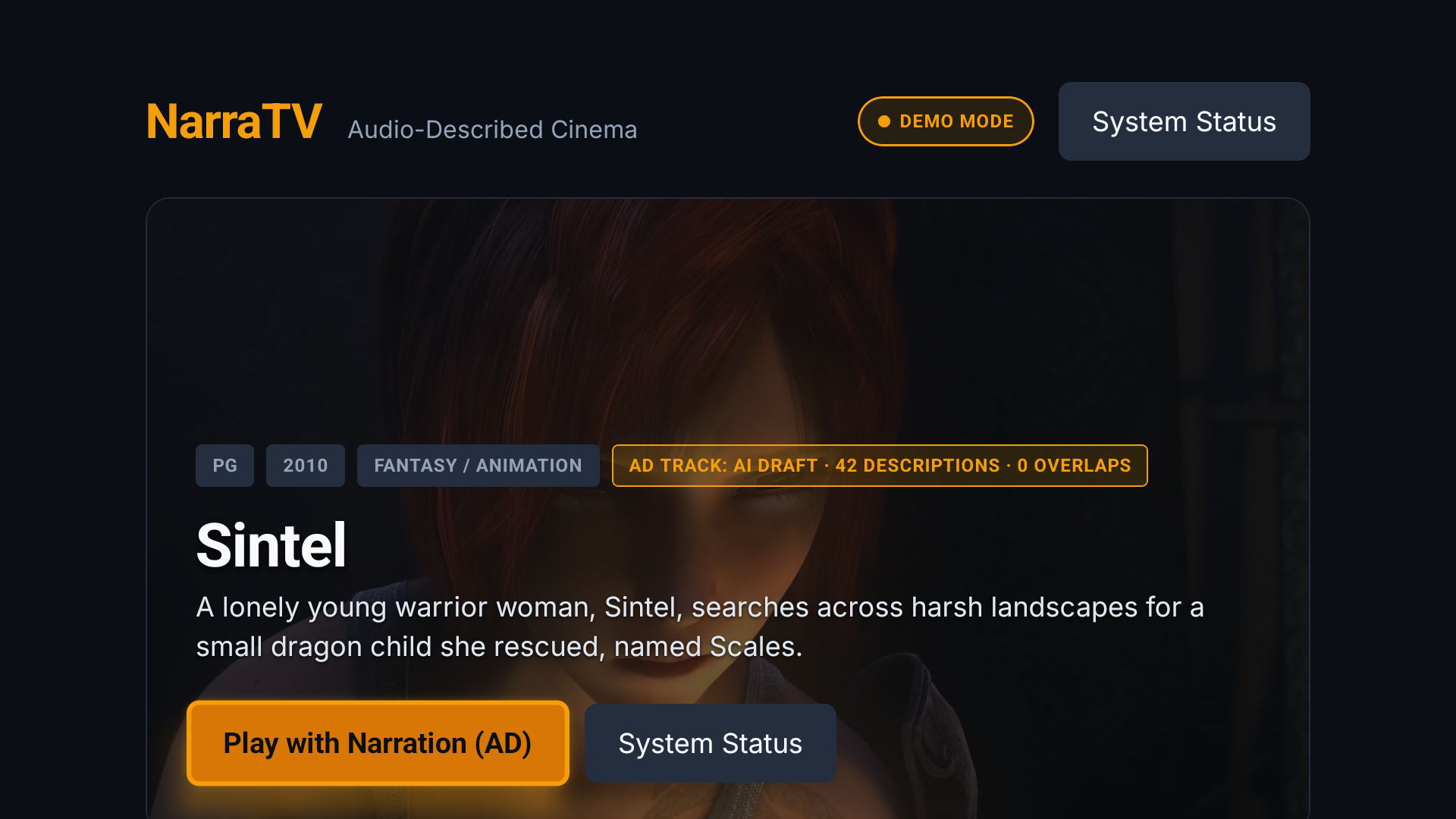
The catalogue. Two titles carry an honest NO AD TRACK state rather than being pretended over.

Inspiration
Open any major streaming app and look at a film's audio menu. Here is a real one — a 2026 Indian feature on a mainstream service:
AUDIO                              SUBTITLES
  Tamil                        ✓    Off
  Malayalam        Original         English
  Malayalam        Audio Description
  Hindi                             English [CC]
  Telugu
  Kannada
Five languages. One audio description track. A blind Tamil viewer, on that platform, on that film, gets nothing — same film, same app, same evening.
That is not an edge case, it is the normal shape of audio description:
- Only about 7% of streaming content carries audio description. Netflix, the leader, sits near 40% of its library.
- Human-authored AD costs $15–75 per minute of runtime — $2,250–11,250 for a 150-minute film, per language.
- So the original-language release gets described and the four dubs do not. Regional cinema, back catalogue and independent film never will.
And the clock is running. India's Ministry of Information and Broadcasting issued OTT accessibility guidelines on 6 February 2026 requiring audio description, and the Delhi High Court is actively directing CBFC and the Centre on cinema and OTT accessibility. Platforms are about to need audio description at a scale description studios cannot staff.
We asked: what if the missing track could be generated on the viewer's own television, for the title in front of them, in the language they actually chose?
Estimated cloud cost for a full 90-minute track: ~$0.37.
What it does
NarraTV is a Fire TV application that generates and speaks scene description for films that have no description track — and is deliberately, visibly honest about what it cannot do.
- Open the catalogue. Two titles show an honest NO AD TRACK state; they are not silently pretended over.
- Play Sintel. Real H.264 streaming, clock driven by
onProgress— never a timer. - The film's first spoken line is at 1:47.250. The 107 seconds before it are dialogue-free, and NarraTV describes that opening in real silence.
- All 13 dialogue-free gaps in the film carry descriptions — 44 lines, every one written from a frame pulled out of the same cut the app streams.
- Each line is spoken by the best voice the device offers, with the film ducked to 25% underneath it, captioned in a slim lower third that never covers the picture.
- 42 of the 44 lines play. Two are refused at runtime and the screen shows
SKIPPED · NO GAPover the picture, because the gap is shorter than the line takes to speak. The refusal is the feature. Or, if the viewer turns on extended mode, the line is not dropped: the film pauses at the earliest safe point (never inside dialogue, at most 5 s late), the description is spoken, and playback resumes, per WCAG 2.2 SC 1.2.7. On the emulator, sintel-ad-11 paused the film at 146.7 s and resumed 5.9 s later; the demo shows it at 1:38. - The HUD counts described gaps over real gaps and overlaps at zero — computed from the track at runtime, never a fabricated 100%.
The model was graded, not trusted. Amazon Bedrock Nova Pro wrote 34 of the 44 lines from frames — never from a synopsis — and every one was then re-read against the frame it came from. 19 of 34 observations were right unaided; 15 were corrected. That split is derived from the per-line labels in the track rather than typed in, and the correction reasons ship with it.
LIVE mode is a deployed endpoint you can call right now.
curl https://oqxbh0hegf.execute-api.us-east-1.amazonaws.com/healthreturns{"mode":"live","providers":{"bedrock":"ok","polly":"ok","s3":"ok"}}. The television reaches Bedrock and Polly through it with a plainfetch(), so no AWS credentials are ever on the device — the Lambda holds them.
The refusal principle
An audio describer that talks over the film is worse than no describer at all. So the interesting engineering here is what the system declines to do, and every refusal is enforced in code and visible on screen.
| It will not… | …without / unless |
|---|---|
| Speak over dialogue | Narration is hard-cancelled the instant a cue starts |
| Start a line | It fits before the next cue with 0.4s to spare, measured from when the voice is actually audible |
| Claim a title is described | The track really exists — otherwise NO AD TRACK |
| Claim AI authorship | The description names the frame it was written from |
| Cover the picture | Nothing renders across the middle of the frame; chrome auto-hides in 4s |
Each of these has a named test. The build fails if a description lacks its frameRef, if two descriptions overlap, or if any description collides with a real dialogue cue — that last test names the offending line when it fails.
How we built it
Fire TV app — React Native for TV (react-native-tvos 0.81, Expo SDK 54, React 19). D-pad navigation, TalkBack-audited, auto-hiding chrome, slim lower-third captions.
Scheduler (packages/scheduler) — pure TypeScript, no I/O. findGaps merges dialogue intervals and applies 300ms guard bands; placeDescriptions budgets by speech rate; counters are computed, never asserted. Verified with fast-check property tests.
Runtime timing (useScheduler) — the part that turned out to matter. Device TTS is not audible the moment you call it; latency varies by voice, device and whether the engine is warm. So TtsAdapter times every utterance from dispatch to first audible sample and feeds a rolling average back as the lead-in. The caption is raised by the engine's real onStart, so text and voice appear together.
The app logs its own sync error against the video clock:
[narratv] AD sintel-ad-07 [email protected] target=58.00s error=0.02s
Mean absolute error across the opening descriptions: 0.20s.
AWS pipeline (services/pipeline) — CDK v2, Lambdas, Step Functions, and LiveDescribeAdapter for Amazon Bedrock Nova Pro (multimodal frame → text) and Amazon Polly Neural (text → speech). DEMO mode throws before any SDK call, so a demo build cannot silently masquerade as live.
It is deployed, and you can check it without installing anything:
GET https://oqxbh0hegf.execute-api.us-east-1.amazonaws.com/health
{"mode":"live","providers":{"bedrock":"ok","polly":"ok","s3":"ok"}}
POST /describe with a real frame returns a Nova Pro description in about two seconds. The television reaches it over plain fetch(), which is the point of the shape: no AWS credentials ever go on the device. On the System Status screen, "Switch to LIVE (AWS Bedrock)" flips the running app over at runtime and the status line reads CONNECTED / NOVA PRO — no rebuild, no env var.
Challenges we ran into
We shipped fabricated data, and caught it. An earlier revision contained a 26-cue Sintel subtitle file in which cues 1–10 carried real script lines at invented timestamps and cues 11–26 were dialogue that does not occur in the film. The description track was a plot summary fitted to those fake gaps. It mattered far beyond wrong captions: findGaps derives gaps from the subtitle track, so every gap was fictional — and the headline "overlaps: 0" was meaningless, because it counted collisions against dialogue that did not exist. We caught it by pulling frames from the real stream and comparing. At video 01:02 the picture is Sintel alone in a snowfield while the app narrated "the warm firelight inside the mountain hut." Both files were replaced: subtitles verbatim from the official Wikimedia Commons track, descriptions written by looking at the frames they name.
The test that should have caught it made it worse. It asserted descriptions.length >= 25. A quantity assertion cannot detect invented content — it actively rewards it. Replaced with correctness assertions: no description overlaps another, none overlaps a real cue, the first cue is after 107s, and every description carries a frameRef and an honest model.
LIVE mode had never once run, in any build we ever shipped. The feature was written, tested and documented; the switch was an env var read at build time. Three separate mechanisms had to line up, and all three quietly did not:
babel-preset-expoinlines only variables prefixedEXPO_PUBLIC_. Ours was not, soprocess.env.API_URLcompiled toundefinedin the bundle.- After renaming it, still nothing.
api.cache(true)inbabel.config.jsmakes Babel's transform cache insensitive to the environment, so the inlined value was served from a cache keyed on a run that never had it. - Gradle's JS bundle task keys on input files. Changing an env var changes no file, so the task came back
UP-TO-DATEand shipped the previous bundle.
Each layer is individually reasonable and the combination is silent: no warning, no error, and a perfectly green test suite, because the tests read the same undefined the app did. We removed env vars from the path entirely — a committed constant plus a runtime toggle. The first test in config-env-prefix.test.ts now asserts that config.ts contains no process.env at all.
A control a remote cannot reach does not exist. With the toggle finally on screen, it was still unusable: focus landed on "Refresh Status" at the bottom of the page, and no D-pad path walked upward into the cards. Reading the component tree would never have shown this. Driving the emulator with real adb keyevents did — the focus ring simply never arrived.
We measured the model instead of trusting it, and it cost us. Every one of the 44 Bedrock-written lines was re-checked against the frame it was written from: 19 of 34 observations were right unaided, 15 were wrong and corrected. The same audit turned on our own hand-written opening gap, which had been labelled verified and then never re-checked — 4 of its 10 lines described a scene the film does not contain. Worth recording: the model's self-reported confidence carried no information at all. Two calls on the same frame both returned 0.95, and both missed a blizzard filling the shot.
adb screenrecord captures no audio, which made the first demos silent and useless for judging AD. Replaced with OBS driven over websocket, plus a verify-take script that checks stream layout, loudness and picture luma — one take came back completely black and only the luma check caught it.
Accomplishments we're proud of
- Mean sync error 0.20s, measured and logged by the app itself rather than eyeballed.
- 34 suites / 172 tests green across four workspaces.
- Complete description coverage on a real film: all 13 dialogue-free gaps, 44 lines, every line written from a frame — and two of them refused on air, out loud, because they did not fit.
- Extended audio description as an opt-in: the two lines that cannot fit are paused for rather than lost. Verified on device for sintel-ad-11 with the pause and resume logged; the second line is covered by tests.
- A live AWS path a judge can hit from a browser, and a runtime LIVE/DEMO switch on the television that needs no rebuild and carries no credentials.
- Every refusal is a named test, not a comment.
- Estimated ~$0.37 in cloud cost for a full 90-minute track, against $1,350–6,750 for the human equivalent.
- We found and removed our own fabricated data, and wrote the tests that make its return a build failure.
What we learned
That a demo can be green, tested and completely dishonest at the same time. Twenty-one suites passed against a fabricated dialogue track, and one of those tests was rewarding the fabrication by counting rows. The design change that followed is now a rule in the repository: never write a description, caption or timestamp from a synopsis — write it from a frame you have actually looked at, and record which frame. Partial and true beats complete and invented, especially in a product whose entire value is a trust claim to blind viewers.
What's next for NarraTV
Honest current limitations, stated plainly:
- The model is wrong often enough that a human has to read every line. 19 of 34 observations were right unaided. A track shipped straight out of Nova Pro would confidently describe things that are not on screen. Today the review step is a person; that is the honest state of the art.
- Voicing on device is the operating system's TTS, not Polly. Polly Neural is verified as a real call and is what the pipeline synthesises with, but the demo speaks through the television's own engine. Swapping the playback path to pre-synthesised Polly audio is next.
- One film, one language. The track that exists is Sintel in English. The entire argument of the project is the Tamil viewer in that opening screenshot, and she is still silent. Per-language authoring is the next build.
- AI description is not as good as a skilled human describer. We are not claiming parity. The claim is coverage of what a human will never be paid to describe.
- Not on real Fire TV hardware. Developed and demonstrated on the Android TV emulator, API 30, 1080p — which the hosts confirmed is an acceptable demo target. Sideloading to a physical Fire TV Stick is untested.
Sources
- Audio description coverage (~7% industry, ~40% Netflix) — TestParty
- AD production cost ($15–75/min) — 3Play Media
- India OTT accessibility guidelines (6 Feb 2026) and Delhi HC direction — MediaNama, Aug 2026
- Sintel, Big Buck Bunny, Elephants Dream — © Blender Foundation, CC BY 3.0
- Sintel subtitles — Wikimedia Commons TimedText, CC BY 3.0
Built With
- amazon-api-gateway
- amazon-bedrock
- amazon-nova-pro
- amazon-polly
- android-tv
- aws-cdk
- aws-lambda
- aws-step-functions
- expo.io
- fast-check
- fire-tv
- jest
- react-native
- typescript

Log in or sign up for Devpost to join the conversation.