-
-
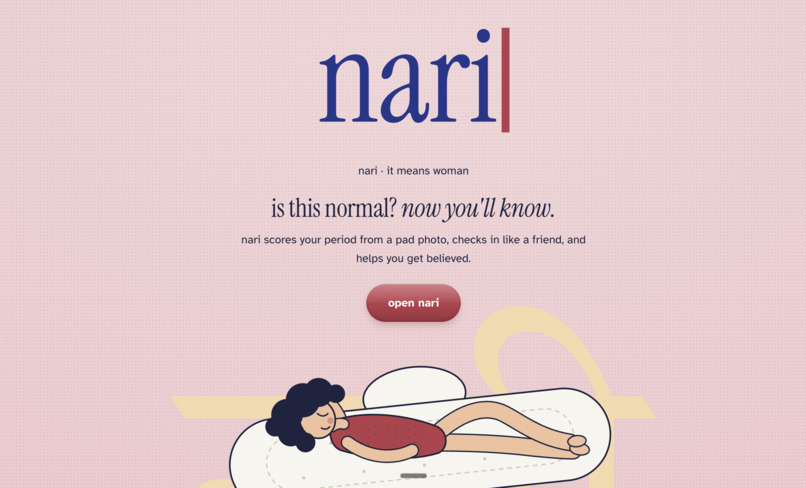
Landing Page
-
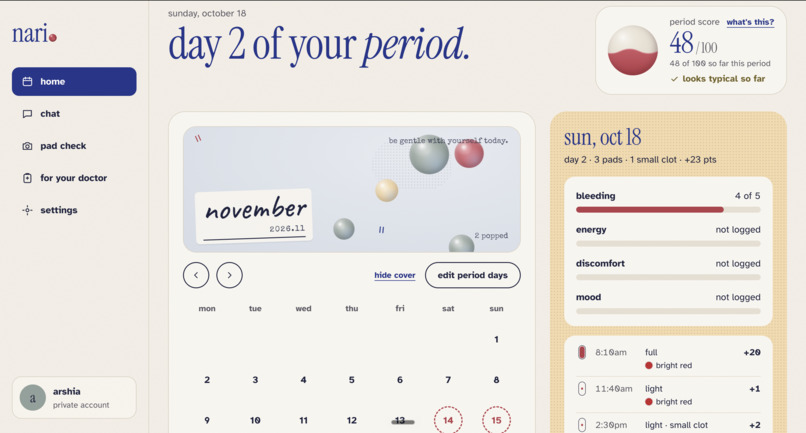
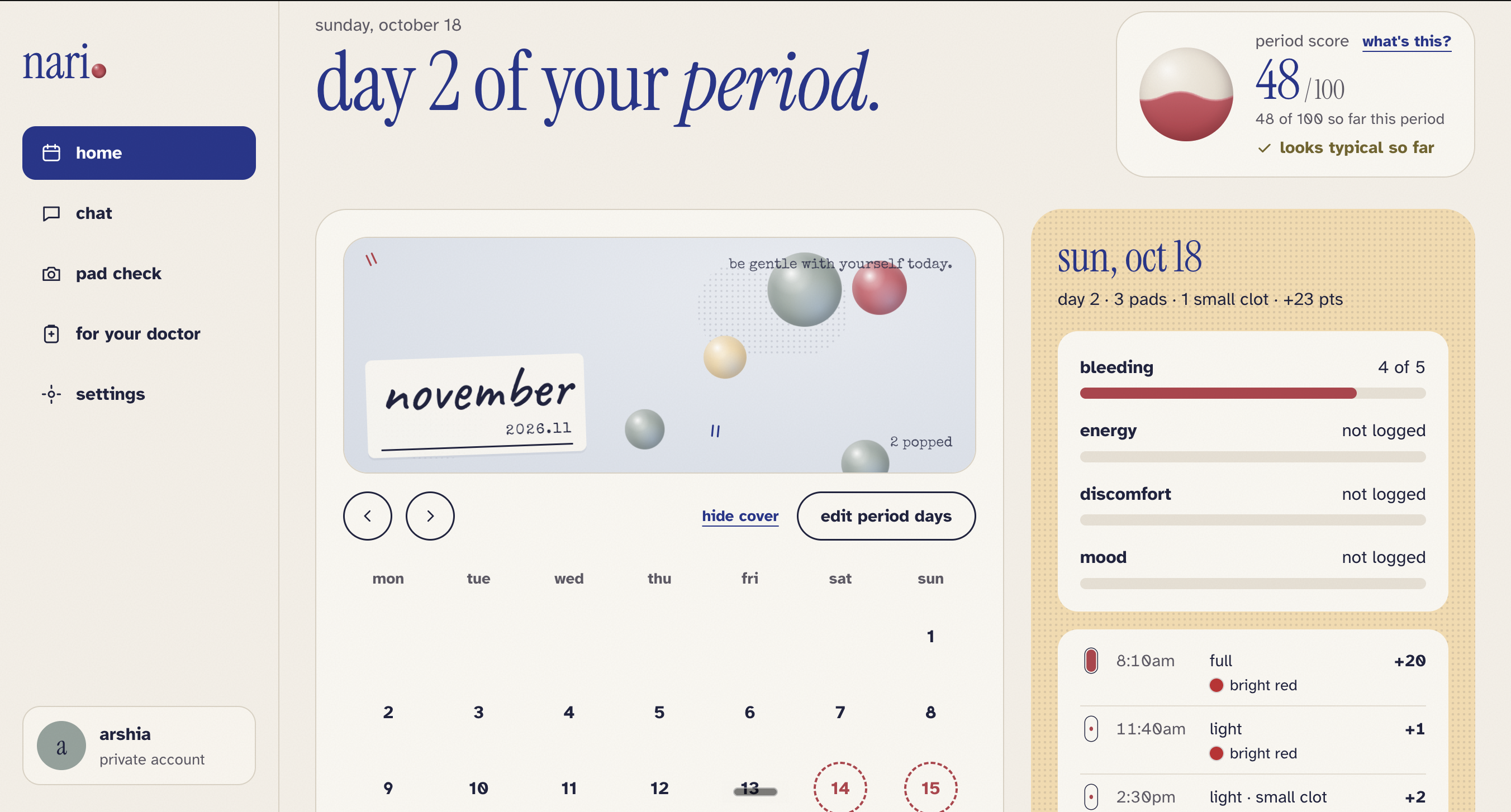
Home page
-
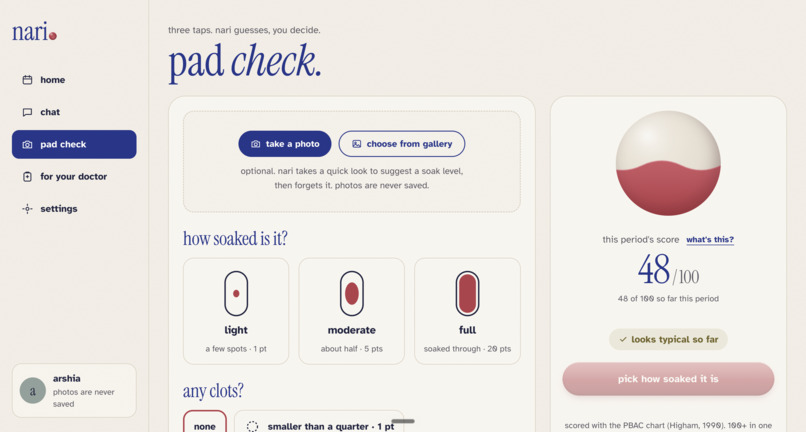
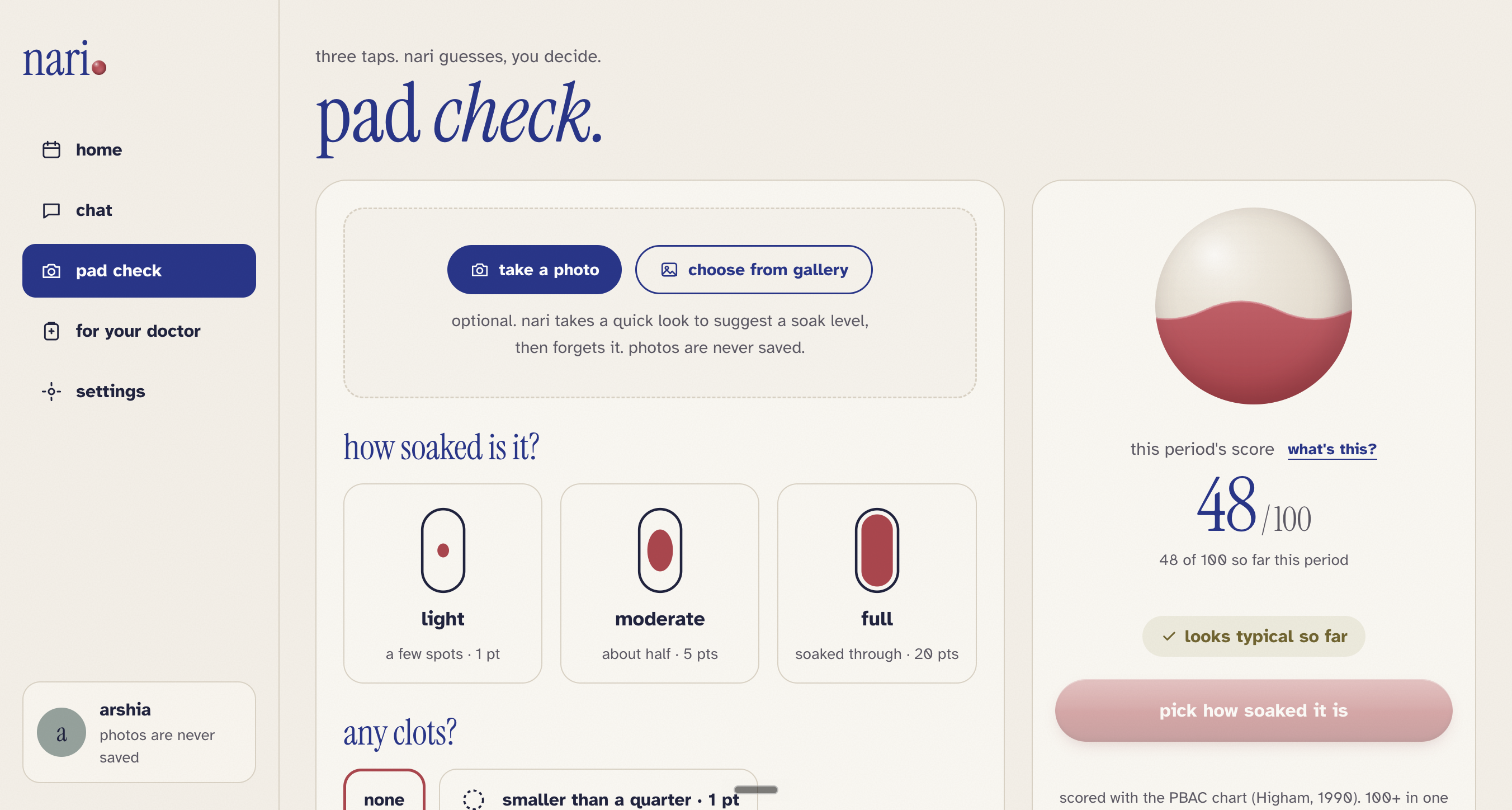
Pad computer vision page
-
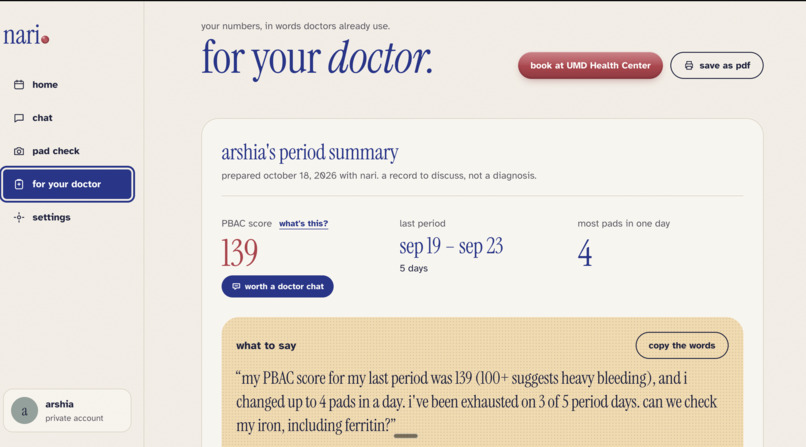
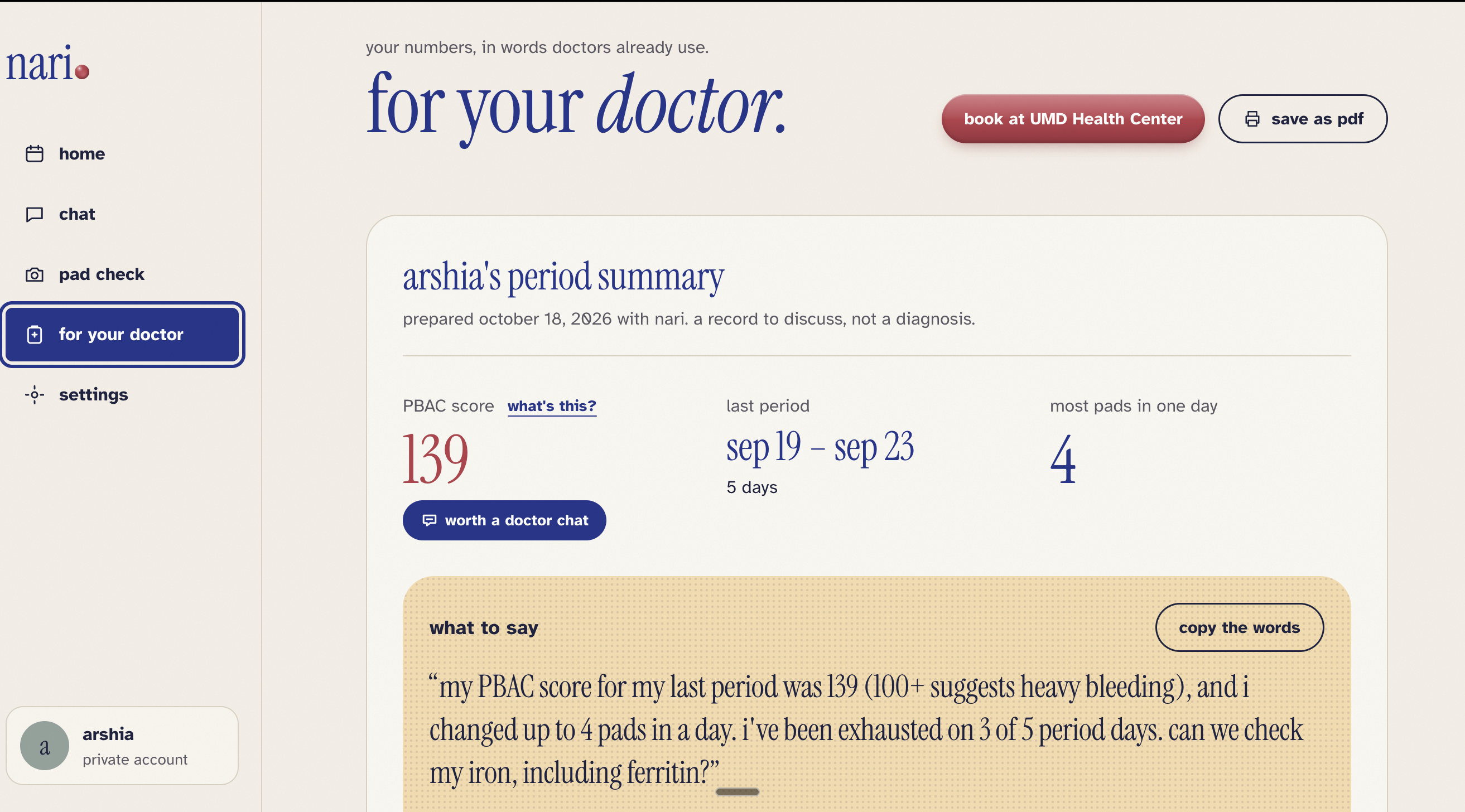
Doctor's page
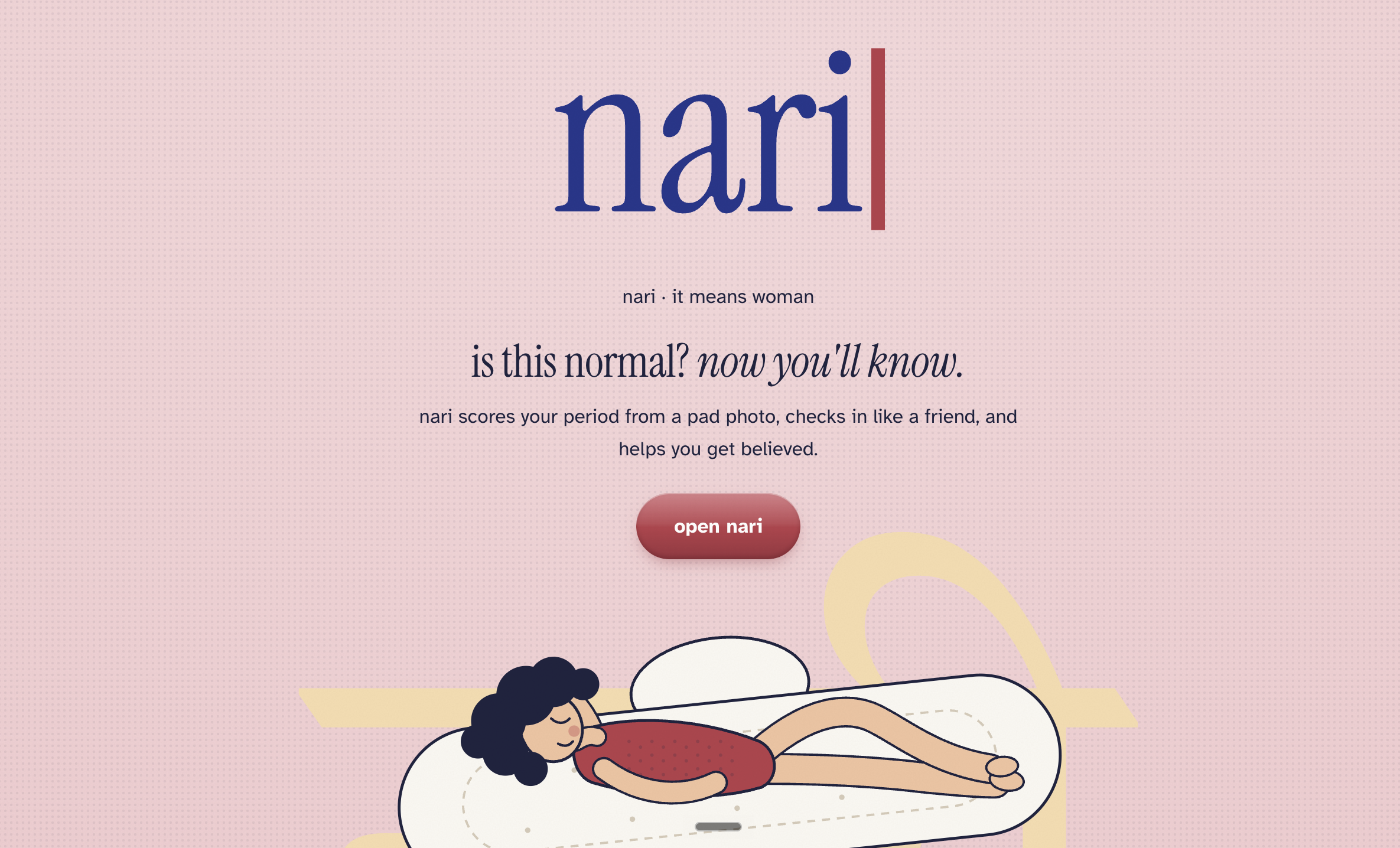
nari (नारी) — woman.
know your flow. trust your body.
In Hindi and Bengali, nari means woman. We named our project after the person it's for, and after the experiences she's so often been told to quietly put up with.
Inspiration: it started with a question at 2 a.m.
"Is this normal?"
One of us typed it into a search bar late at night, the way so many of us have. What followed wasn't an answer. It was a spiral of TikToks, unfamiliar medical terms, and worst-case scenarios we hadn't even known to worry about.
By the time we closed the app, we weren't reassured. We were scared.
And we kept thinking: why is it so difficult to understand something our bodies go through every month?
Heavy bleeding, debilitating cramps, constant exhaustion. We're often taught to accept these experiences as part of being a woman. But heavy menstrual bleeding can contribute to iron deficiency and sometimes signal an underlying bleeding disorder.
Research shows how easily these experiences get overlooked. Women with von Willebrand disease can spend years waiting for an explanation, while many people experiencing heavy periods never seek medical care at all.
The problem isn't always that we don't notice our symptoms. It's that we're rarely given the tools to measure them, understand them, or explain them in a way that gets taken seriously.
We wanted to build something that changed that.
Not another period tracker that simply predicts a date. Something that helps you understand what is happening, recognizes when an experience might deserve attention, and makes it easier to advocate for yourself.
That's how Nari began.
What it does
Nari is an AI-assisted menstrual wellness companion that helps users track bleeding, understand symptom patterns, receive personalized support, and prepare for conversations with healthcare professionals.
We designed Nari around three simple actions: snap. check in. get believed.
1. Pad Check: making the invisible measurable
Our first idea was to use AI to analyze menstrual blood color from a photograph.
It sounded innovative. But the more we researched, the more we realized that lighting, camera quality, and menstrual product materials could make color-based medical interpretations unreliable.
We didn't want to build something that could falsely reassure someone or make an already anxious person even more frightened.
Instead, we discovered the Pictorial Blood Loss Assessment Chart (PBAC), a clinically studied method of estimating menstrual blood loss by recording how saturated menstrual products become.
The original chart assigns points to lightly, moderately, and heavily soaked pads, with additional points for clots and flooding. In the original scoring method, a score of 100 or greater during a period can suggest heavy menstrual bleeding.
We realized something: if a chart is already pictorial, why are we still asking people to fill it out manually?
With Nari, users can photograph a pad and receive a Gemini-powered suggestion about its saturation level and visible clots. They can review or correct the result before adding it to their log.
The app translates these entries into a running PBAC-style score, explains how the score adds up, and helps users understand whether their bleeding may be worth discussing with a clinician.
Photos are intended to be analyzed without being stored as part of the user's menstrual history.
AI helps observe. The user confirms. The scoring rules do the math.
We also designed a manual fallback because users shouldn't lose the ability to track their health when an AI service is unavailable.
2. A check-in that feels like talking to a friend
Most period trackers ask you to choose symptoms from a list.
But real life doesn't fit neatly into a dropdown menu.
Sometimes all you want to say is:
"my cramps are literally killing me, I have an exam tomorrow and I barely slept."
Nari is designed to understand those conversations.
Instead of treating chat as another medical intake form, we created an AI companion that listens to how users naturally describe their experiences.
Using Gemini, Nari can respond conversationally while identifying information about energy, discomfort, mood, and daily activities. Users can review and adjust what gets recorded.
And we wanted to go further than text.
We designed voice interactions so that users can speak to Nari and listen to responses aloud, with ElevenLabs-powered speech generation and text always available as an alternative.
The goal is a check-in that feels approachable even when you're exhausted, overwhelmed, or simply don't feel like filling out another form.
3. A calendar that actually connects the dots
Your period doesn't exist separately from the rest of your life.
Nari's calendar brings together bleeding logs, cycle predictions, energy, mood, discomfort, and daily activities.
Instead of seeing disconnected entries, users can begin noticing patterns: whether their energy consistently drops on certain days, whether one cycle is heavier than another, or whether certain symptoms keep recurring.
Users can edit their period dates and cycle information, and add a predicted period event to Google Calendar to help plan around upcoming commitments.
The predictions use cycle information rather than asking AI to invent a medical forecast.
4. Gentle health signals, not AI diagnoses
One of our most important design decisions was deciding what Nari should not do.
It shouldn't tell someone they have anemia. It shouldn't diagnose a bleeding disorder. And it shouldn't decide that everything is fine based on one photograph.
Instead, Nari uses explicit, research-informed rules to identify patterns that may deserve attention.
For example, consistently heavy bleeding alongside low energy can prompt a suggestion to discuss iron deficiency with a healthcare professional.
A short bleeding-history questionnaire helps users document other potentially relevant symptoms, such as frequent nosebleeds, easy bruising, or a family history of bleeding disorders.
And when users report potentially urgent warning signs, Nari prioritizes guidance to seek appropriate care.
We wanted Nari to be supportive without pretending to replace a doctor.
5. Get believed: making doctor visits less intimidating
Recognizing a pattern is only half the challenge. Explaining it can be just as difficult.
Nari organizes bleeding scores, daily symptom logs, and recurring patterns into a doctor-friendly summary.
Instead of walking into an appointment wondering how to describe their experiences, users have specific information and suggested language to start the conversation.
For students at the University of Maryland, we also included a direct connection to the university's health appointment portal.
Because sometimes the hardest part isn't noticing that something is wrong.
It's finding the words to ask someone to take it seriously.
How we built it
We built Nari as a responsive web application using **Next.js, React, TypeScript, ElevenLabs, Gemini API deployed on Vercel.
Built With
- css
- elevenlabs
- git
- github
- google-gemini
- google-genai
- html
- javascript
- next.js
- postgresql
- react
- supabase
- tailwind-css
- typescript
- vercel


Log in or sign up for Devpost to join the conversation.