Inspiration
Everyone has a game idea — usually scribbled on a napkin and forgotten, because turning it into a real game takes a whole studio: designers, 3D artists, programmers, QA and playtesters. We wanted to give everyone that studio, made of AI agents, and hold it to the standard real studios use: you don't ship until it's tested and fun.
What it does
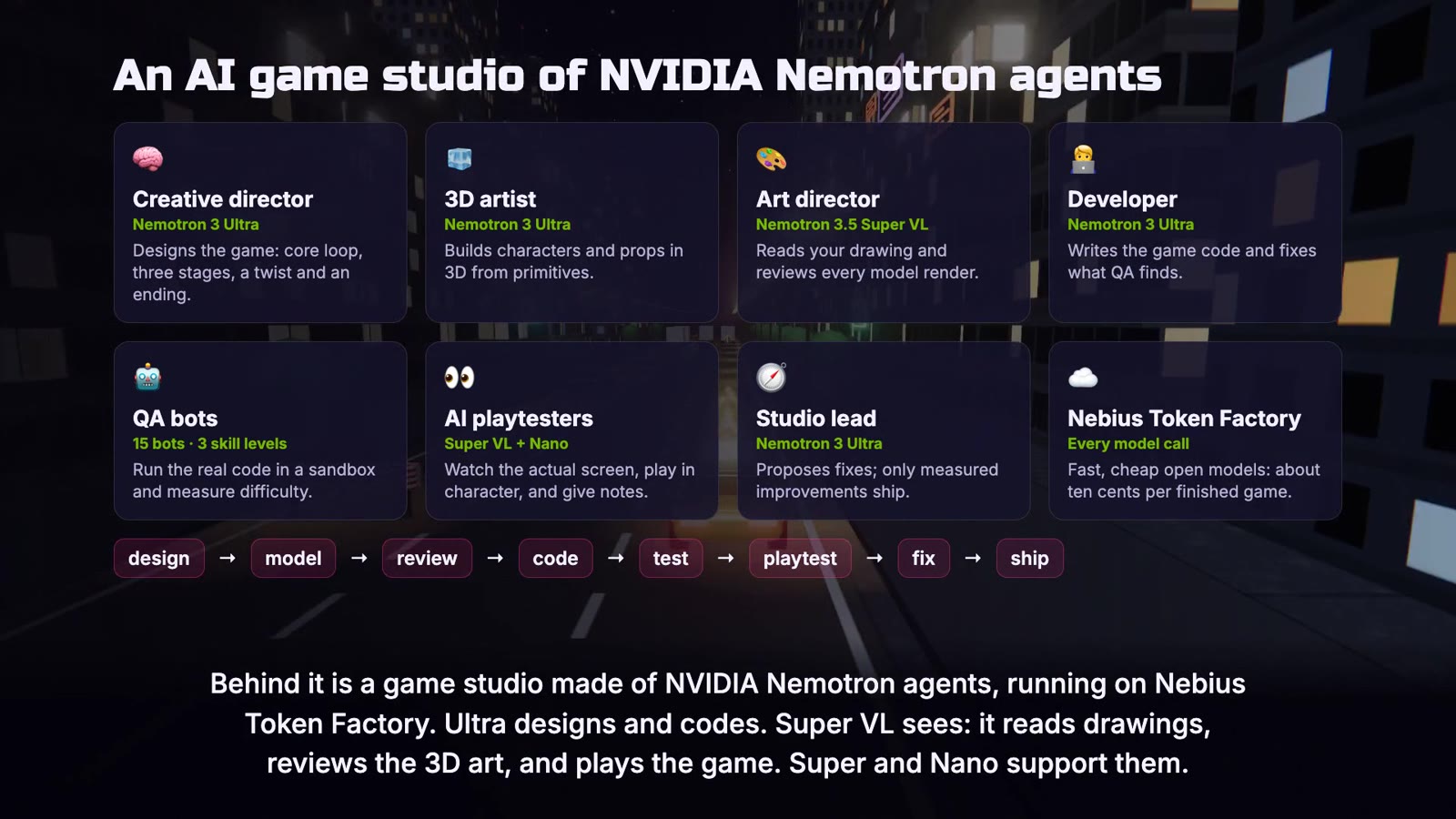
You snap a drawing or type one sentence. A studio of NVIDIA Nemotron agents running on Nebius Token Factory then:
- designs the game (Nemotron 3 Ultra): template, world, controls, three stages, a twist, win and lose rules;
- builds the 3D art (Ultra) from primitives with physically based materials — and the art director (Nemotron 3.5 Super VL) reviews a render of every model with vision, sending back concrete problems ("parts are floating") until it reads right;
- writes the game code (Ultra) as a JavaScript module for our 3D engine;
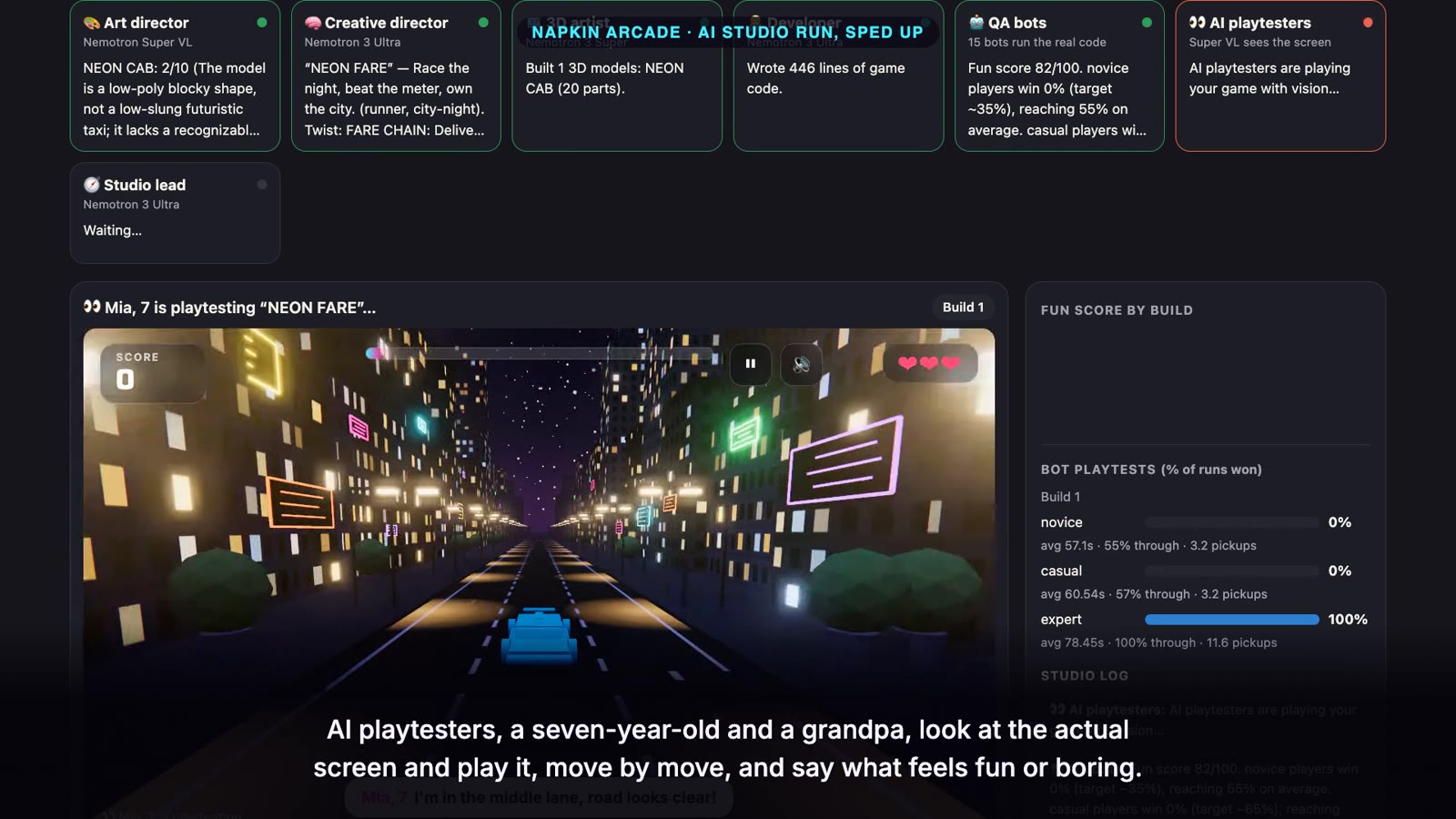
- tests it: a static linter and 15 headless bot players at three skill levels run the real code in a sandbox; crashes and gameplay bugs go straight back to the developer with the exact failing line;
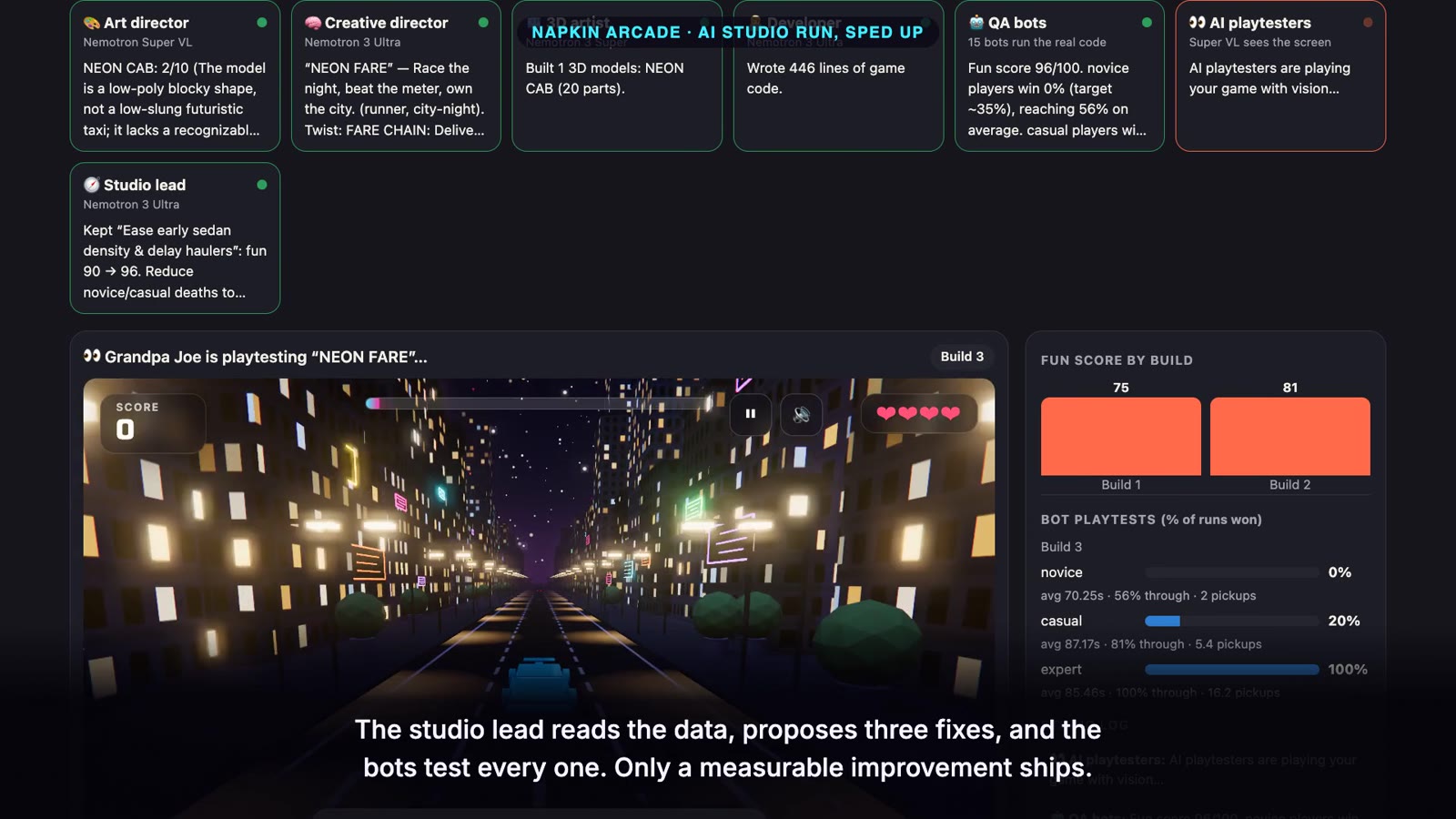
- playtests it with vision: AI personas (a 7-year-old, a grandpa) look at real frames of the running game, choose every move with Super VL, and write their notes with Nemotron Nano;
- fixes what isn't fun: the studio lead (Ultra) proposes three fixes, a built-in auto-tuner adds a fourth, the bots measure every one, and only a measurable improvement ships.
In the demo video's live run, the studio took "NEON FARE" from fun score 82 → 90 → 96 and shipped it for $0.09 of AI.
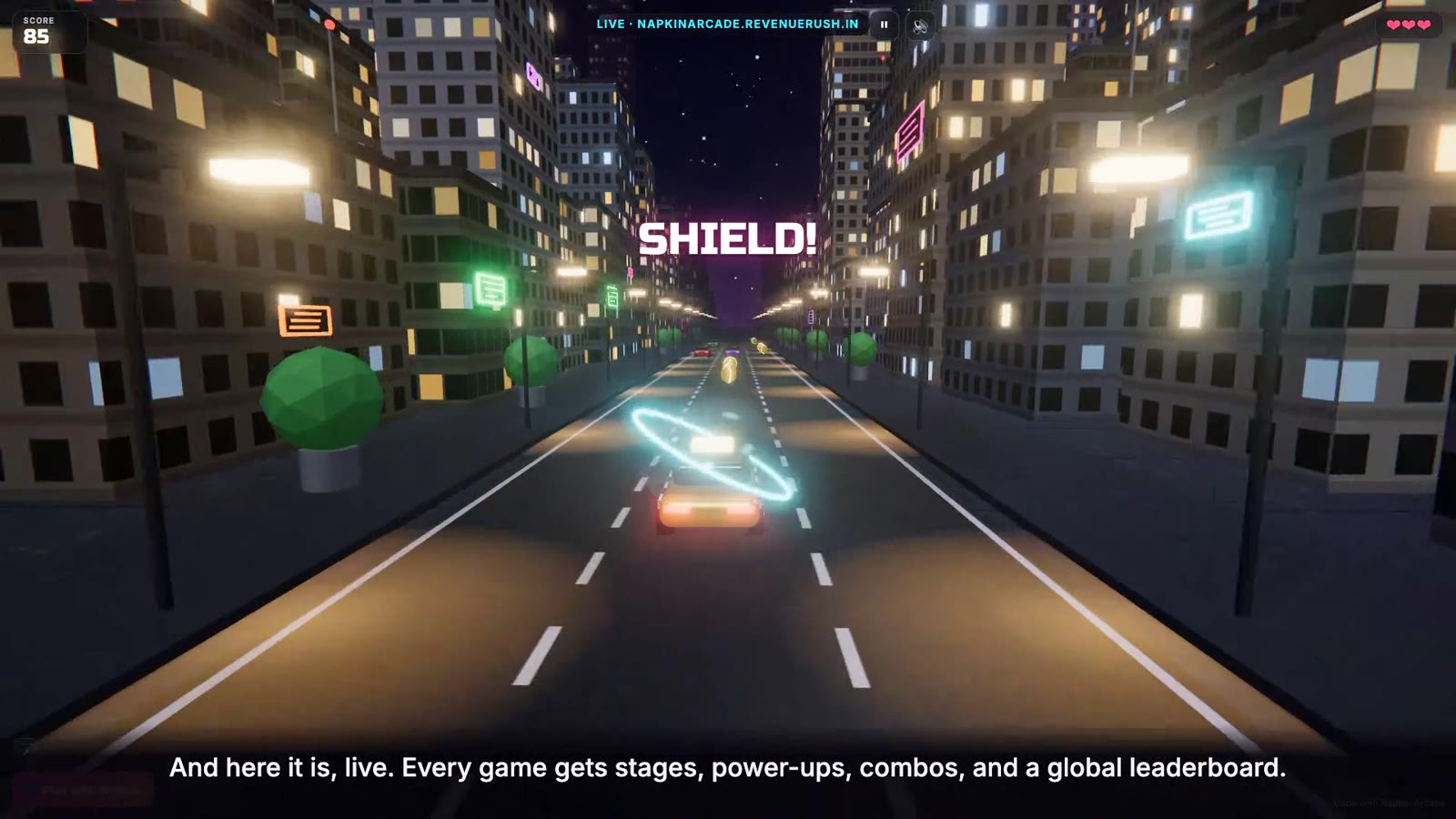
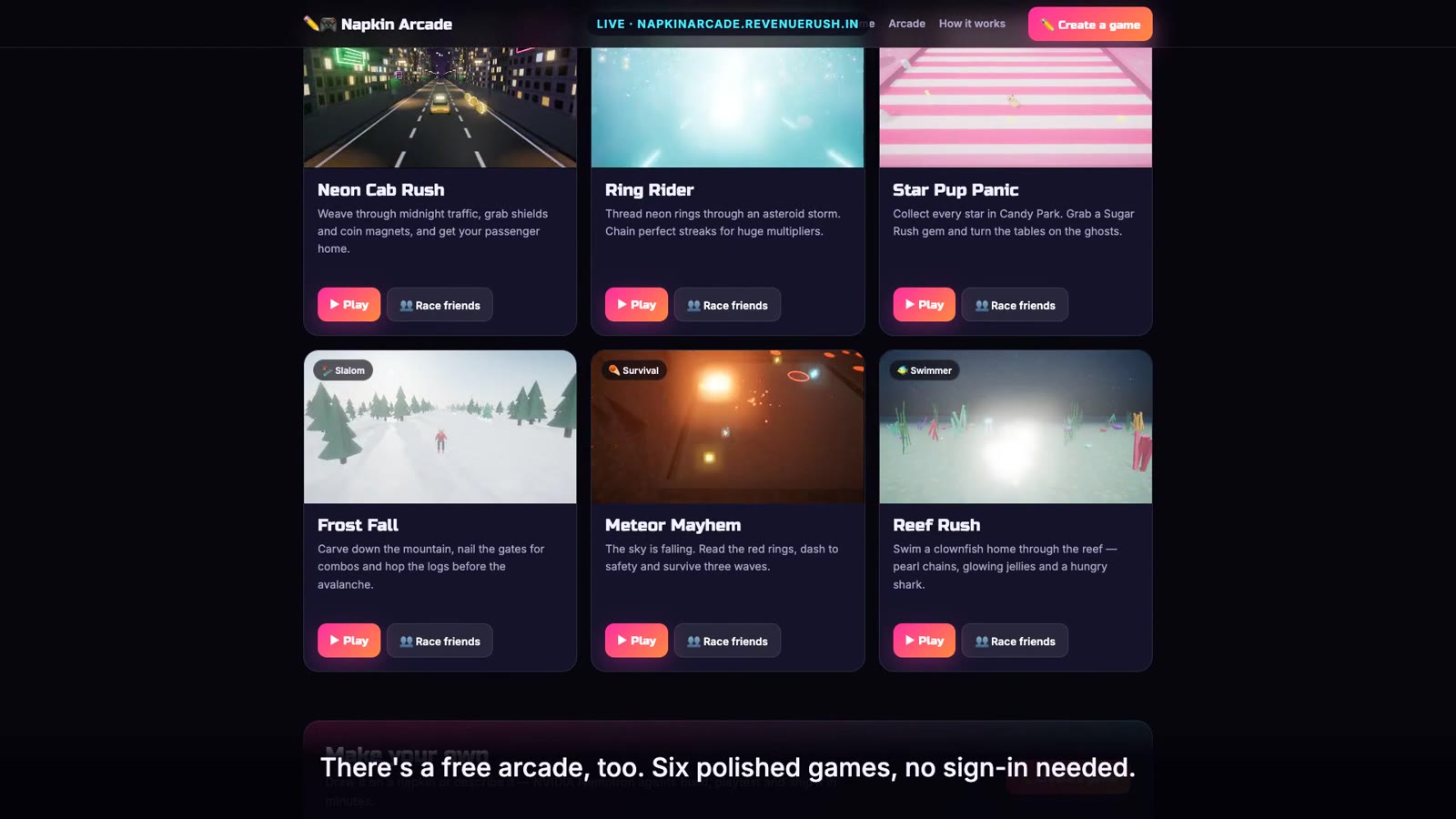
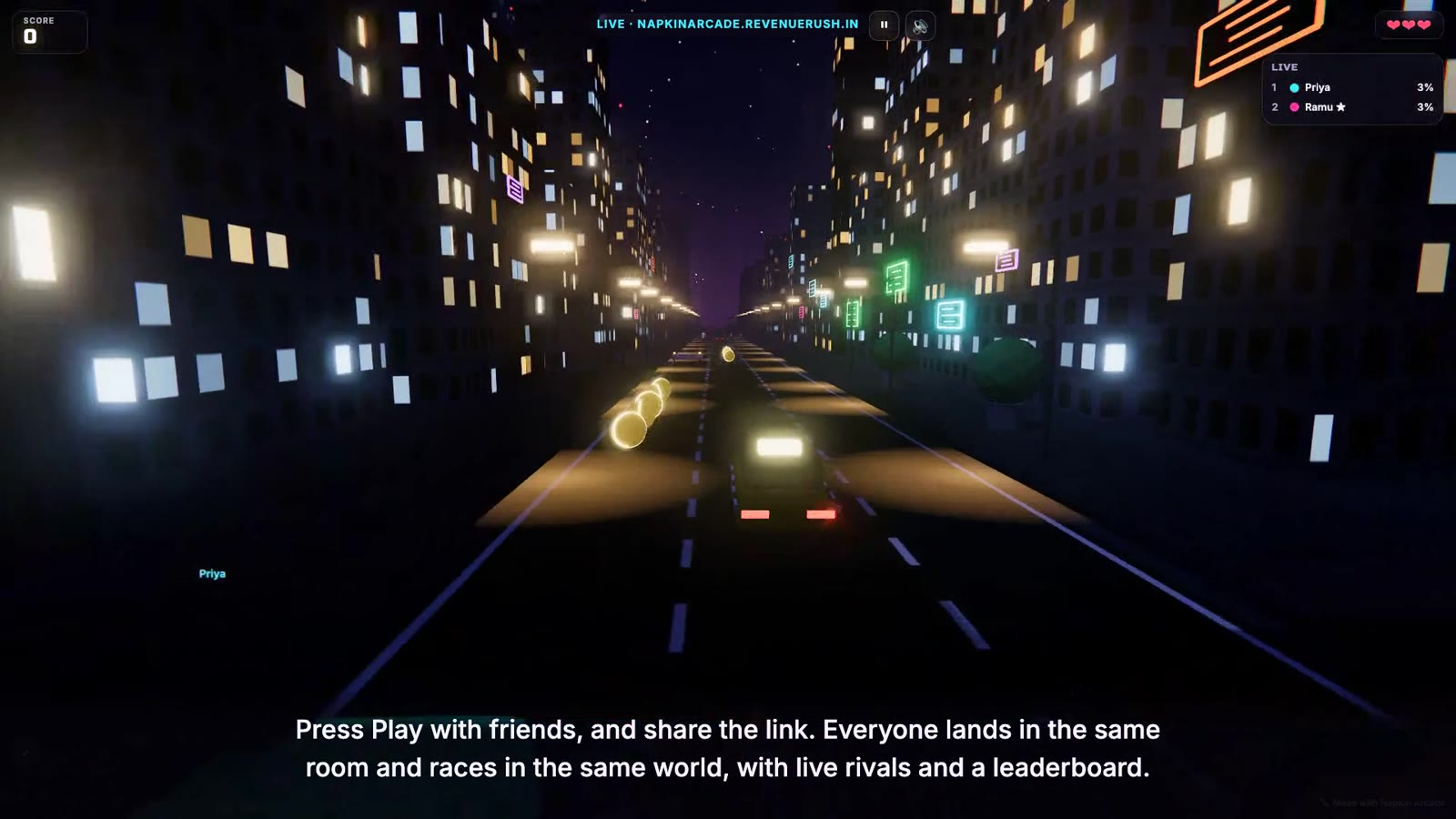
Every game ships with a link and QR code, 3D worlds with real-time lighting, power-ups and combos, a global leaderboard, keyboard and touch controls, and multiplayer rooms: share a link, everyone lands in the lobby, and you race in the same world with live rivals. There's also a free arcade of six polished games — no sign-in needed.
New since the first submission
- Agentic gates: every game must pass a lint check, 15 bot players, vision playtesters and a 2-player race test before it ships; any failure goes back to the developer agent with the exact error.
- It keeps improving: a workshop per game with memory. Players' bug reports and ideas arrive for the creator's approval, the agents build them as a draft, and the creator publishes.
- Community: multiplayer from one link (everyone in their own lane), leaderboards by week, month, all time and country, groups with join links, and tournaments with prizes in any currency.
- Publish everywhere: offline HTML5, playable ads (AppLovin, Unity, ironSource, Mintegral, Meta, Google), iOS, Android, Android TV, Fire TV, Samsung and LG TVs, desktop — with game controllers and TV remotes — plus an App Store / Google Play connector with cloud builds.
How we built it
- Nemotron on Nebius Token Factory through the OpenAI-compatible chat completions API: Ultra for design, 3D modeling, code and leadership; Super VL for drawing reading, art review and playing; Nano for playtester summaries. Over development: 397 model calls, $1.34 total.
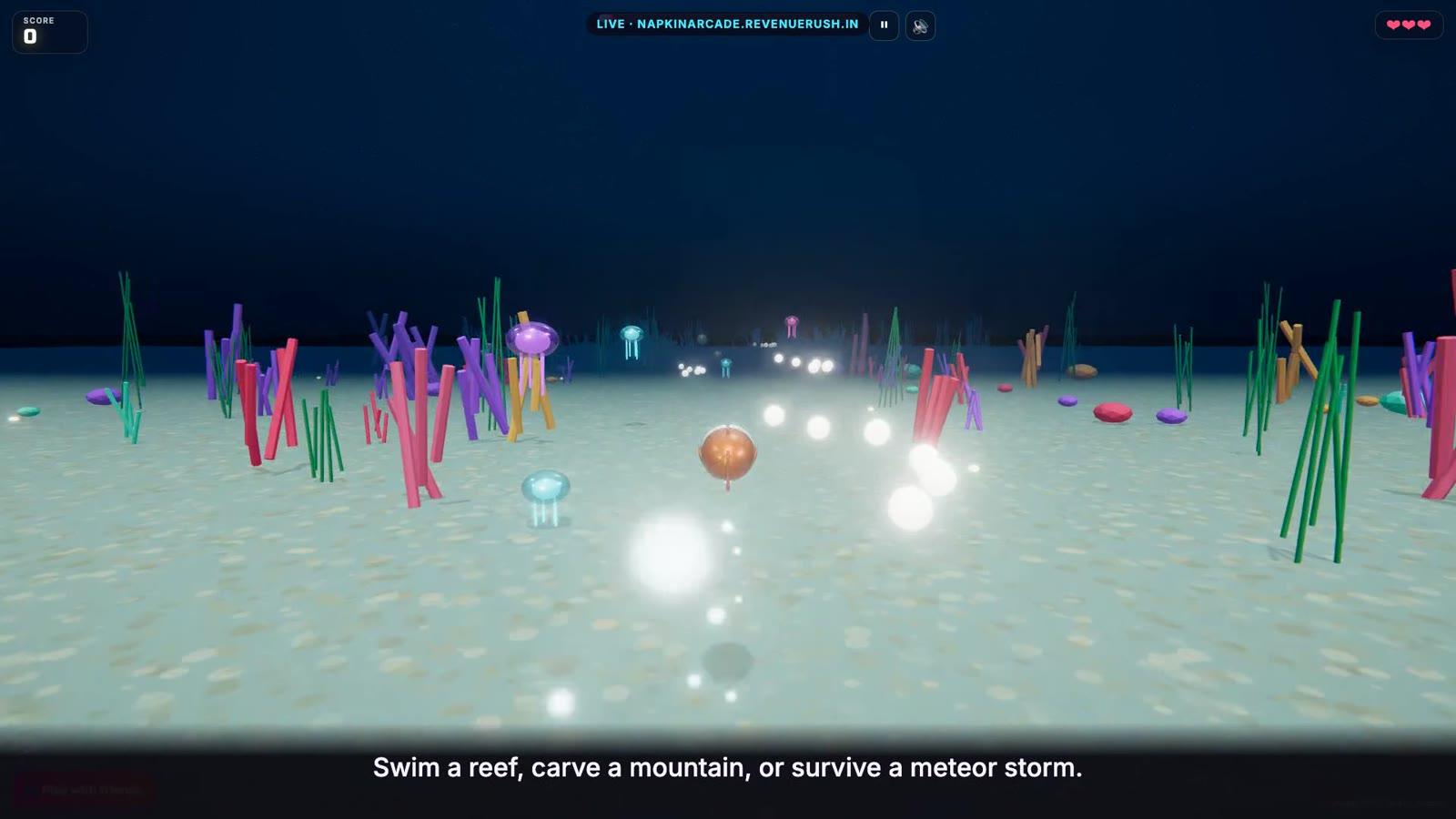
- A purpose-built 3D engine on three.js: 12 world presets (neon city, space, underwater, volcano, synthwave…), procedural textures and instanced scenery, ACES tone mapping, soft shadows, reflections, bloom, particles, procedural sound, and a JSON model format the AI can write.
- Agent tooling: an acorn-based linter that quotes failing lines, telemetry-driven bots (lane planning and sampled safe moves), a fun score with partial credit, and an auto-tuner.
- Safety: AI-written code only ever runs in sandboxed, opaque-origin iframes in the browser — never on the server. Spending caps per game, per hour, per user and in total.
- Platform: email one-time-code sign-in, WebSocket multiplayer rooms, global leaderboards, deployed on AWS (EC2 + Caddy HTTPS, Route 53, SES, CloudFormation, Systems Manager).
- The demo video is generated from the real app: Playwright records it, Amazon Polly narrates it, ffmpeg edits it.
Challenges we ran into
- Thinking models spending the whole budget on reasoning. Ultra and Super VL sometimes returned no content because reasoning used every token;
chat_template_kwargs: { enable_thinking: false }fixed it (the/no_thinktag didn't work for the VL model). - AI code with subtle bugs. Without reasoning, Ultra sometimes used variables it never declared. A line-quoting linter plus crash and gameplay checks turned this into a self-healing loop.
- "Everything scores zero." Our first fun score bottomed out at 0 for games that were too hard, so no fix could prove progress. Partial credit for how far players get, plus an auto-tuner, let the studio climb out.
- Bots that play like people. Early bots lost as often as experts; lane planning and predictive dodging gave real skill differences, so difficulty targets mean something.
- Making 3D look good from text. We moved from 2D tiles to a full 3D engine and gave the artist hand-made reference models and a vision review loop.
Accomplishments that we're proud of
- An agent loop that doesn't just generate code — it runs, tests, playtests and measurably improves it.
- Vision in the loop twice: the same Super VL model reviews 3D art and plays the finished game.
- Real games, real multiplayer, real leaderboards — live today, at about ten cents per game.
What we learned
Agents get dramatically better when they're held accountable by measurements: a linter, bots and a fun score turn "generate and hope" into "generate, test, keep what's better". Fast, cheap open models on Token Factory make that loop affordable — Super VL makes a playtest decision in about a second.
What's next
More genres (racing physics, puzzles, platformers), drawings becoming the actual textures of characters, longer games with saved progress, and letting players remix any game with a sentence.
How to test (sign-in required to build games)
Judge login — no email needed:
- Open https://napkinarcade.revenuerush.in/login
- Email: [email protected] → press Email me a code
- Code: 061628 (fixed for this account; no email is sent)
Then try:
- Build a game: in the Studio, type an idea (e.g. "a penguin delivering pizza across melting icebergs") and press Build my game. Keep the tab open; a build takes 2–4 minutes while the Nemotron agents design, model, code and test it live.
- Play it: press Play — touch, keyboard and game controllers work. Open 🏆 Leaderboard for week / month / all time and by country.
- Multiplayer: press 👥 Play with friends, open the share link in a second browser window, then Start race.
- Keep improving it: open the game's workshop (My games → the game) and ask the studio for a change in the chat — it's built as a draft and tested before you Publish.
- Publish everywhere: in the workshop, download the HTML5 game, the playable ads or the iOS / Android / TV projects.
- Community: create a Group (share its join link) or host a Tournament with a prize from the Studio.
No sign-in: play the free arcade at https://napkinarcade.revenuerush.in/arcade, or the AI-made game NEON FARE at https://napkinarcade.revenuerush.in/play/d91b2502.
Built With
- acorn
- amazon-ec2
- amazon-polly
- amazon-route-53
- amazon-ses
- aws-cloudformation
- aws-systems-manager
- caddy
- javascript
- nebius-token-factory
- node.js
- nvidia-nemotron
- playwright
- three.js
- webgl
- websockets

Log in or sign up for Devpost to join the conversation.