Inspiration
What it does
How we built it
Challenges we ran into
Accomplishments that we're proud of
What we learned
What's next for NapaSathi AI — Smart Fabric Planning
Inspiration
Tailors and artisans work with fabric every day, but planning how to arrange pattern pieces on a fabric roll can be time-consuming and may lead to unnecessary material waste. For small tailoring businesses, using fabric efficiently can help manage material costs and make better use of available resources.
We created NapaSathi AI — Smart Fabric Planning with a simple goal: make fabric planning more accessible, visual, and practical for everyone. We wanted to build a tool that helps users plan before cutting, understand estimated material usage, and make more informed decisions.
What it does
NapaSathi AI is a web-based fabric planning prototype designed for tailors, artisans, students, and small clothing businesses.
Its current features include:
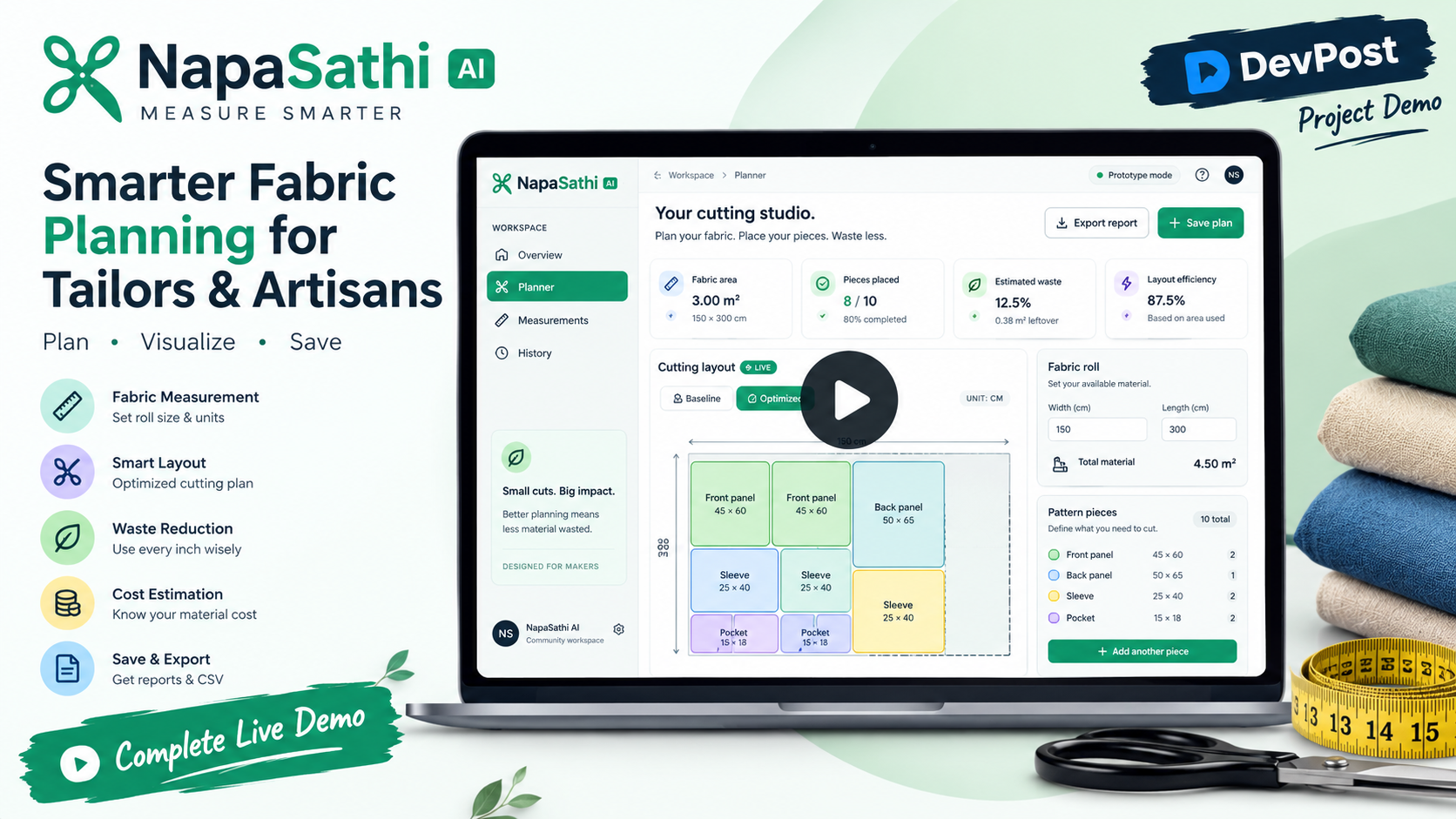
- Fabric Roll Configuration: Enter the width and length of the available fabric and select measurement units.
- Pattern Piece Management: Add, edit, and remove pattern pieces, adjust their dimensions, and set quantities.
- Visual Cutting Layout: Preview how pattern pieces can be arranged on a fabric roll.
- Layout Comparison: Compare a baseline arrangement with an area-sorted arrangement using an approximate shelf-packing heuristic.
- Fabric Usage Estimates: View estimated material utilization, used area, and leftover fabric.
- Material Cost Estimation: Enter a price per linear metre to estimate the material cost for the planned fabric usage.
- Save and Export: Save plans and export available reports or CSV data for reference.
The application is designed to support better planning before fabric is cut. Its layout and waste calculations are estimates, not guarantees of the best possible cutting arrangement or actual waste reduction.
How we built it
We built NapaSathi AI as a web application using modern web development technologies.
- Next.js: Application framework and page structure.
- React: Interactive user interface and reusable components.
- TypeScript: Type safety and more maintainable code.
- Tailwind CSS and custom CSS: Responsive styling and visual presentation.
- Lucide React: Icons for navigation and interface elements.
- Client-side calculations: Fabric area, piece quantities, layout placement, utilization estimates, and cost calculations.
- CSV and report export: Support for taking planning information outside the application.
The layout algorithm uses an approximate shelf-packing approach to arrange pattern pieces, with an area-sorted option for comparison. We chose this approach for the prototype because it provides a fast, understandable starting point for visual fabric planning.
We also ran TypeScript checks and a production build to verify that the application compiles successfully.
Challenges we ran into
One of our main challenges was translating a real-world fabric-cutting problem into a simple and understandable digital experience.
We needed to make fabric dimensions, pattern quantities, layout previews, and material estimates work together while keeping the interface approachable for users who may not have technical experience.
Another challenge was developing a layout approach that could place pieces efficiently while handling different dimensions and optional rotation. A simple shelf-packing heuristic is useful for a prototype, but it does not guarantee a globally optimal cutting plan.
We also had to balance the scope of the project with the time available. Advanced capabilities such as camera-based body measurements, calibrated computer vision, and a persistent cloud database require additional implementation and testing, so they remain future development goals rather than completed features.
Accomplishments that we're proud of
We are proud to have built a working, interactive prototype that brings several useful fabric-planning tasks into one place.
Our key accomplishments include:
- Creating a responsive interface for configuring fabric rolls and pattern pieces.
- Building a visual cutting-layout preview.
- Implementing a baseline-versus-area-sorted layout comparison.
- Calculating estimated fabric usage, leftover area, and material cost.
- Adding plan-saving and export workflows.
- Successfully passing TypeScript validation and the Next.js production build.
- Deploying the application so that people can explore the project online.
Most importantly, we turned an everyday challenge faced by tailors and artisans into a practical software prototype that can be tested, improved, and expanded.
What we learned
This project helped us understand that useful software is not just about displaying information; it must help users make better decisions.
We learned how to connect interactive inputs with real-time calculations, visualize a two-dimensional layout, structure a Next.js application with TypeScript, and validate a project through production builds.
We also learned the importance of being transparent about algorithmic limitations. An estimated layout is not the same as a guaranteed optimal cutting plan, and projected material savings must be validated against real cutting results.
Finally, we learned that designing for accessibility and practical use is essential when building technology for small businesses and local artisans.
What's next for NapaSathi AI — Smart Fabric Planning
Our next goal is to evolve NapaSathi AI from a planning prototype into a more complete tool for tailoring workflows.
Planned improvements include:
- Improved Cutting Optimization: Explore stronger nesting and optimization algorithms that consider fabric width, piece rotation, grain direction, and cutting constraints.
- Camera-Assisted Measurement: Investigate calibrated computer vision to assist with measurements, with clear guidance and user verification.
- Persistent Project Storage: Add a secure backend and database so users can save, revisit, and manage plans across sessions and devices.
- Garment Templates: Introduce reusable templates for common garments and tailoring projects.
- More Accurate Costing: Include fabric prices, cutting allowances, and other relevant material costs.
- Real-World Validation: Test the application with tailors and artisans, compare estimated layouts with actual cutting outcomes, and measure material savings before making impact claims.
- Accessibility and Localization: Improve mobile usability and explore support for additional languages.
Our long-term vision is to make smart fabric planning accessible to more tailors and artisans, helping them use materials thoughtfully, manage costs, and explore more sustainable ways of working.
Built With
- css
- fabric-optimization
- javascript
- lucide-react
- next.js
- react
- responsive
- sustainability
- tailwind-css
- textile
- typescript
- vercel

Log in or sign up for Devpost to join the conversation.