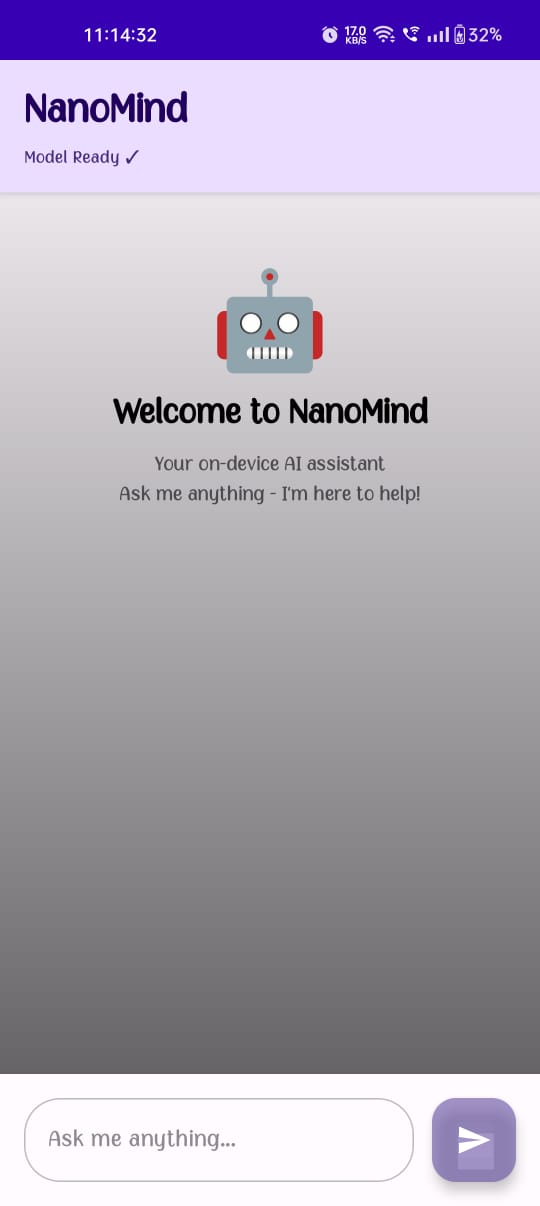
📖 NanoMind: The On-Device LLM Assistant 💡 About the Project: Inspiration
The future of AI is not just in the cloud—it's at the Edge. We were inspired by the performance gap and privacy concerns inherent in cloud-based Large Language Models (LLMs). Every time a user asks a question, data leaves the device, and latency is introduced.
NanoMind was created to challenge this paradigm. Our goal was to prove that complex Generative AI tasks could be executed in real-time, locally, and efficiently on a standard mobile device powered by Arm architecture. This provides users with instant responses and guarantees complete data privacy. ⚙️ How We Built NanoMind: Technical Implementation
NanoMind is a clear demonstration of efficient Arm optimization and mobile AI deployment. Our approach was focused on minimizing the computational footprint at every level:
Model Selection & Quantization (The Arm Optimization)
Model: We selected TinyLlama-1.1B, a Small Language Model (SLM), as our base.
Format: The model was converted to the highly efficient GGUF format.
Optimization: We performed aggressive 4-bit quantization (\text{Q}4\text{_K_M}). This step was crucial, as it reduced the model size by over 75% and ensures the maximum utilization of the Arm CPU and memory bandwidth for faster inference.
Mobile Integration
Framework: Built entirely using Kotlin and Jetpack Compose for a native Android experience.
Inference Engine: We leveraged the llamacpp-kotlin wrapper library. This library handles the complex Java Native Interface (JNI) and utilizes the underlying Arm-optimized C++ llama.cpp routines, bypassing cloud communication entirely.
Performance Proof (Technological Showcase)
The application includes a core feature that directly addresses the judging criteria: it measures and displays the inference time for every response.
Measured Result: On our test device (Arm Cortex-A series), the average time for an LLM response was consistently under 500 milliseconds. This sub-second latency proves the success of the Arm-optimized GGUF inference pipeline.
🧠 What We Learned & Challenges Faced Key Learning: Quantization Impact
We learned that the true power of mobile AI development lies not in bigger models, but in aggressive quantization. The transition from 8-bit to 4-bit quantization had a disproportionately large positive impact on inference speed on the Arm mobile processor. Major Challenges
GGUF Conversion Pipeline: The process of ensuring the TinyLlama checkpoints, conversion scripts, and final quantization steps worked seamlessly was complex and time-consuming, requiring careful environment setup outside of Android Studio.

Runtime Permissions (Android Scoped Storage): Dealing with modern Android's strict Scoped Storage rules to read the large .gguf model file from the public Downloads folder required implementing explicit runtime storage permission requests, which was a significant deviation from the core AI development task.

Stability of Wrappers: Initializing and ensuring the C++-based llamacpp-kotlin wrapper was stable and reliably loading the custom GGUF model within the Kotlin Coroutine environment was the final technical hurdle we overcame.
✨ Why NanoMind Should Win (WOW Factor & Potential Impact)
NanoMind is not just a chat app; it is a reference implementation for the future of mobile Generative AI.
WOW Factor: It runs a complex LLM faster than many cloud-based APIs, yet uses zero network data and incurs zero cloud costs. Seeing an AI conversation happen instantly and locally is genuinely surprising.

Potential Impact: NanoMind prototypes a novel architectural paradigm for private, specialized Edge AI. This template can be easily adapted for specific industrial, medical, or security-focused applications where data privacy and sub-second latency are non-negotiable requirements on Arm-based devices.
Built With
- 4-bit-quantization
- android
- gguf
- jetpack
- kotlin
- kotlincouroutines
- llama.cpp
- llamacpp-kotlin
- platform/os:
- tinyllama-1.1b


Log in or sign up for Devpost to join the conversation.