Inspiration
Healthcare professionals often face difficulties locating veins in children, elderly patients, and people with dark skin tones or dehydration. Repeated needle attempts cause pain, delays, and stress. NanoMedic AI was inspired by the vision of future medicine, where AI-powered medical nanobots could detect diseases early, deliver drugs with pinpoint accuracy, and continuously monitor health—making treatments safer, faster, and more personalized.
What it does
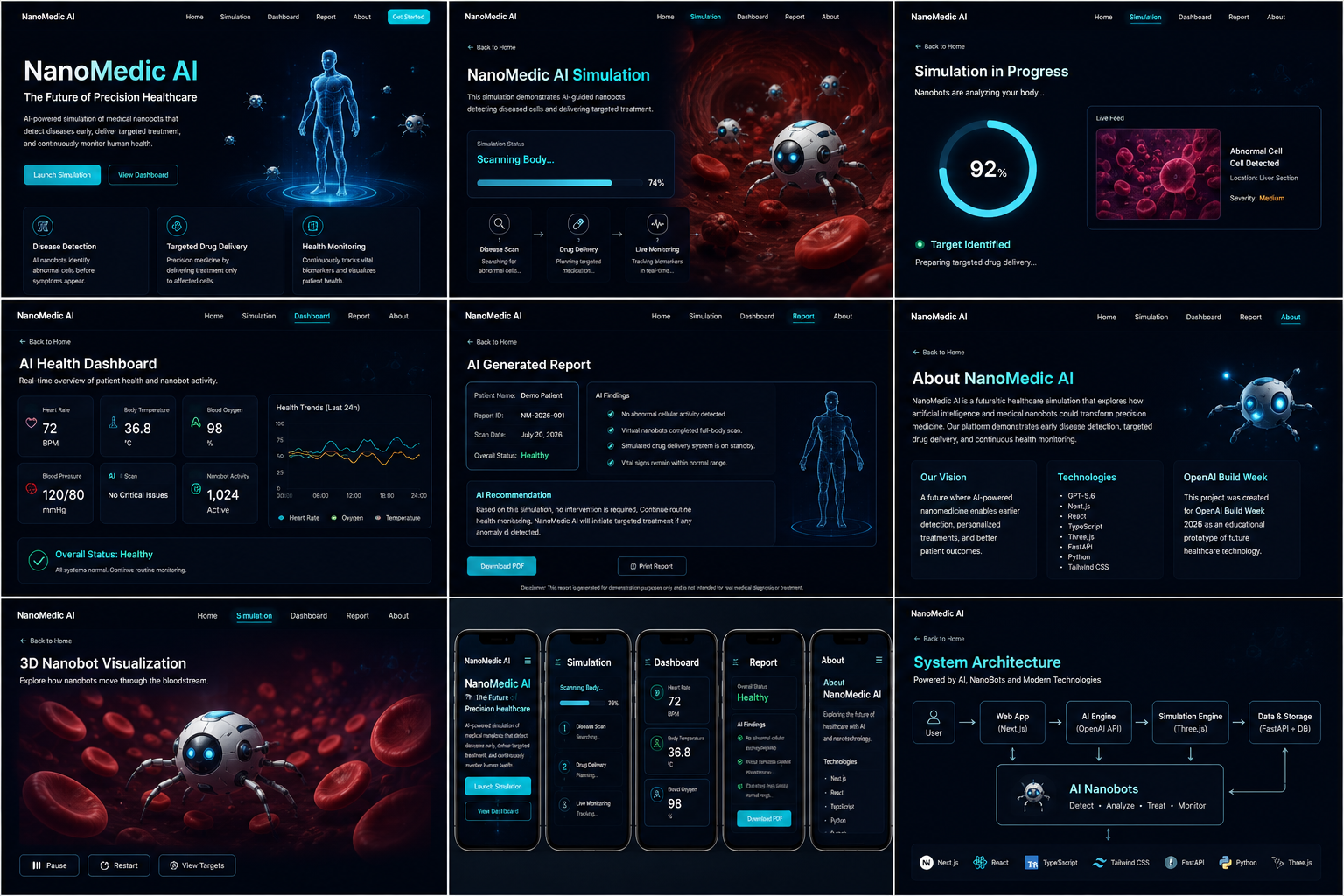
NanoMedic AI is a futuristic AI platform that simulates how intelligent medical nanobots could navigate through the human body. The system detects abnormal cells, identifies potential diseases, recommends targeted drug delivery, monitors vital biomarkers in real time, and presents health insights through an interactive dashboard. It demonstrates the future of precision medicine using AI-driven simulations.
How we built it
GPT-5.6 for medical reasoning and explanations.
Codex to accelerate development.
React/Next.js for the user interface.
Python (FastAPI) for backend logic.
Three.js for interactive 3D nanobot and human-body visualization.
OpenCV for image processing and simulation.
Firebase/Supabase for secure data storage.
AI simulation models to demonstrate nanobot navigation and targeted drug delivery.
Challenges we ran into
Since medical nanobots are still an emerging technology, we relied on realistic simulations rather than physical hardware.
Balancing scientific accuracy with an engaging user experience.
Designing intuitive 3D visualizations that clearly explain complex biomedical concepts.
Ensuring the AI presents information responsibly without making unsupported medical claims.
Accomplishments that we're proud of
Designed a unique vision for AI-guided nanomedicine.
Built an interactive simulation that makes complex healthcare concepts easy to understand.
Combined artificial intelligence, biomedical engineering, and 3D visualization into one platform.
Created a project with the potential to inspire future medical innovations.
What we learned
This project strengthened our understanding of AI in healthcare, precision medicine, medical visualization, and responsible AI design. We also learned how AI can simplify complex biomedical concepts through interactive simulations.
What's next for NanoMedic AI
Integrate digital twin technology for personalized treatment simulations.
Add AI-powered disease prediction using wearable sensor data.
Improve nanobot navigation algorithms using reinforcement learning.
Collaborate with biomedical researchers to validate future concepts.
Expand the platform into an educational and research tool for next-generation precision medicine.
Built With
- api
- codex
- fastapi
- firebase
- github
- gpt-5.6
- python
- react.js
- three.js
- vercel
- you-can-list:-gpt-5.6-openai-api-codex-python-fastapi-react.js-next.js-javascript-html5-css3-three.js-opencv-firebase-supabase-git-github-figma-blender-(for-3d-nanobot-models)-vercel-(deployment)-if-you're-only-creating-a-prototype-or-concept-demo

Log in or sign up for Devpost to join the conversation.