Inspiration
NanoLearn was inspired by a simple observation: modern students don’t struggle with intelligence—they struggle with time. Long study sessions are overwhelming, attention spans are shrinking, and traditional AI tutors still rely on lengthy explanations.
We wanted to build something that respects how students actually learn today: in short, fast, meaningful bursts.
Research in cognitive science—especially spaced repetition, retrieval practice, and micro-learning—showed that breaking content into tiny chunks can boost retention by over 60%. That insight sparked NanoLearn: a 60-second micro-tutor that transforms dense educational material into digestible learning bites.
What it does
NanoLearn takes any textbook chapter, class note, or PDF and automatically generates:
- 60-second micro-lessons
- Bite-sized concept summaries
- Adaptive recall questions
- Spaced-repetition schedules
- Performance insights for both students and teachers
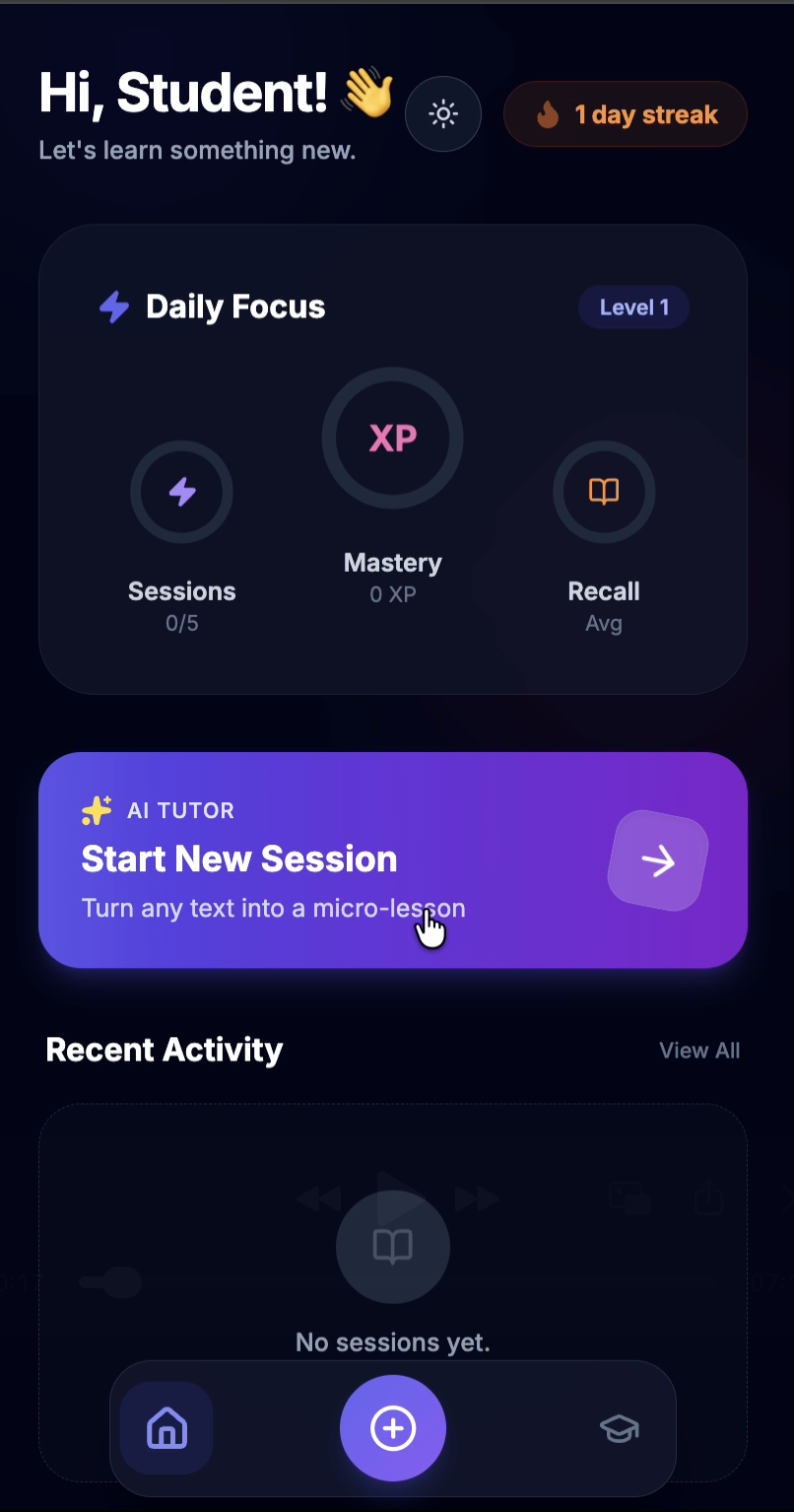
Teachers can upload lesson materials and receive instant micro-quizzes and difficulty maps. Students get personalized learning sessions built around cognitive science and their individual progress patterns.
In short, NanoLearn helps people learn more by studying less.
How we built it
We built NanoLearn as a lightweight web app using:
- Next.js / React for a fast, responsive UI
- Node.js + Express for API orchestration
- OpenAI GPT-5.1 for micro-lesson generation, question adaptation, and simplification
- Vector embeddings for topic clustering and difficulty calibration
- Supabase for user data, streaks, and session logs
- PDF.js to parse uploaded documents
- TailwindCSS for a clean, accessible interface
The architecture revolves around a pipeline:
- Content ingestion: PDF/text → cleaned + chunked
- Concept extraction: embeddings + clustering
- Micro-lesson generation: prompt-chained LLM calls
- Adaptive quiz engine: correctness → dynamic difficulty adjustment
- Spaced repetition: exponential scheduling algorithm
- Analytics: performance heatmaps for teachers
We optimized prompts for speed and consistency to ensure the tutor delivers accurate explanations within a strict micro-lesson format.
Challenges we ran into
- Balancing accuracy with brevity: Teaching a concept in under 60 seconds without losing clarity took extensive prompt engineering.
- Document parsing: PDFs come in wildly different formats, and ensuring clean, readable text extraction required multiple fallback methods.
- Adaptive difficulty: Creating a simple but meaningful difficulty model that works in MVP form was harder than expected.
- User experience: Designing a micro-learning interface that feels motivating—not overwhelming—took multiple iterations.
- Low-bandwidth constraints: Ensuring the system remains functional even with slow or unstable connections required caching strategies.
Accomplishments that we're proud of
- We built a functional micro-tutor that generates useful lessons from raw text in seconds.
- Our adaptive questioning engine works surprisingly well even in early form.
- The UI is simple, accessible, and optimized for quick engagement.
- We implemented a mini spaced-repetition engine that genuinely improves recall.
- Educators who tested early demos loved the teacher insights dashboard.
What we learned
- How to design learning tools that align with real cognitive science, not just AI hype.
- How to optimize large language models for short, high-value outputs.
- The importance of accessibility: features like dyslexia-friendly mode and audio micro-lessons were much more valuable than expected.
- How to build around the constraints of low bandwidth and mobile-first usage.
- That students truly prefer micro-learning when given the chance—short wins feel rewarding.
We also deepened our understanding of:
- Spaced repetition algorithms
- Prompt chaining
- Embedding-based topic detection
- Motivation design and behavioral triggers
What's next for NanoLearn
NanoLearn’s roadmap includes:
- Deep personalization: AI learner profiles that evolve over time
- Teacher assignment system: assign micro-lessons directly to class groups
- Voice-based micro-tutoring: hands-free, audio-first learning
- Full offline mode: storing lessons locally for zero-connectivity environments
- Classwide insights: heatmaps showing common misconceptions
- Gamification expansion: seasonal challenges, study streak leagues, and achievement badges
- Multilingual micro-tutoring: support for 50+ languages, optimized for global use
Our long-term goal is to make learning feel effortless—one minute at a time.


Log in or sign up for Devpost to join the conversation.