-
-
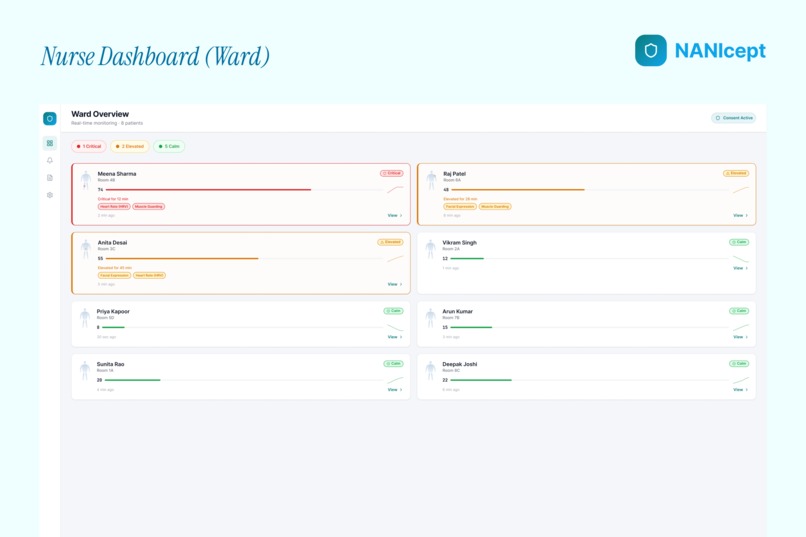
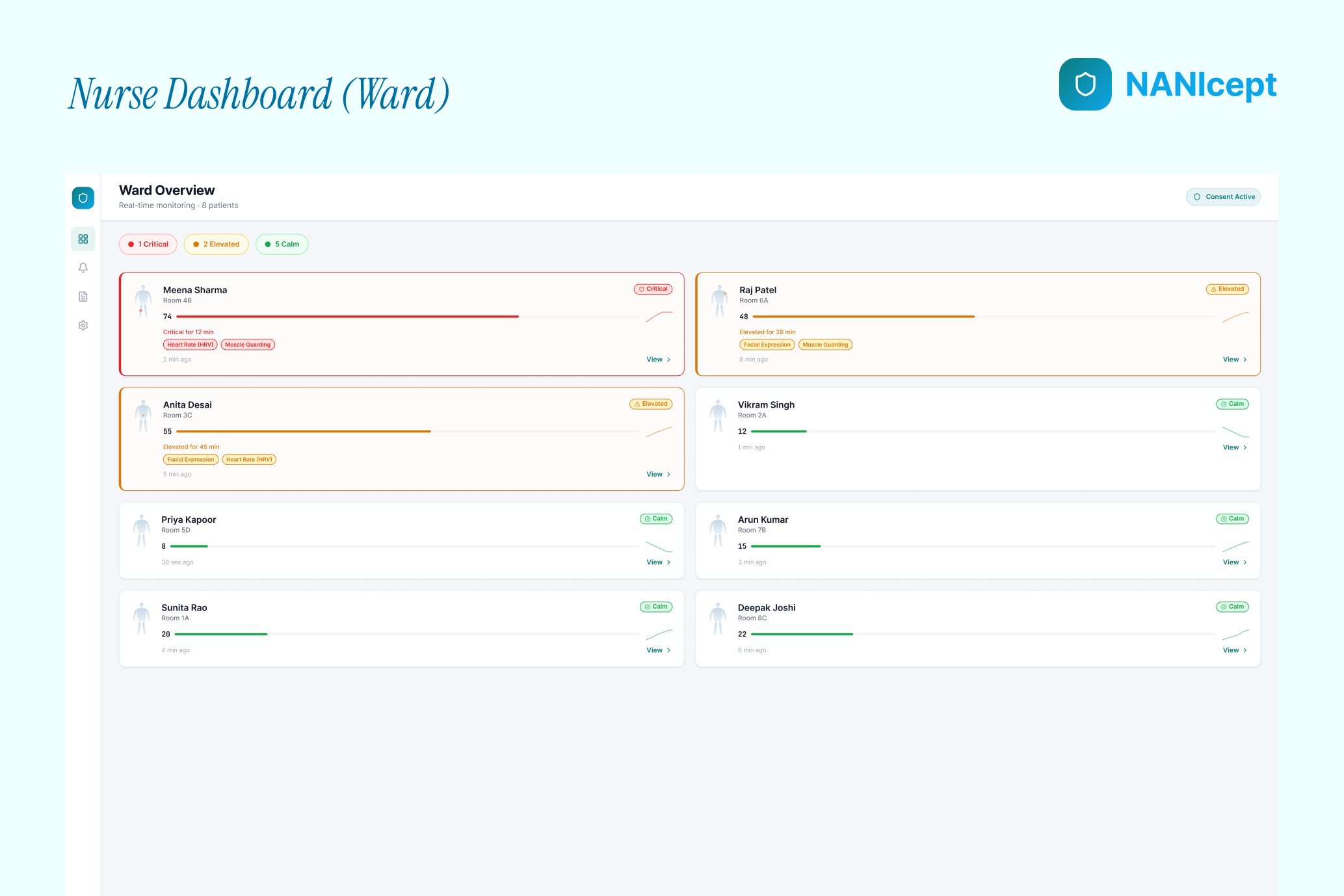
Nurse Dashboard (Ward)
-
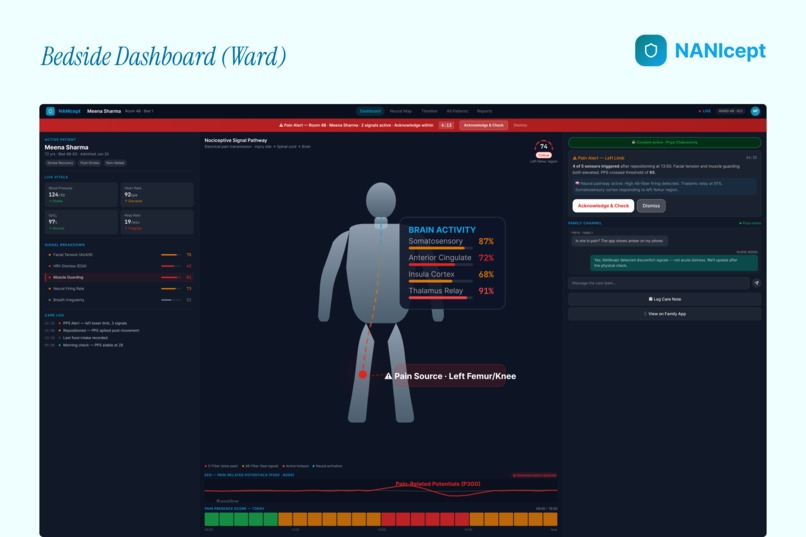
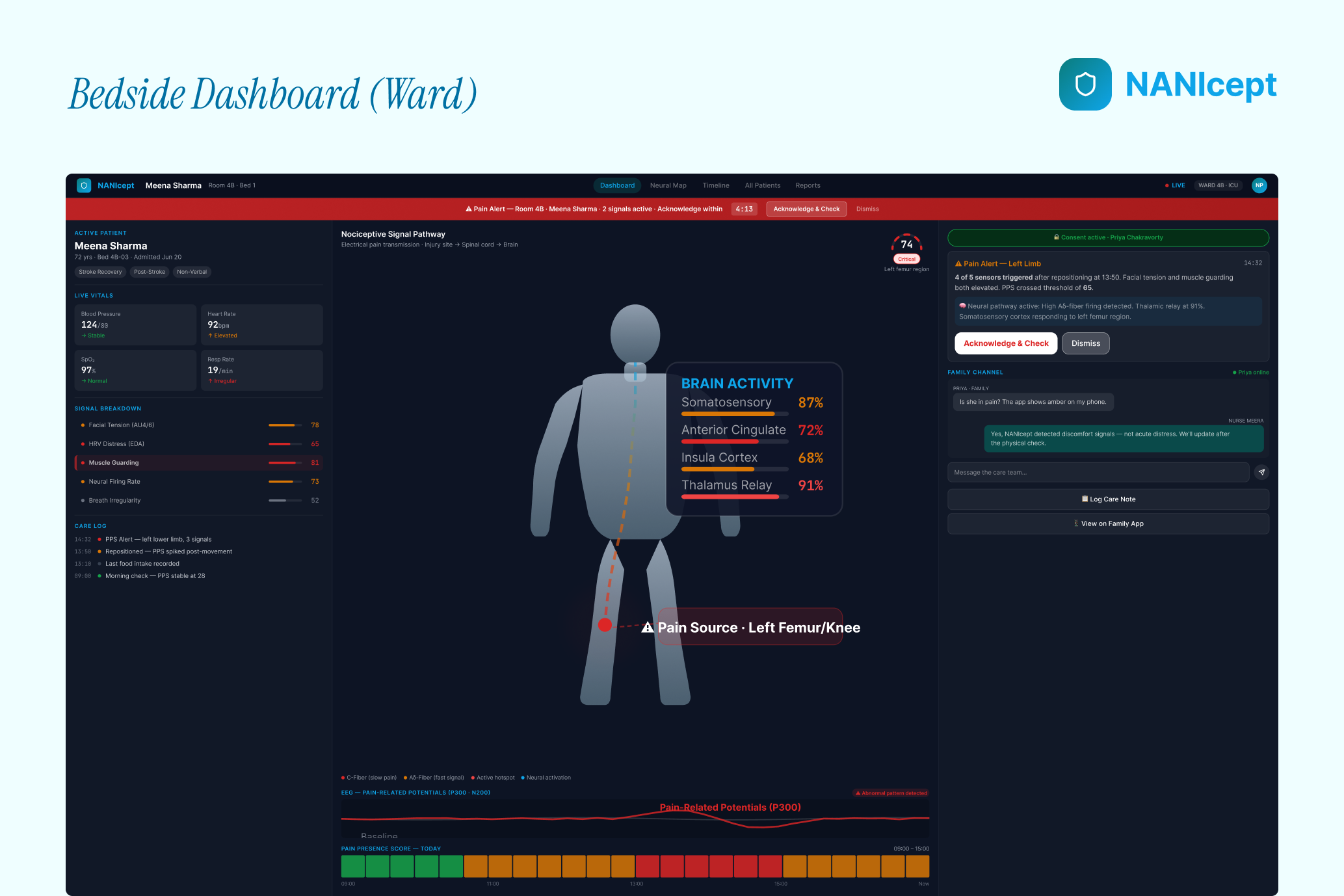
Bedside Dashboard (Ward)
-
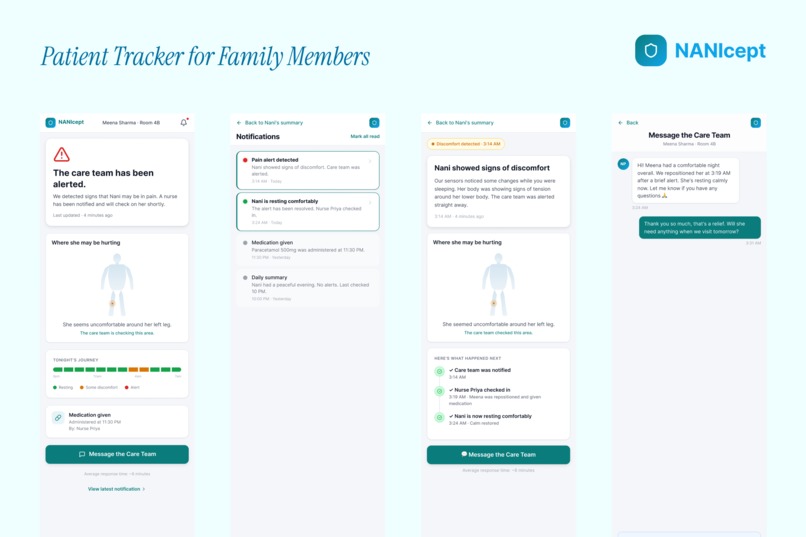
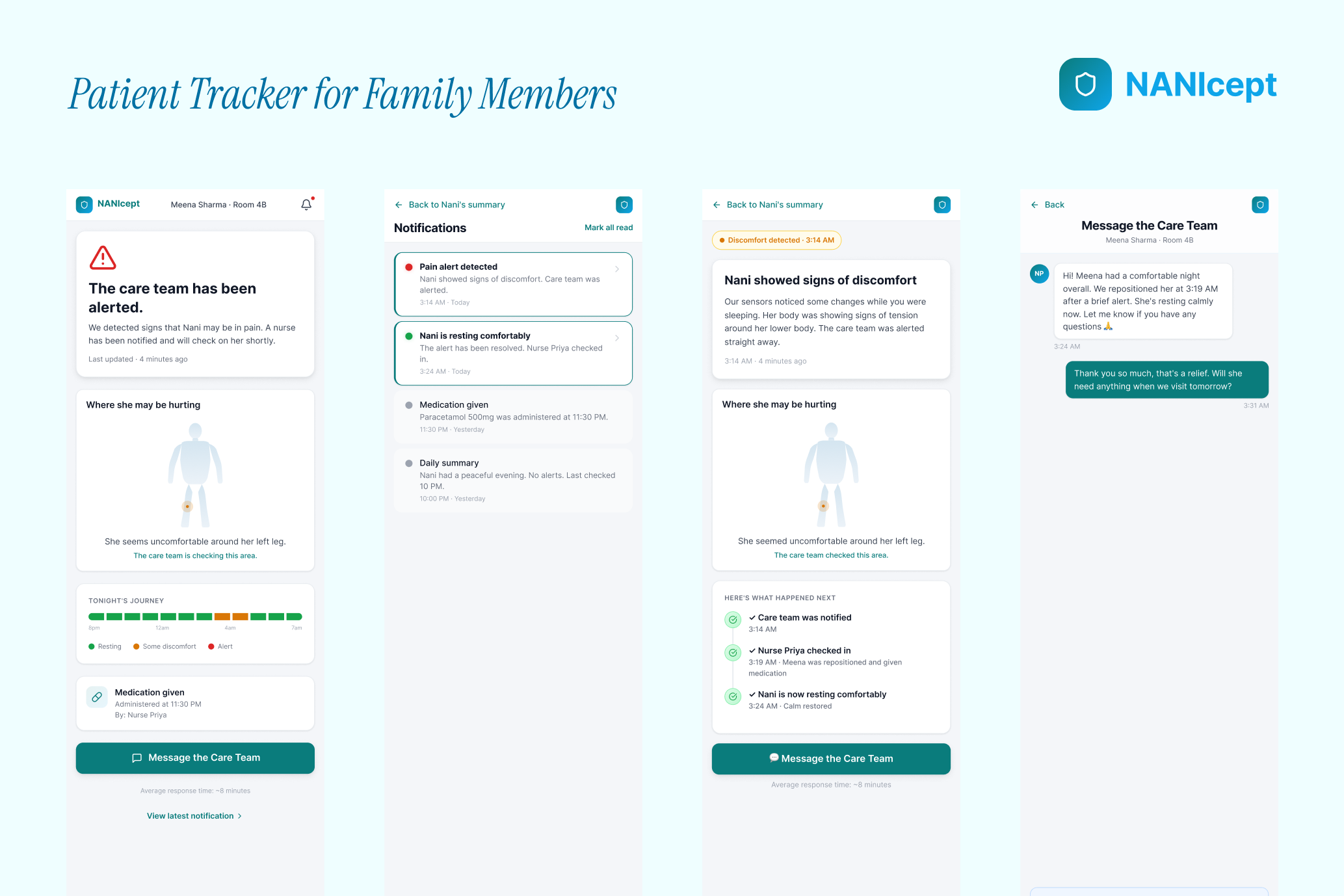
Patient Tracker for Family Members
🌟 Tagline
Because pain shouldn't have to be spoken to be heard.
🗣 Elevator Pitch
Ultra-short (10s):
A multi-sensor system that detects pain in non-verbal patients — giving caregivers a new sense: the ability to hear what cannot be spoken.
Standard (20–25s):
NANIcept is a speculative multi-sensor system designed to detect pain in patients who cannot communicate — such as stroke survivors, dementia patients, or sedated ICU patients. The system combines facial micro-expression analysis, physiological signals like heart rate variability, and movement patterns from smart bed sensors to compute a real-time Pain Presence Score. When pain is detected, caregivers are alerted instantly and families receive clear, human-friendly updates. Our goal is to give a voice to patients whose pain would otherwise remain invisible.
Inspiration
Pain is one of the most private human experiences. Yet in hospitals, thousands of patients live through it completely alone — not by choice, but because they cannot speak.
A friend on our team experienced this firsthand:
Their grandmother(NANI) had a stroke. She lost the ability to speak, gesture, or point to where she hurt. During her hospital stay, she suffered a hairline femur fracture that went undetected for hours because she couldn’t communicate her pain.
She wasn’t neglected — nurses cared deeply. The system just wasn’t built to hear her.
What if caregivers could perceive pain even when a patient cannot express it?
Many patients fall into this category:
- 🧠 Stroke survivors
- 🧓 Dementia patients
- 🏥 Intubated ICU patients
- 🧬 Individuals with severe neurological conditions
- 👶 Infants
Their pain becomes invisible. We built NANIcept to change that.
The name comes from the Hindi word Nani — meaning grandmother and Nociception (Sense of Pain), a reminder that behind every patient chart is someone deeply loved.
What it does
NANIcept gives caregivers a new sensory capability: the ability to perceive pain when a patient cannot express it.
Instead of relying on periodic observation or self-reported pain scales, NANIcept continuously monitors the body's involuntary signals, the ones that tell the truth even when words can't.
Four signal streams:
- Facial micro-expressions → Brow tension, eye tightening, cheek raising
- Muscle guarding & movement resistance → Smart bed-integrated sensors detect involuntary flinching and asymmetry
- Heart Rate Variability (HRV) & electrodermal activity → Wristband sensor captures autonomic stress
- Neural activity proxies (fNIRS) → Near-infrared spectroscopy signals associated with nociceptive processing
These signals are fused to create a Pain Presence Score (PPS) in real-time:
PPS = f(Ef, Mg, HRV, Nb)
Ef  = facial expression signals
Mg  = muscle guarding patterns
HRV = autonomic stress indicators
Nb  = neural activity proxies
When pain is detected, NANIcept:
- 🚨 Alerts caregivers immediately
- 💌 Notifies family members in human-friendly language
- 🛌 Initiates gentle environmental responses
- 📈 Logs a Pain Timeline for medical review
Over time, it learns each patient’s baseline to improve accuracy.
How we built it
Smart Bed Sensor Layer
- Detects muscle guarding, flinching, and asymmetrical movement
- Avoids wearables that interfere with IV lines or equipment
- Detects muscle guarding, flinching, and asymmetrical movement
Vision-Based Expression Detection
- Facial micro-expressions analyzed on-device
- No video is stored; only scores leave the device
- Facial micro-expressions analyzed on-device
Sensor Fusion Engine
- Correlates multi-stream signals over time
- Detects pain-specific cascades rather than single spikes
- Differentiates pain from fear, exertion, or startle responses
- Correlates multi-stream signals over time
Multi-Surface Interface
- Caregiver Dashboard (Tablet): PPS gauge, body-map localization, Pain Timeline, one-tap alert acknowledgment, messaging
- Family Mobile App: Emotional updates, color-coded history, nurse messaging, no raw numbers
- Admin Dashboard (Desktop): Full Pain Timeline, exportable reports, cross-patient analysis
- Patient Wristband: LED + haptic pulse indicating current PPS
- Caregiver Dashboard (Tablet): PPS gauge, body-map localization, Pain Timeline, one-tap alert acknowledgment, messaging
Challenges we ran into
- False Positives → HRV spikes from anxiety, movement from exertion, or facial changes from fever mimic pain. Solved with multi-stream correlation requiring ≥2 signals to trigger alert.
- Ethics & Privacy → Consent management, on-device processing, family sees summaries only, nurse override, auto-escalation, data deletion after discharge.
- Two User Types → Nurses need clinical dashboards; families need emotionally supportive updates.
- Hardware Feasibility → Wearables impractical for ICU patients, so sensors were integrated into the bed itself.
Accomplishments that we're proud of
- ✅ Built a working multi-sensor prototype demonstrating real-time PPS
- ✅ Designed dual-layer communication for caregivers and families
- ✅ Implemented ethical safeguards from day one (consent, privacy, transparency)
- ✅ Conceptually aligned with state-of-the-art research in multimodal pain detection and affective computing
- ✅ Created a human-centered workflow that research prototypes often ignore
What we learned
- Healthcare technology is human-first, technical-second
- Trust is harder to engineer than sensors
- Data alone is not enough; information must reduce anxiety
- Designing for vulnerable patients requires careful consideration of consent, autonomy, and power dynamics
- Speculative design uncovers invisible gaps in real-world healthcare systems
Pain should never go unheard simply because someone cannot speak.
What's next for NANIcept
- Expand signal modalities (EEG, advanced fNIRS) for even more accurate pain inference
- Conduct real-world usability studies with clinicians and families
- Explore integration with hospital EMRs for seamless workflows
- Research predictive analytics to anticipate pain events before they occur
- Refine the family communication app to support personalized, context-aware updates
Built With
- claude
- figma
- figmamake


Log in or sign up for Devpost to join the conversation.