-
-
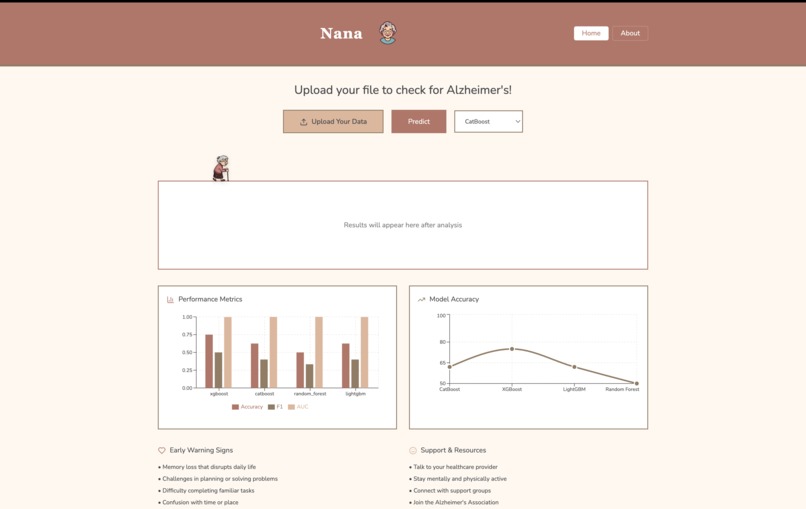
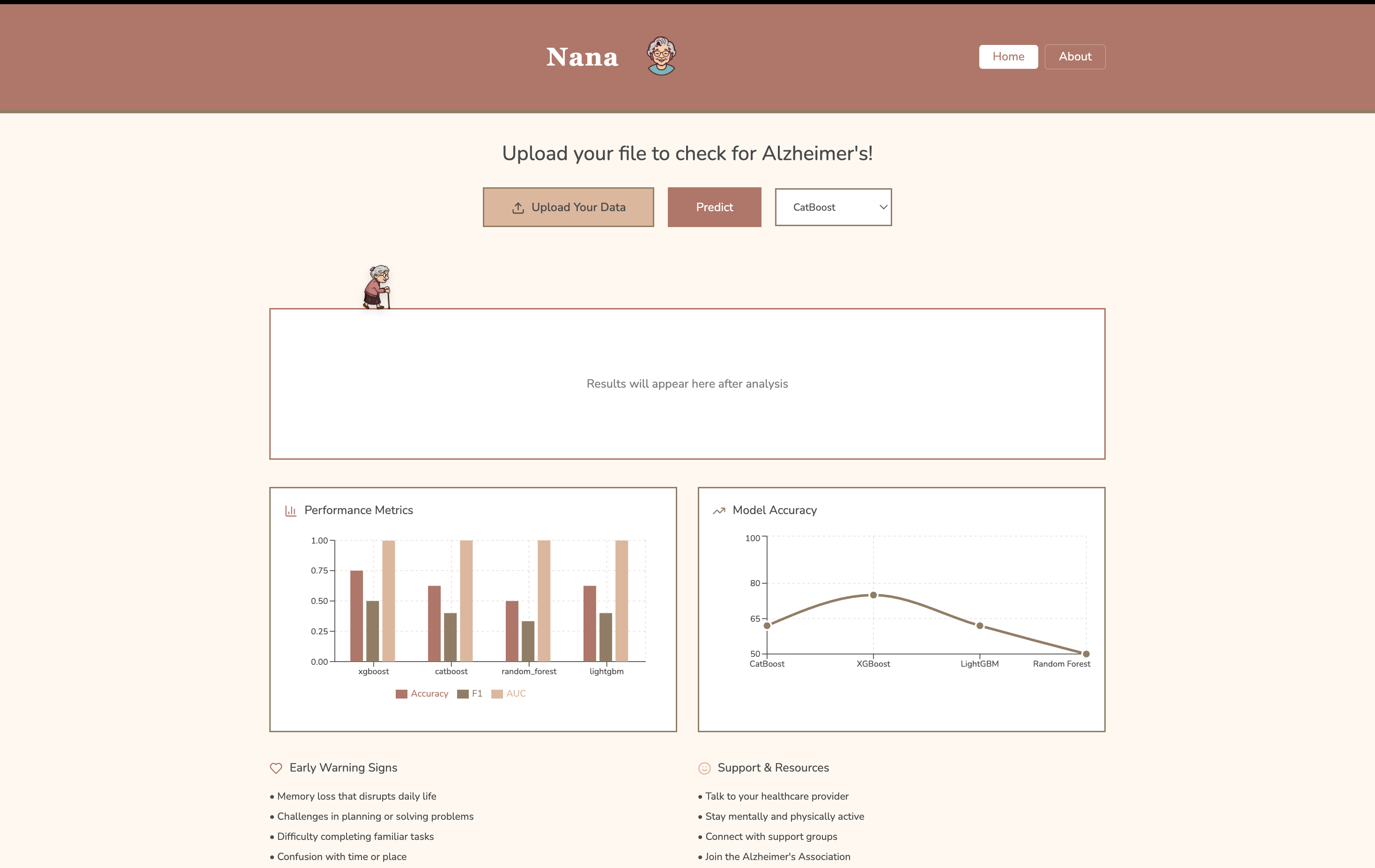
frontend home page
-
-
-
🧠 Nana — EEG-Based Alzheimer’s Detection | PharmaHacks 2026 | Challenge 3
Over 770,000 Canadians are currently living with dementia, including Alzheimer’s disease, and early detection remains one of the biggest challenges in improving outcomes.
Most diagnostic tools today are expensive, time-consuming, or inaccessible. We asked: What if early Alzheimer’s screening could be as simple as uploading a brain signal file?
Nana bridges the gap between machine learning research and real-world usability. By combining EEG-based detection with an intuitive interface, we take a step toward making early Alzheimer’s screening more accessible, scalable, and practical.
💡 What it does
Nana is an end-to-end system that detects Alzheimer’s disease from EEG recordings. It allows users to:
📁 Upload EEG data files 🧠 Automatically extract brainwave features 🤖 Run a trained machine learning model 📊 Receive a prediction: → Alzheimer’s Disease (AD) → Cognitively Normal (CN)
Unlike traditional tools, Nana makes this process fast, simple, and user-friendly through an interactive frontend.
🛠️ How we built it
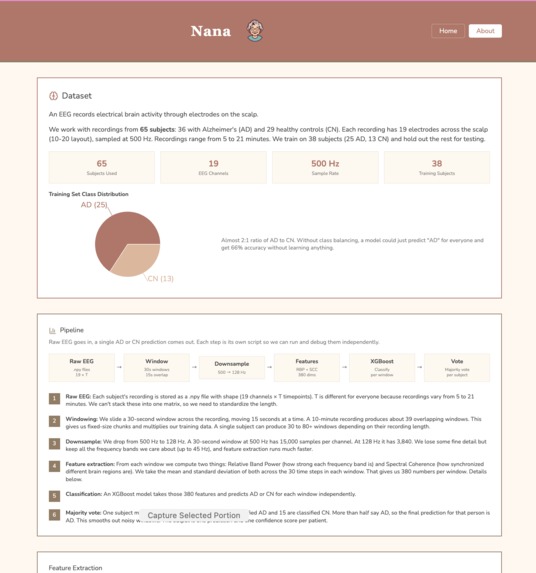
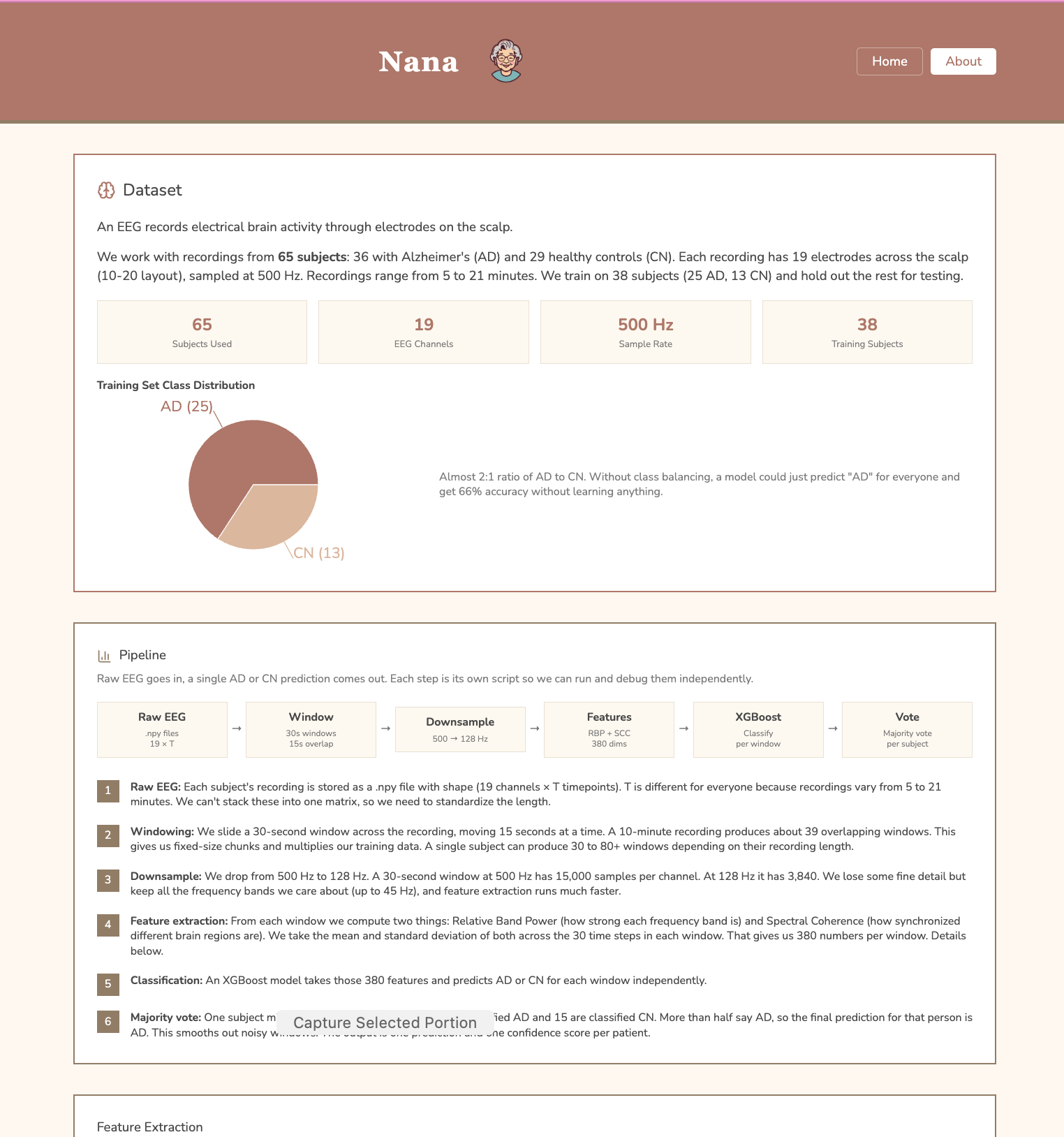
Data: 88 subjects total Binary classification: AD vs CN 19 EEG electrodes, sampled at 500 Hz 3–5 minute recordings per subject
Feature Engineering: We implemented a signal-processing pipeline using sliding windows: 30-second windows with 15-second overlap Downsampled to 128 Hz
For each window, we extracted:
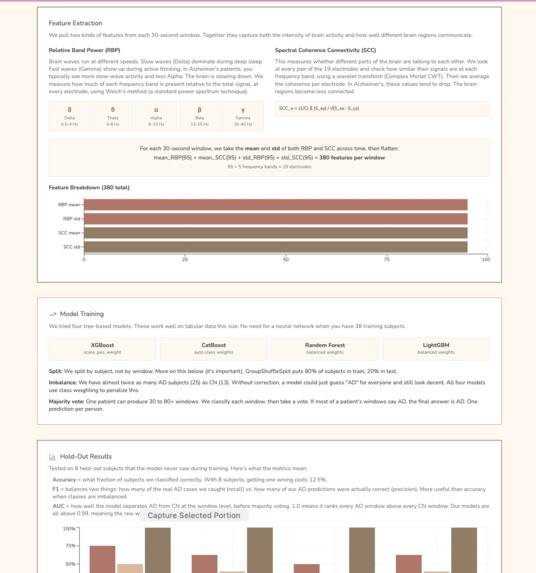
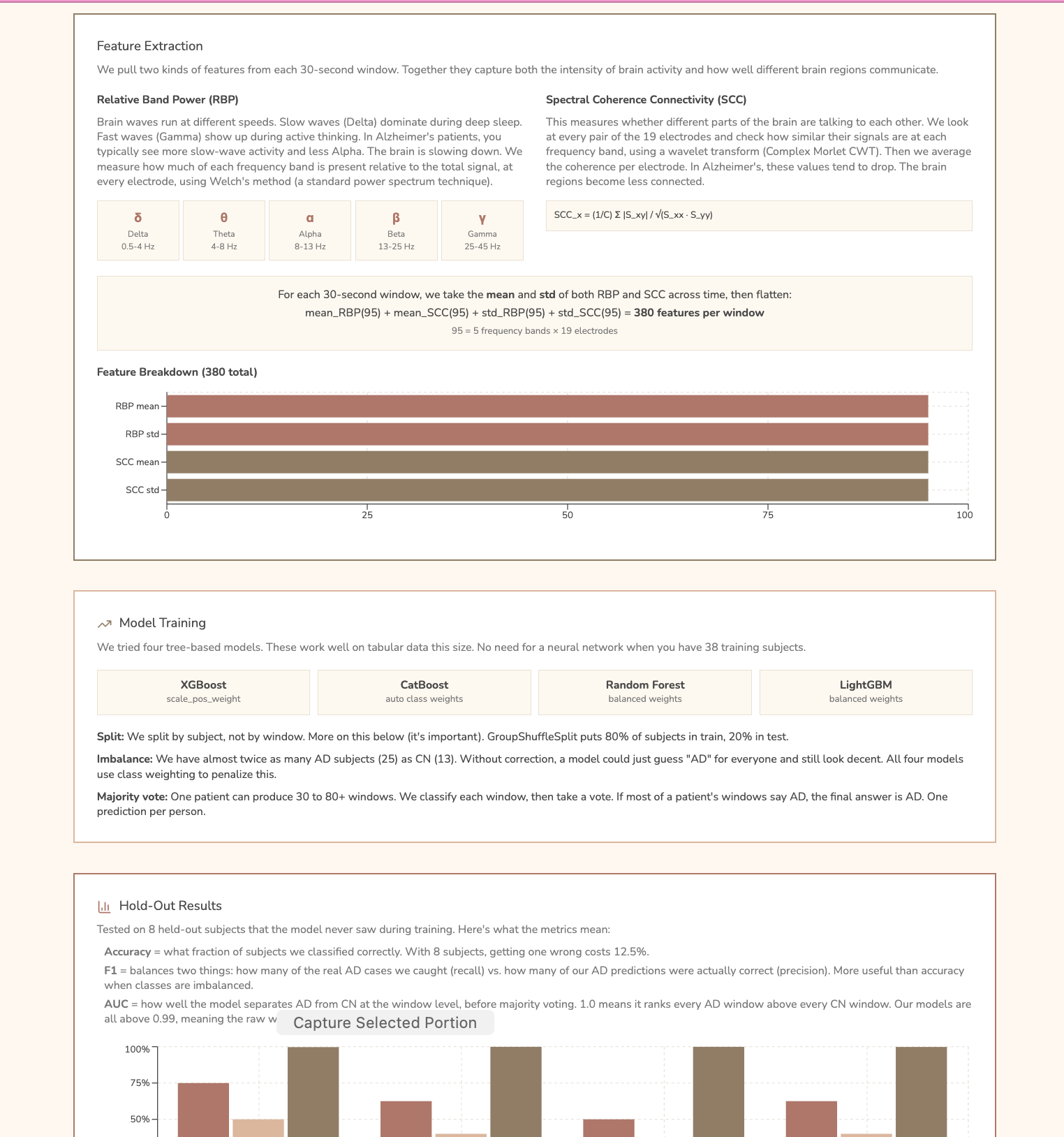
Relative Band Power (RBP) Energy distribution across: Delta, Theta, Alpha, Beta, Gamma
Spectral Coherence Connectivity (SCC) Measures synchronization between brain regions We computed the mean and standard deviation ➡️ Total: 380 features per window
🤖 Machine Learning We trained and compared:
- CatBoost
- Random Forest
- XGBoost
- LightGBM
Key decisions:
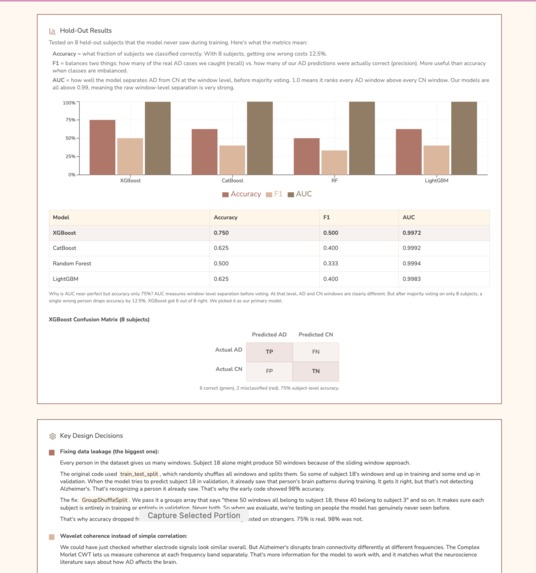
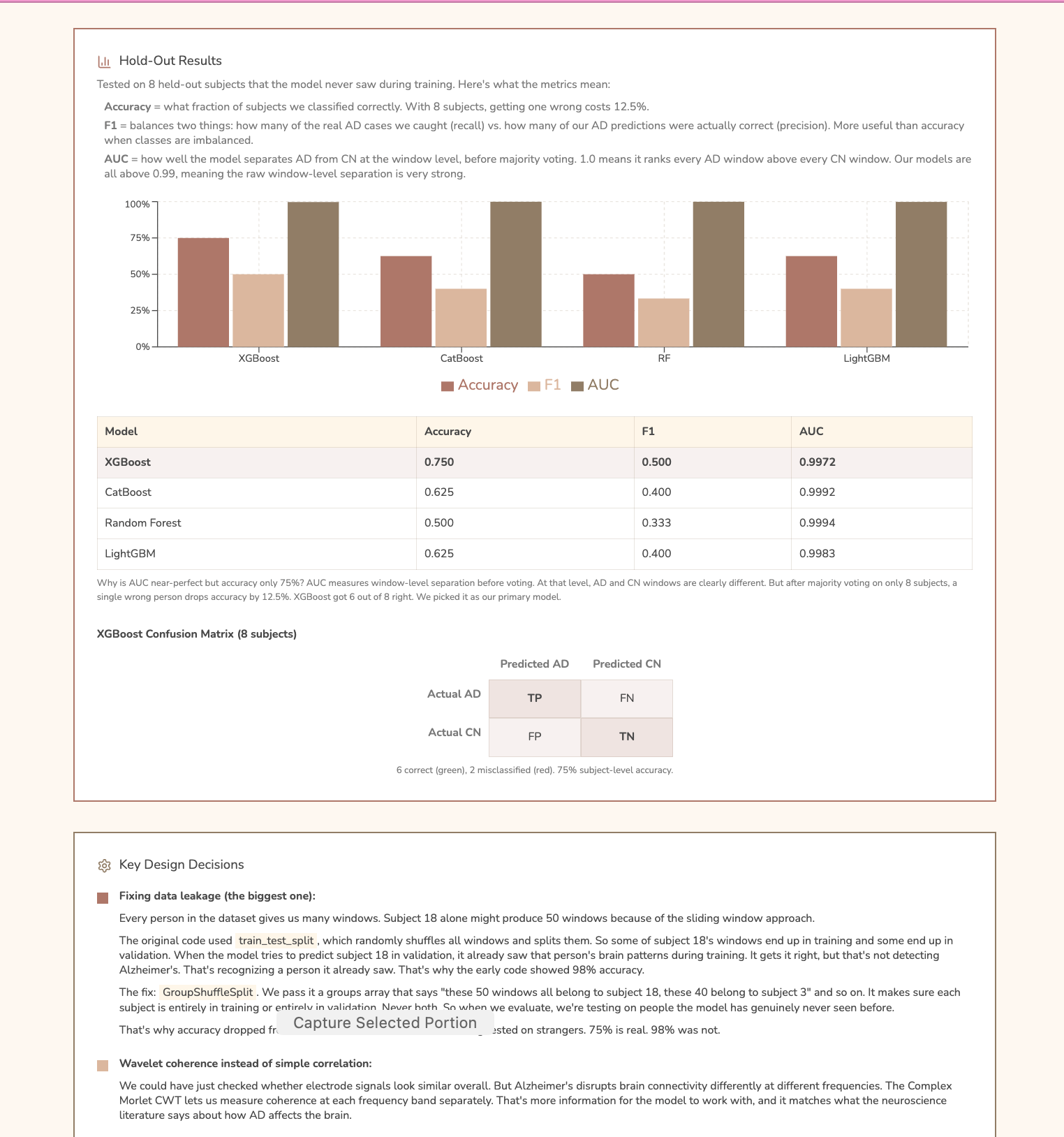
GroupShuffleSplit to prevent subject-level leakage Class balancing for skewed data Majority voting for subject-level predictions
🌐 Frontend
We built a simple, user-friendly interface that: Allows users to upload EEG .npy files Connects to the backend pipeline Runs preprocessing + inference automatically ✅ Best model: XGBoost ⚠️ Evaluated on a small validation set (8 subjects)
⚙️ Challenges we ran into
Working with limited and imbalanced medical data Avoiding data leakage across subjects Extracting meaningful signals from noisy EEG data Bridging the gap between ML pipeline and frontend usability Ensuring predictions are meaningful at the subject level
🏆 Accomplishments that we’re proud of
- Built a full end-to-end system (data → model → user interface) Designed a clean frontend for real-world usability Engineered neuroscience-based features from raw EEG Achieved strong results despite small dataset Successfully integrated ML into an interactive application
📚 What we learned
- Real-world ML requires more than models, it needs usability
- Preventing leakage is critical in healthcare AI
- Feature engineering is key for EEG data
- Frontend integration dramatically increases project impact
- Collaboration across domains is essential
🔮 What’s next for Nana
Deploy as a web app with real-time inference Expand the dataset for improved generalisation Add deep learning models to raw EEG signals Extend to multi-class classification (AD, FTD, CN) Improve UI with visualisations of brain activity


Log in or sign up for Devpost to join the conversation.