
Inspiration
Most budgeting apps show you a list of past transactions and leave the hard question to you: if I do this, am I going to be okay? We wanted a tool that shows your money's future, not just its past, and never guesses about it. AI is good at explaining and bad at arithmetic, so in Koin code does the math and AI only explains it.
What it does
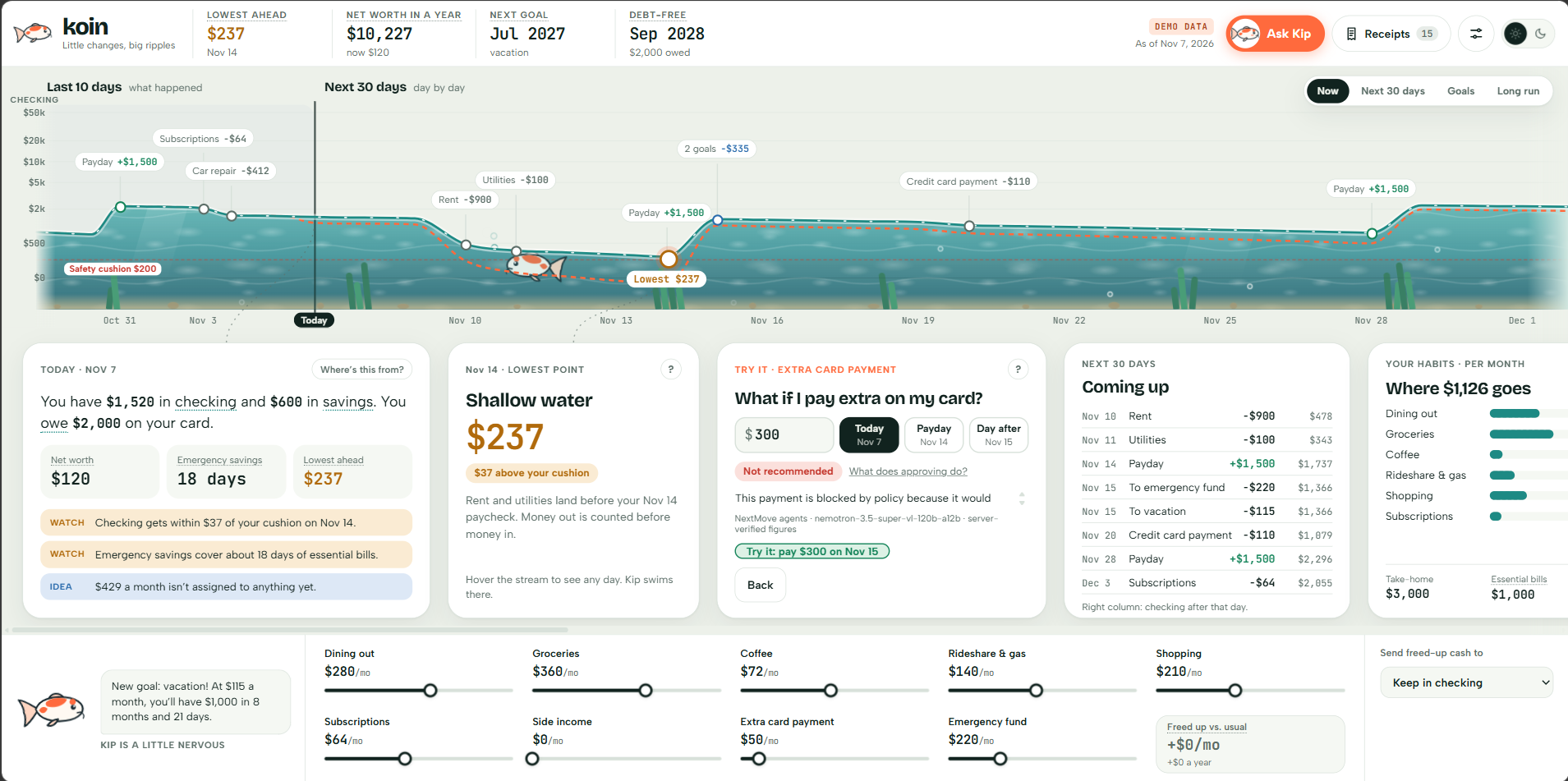
Koin shows your checking balance as a living stream of water flowing through time: the last 10 days, the next 30 days day by day, the year ahead month by month, then the long run. Bills, paydays and goal payments are pinned where they happen, your safety cushion is a dashed line, and your lowest point ahead is highlighted.
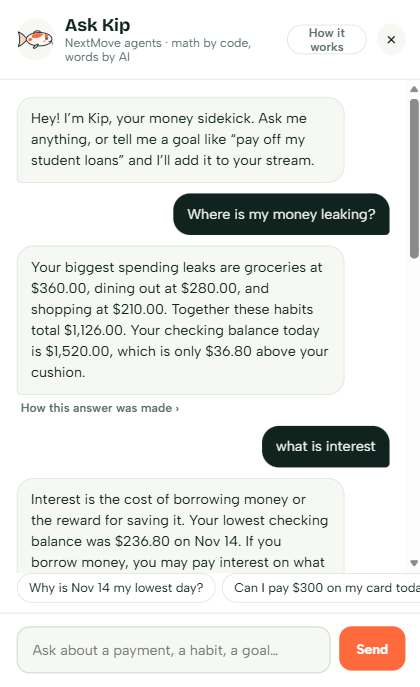
- Kip, your Sidekick. A koi who swims along the stream and reacts to your situation, from thriving down to panicking. Ask Kip a question or tap a quick ask like "Why is Nov 14 my lowest day?" Every answer shows how it was made: which steps were code, which were AI.
- Try before you commit. Preview an extra card payment on the stream. If it would push checking below your cushion, Koin blocks it and suggests a safer date.
- Habits and goals. Drag sliders like dining out to see what you free up and where your net worth lands in a year. Tell Kip a goal in plain words ("Pay off $18,000 in student loans at 5%") and it becomes a card on the stream with a finish date.
- You approve, nothing moves. Changes only happen when you approve them, and they only update your plan. Koin never moves money. Every review leaves a decision receipt with its figures, checks and steps.
- Real sandbox data. Switch to a Capital One Nessie sandbox customer and their accounts, debts and upcoming bills fill the stream. Anything the sandbox doesn't provide, like take-home pay or an interest rate, is shown as unknown, never guessed.
How we built it
- Backend: Node 22 with built-in SQLite and no npm dependencies. All money is integer cents, and one finance module computes every forecast, safety check and payoff.
- AI workflow: NVIDIA Nemotron plays three roles (Coordinator, Strategist, Coach) in a strictly bounded workflow: at most 4 model calls, 6 tool calls and 45 seconds. The model can only cite verified figures through placeholders like
{lowest_balance}, and the server rejects any text with a number it didn't supply. The AI can't approve anything; approvals are server-checked and single-use. - Frontend: the Koin interface was designed in Claude Design and built with animated SVG water, light and dark themes, and Kip as an animated SVG mascot.
- Built for a public demo: strict security headers, secure session cookies, cross-site request checks, rate limits, a daily AI cap and auto-expiring sessions.
Challenges we ran into
- Keeping AI honest: we designed placeholder-based explanations and server-side checks so the model can't invent a balance or contradict the safety check.
- Telling the truth about data: the sandbox has no pay dates, interest rates or reliable account history, so we show "unknown" instead of plausible-looking guesses.
- Making a forecast feel alive: we fit days, months and years onto one continuous stream while keeping the lowest point always visible.
Accomplishments that we're proud of
- A Sidekick that shows its work and labels what was AI, what was code and what was your input.
- A complete loop: forecast, review, safety check, your approval and a saved receipt.
- A finance app that's genuinely fun to look at.
What we learned
Trust comes from showing your work. Keeping "code calculates" separate from "AI explains" made Koin both safer and easier to understand.
What's next for Koin
- Move Koin's what-if math (habits, goals, long-run projection) into the backend finance engine so every screen shares one source of truth.
- Mobile layouts and more data sources.
- Ongoing monitoring, so Kip can warn you before a low point arrives.
