Focus Buddy
An AI-powered assistant for your productivity, that grows and adapts to your lifestyle and daily flow!
Procrastination...
We've all been there: you open your laptop to study, blink, and somehow 45 minutes of YouTube Shorts have disappeared. The standard approach is blunt and binary: block this site, allow that one, done. There's no awareness of who you are & what you're trying to accomplish, let alone what your day actually looks like. It's a one-size-fits-all solution to a deeply personal problem, and it shows. People disable these tools within days because they feel like they're fighting them rather than being supported by them.
Every person has a completely different relationship with focus. A university student pulling a late-night study session, a shift worker squeezing in deep work between meetings, a high schooler trying to get homework done after practice, these are not the same story. And yet, almost every productivity app treats them identically.
Focus Buddy started from a different premise: what if your productivity tool actually understood your context? What if, instead of enforcing a generic rulebook, it learned your patterns, respected your lifestyle, and intervened in a way that felt human?
What it does
Focus Buddy is an assistant that monitors your browsing behaviour in real time and uses Gemini 2.5 flash to determine whether you're procrastinating with genuine nuance. Not "are you on YouTube?", but "are you watching a lecture recording or mindlessly scrolling Shorts at 2am when you have a deadline tomorrow?"
It starts by learning your story. During onboarding, you choose a profile and share details about your schedule, goals, and work style. That context shapes everything the AI does afterward: what counts as a productive session for you is different from everyone else.
The problem with most productivity blockers is that they're stateless. They look at a URL and make a call. But research shows procrastination isn't really about which app you're on - it's an emotion-regulation response. People leave tasks because the work feels aversive, threatening, or slow to pay off, and the alternative offers immediate mood repair. A tool that just blocks Instagram has fundamentally misread the problem.
From there, it uses a two-tier alert system designed to feel proportional, not punishing. Research on self-report accuracy is clear: if telling the truth can trigger a punishment, users will lie. Focus Buddy separates diagnostic questions from consequences entirely - saying "I'm taking a break" never counts against you.
- Soft alert: A gentle check-in when the AI is unsure: "This looks like a break, want a timer?" You're in control.
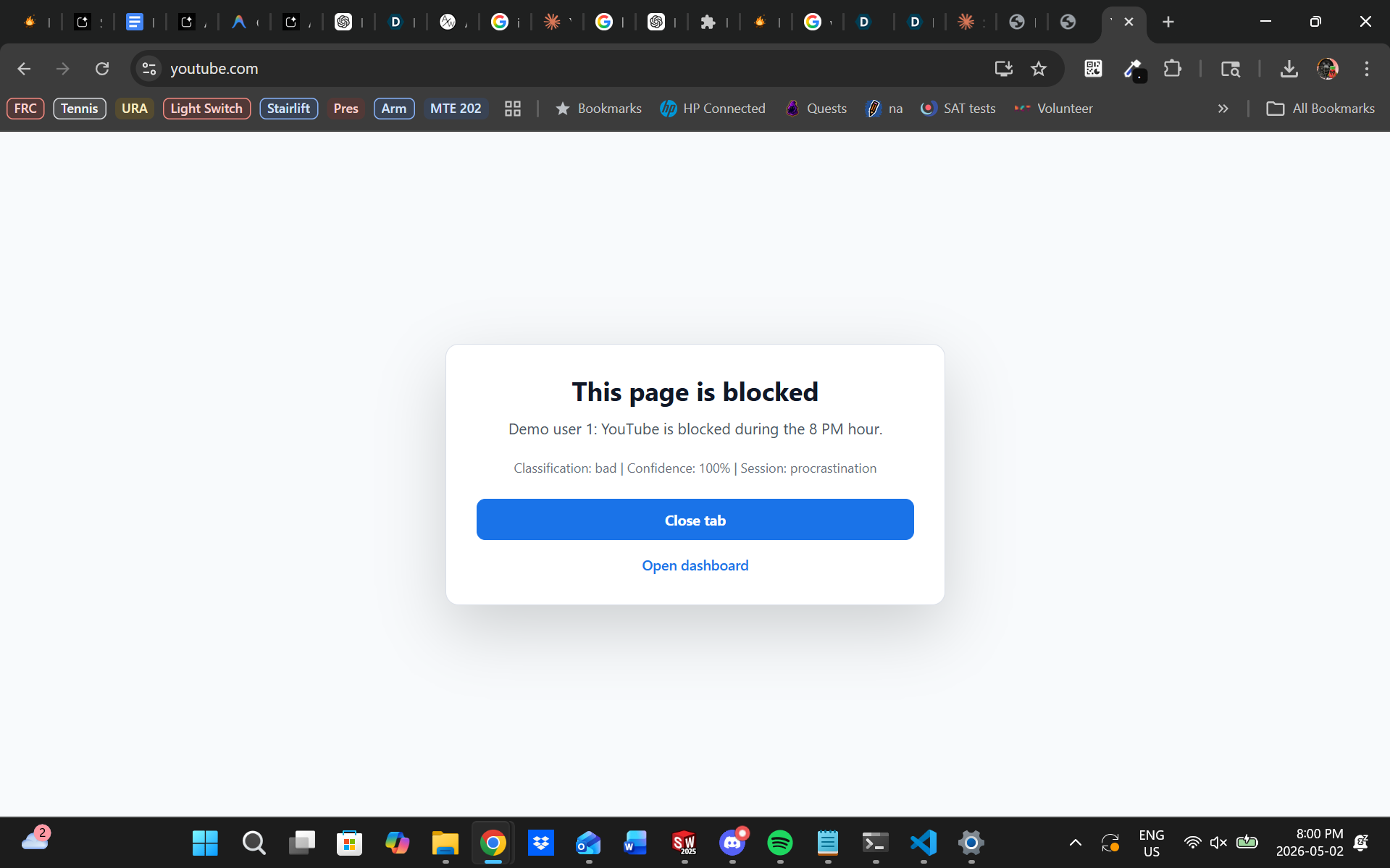
- Hard alert: A blocking screen for high-confidence procrastination, with intervals that grow if you keep dismissing it.
Crucially, there's no penalty for honesty. If you tell Focus Buddy you're taking a break, it backs off with no judgment or strike. The goal isn't surveillance; it's support. Apart from just good UX and retaining users, that honesty is also how you get accurate data to actually improve the model over time.
How we built it
So far, Focus Buddy is a Chrome extension with a background service worker that builds a live picture of your session from multiple signal layers: active tab URL and duration, tab switch frequency, scroll speed and click patterns, idle vs. active time, background tab activity, time of day, content category signals, and session sequence patterns.
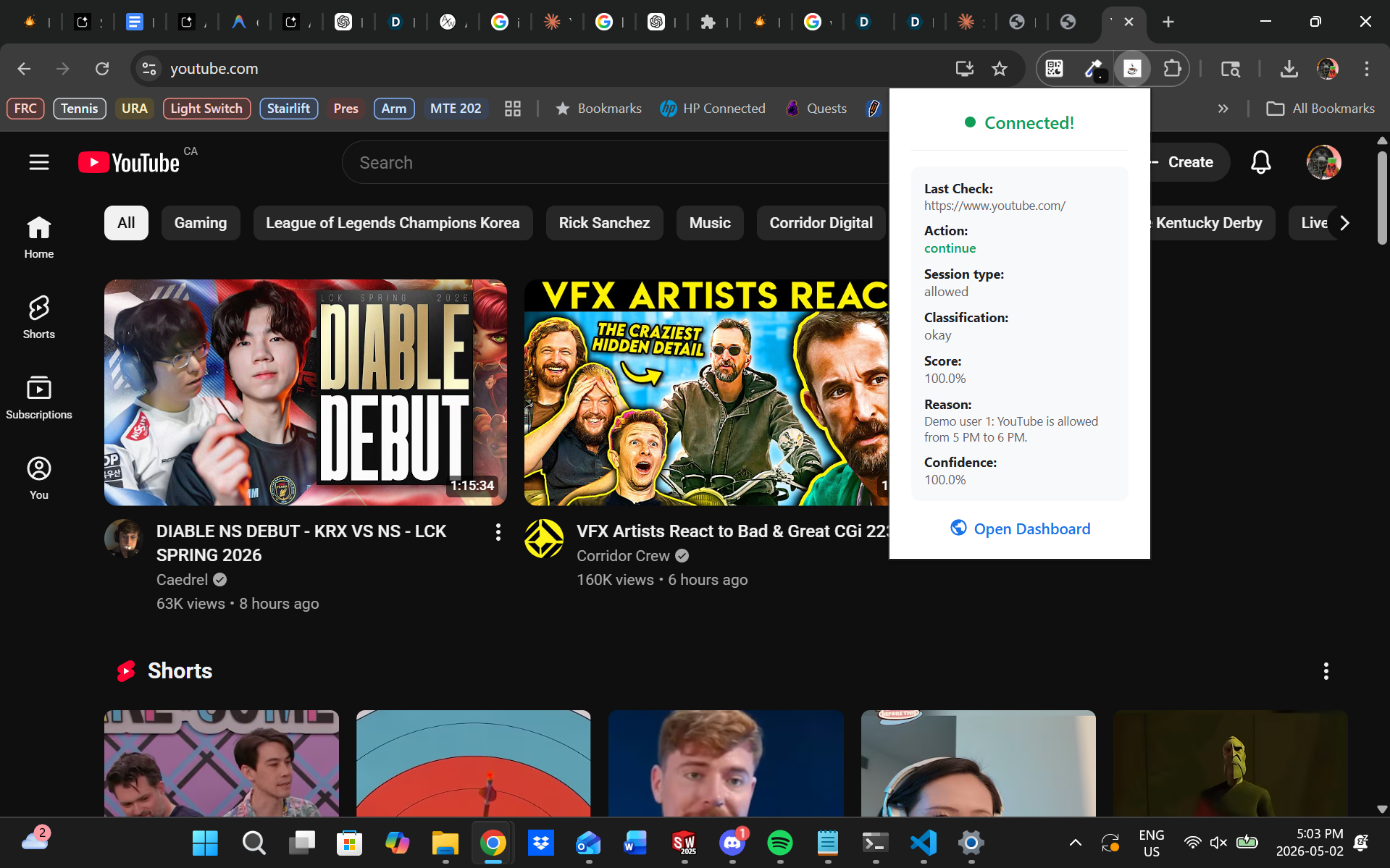
These signals are passed to an AI classifier that produces a procrastination confidence score personalised to the user's profile. The same URL carries completely different weight depending on who you are and what came before it in your session. A Stack Overflow tab after twenty minutes of active typing reads very differently than one opened immediately after Reddit.
We require several independent signals to align before triggering a hard block: goal mismatch, a high-risk feed format, a derailment sequence, and low genuine engagement. If any of those are missing, the system stays in soft-alert mode. False positives aren't a minor UX mistake - research on warning systems shows they reliably produce "cry-wolf" effects, alarm fatigue, and psychological reactance, where users resist and sometimes do more of the restricted behaviour out of spite.
We tuned the model hard to minimise false positives. Getting it wrong and blocking someone doing real work erodes trust irreparably, and without trust, we become just another failed productivity app.
Chal
Accomplishments we're proud of
We're most proud of the intervention philosophy. Most productivity tools are either too passive (you ignore them instantly) or too aggressive (you uninstall them). We spent a long time on deciding on our final extension interaction: soft/hard alert split with growing intervals, a no-penalty honesty mechanism, and low-confidence nudges instead of blocks. It's a deliberate attempt to build a tool that respects you as a person with a real life, not a compliance problem to be solved.
The profile system also came out better than we expected. Watching the classifier behave differently for the same URL depending on the user's declared context (e.g. a shift worker at 11pm vs. a student at 11pm) felt like the tool was actually starting to understand people rather than just patterns.
What we learned
The biggest lesson: behaviour only makes sense in context. Procrastination isn't a URL - it's a relationship between what you're doing, what you were supposed to be doing, who you are, and what time it is. Building for that complexity forced us to think less like engineers designing a filter and more like designers trying to understand a person.
The research on digital self-control tools is humbling: pure awareness features (usage dashboards, basic timers) have weak and short-lived effects. Harder interventions work, but only when they're difficult to bypass and feel user-chosen. The moment a block feels externally imposed and unjustified, self-determination theory predicts resistance, people restore their sense of autonomy by defeating the tool. The difference between a productivity app people keep and one they uninstall in a week often comes down to whether it felt like a collaborator or a warden, and finding that balance for even just ourselves was a fascinating exploration.
We also learned that the most important feature in a tool like this isn't detection accuracy, it's trust. If a user feels understood and respected, they engage with the tool. If they feel policed, they opt out. Every product decision came back to that tension.
What's next
The next chapter of Focus Buddy is richer context: calendar and task list integration so the tool knows you have a deadline today, user-declared session goals ("I'm studying control systems for the next two hours"), and cross-device awareness to close the loop: people scroll on their phone, not their laptop, and we want to be able to close that to make the system whole.
Longer term, we want Focus Buddy to build a genuinely personal productivity model for each user - not a generic template, but something that learns when you do your best work, what your warning signs look like, and how to nudge you in a way that actually works for you specifically. Everyone's story is different. The tool should be too.
Built With
- chrome-extensions-api
- flask
- gemini
- javascript
- python


Log in or sign up for Devpost to join the conversation.