-
-
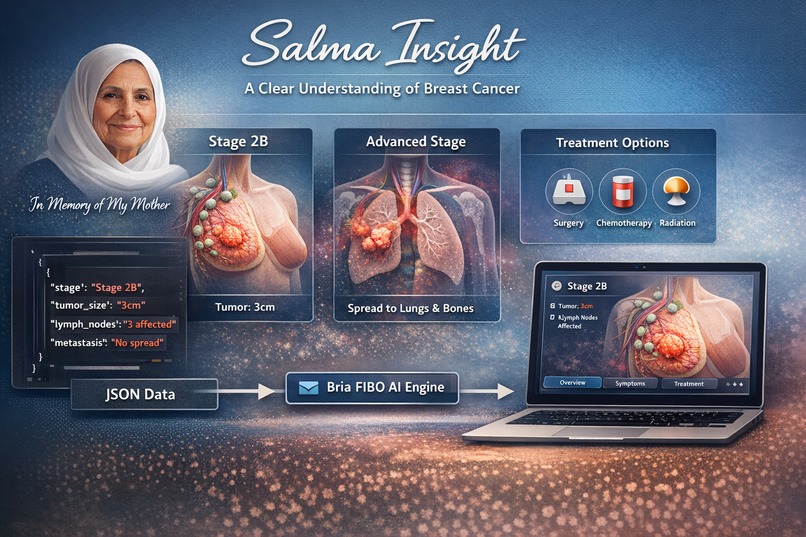
This image summarizes the entire project
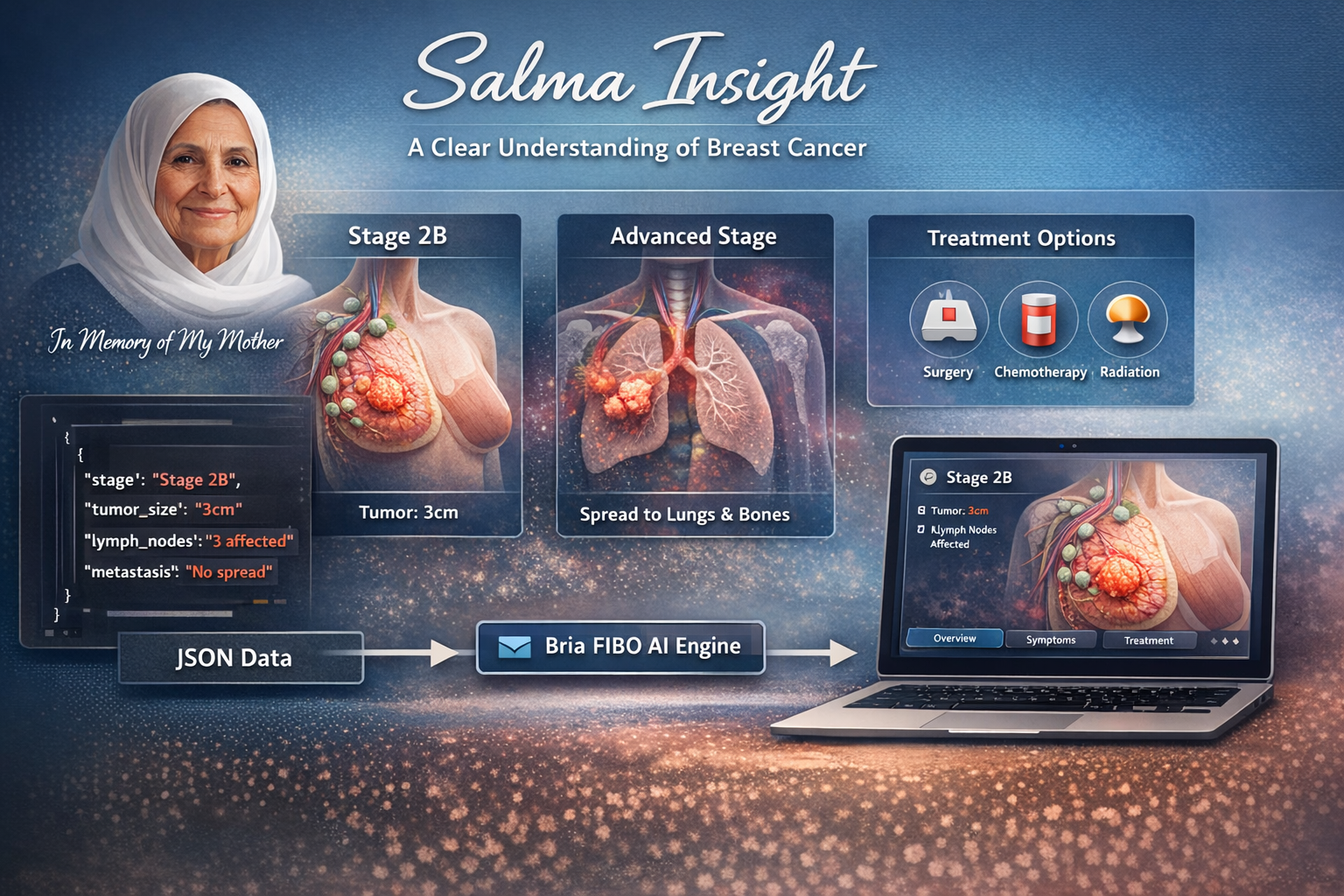
About the Project:
Inspiration:
This project was inspired by my mother.
She passed away due to breast cancer after a late diagnosis.
At the time, my family and I struggled to understand the medical reports, the stage of the disease, and how far the condition had progressed. The information was technically available, but it was not visually or emotionally understandable for non-medical people.
I realized that beyond early detection and treatment, there is a critical gap in how medical information is communicated to patients and their families. This project is my attempt to address that gap.
In her memory, I decided to name this project after her — not as a medical claim, but as a tribute and a reminder of why clarity and communication matter.
What I Built:
I built a JSON-native medical visualization system using Bria FIBO that generates deterministic, explainable visual representations of breast cancer progression.
Instead of relying on fragile text prompts, the system uses structured JSON parameters to control:
- Anatomical context
- Tumor stage and approximate size
- Tumor location within the breast
- Camera angle and field of view
- Lighting conditions and color palette
- High-fidelity 16-bit / HDR rendering
This approach ensures consistent, repeatable outputs suitable for educational and clinical communication purposes.
Important:
This project does not perform diagnosis, prediction, or treatment recommendations.
It is strictly a visualization and education tool.
How I Built It:
The project was built using the official Bria FIBO API and FIBO Lab, leveraging its JSON-native generation capabilities.
The workflow is simple and production-oriented:
- Define structured medical parameters in JSON:
{ "model": "bria-fibo", "generation_type": "json_native", "prompt_json": { "anatomy": "female_breast", "tumor_stage": "stage_II", "tumor_location": "upper_outer_quadrant", "tumor_size_mm": 28, "view": "cross_section", "camera": { "angle": "orthographic", "fov": 45 }, "lighting": { "type": "clinical", "intensity": "soft" }, "color_palette": "medical_neutral", "bit_depth": "16bit", "background": "clean_white" } }
- Submit the JSON to the FIBO generation engine
- Receive a deterministic, high-quality medical visualization
- Preserve both the input JSON and the generated output for reproducibility:
{ "short_description": "A detailed cross-section view of a female breast, highlighting a Stage II tumor in the upper outer quadrant. The image uses a medical neutral color palette, emphasizing anatomical accuracy and clarity for clinical study.", "objects": [ { "description": "The internal structure of a female breast, meticulously rendered to show various tissue layers including glandular tissue, fatty tissue, and ducts. The cross-section reveals the intricate architecture of the mammary gland.", "location": "center", "relationship": "The central subject, providing the anatomical context for the tumor.", "relative_size": "large within frame", "shape_and_color": "Irregular ovoid shape, rendered in muted pinks, creams, and whites with subtle variations in translucency.", "texture": "Smooth, with implied softness and internal fibrous structures.", "appearance_details": "Highly detailed anatomical rendering, showing the lobules and ducts with precision.", "orientation": "oriented vertically, revealing internal layers" }, { "description": "A malignant tumor, approximately 28mm in diameter, positioned within the upper outer quadrant of the breast. It has irregular margins indicative of its invasive nature.", "location": "upper-right quadrant of the breast cross-section", "relationship": "Embedded within the breast tissue, representing the primary area of focus.", "relative_size": "medium within the breast structure", "shape_and_color": "Irregular, lobulated mass, depicted in a slightly darker, more opaque shade of purple-grey or reddish-brown to contrast with healthy tissue.", "texture": "Dense, slightly granular texture, suggesting cellular proliferation.", "appearance_details": "Clearly demarcated from surrounding healthy tissue, with visible micro-calcifications or spicules extending from its edges, indicating a Stage II malignancy.", "orientation": "irregularly shaped, embedded within tissue" } ], "background_setting": "A sterile, clean white background, free of distractions, designed to highlight the anatomical subject without any contextual elements.", "lighting": { "conditions": "Soft, diffused clinical lighting", "direction": "Evenly distributed from multiple angles, minimizing harsh shadows", "shadows": "Minimal and very soft, primarily cast by internal structures to provide subtle depth." }, "aesthetics": { "composition": "Centered, orthographic projection, emphasizing clarity and scientific accuracy.", "color_scheme": "Medical neutral palette, featuring muted pinks, creams, and subtle purples/reds for pathological areas, ensuring high contrast for diagnostic features.", "mood_atmosphere": "Clinical, informative, precise, and serious.", "preference_score": "very high", "aesthetic_score": "very high" }, "photographic_characteristics": { "depth_of_field": "Deep, ensuring all elements of the cross-section are in sharp focus.", "focus": "Sharp focus on all anatomical and pathological details.", "camera_angle": "Orthographic (straight-on view, removing perspective distortion), with a slight tilt to reveal internal contours.", "lens_focal_length": "Standard lens (e.g., 50mm equivalent) for a realistic, undistorted view." }, "style_medium": "3D render", "context": "This is a scientific visualization or medical illustration, likely intended for educational purposes, diagnostic training, or medical research, focusing on breast cancer pathology.", "artistic_style": "realistic, anatomical, sterile" }
This structure mirrors real-world production pipelines where consistency and control are critical.
Challenges Faced:
One of the main challenges was translating complex medical concepts into clear visual parameters without oversimplifying or misrepresenting the condition.
Another challenge was working under strict ethical constraints — ensuring that the project remained educational and illustrative, without crossing into diagnosis or medical decision-making.
Finally, balancing technical rigor with emotional sensitivity was essential. The goal was not to dramatize the disease, but to create a respectful, informative tool that helps people understand what is happening.
What I Learned:
Through this project, I learned that:
- Visual clarity can be as important as medical accuracy
- Structured, deterministic AI systems are better suited for sensitive domains like healthcare
- JSON-native control enables scalable, reproducible workflows far beyond prompt engineering
- Personal experiences can inspire technically sound and ethically responsible innovation
Future Roadmap & Scalable Impact:
This project is built as a Deterministic Visual Protocol that can be scaled across multiple high-stakes industries where precision and clarity are non-negotiable.
1- Medical & Pharmaceutical Industry (Next Step) Mechanism of Action (MoA) Visualizer: Converting complex drug data into JSON-native animations to show patients exactly how a medication interacts with their cells.
2-Personalized Pharmacy Reports: Transforming dry dosage instructions into visual "digital twins" of the patient's treatment path.
3-Global Medical Dictionary: Expanding our JSON schemas to cover Cardiology, Neurology, and Orthopedics, creating a universal visual language for healthcare.
Enterprise & Professional Tools:
Automated Production Pipelines: Replacing manual medical illustration with an automated API that generates 16-bit, HDR-ready visual assets for textbooks, clinical trials, and insurance reports in seconds.
Intelligent Agent Flows: Building AI agents that can read any medical EHR (Electronic Health Record) and autonomously output a simplified, empathetic visual report for family members.
Business Potential:
SaaS Licensing: Licensing our proprietary "Medical-to-JSON" translation logic to pharmaceutical giants and hospitals.
Standardization: Positioning our JSON schema as the industry standard for Deterministic Generative AI in sensitive sectors, ensuring zero-hallucination and 100% reproducibility.

Log in or sign up for Devpost to join the conversation.