Inspiration
Urban civic issues such as potholes, water leakages, broken streetlights, and waste overflow are common in many cities, yet the process of reporting and resolving them is often inefficient and opaque. Complaints are scattered across multiple platforms, follow-ups are unclear, and citizens rarely know whether their issues are being addressed. This gap between citizens and authorities inspired the creation of NagarNetra. The goal was to build a system that not only allows people to report problems easily, but also ensures verification, transparency, and accountability using AI and real-time data.
What it does
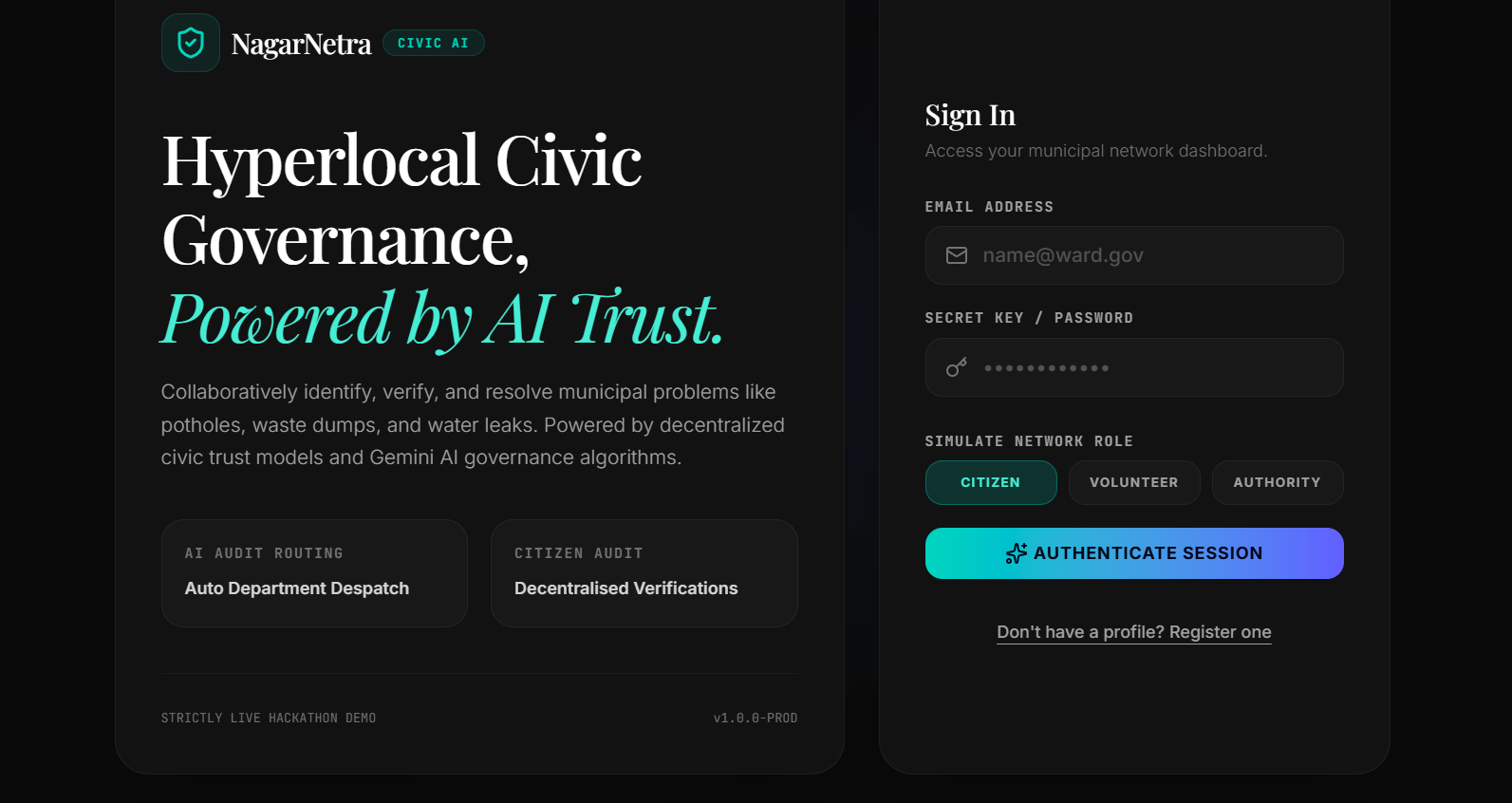
NagarNetra is an AI-powered hyperlocal civic issue reporting and resolution platform. It allows users to report real-world infrastructure problems using images, videos, voice input, and automatic location capture. The platform uses artificial intelligence to classify issues, detect duplicates, and prioritize problems based on severity and impact. Reported issues are displayed on an interactive map, verified by nearby users, and tracked through a clear resolution timeline until completion. Authorities and administrators can monitor issues through an AI-prioritized dashboard and analyze city-level trends through analytics and heatmaps.
How we built it
The project was built as a full-stack web application. The frontend was developed using modern web technologies with a Bento Grid–based layout for clarity and usability. The backend handles authentication, data storage, and real-time updates using cloud services. Leaflet with OpenStreetMap was integrated to display reported issues on an interactive map. Google AI Studio and Gemini models were used to experiment with image classification, text understanding, and AI-generated insights. Firebase services were used for authentication, real-time database updates, and notifications. The system was designed in a modular way so that AI components, mapping, and reporting workflows can scale independently.
Challenges we ran into
One of the main challenges was designing AI features that feel useful rather than superficial. Ensuring that issue classification, duplicate detection, and prioritization added real value required careful prompt design and workflow planning. Another challenge was balancing feature scope with realism, focusing on building a working product rather than an overextended concept. Integrating real-time maps, authentication, and AI workflows into a cohesive user experience also required thoughtful system design.
Accomplishments that we're proud of
We are proud of building a realistic, end-to-end product rather than just an AI demo. NagarNetra demonstrates how AI can be meaningfully integrated into civic workflows, from issue detection to analytics and decision support. The platform emphasizes transparency, user trust, and real-world applicability, aligning closely with how such a system could be adopted by cities or communities.
What we learned
Through this project, we learned how to design AI-powered systems with a strong focus on user needs and real-world constraints. We gained experience in integrating AI services with full-stack applications, handling real-time data, and designing workflows that balance automation with human verification. We also learned the importance of prioritizing clarity, usability, and impact over feature quantity.
What's next for NagarNetra
Future improvements include deeper AI-based predictive analytics for infrastructure risk, integration with IoT sensors for automatic issue detection, support for offline reporting with background synchronization, and expanded authority tools for performance tracking. The long-term vision is to evolve NagarNetra into a deployable smart city platform that cities and communities can use to improve civic infrastructure management at scale.


Log in or sign up for Devpost to join the conversation.