-
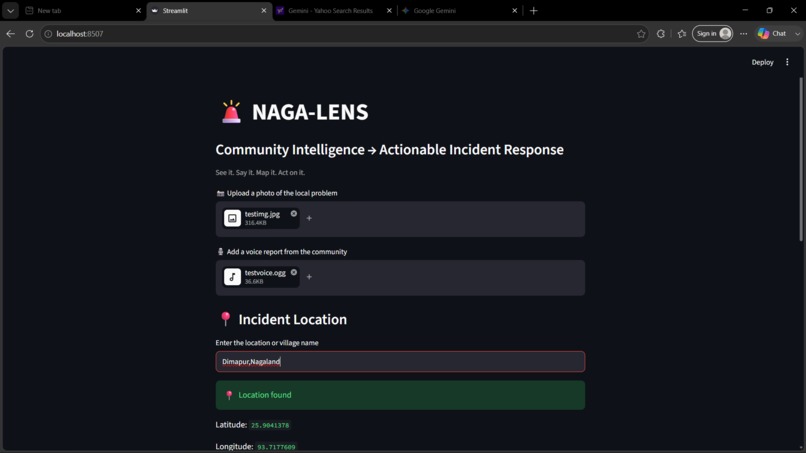
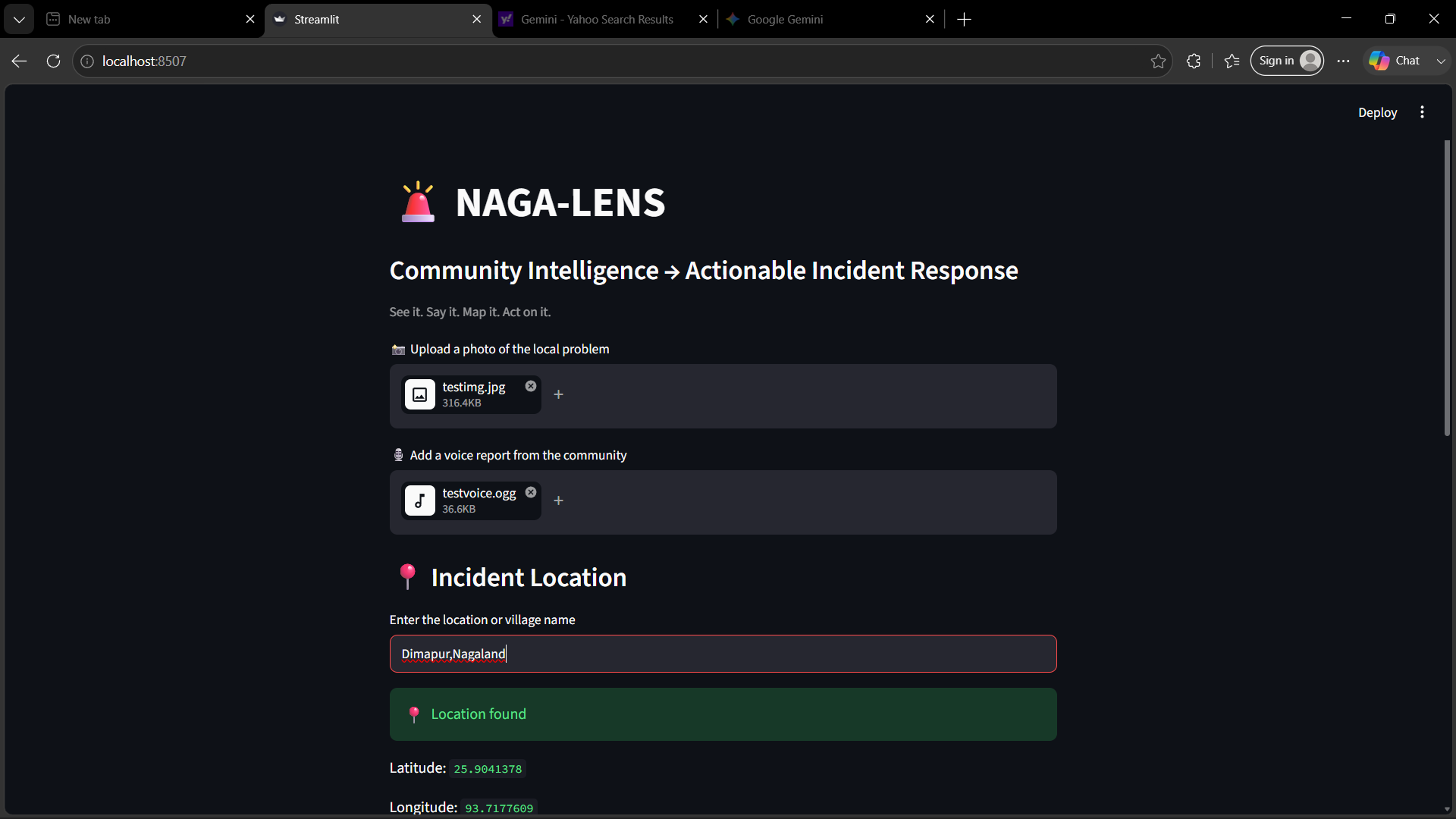
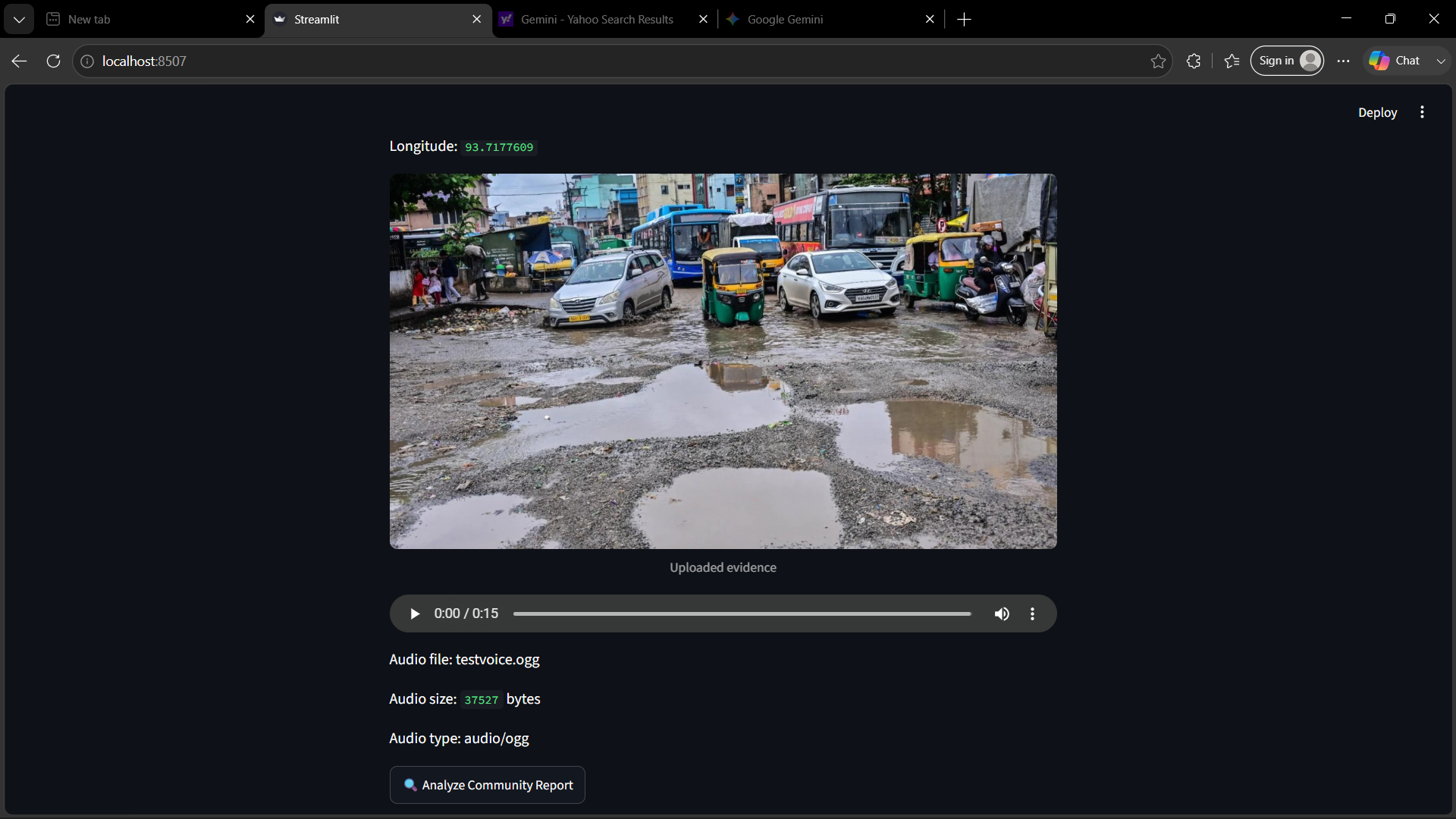
Community Report Interface — Users submit photographic evidence, voice reports, and incident locations.
-
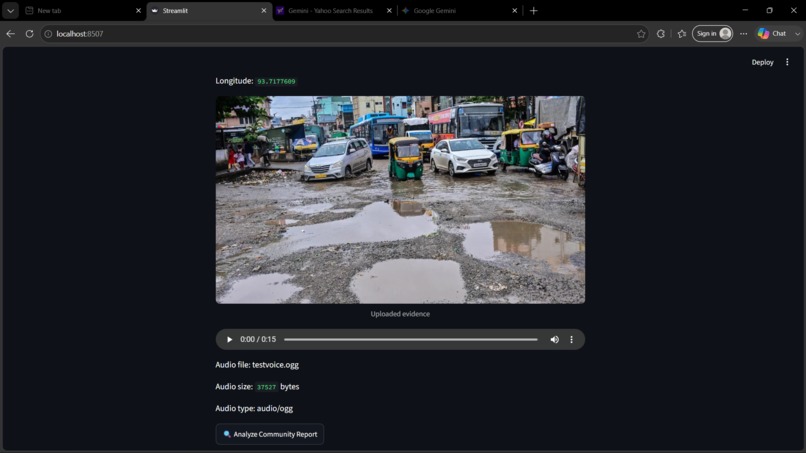
Community Report Interface — Users submit photographic evidence, voice reports, and incident locations.
-
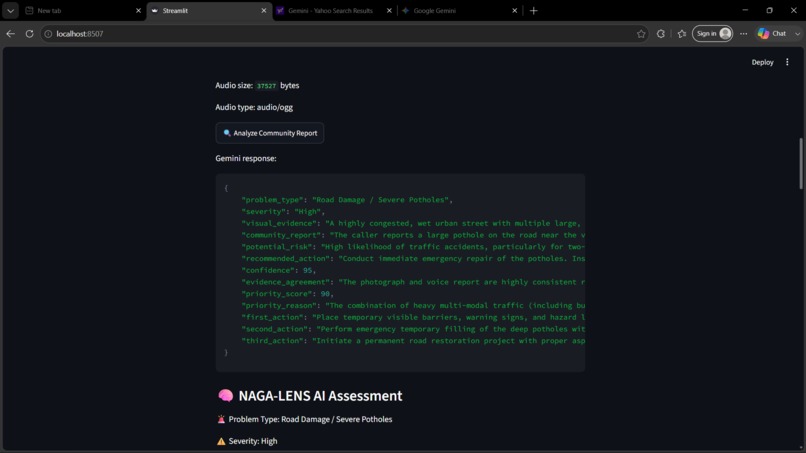
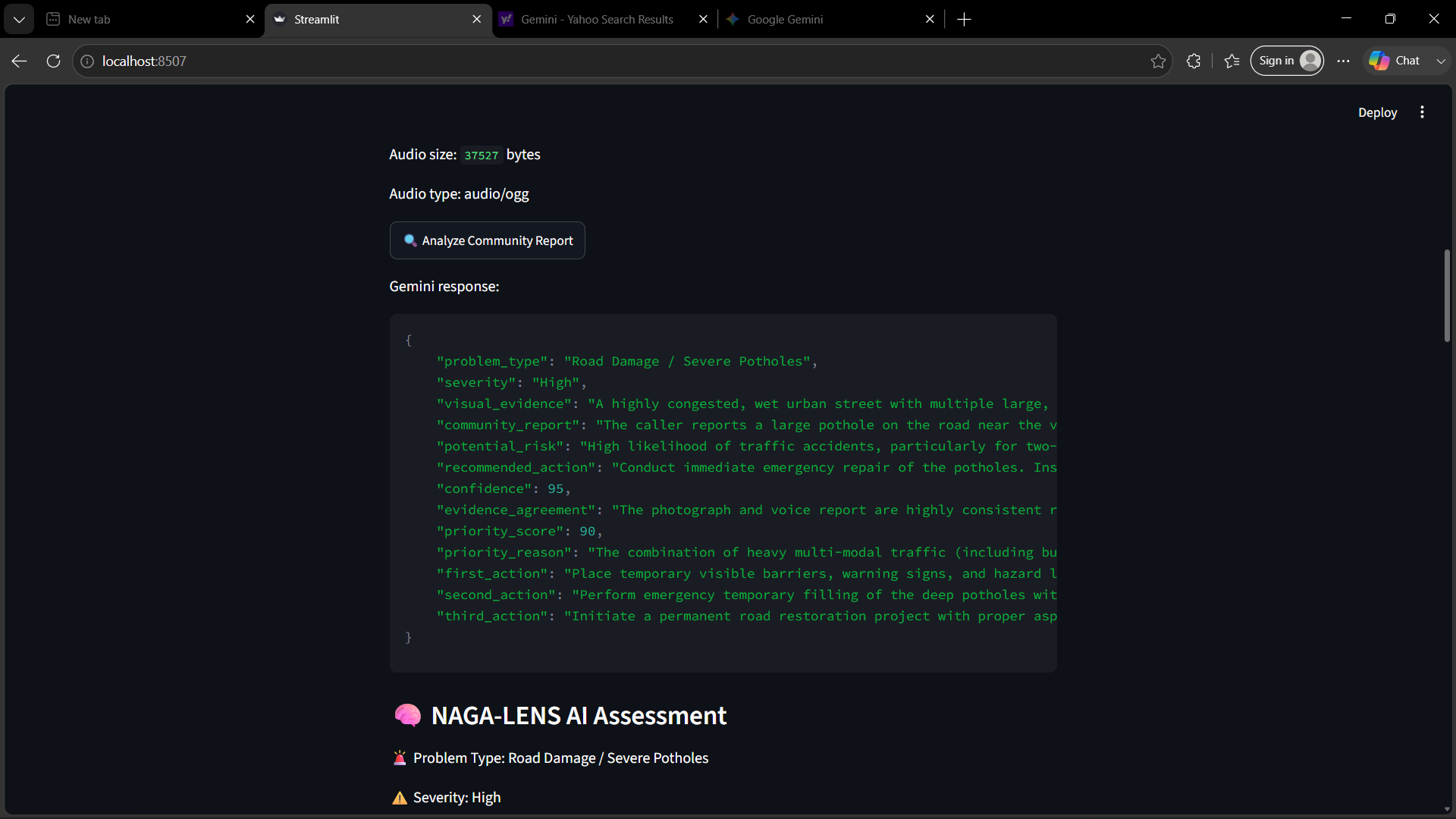
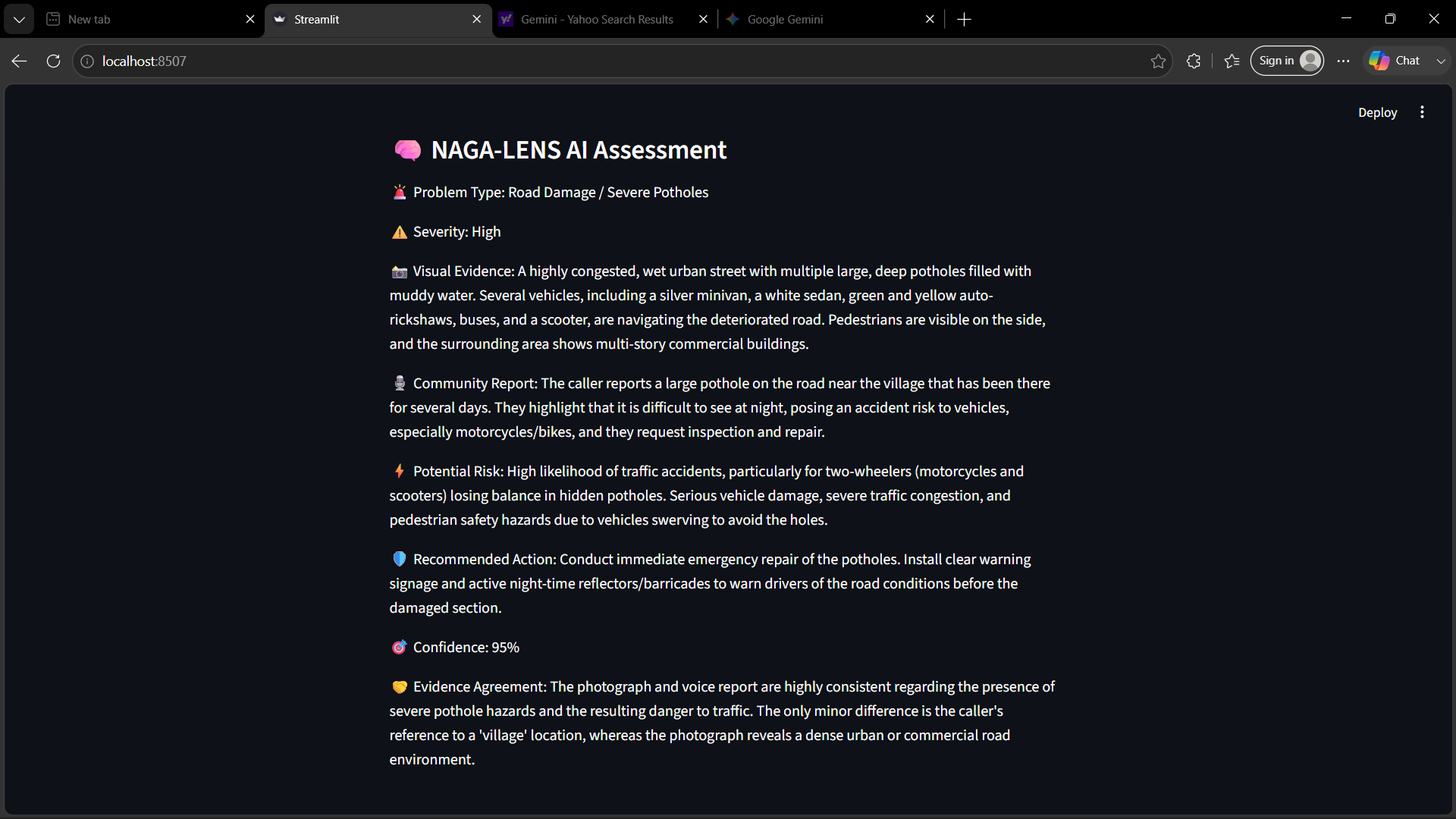
Multimodal AI Assessment — Gemini analyzes visual and voice evidence together while keeping the evidence sources separate.
-
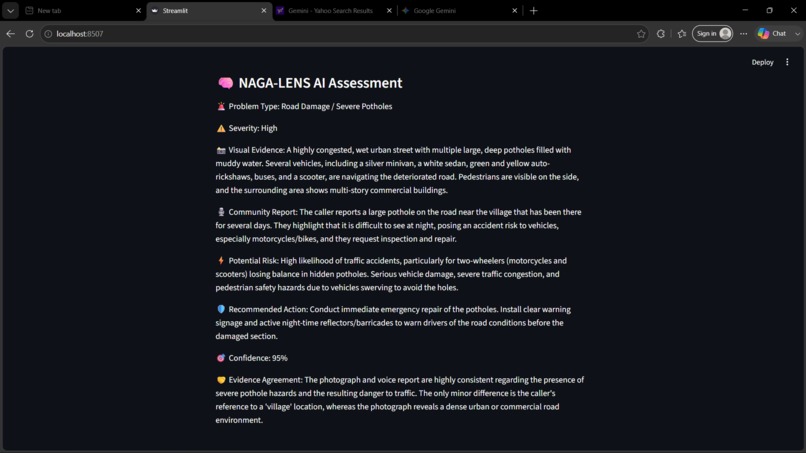
Multimodal AI Assessment — Gemini analyzes visual and voice evidence together while keeping the evidence sources separate.
-
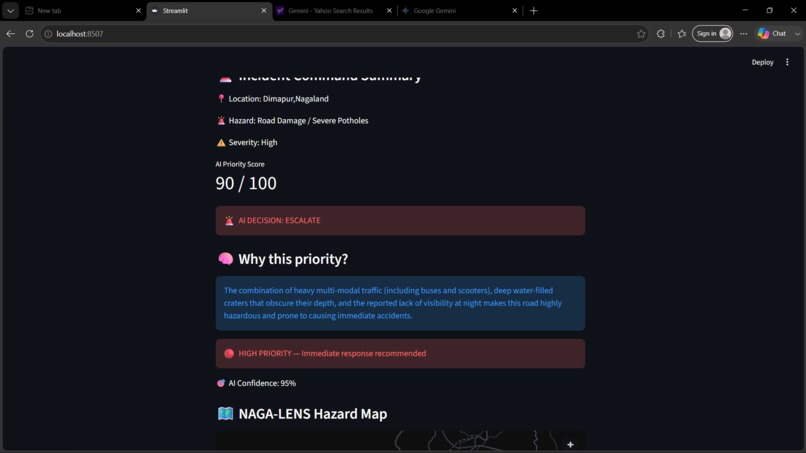
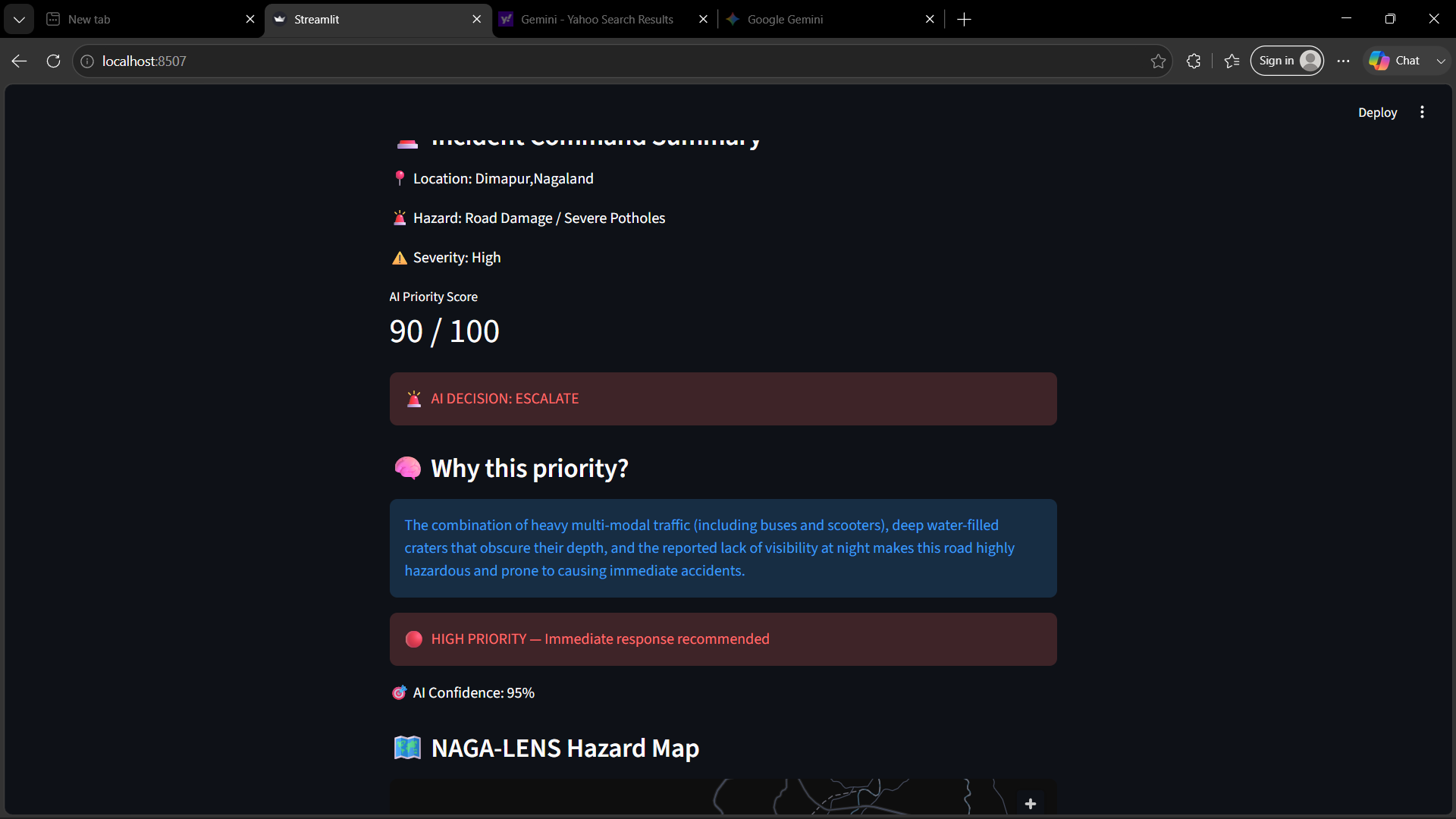
Incident Command Summary
-
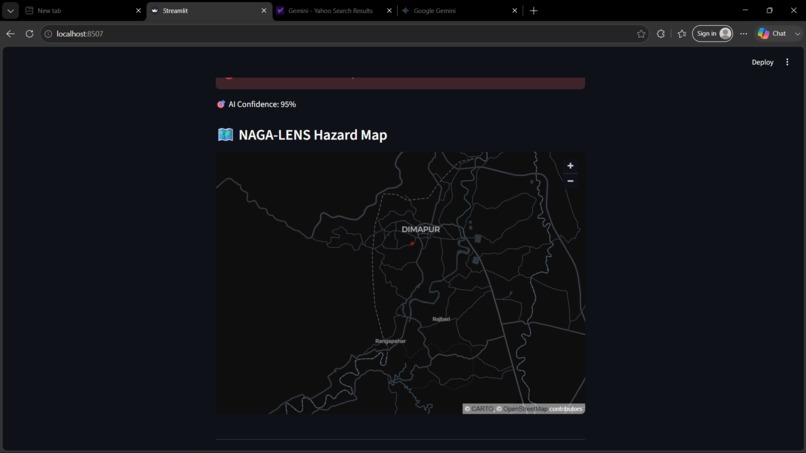
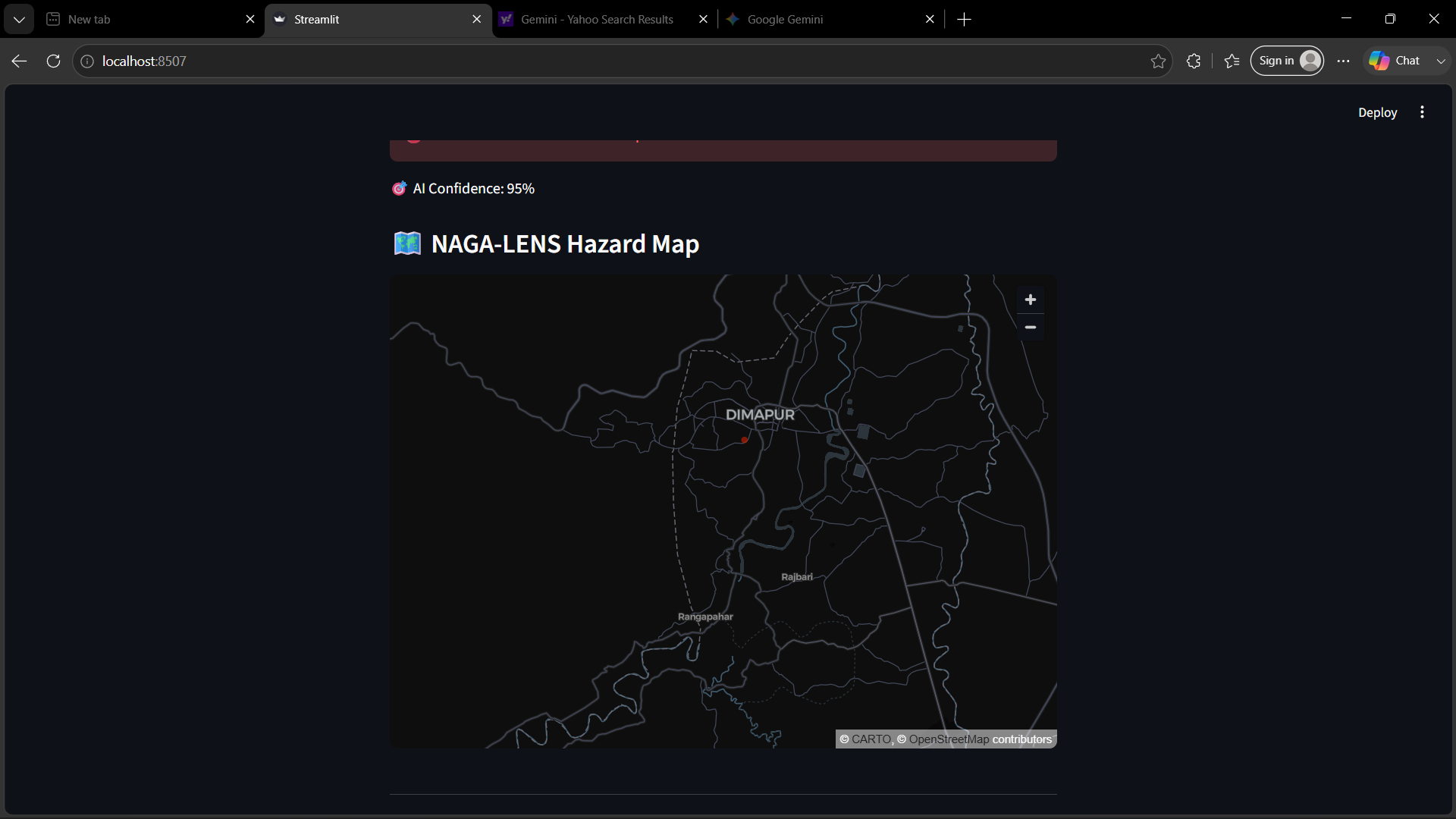
Hazard Map:Geospatial Incident Mapping — Reported locations are geocoded and visualized for faster situational awareness.
-
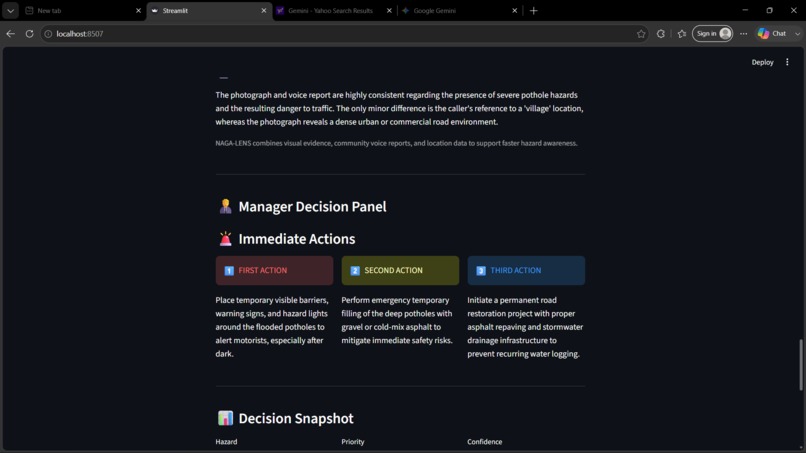
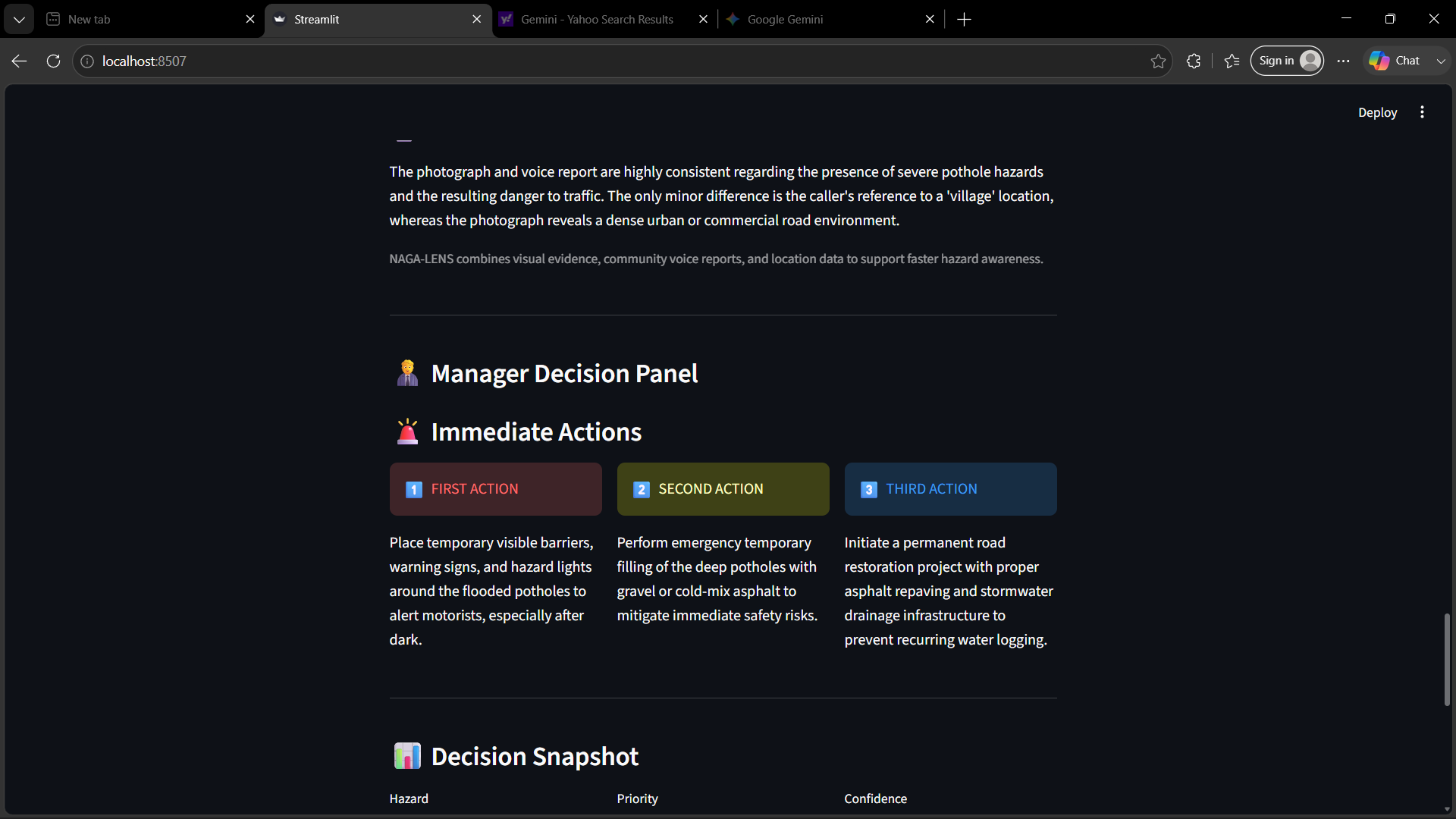
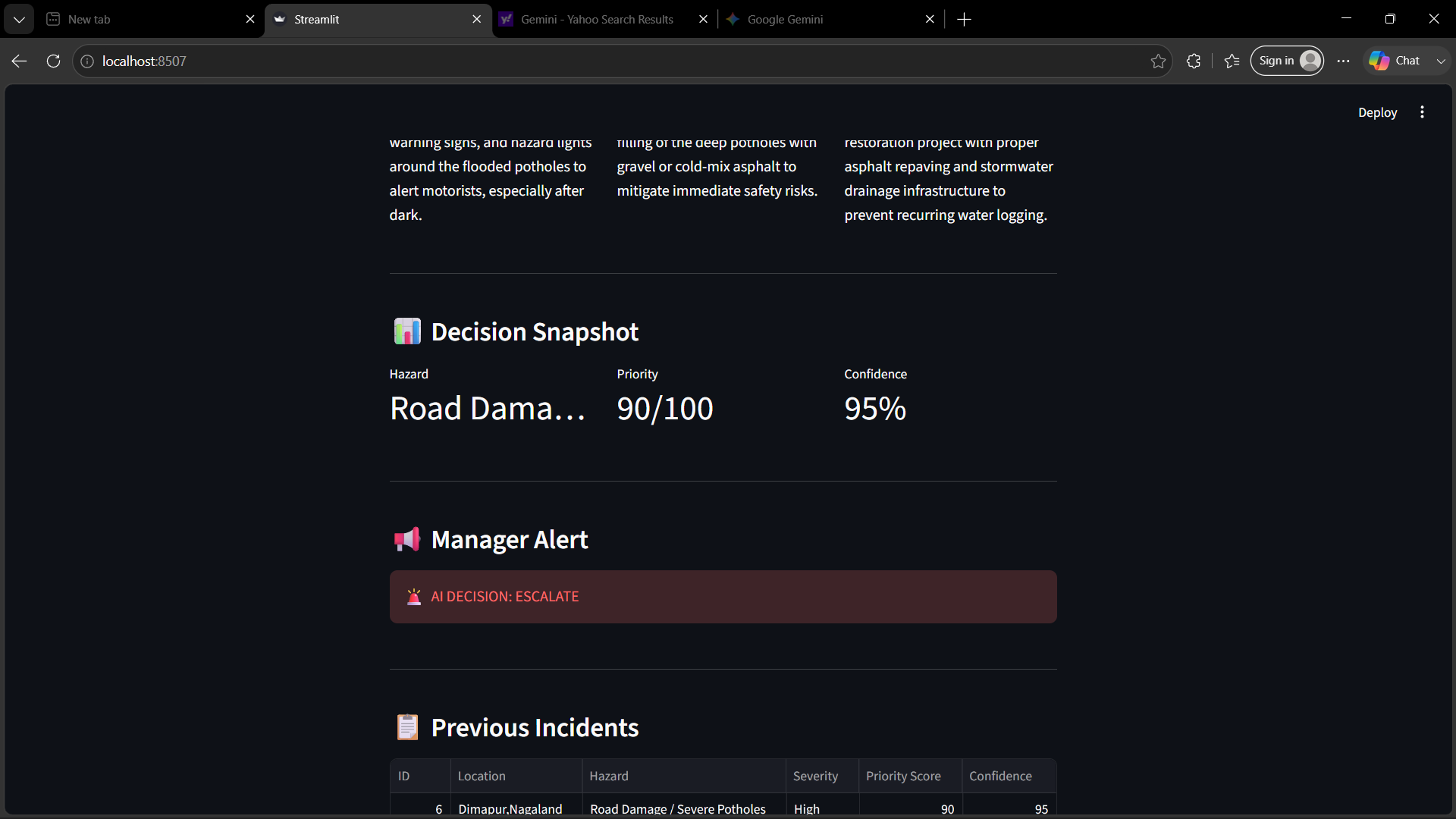
Manager Decision Panel — The system converts AI analysis into three practical response steps.
-
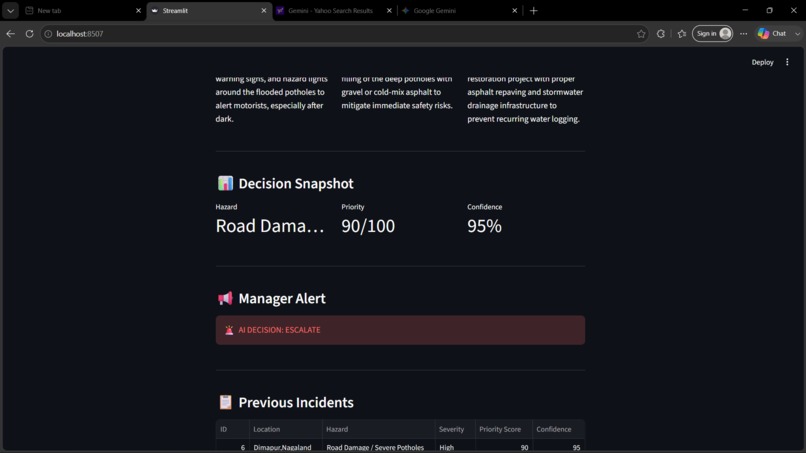
Manager Decision Panel — The system converts AI analysis into three practical response steps.
-
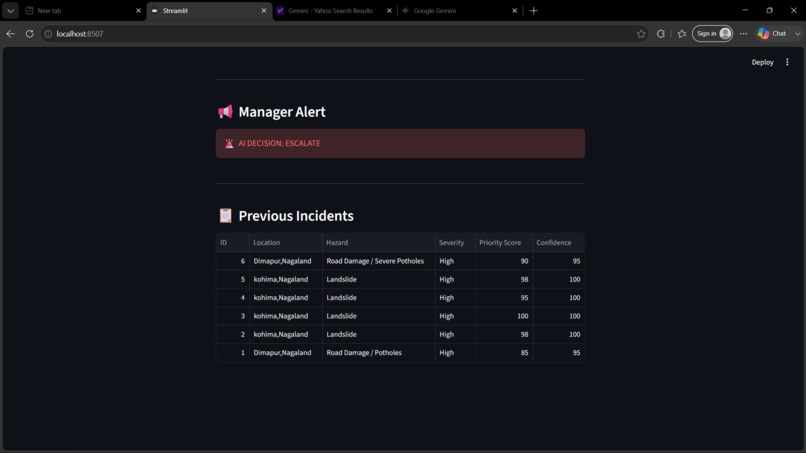
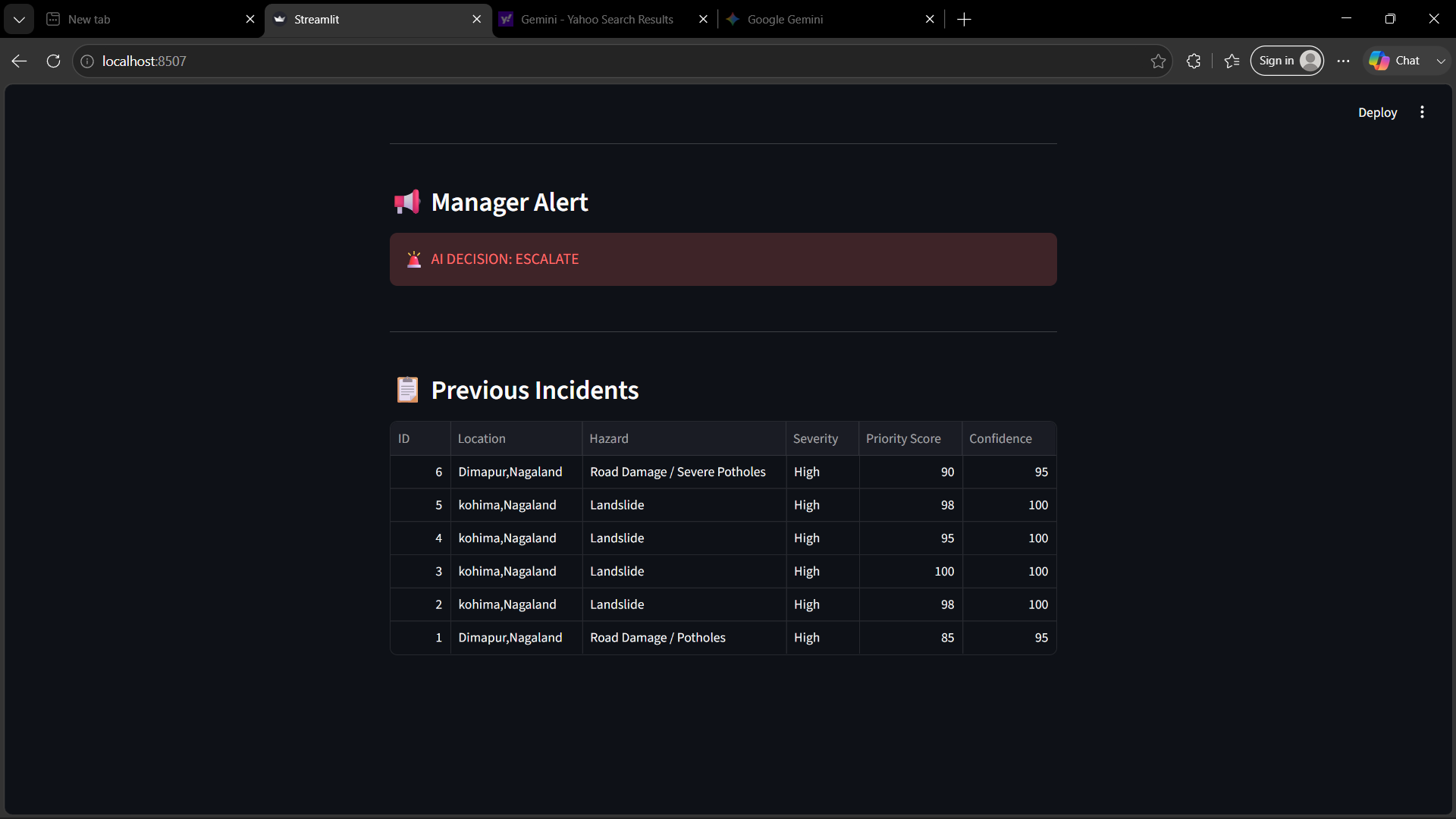
Incident History
Inspiration
We were inspired by a simple problem: community hazards such as potholes, damaged roads, flooding, and other infrastructure issues are often reported without enough information to understand their urgency. We wanted to create a system where a person could simply show the problem through a photo, describe it through their voice, and provide the location, while AI turns that information into an actionable incident report. That idea became NAGA-LENS — “See it. Say it. Map it. Act on it.”
What it does
NAGA-LENS is an AI-powered community hazard reporting system. Users can: 📸 Upload a photo of a local problem 🎙️ Upload a voice report describing the issue 📍 Enter the incident location 🧠 Get AI analysis using both image and voice evidence ⚠️ Receive a severity level: Low, Medium, or High 🎯 Get an AI priority score 🗺️ View the incident on a map 🛡️ Receive recommended response actions 📋 View previous reported incidents The system also compares the visual evidence with the community's voice report and highlights disagreements between them.
How we built it
We built NAGA-LENS using Python and Streamlit. The main components are: Google Gemini API for multimodal analysis of images and voice reports Streamlit for the interactive application interface Nominatim / Geopy for converting locations into latitude and longitude SQLite for storing incident history Python JSON processing for handling structured AI responses Streamlit maps and data tables for incident visualization The overall workflow is: Photo + Voice + Location → Gemini AI Analysis → Severity & Priority → Recommended Actions → Incident History
Challenges we ran into
One of our biggest challenges was getting the AI to consistently return structured JSON that our application could process. We also had to handle different types of uploaded evidence, including images and .ogg voice recordings. Another challenge was ensuring that the AI clearly separated what it could actually see in the image from what was reported through the voice recording. We also encountered database issues while connecting SQLite with the Streamlit application and had to make sure every database column matched the corresponding inserted value.
Accomplishments that we're proud of
We are proud that NAGA-LENS became more than just an AI analysis tool. It successfully combines three different types of information — visual evidence, community voice reports, and geographic location — into one incident response system. The application can turn a raw pothole report into something like: Road Damage → High Severity → 85/100 Priority → ESCALATE It also provides practical first, second, and third response actions and maintains a history of previous incidents using SQLite.
What we learned
Through this project, we learned how to build a real-world application around a multimodal AI model. We learned how to: Work with image and audio inputs Use Gemini for multimodal reasoning Request structured JSON from an AI model Handle JSON parsing errors Build interactive interfaces with Streamlit Convert locations into geographic coordinates Display incidents on maps Store structured information using SQLite Design an AI-assisted decision-support workflow Most importantly, we learned that AI is more useful when it converts raw information into clear decisions and actionable next steps.
What's next for NAGA-LENS
We want to take NAGA-LENS from a prototype into a larger community-response platform. 🌐 Deploying NAGA-LENS as a publicly accessible web application 📱 Making the interface more mobile-friendly 🗣️ Supporting multiple local languages 🔔 Automatically notifying relevant authorities for high-priority incidents 📍 Detecting duplicate reports from the same location 📊 Adding analytics to identify recurring infrastructure problems 🗺️ Building a larger real-time hazard dashboard 🧠 Improving priority scoring using historical incident data Our long-term vision is for NAGA-LENS to help communities report problems faster and help decision-makers understand which problems need attention first.
Built With
- ai
- api
- audioai
- data
- decisionsupport
- gemini
- geopy
- natural-language-processing
- python
- pythonjson
- sqlite
- streamlit
- visualization

Log in or sign up for Devpost to join the conversation.