-
-
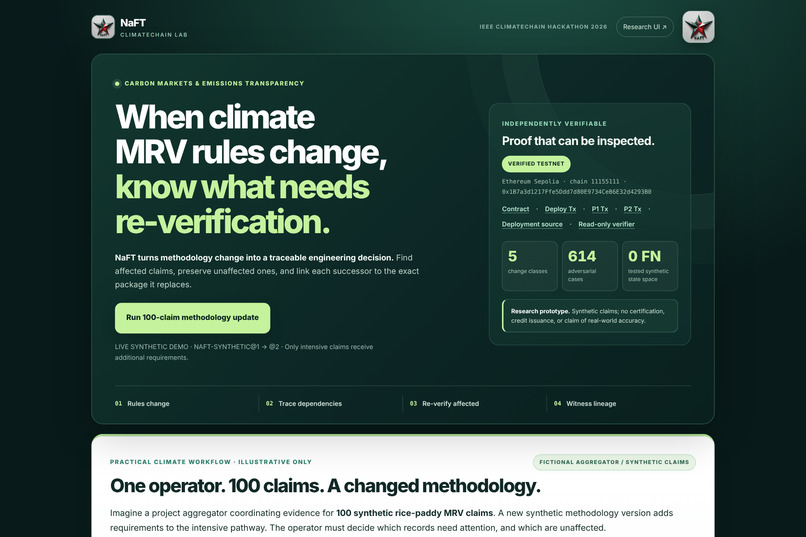
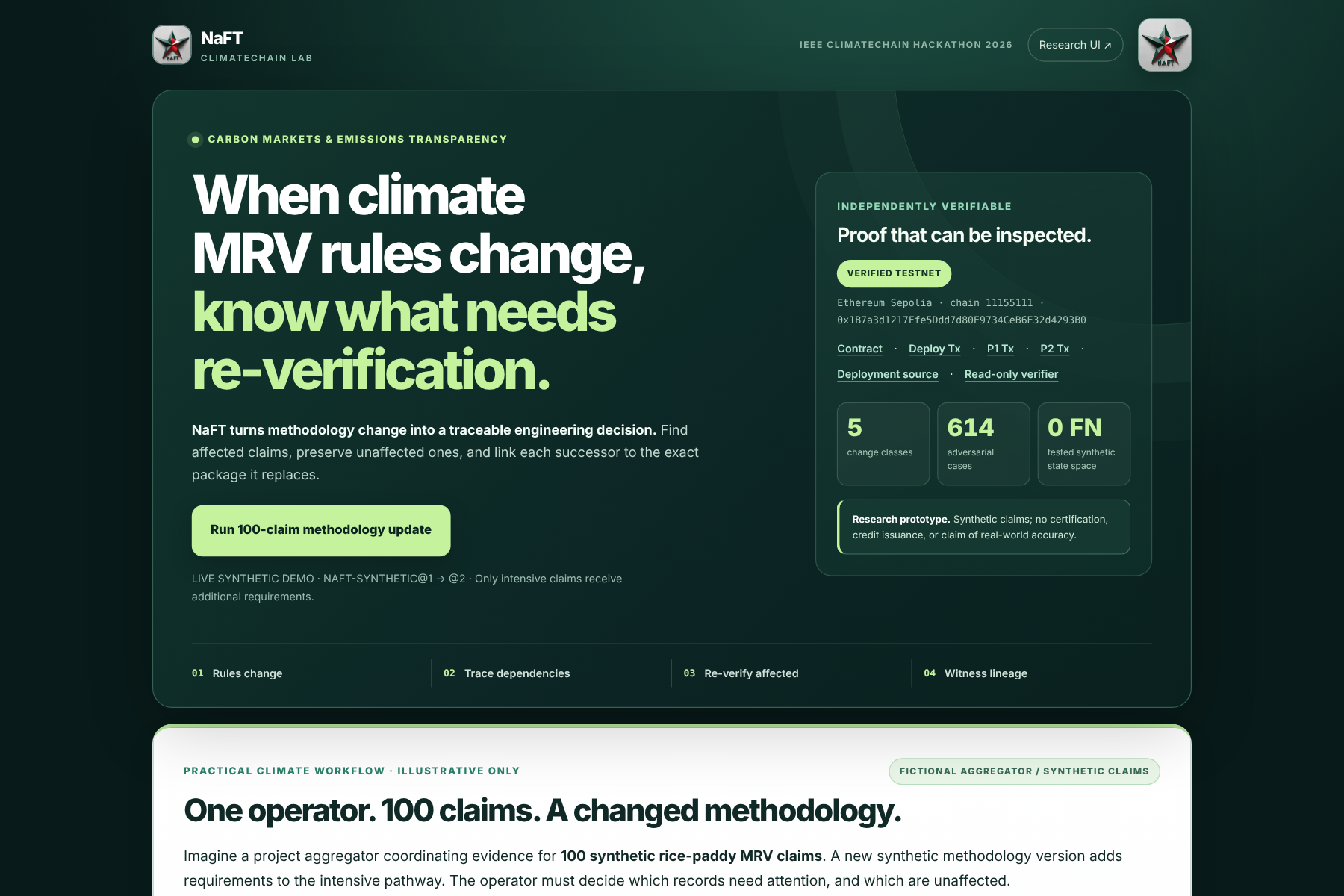
NaFT live demo: when climate MRV rules change, know exactly which claims need re-verification.
-
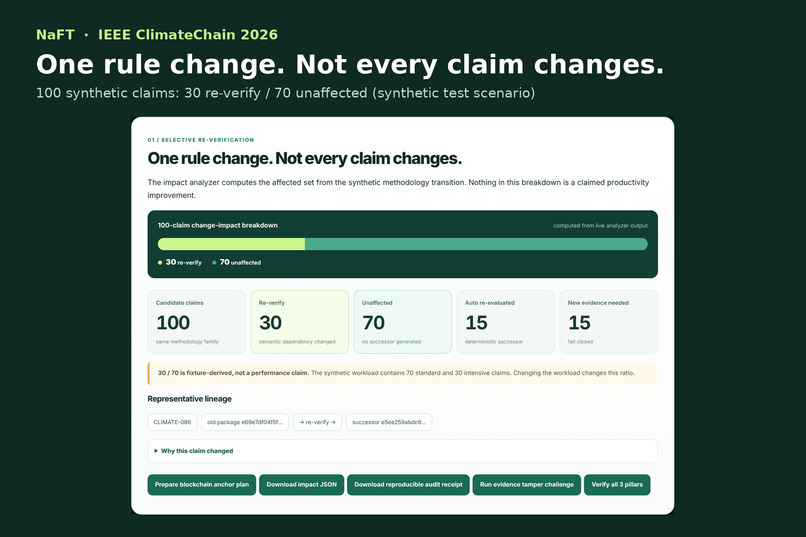
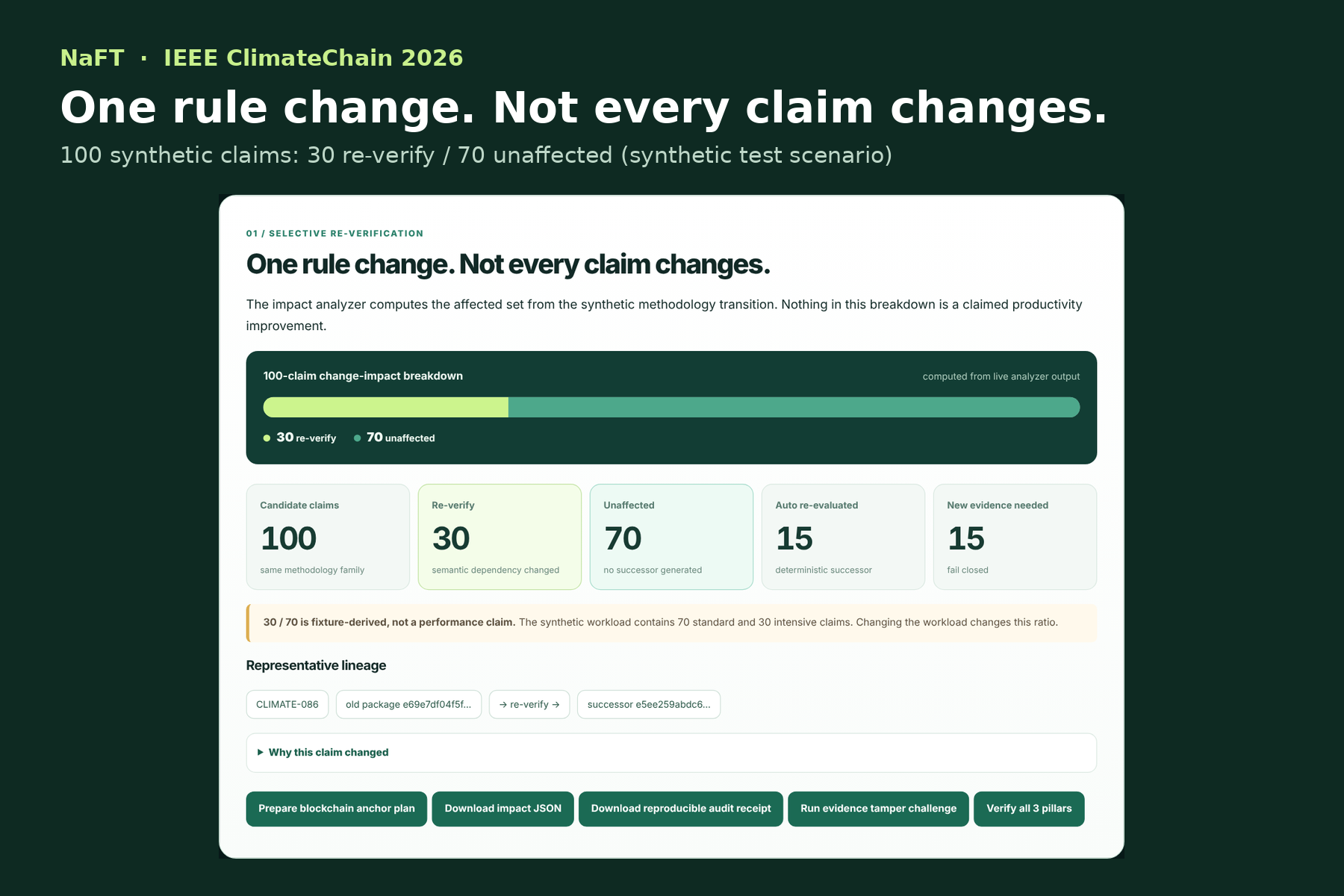
One methodology update, 100 synthetic claims: 30 re-verify, 70 unaffected, 15 auto re-evaluated, 15 need new evidence.
-
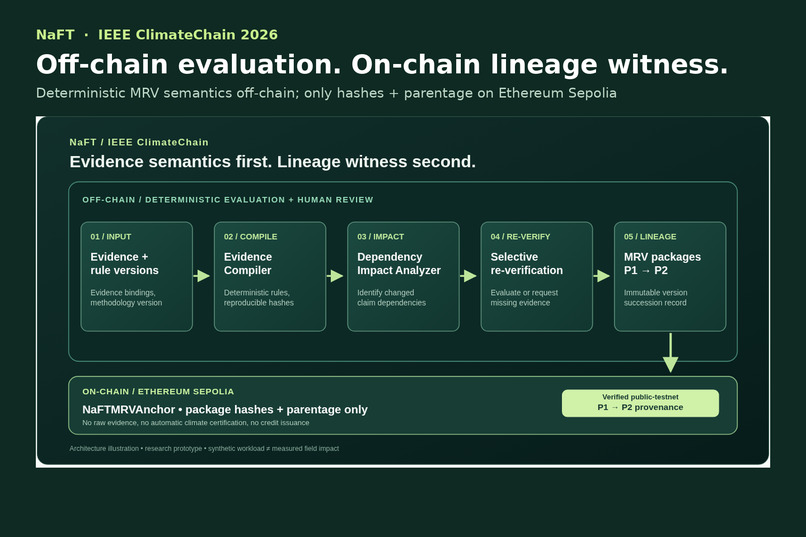
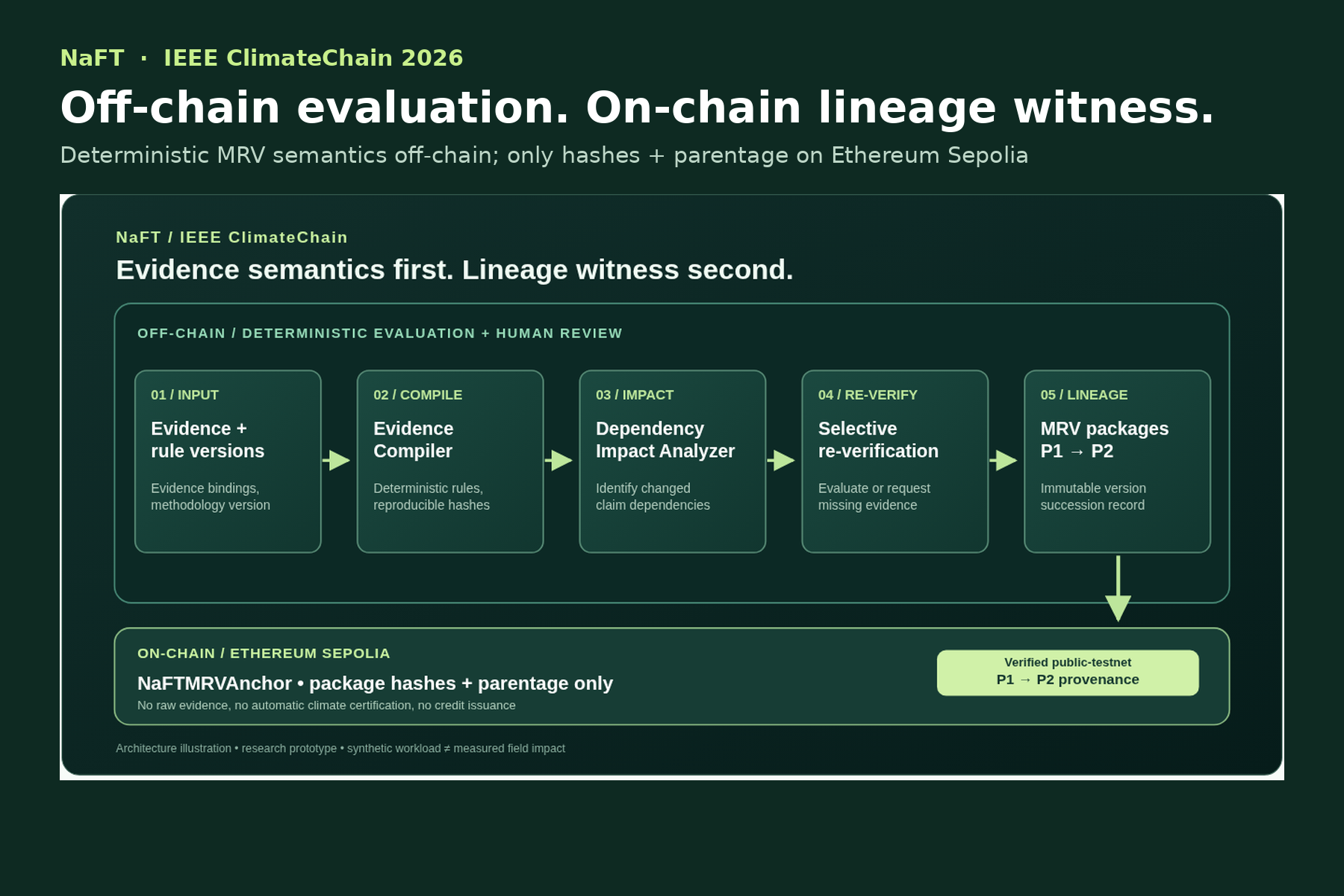
Architecture: deterministic MRV evaluation off-chain; only package hashes and parentage are witnessed on Ethereum Sepolia.
-
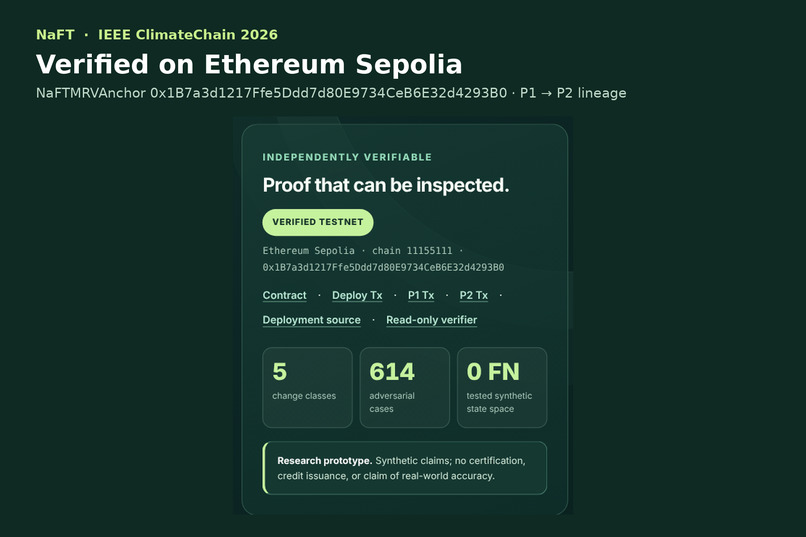
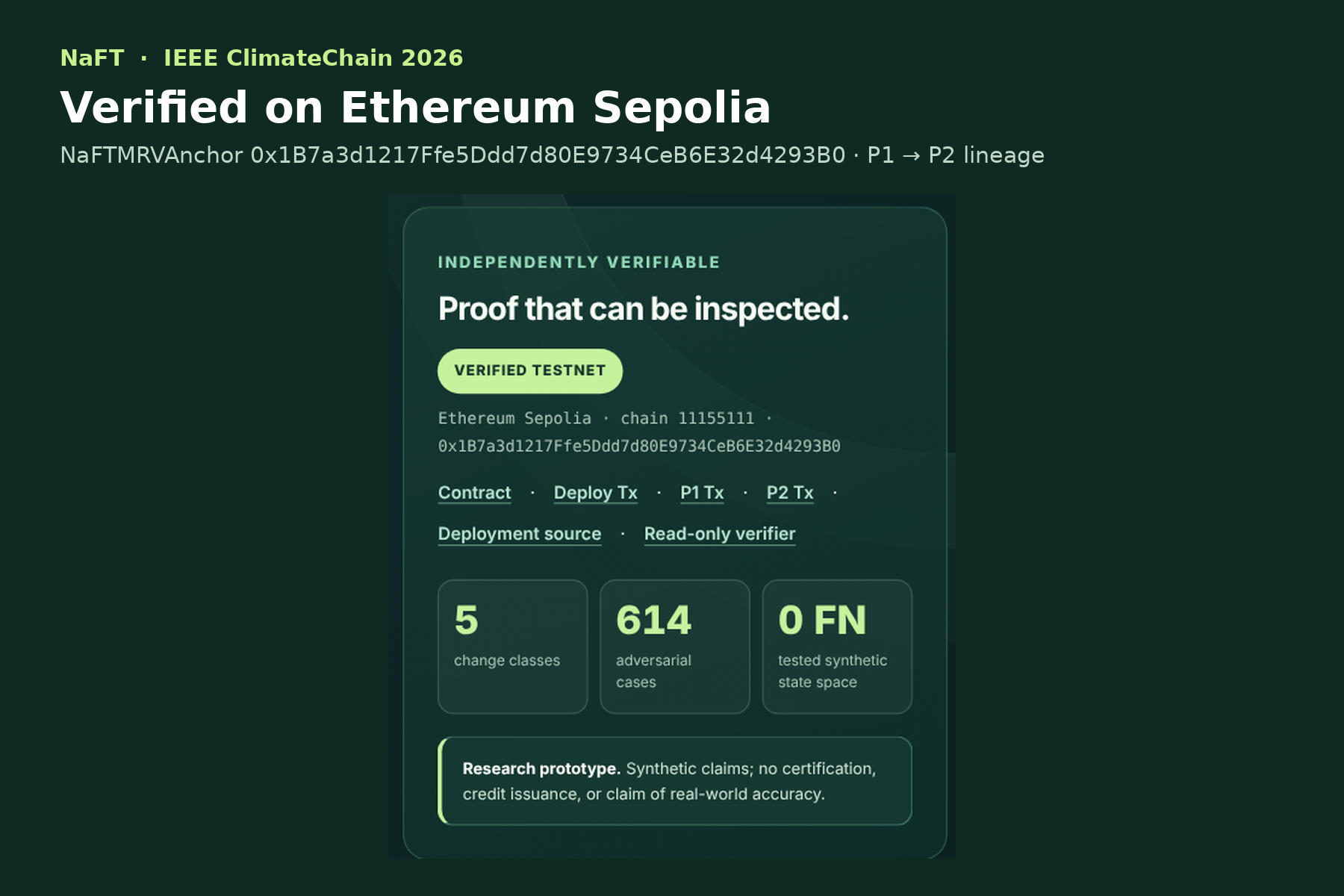
Verified on Ethereum Sepolia: NaFTMRVAnchor 0x1B7a3d1217Ffe5Ddd7d80E9734CeB6E32d4293B0 with a P1 → P2 package lineage.
-
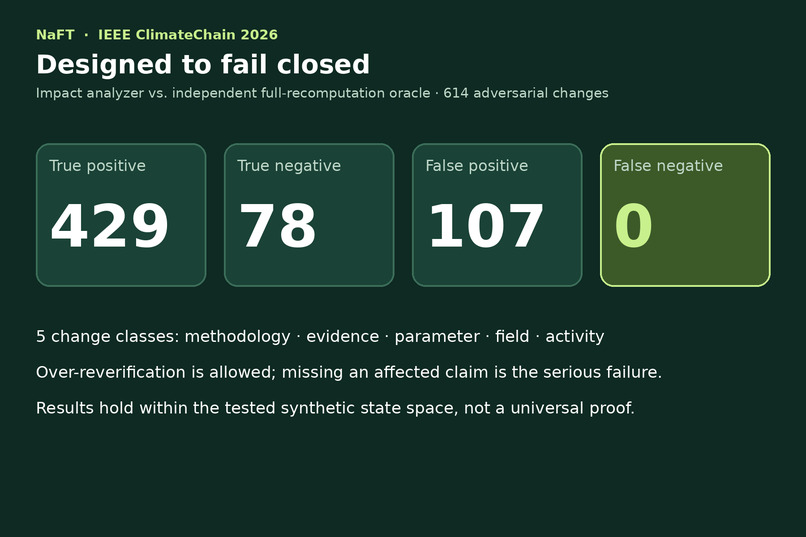
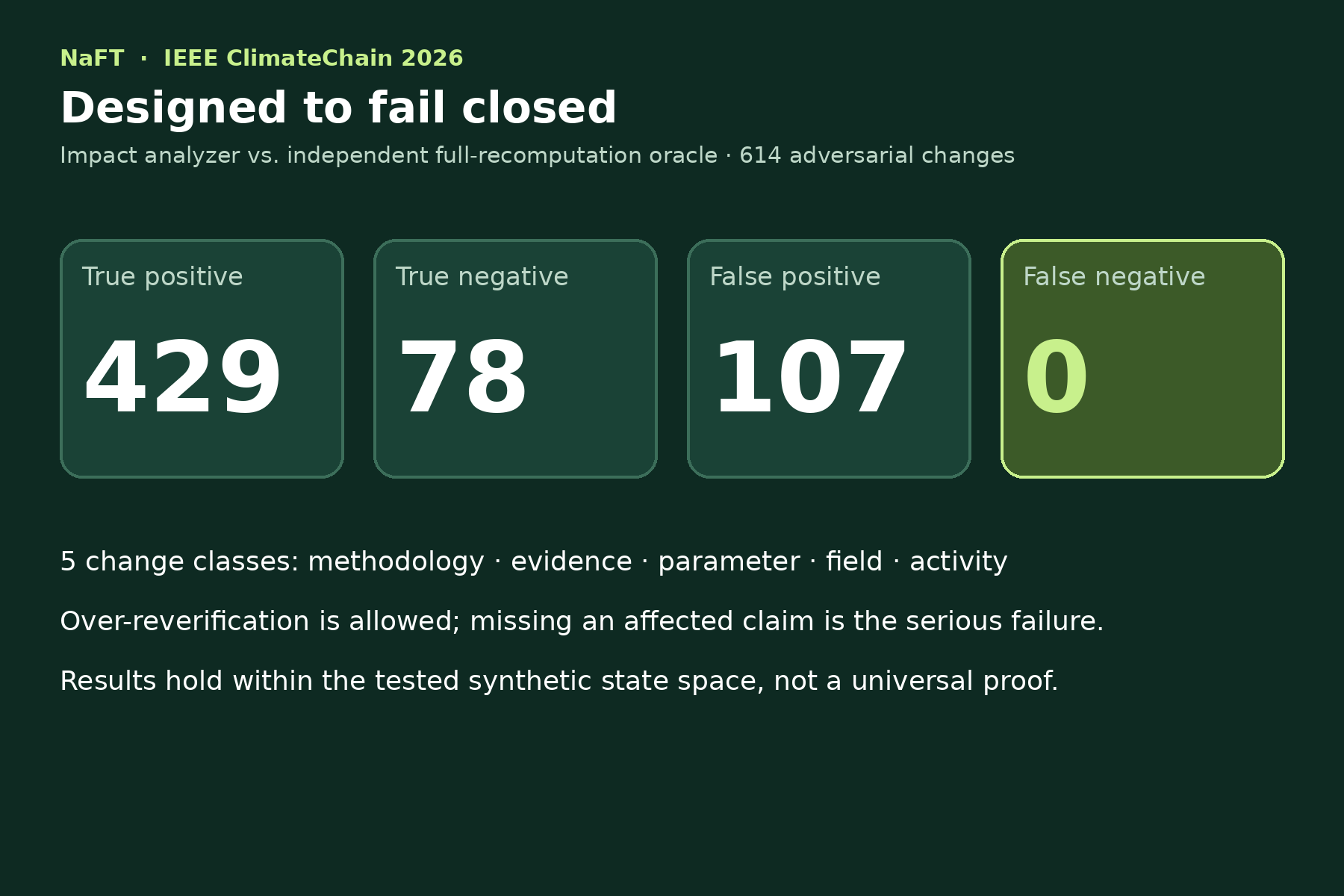
614 adversarial changes vs an independent full-recomputation oracle: TP 429/ TN 78/ FP 107/ FN 0, within the tested synthetic state space.
NaFT — Version-Aware Climate MRV
Carbon markets face a critical problem: when verification methodologies change, previously evaluated climate claims may become outdated.
NaFT identifies which claims need re-verification, explains why, and preserves a transparent, independently traceable history of every change.
Instead of reviewing everything again, NaFT helps verification operators focus on claims actually affected by new rules or evidence requirements.
Inspiration
Carbon credits depend on trustworthy measurement, reporting, and verification (MRV). However, verification rules, emission factors, and evidence requirements change over time.
Traditional systems often struggle to explain how these changes affect previously evaluated claims.
I built NaFT to address a fundamental question:
When a methodology changes, which historical climate claims must be reviewed again, and why?
Blockchain can preserve records, but it cannot determine whether environmental evidence is scientifically valid. NaFT addresses the missing connection between methodology changes, evidence dependencies, and verifiable record history.
What It Does
NaFT is a version-aware MRV evidence compiler and selective re-verification engine.
Its core capabilities include:
• Tracking climate claims across methodology versions. • Detecting changes in rules, evidence, parameters, fields, and activities. • Identifying claims requiring re-verification. • Explaining exactly which dependencies changed. • Blocking evaluations when essential evidence is missing. • Preserving immutable predecessor and successor records. • Recording package hashes and lineage on Ethereum Sepolia.
The live demo illustrates a methodology update affecting 100 synthetic climate claims.
NaFT identifies:
• 30 claims requiring re-verification. • 70 claims unaffected. • 15 claims eligible for automatic re-evaluation. • 15 claims requiring additional evidence.
These results demonstrate the system’s selective verification logic. They are based on a synthetic test scenario, not measured operational savings or certified emission reductions.
Real Data
The repository also ingests real public data to test the pipeline: quality checks on JapanFlux JP-Hrt rice-paddy methane (CH4) flux observations, cross-checks against published Chinese rice-paddy data, and an independent recalculation of Gold Standard calculation worksheets. These checks test the workflow; they do not certify any project.
How I Built It
NaFT combines deterministic verification logic with blockchain-based provenance records.
The core engine uses JavaScript, structured JSON, SHA-256 hashing, and dependency analysis to create reproducible MRV evidence packages.
A Solidity smart contract on Ethereum Sepolia records package hashes and their relationships.
The demo includes a verified predecessor-to-successor transaction history, independently checked against the recorded source code.
GitHub Actions automates testing, while GitHub Pages provides a publicly accessible interactive demonstration.
The architecture deliberately separates off-chain evidence evaluation from on-chain record integrity.
Challenges I Faced
The biggest challenge was designing a system that distinguishes evidence integrity from scientific validity.
A blockchain record can prove that data was committed, but not that the underlying climate claim is correct.
Another challenge was ensuring that selective re-verification does not overlook affected claims.
To evaluate this risk, I compared the impact analyzer against an independent full-recomputation oracle across 614 deterministic adversarial test cases covering five change classes.
The tests observed zero false negatives within the tested synthetic state space, while allowing conservative additional review.
These results do not establish universal correctness or formal certification.
Accomplishments
NaFT demonstrates three technical achievements:
- Selective, explainable re-verification when methodologies change.
- Independently reproducible verification logic with explicit evidence dependencies.
- Real Ethereum Sepolia provenance records linking successive MRV packages.
The project combines reproducible computation, evidence traceability, and blockchain-based record integrity without treating blockchain as proof of environmental truth.
What I Learned
Climate-market transparency requires more than storing records permanently.
A trustworthy MRV system must explain which methodology produced a result, what evidence supported it, and why a later change requires additional verification.
I also learned the importance of separating experimental engineering results from real-world environmental claims.
What’s Next
The next phase is to validate NaFT with MRV practitioners and verification organizations.
Future development will focus on broader methodology support, secure evidence management, real-world testing, and integration with existing verification workflows.
My long-term goal is to make climate evidence independently reproducible, explainable, and trustworthy across changing standards.
Try the Live Demo
https://takzin1.github.io/NaFT-IEEE_Climate_Hackathon_Edition/#/climatechain
Click “Run 100-claim methodology update” to explore NaFT’s selective re-verification workflow.
Source code:
https://github.com/Takzin1/NaFT-IEEE_Climate_Hackathon_Edition
Built With
- ethereum
- github
- javascript
- node.js
- playwright
- sha-256
- solidity

Log in or sign up for Devpost to join the conversation.