Inspiration
After birth, a mother rarely experiences one isolated problem. Pain, fragmented sleep, feeding demands, nutrition, emotional distress, and inadequate practical support can arrive together. Yet she is often expected to identify, organize, explain, and solve each issue while exhausted.
As a clinical pharmacist, maternal-health creator, and mother, I wanted to build a different kind of postpartum tool: one that does not give an overwhelmed mother another library of advice. NAFAS starts with her unfiltered story, reduces decisions, protects safety boundaries, and makes recovery a shared responsibility.
What it does
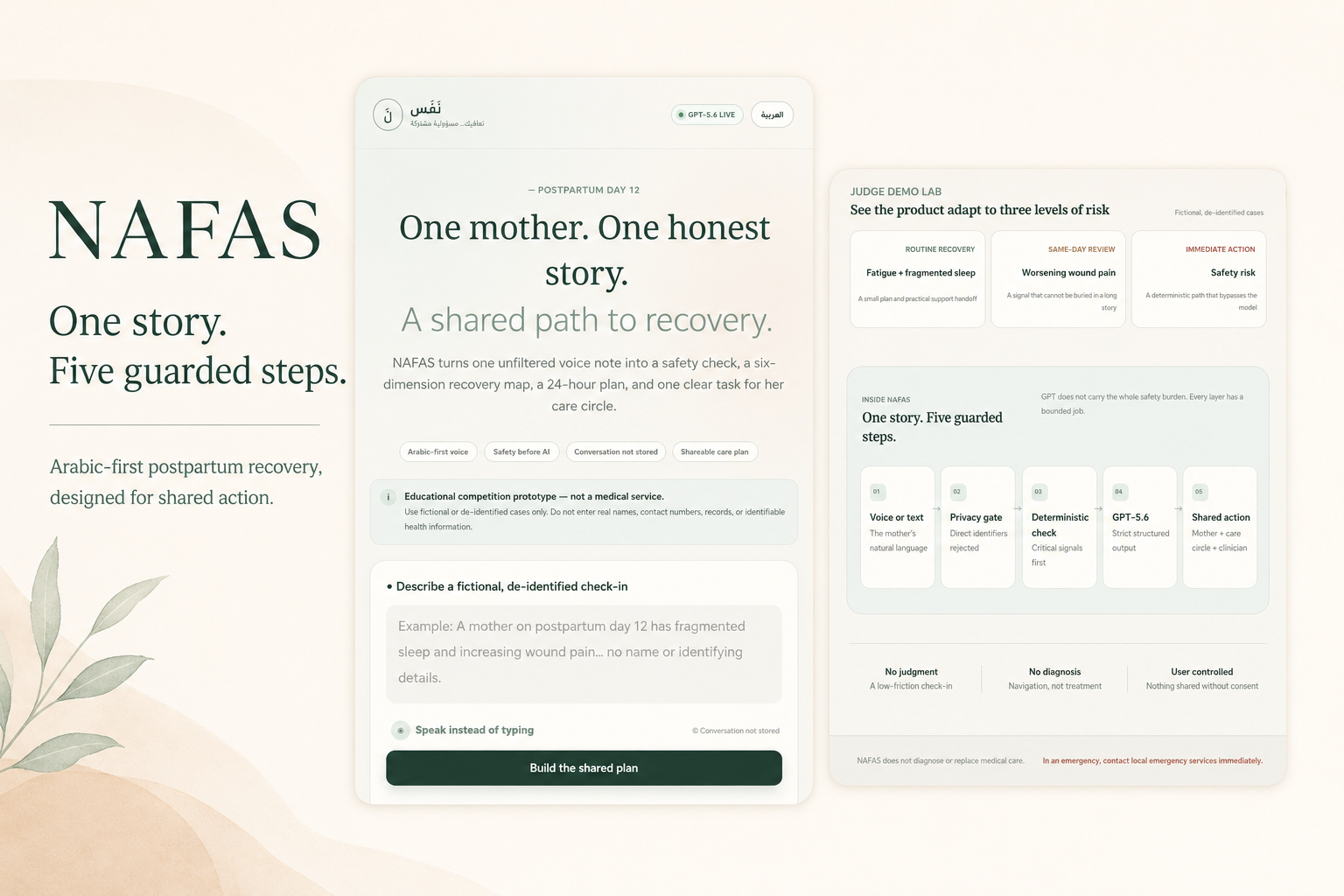
NAFAS accepts a fictional or de-identified voice or text check-in in Arabic or English and turns it into four connected outputs:
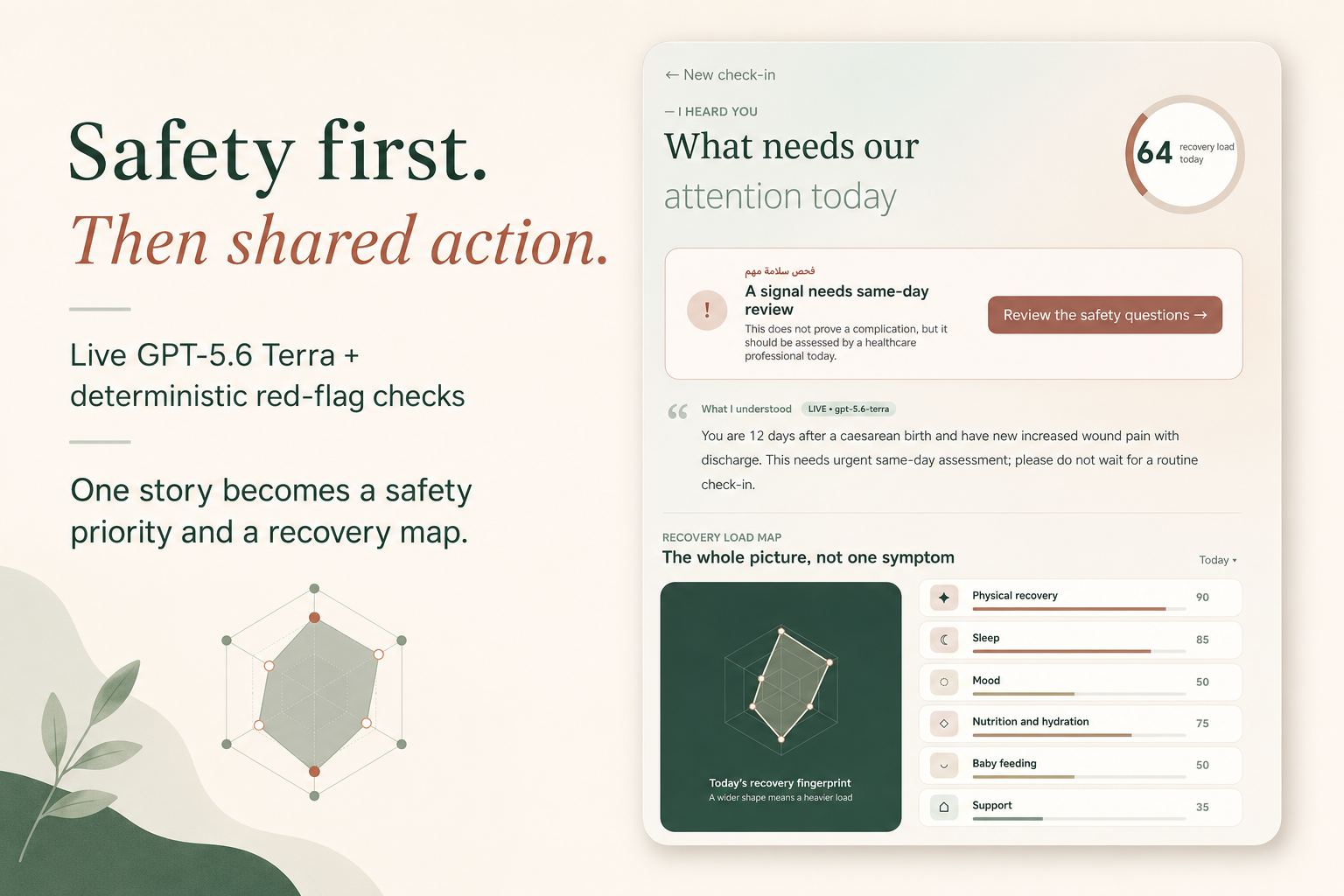
- A deterministic safety priority that runs before the model.
- A visual recovery-load map across physical recovery, sleep, mood, nutrition, infant feeding, and support.
- A focused 24-hour plan with no more than four actions and a clear owner for every step.
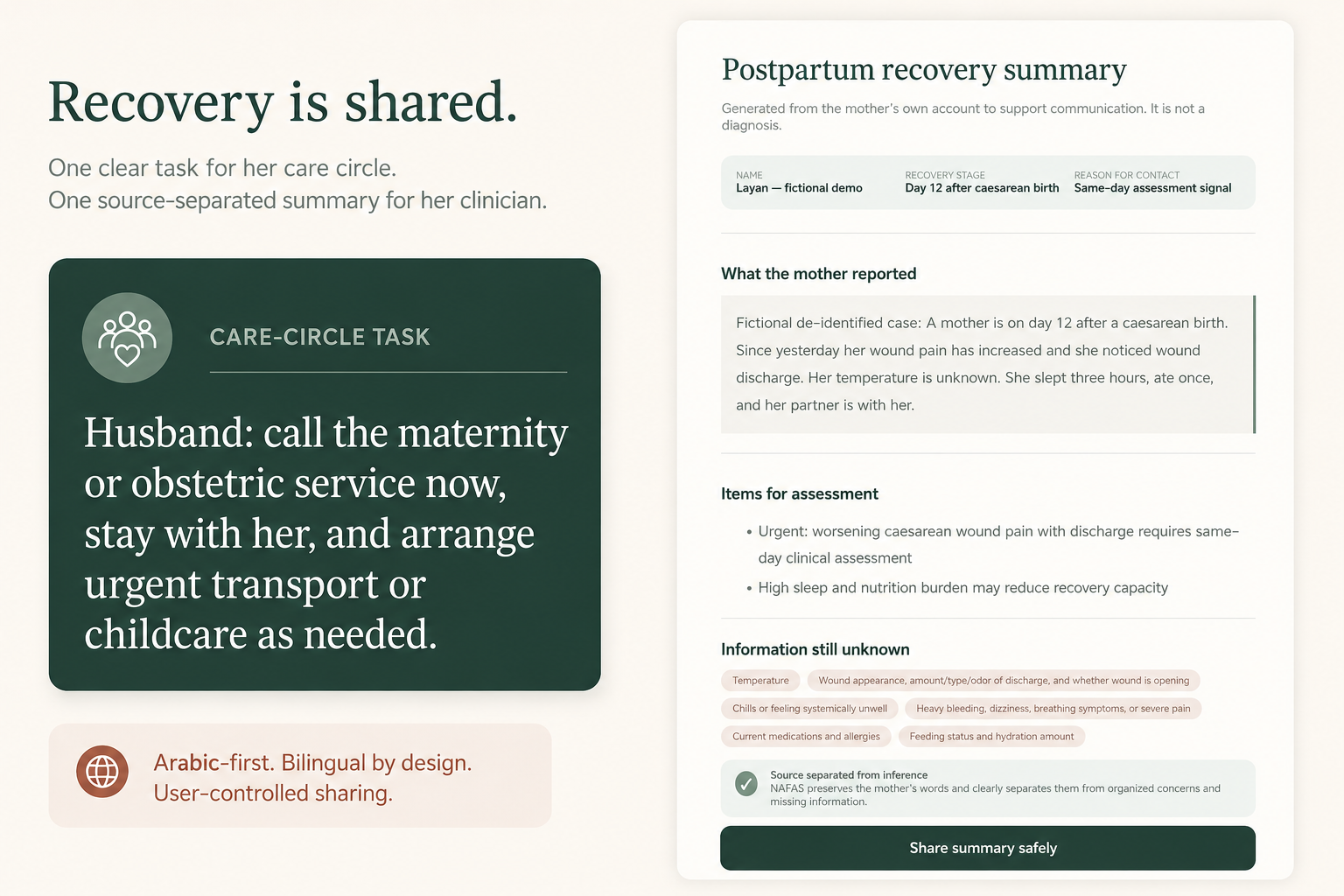
- One ready-to-share task for the mother’s care circle, plus a clinician-ready summary that separates her own words from organized concerns and missing information.
Judge Mode includes three fictional scenarios—routine, same-day review, and immediate action—so reviewers can see how the product changes its response as risk changes. An emergency phrase bypasses GPT completely and returns immediate human-help steps.
How I built it
NAFAS uses a layered pipeline instead of asking one model to do everything:
- A privacy gate rejects common direct identifiers before analysis.
- Deterministic Arabic and English red-flag rules establish routine, urgent, or emergency priority.
- GPT-5.6 Terra uses the Responses API with low reasoning effort,
store: false, and strict JSON Schema Structured Outputs. - A responsive bilingual interface renders the result as a recovery fingerprint, shared 24-hour plan, care-circle handoff, and provider summary.
- A timeout-bounded safe fallback preserves a complete and explicit experience if the API is unavailable.
- Twenty automated Arabic and English safety and privacy evaluations check priority preservation and key prototype boundaries.
I used Codex from the first idea through deployment. It helped transform my domain framing into a working public product: scaffolding the implementation, converting safety decisions into deterministic tests, designing the strict output schema, building the bilingual mobile experience, improving latency and failure handling, and preparing the repository, documentation, and deployment.
The most important human decisions remained mine: the unmet problem, clinical framing, Arabic-language nuance, cultural context, safety boundaries, recovery dimensions, visual tone, and the principle that AI should remove work from the mother rather than add more advice.
Challenges I ran into
The hardest challenge was preventing AI from appearing to be the source of clinical truth. I separated deterministic safety from generative personalization, required unknown information to stay visible, prohibited diagnosis and prescribing, and created an emergency path that does not call the model.
Arabic-first design added another challenge: the product had to accept natural Arabic while remaining immediately understandable to international judges. I built a complete RTL/LTR Judge Mode and required every structured output field to follow the selected language.
I also had to balance quality with live-demo latency. GPT-5.6 Terra, low reasoning effort, lean prompts, strict output limits, progressive loading stages, and a bounded fallback created a fast and resilient experience.
Accomplishments I’m proud of
- A public end-to-end working product, not a static mockup.
- One mother’s check-in becomes a safety check, six-dimension recovery map, focused action plan, care-circle task, and provider summary.
- Emergency language bypasses the model inside the application pipeline.
- The interface exposes the execution path, latency, privacy gate, structured output, and no-storage status to judges.
- Twenty automated Arabic and English safety and privacy evaluations pass.
- The experience remains simple for an exhausted mother while revealing its technical depth through Judge Mode.
What I learned
The most useful role for AI in postpartum recovery may not be generating more health information. It may be reducing cognitive load, preserving uncertainty, and coordinating one next action across the mother, her support network, and her healthcare professional.
I also learned that safety improves when model capability is bounded by deterministic gates, strict data structures, visible uncertainty, and clear human escalation paths.
What’s next for NAFAS
- Evidence-reviewed pathways with qualified maternal-health professionals.
- Broader Arabic dialect and adversarial safety evaluation.
- Consent-led authenticated care-circle collaboration.
- Longitudinal recovery-load trends.
- Usability research with postpartum mothers and families.
- Privacy, security, clinical, and regulatory review before any real-world clinical use.
Built With
- codex
- css
- gpt-5.6
- html
- javascript
- node.js
- openai
- rtl

Log in or sign up for Devpost to join the conversation.