-
-
NADK - Google Immersive Geo Challenge - Revealing the invisible reality of every city
Inspiration
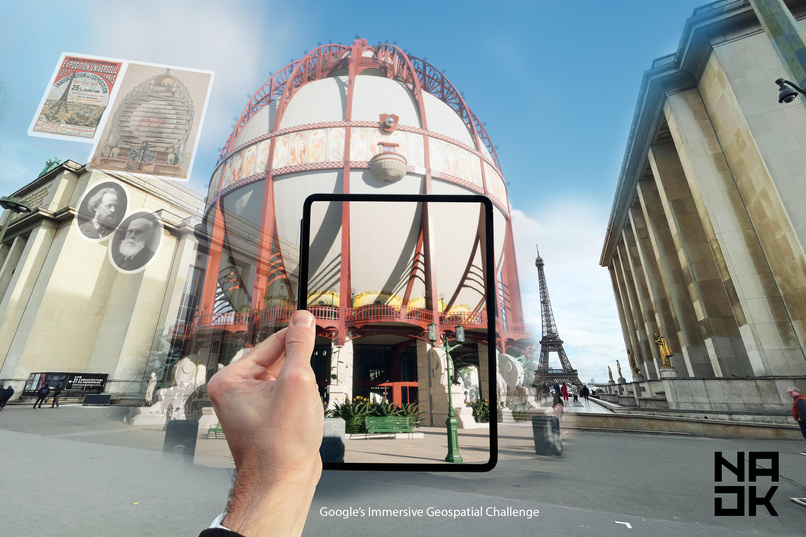
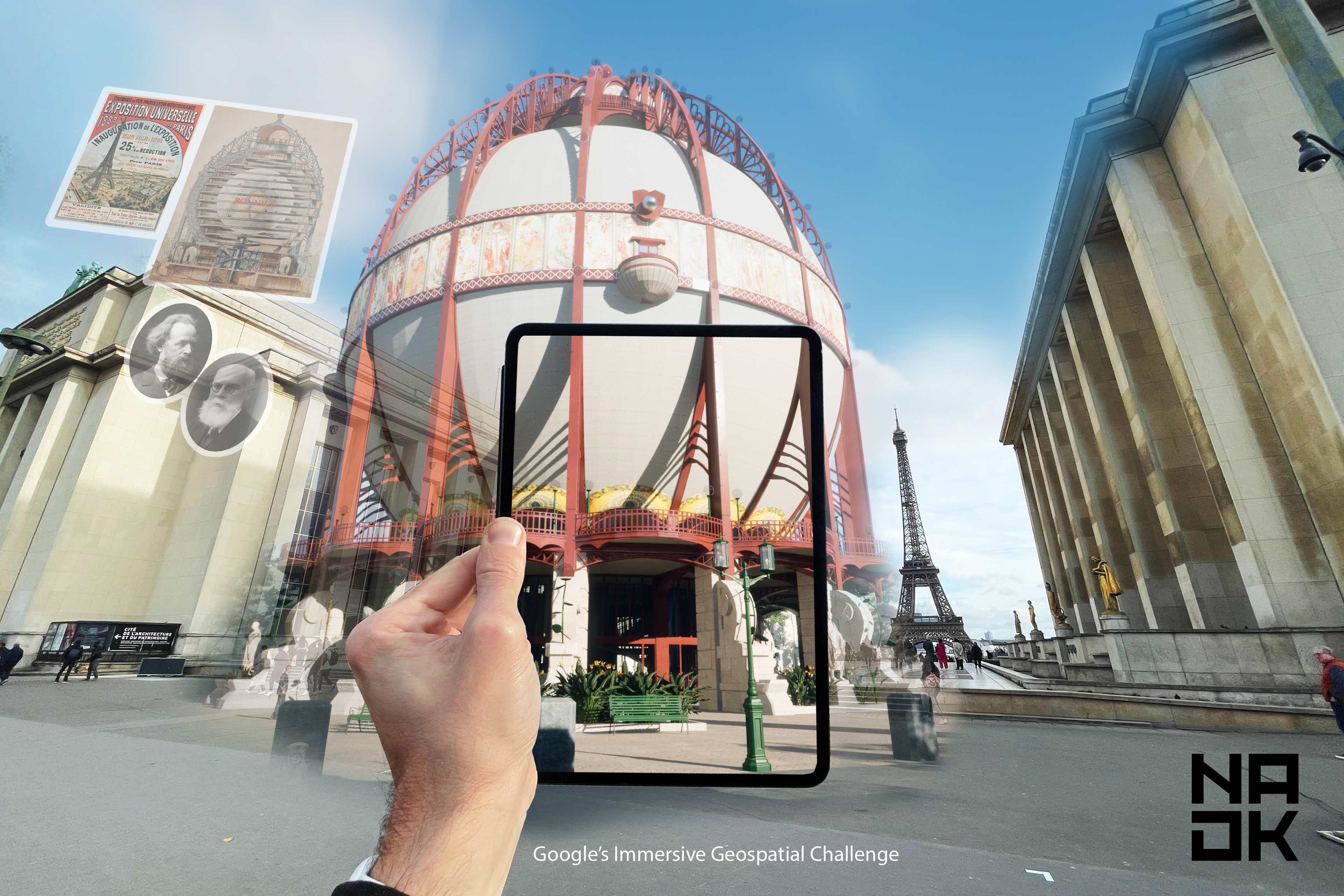
Our cities have a hidden parallel reality... What would Paris look like if the history of construction had been slightly different?... What would Paris look like if Jules-Désiré Bourdais had won the competition instead of Gustave Eiffel? What would Paris look like if Jean-Antoine Lavoine had built the colossal elephant on Place de la Bastille? What would Paris look like if Étienne-Louis Boullée had built his opera on Place du Carrousel next to the Louvre? What would Paris look like if Louis Bonnier had erected Elisée Reclus's Globe on Place du Trocadéro for the 1900 Universal Exhibition in Paris? That's why Reveal Lab has created the AR NADK application, which, thanks to Google Maps and Adobe Aero technologies, allows visitors to discover the parallel reality of cities with their smartphones. NADK allows inhabitants and visitors of large cities to explore the city in search of their alternative reality, both distant and now so palpable. NADK is an unparalleled tool for cities and their museums to showcase their history, evolution, heritage richness, hidden treasures, unknown, now accessible to all in augmented reality! NADK presents the Globe of Élisée Reclus that was supposed to be erected in 1900 on the current Place du Trocadéro. A monumental, incredible building project from the late 19th century, and now accessible as if it were true. NADK, the augmented city.
What it does
NADK's AR application shows the parallel reality that could have existed in our cities. As a demonstration, the app shows the Earth Globe building by geographer Elisee Reclus and architect Louis Bonnier, originally designed for the 1900 Paris Exposition Universelle opposite the Eiffel Tower. Due to financial and structural constraints, the building was never built in 1897. Using Google maps, visitors to the Place du Trocadéro in Paris can see the Globe building at actual scale, as if it had actually been built, and admire its proportions and Art Deco aesthetic.
How we built it
Our mission is to criss-cross the globe to unearth these extraordinary creations, materialize them to make them employable, give them a second wind, and make them visible so that they can inspire as many people as possible. We model and texture in 3D a selection of historic and contemporary building projects that have never been built. We use the Adobe Aero application to give them a second life in the virtual world, and enable as many people as possible to contemplate these full-scale buildings in their urban context.
Challenges we ran into
We had to find and compile a wealth of knowledge, plans, sections, elevations and architectural details on Elisee Reclus' Globe building, originally planned for the 1900 Paris World Fair, in order to produce the most reliable digital reconstruction possible.
Accomplishments that we're proud of
More than 80% of architectural creation has never been built, and this is a great frustration for architects of all eras. Yet it is often the most ambitious projects that remain in the archives. All these projects have the potential to amaze, to move, to make us understand a culture, an era, they are the reflection of history and collective imaginations. As architects, we're proud to participate in the virtual rebirth of these architectural masterpieces. And we believe that these buildings can also inspire large audiences in video games, cinema, advertising, metaverses and so on.
What we learned
We've realized that the creation of augmented reality content is within everyone's grasp, and that we can use it as a new vector for conveying emotions, showing projects in real size, and creating participative experiences between visitors.
What's next for NADK - Reveal unbuilt architectural creativity
We'd like to continue our work in augmented reality by bringing to life in augmented reality the entire Paris 1900 Universal Exhibition. We'd also like to create immersive augmented reality exhibitions on strong architectural themes, such as highlighting certain key historical designers and architectural styles.
Built With
- adobe
- aero
- blender


Log in or sign up for Devpost to join the conversation.