-
-
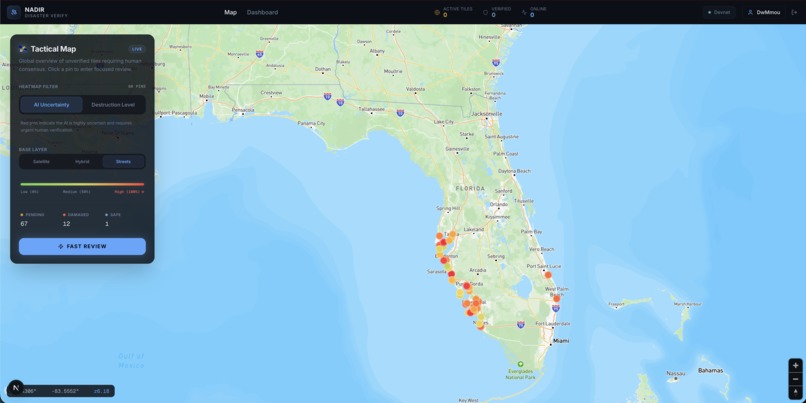
Tactical Map of Florida
-
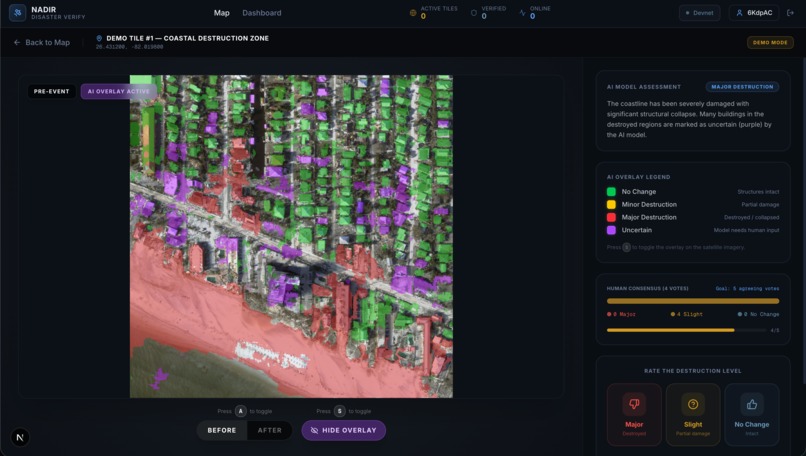
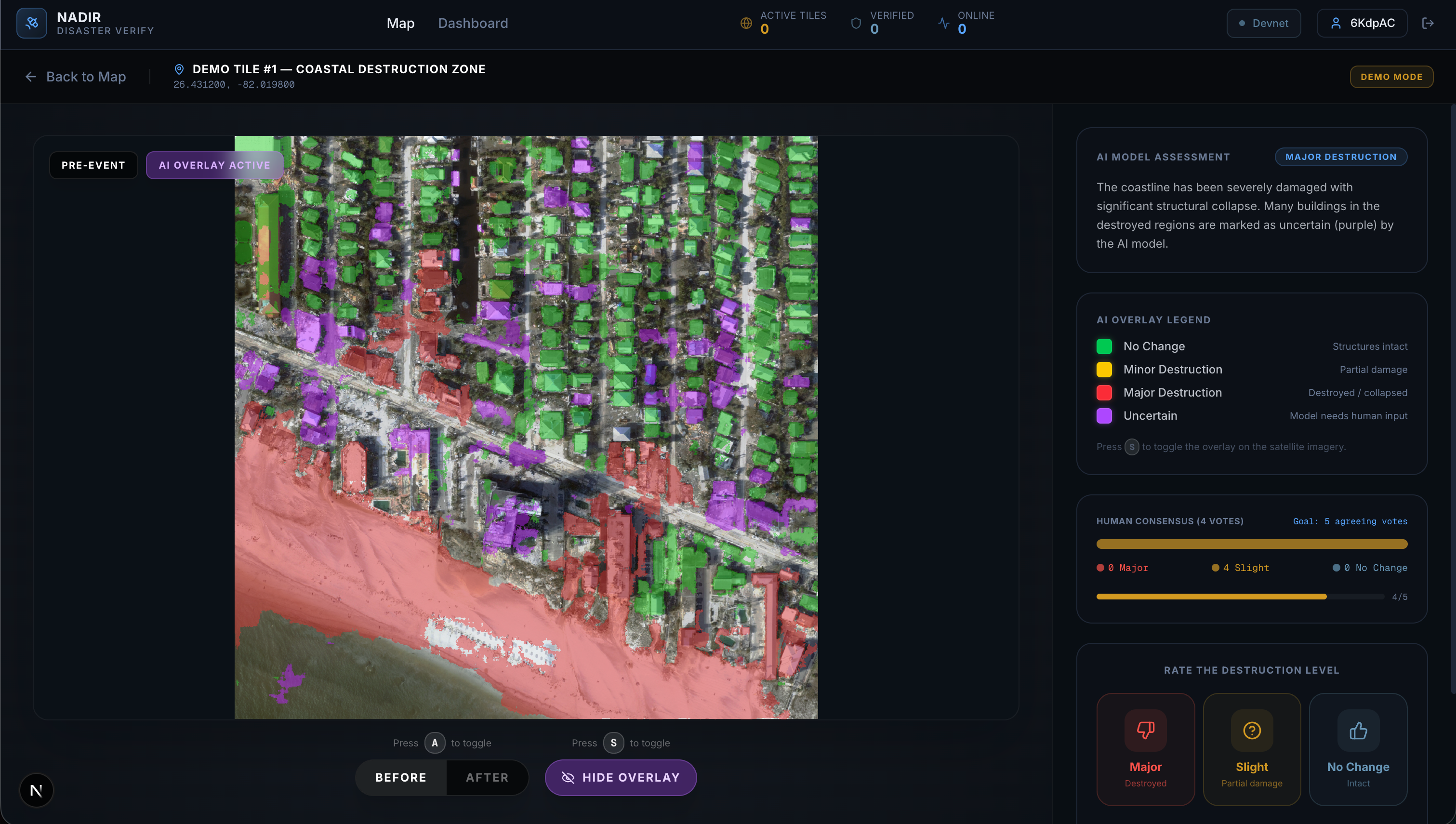
AI Destruction Analysis
-
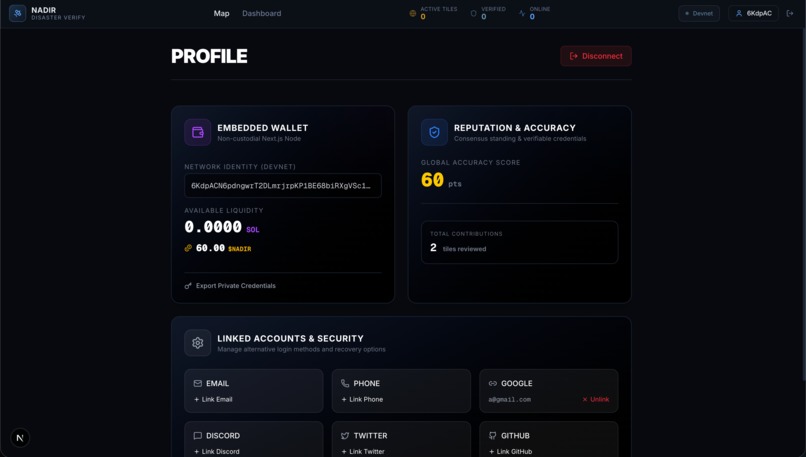
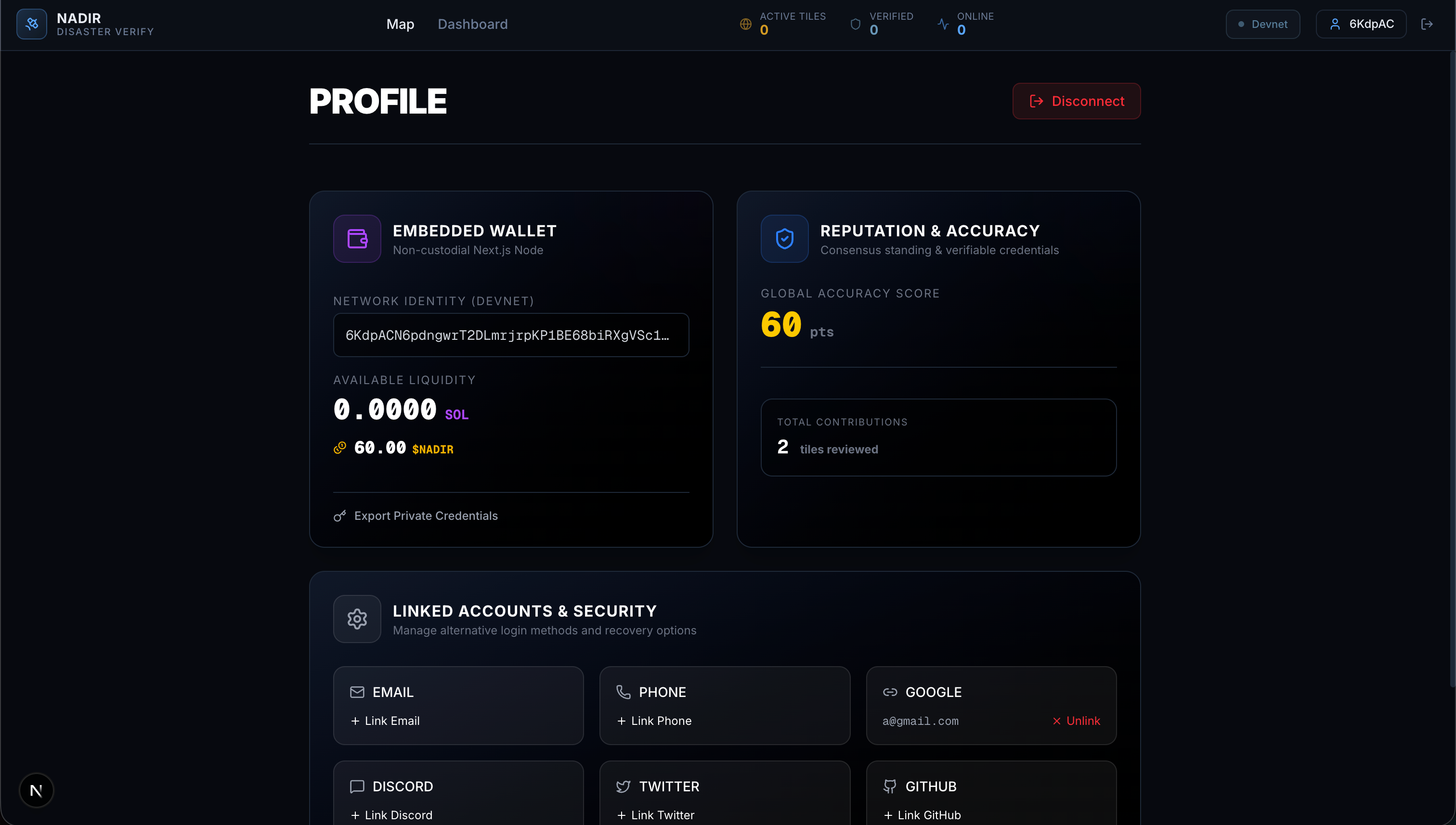
Solana Wallet Integration
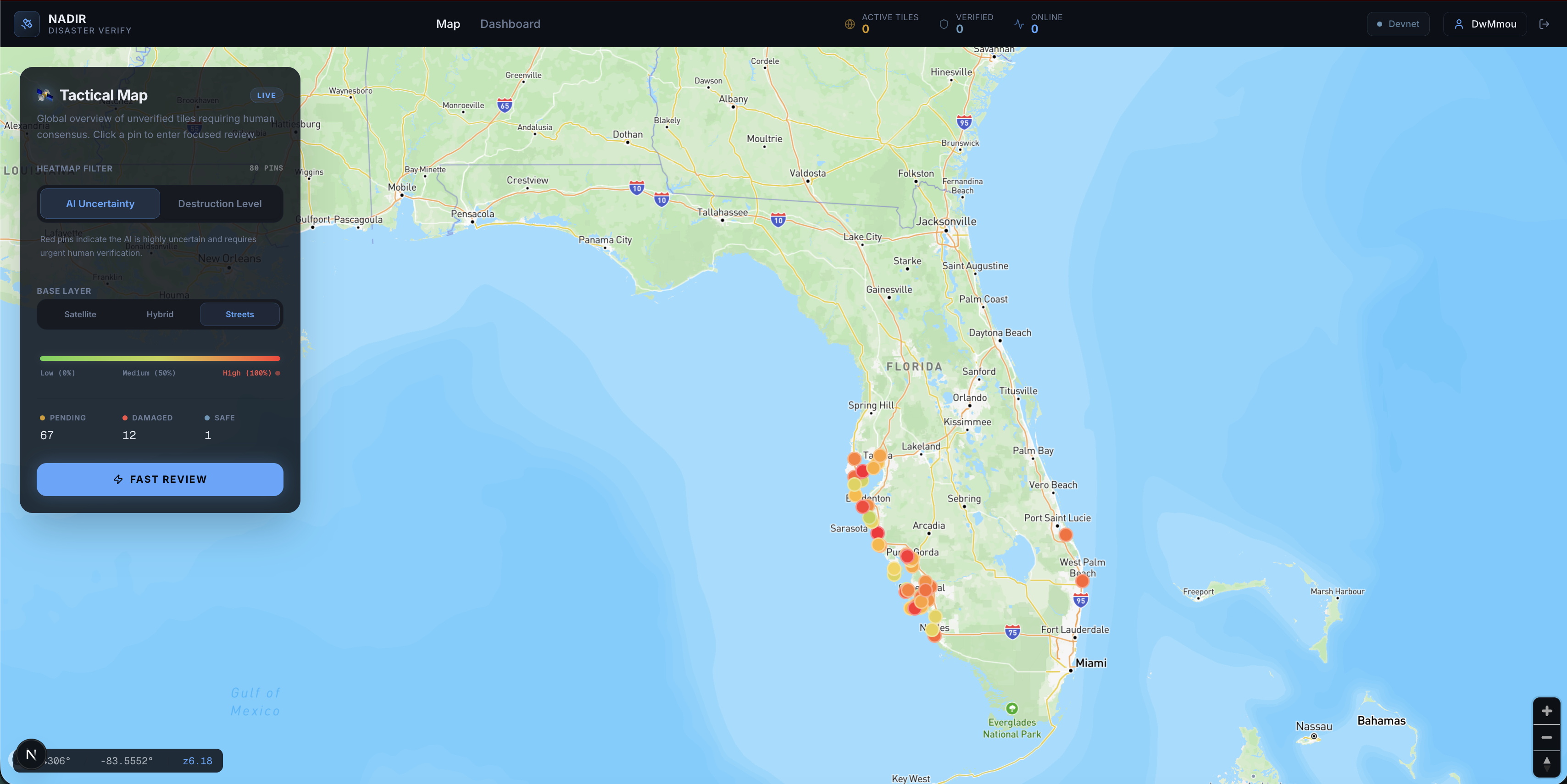
Nadir: The Truth Layer for Disaster Response
About the Project Nadir is a real-time disaster intelligence platform that uses machine learning to automatically detect structural damage from before-and-after satellite imagery, generating live heatmaps for first responders within minutes. When the AI encounters uncertainty, due to clouds, ambiguous damage, or low-confidence predictions, it escalates those regions to a decentralized verification layer on Solana, where participants validate the results and are rewarded for accurate consensus. By combining automated scale with incentive-aligned human verification, Nadir delivers fast, trustworthy operational insight when it matters most.
Inspiration: Solving the "Latency of Truth" The spark for Nadir came from observing a recurring bottleneck in disaster response: the latency of information.
In major crises, satellite data is often captured within hours, yet it consistently takes days for that information to be filtered, verified, and distributed to teams on the ground. We realized that by decentralizing this verification and anchoring it to a blockchain, we could create a real-time, high-integrity "truth layer" that bypasses traditional bureaucratic delays.
The idea for Nadir came from noticing a simple problem in disaster response: the information is there, but it moves too slowly. Satellite images are often captured within hours of a storm, yet it can take days before that data turns into something responders can actually use. We realized machine learning could act as a fast first pass, automatically scanning before-and-after imagery to flag structural damage and generate a rough severity map almost immediately. Then, instead of waiting on centralized review, uncertain regions can be verified through a decentralized consensus layer, creating a faster and more reliable way to surface operational truth.
** The Technical Stack ** We built Nadir using a modern, tactical stack designed for speed and reliability:
Frontend: Next.js with Tailwind UI and Mapbox for high-performance geospatial visualization. Authentication: Privy for seamless Web3 onboarding. ML: PyTorch Backend/DB: Prisma and PostgreSQL (DigitalOcean) for fast off-chain state management. Blockchain: Solana (via Seahorse & Anchor) for immutable consensus anchoring and Helius for minting compressed NFT (cNFT) verification badges.
Challenges and Solutions
Speed vs. Security Making instant human decisions work smoothly with blockchain technology was a major hurdle. We didn’t want users stuck on a "loading" screen while their vote was being saved. The Solution: We implemented Durable Nonces, allowing us to record data securely without slowing down the volunteer's experience.
The "Shadow" Problem AI is powerful but imperfect—it often struggles to distinguish between a dark shadow and a collapsed roof. The Solution: We built a human-in-the-loop system. If the AI is even slightly unsure about an image, it automatically requests a second opinion from the community, ensuring critical areas get human attention.
One Person, One Voice In a global application, ensuring integrity against fake accounts is vital. The Solution: We utilized Privy and $NADIR Tokens to create a "digital reputation" for every volunteer. This keeps the mission honest and ensures every voice is real, all without compromising personal privacy.
Conclusion We learned that transparency is the ultimate trust-builder. Web3 technology is more than a financial tool; it is a mechanism for accountability in critical human missions. Nadir ensures that in the wake of a disaster, truth is delivered at the speed of the internet.
Built With
- anchor
- digitalocean
- helius
- machine-learning
- mapboxsdk
- modal
- next.js
- postgresql
- prisma
- privy
- python
- pytorch
- react
- seahorse
- solana
- typescript


Log in or sign up for Devpost to join the conversation.