Inspiration
The inspiration for this project came from our own group member's experiences with our own older relatives. With the coinciding age increase between both sides, that means us students are getting busier, and our relatives are getting older. Technology has only been getting better, and it is becoming cumbersome for our relatives to keep up. At the same time, we've noticed the amount of gig work increase, and the rate of unemployment increasing for younger people in our generation. We theorized it could be from the complexity and hardships within the job market. From these points of views, we decided it to combine these two noticeable trends, and use them to create an app that could help those with accessibility needs in their everyday lives. This would mean a simple and easy UI to be used on both the asker, and the helper's side. As well, tapping into a market to help those, such as the youth like us, to find jobs and provide help whenever possible.
What it does
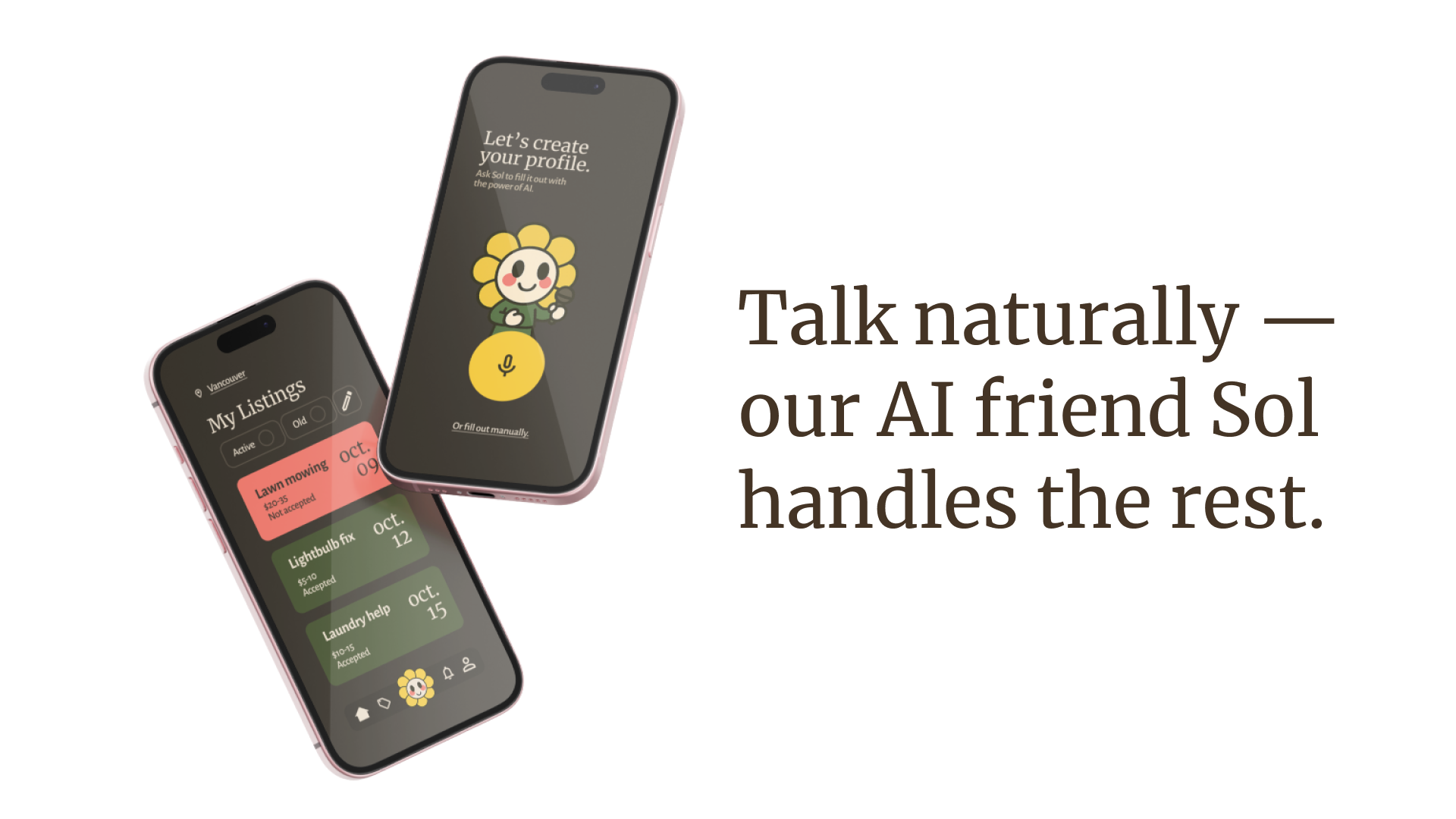
Nabley is a marketplace to help connect people for one-off tasks in a simple and accessible manner. Through the means of AI to help create spoken descriptions, it allows easy and quick creations of both accounts and listings. These listings are then matched to curated helpers through the help of AI, and help to guarantee satisfaction to those who need it.
How we built it
Through the usage of Figma, we laid out a design for the whole app itself, including from login to the task list. The character of Sol was hand drawn, and Chatgpt was used to give alternative poses. Afterwards, we used Flet from Python to build a mobile app with a GUI. GitHub was used as a version control so everyone's part was not clashing with each other. We used Chatgpt and Copilot to help us understand the commands and inform us how they are supposed to be used in our code. We used multiple modules to create objects containing the data for the accounts and tasks. Initially, we planned the overall functions and control flow of how the project would work. Then, the lower-level modules were built before moving onto the higher-level modules. A lot of the time, we would have to create separate files just to make sure the commands of Flet were running properly. After getting the main functionality of an account login system and task displays, we used Flet to make the GUI look like the designs from Figma. Then, we integrated GeminiAPI, and libraries such as speech_recognition to create a sort of AI bot that can speak and listen. CoPilot was used to help develop and incorporate GeminiAPI, in order to create the AI bot as well.
Challenges we ran into
A challenge that we ran into was much of the backend code, and attempting to fix the Gemini API into being able to actually speak to the user in their account creation. As well, the scale of the project had to be evaluated and either scaled back or a little more up. Trying to find the right balance within a 24 hour frame took some amount of discussion.
Accomplishments that we're proud of
Having a design that was aligned with our goals and what we wanted, and that we had accomplished as much as we could within the 24 hours.
What we learned
The usefulness of teamwork, and how it leads to ideas and approaches we have not considered in many aspects of our project.
What's next for Nabley
As a concept, to hopefully be more fleshed out in the future, such as an actual business idea or a stormhack idea.


Log in or sign up for Devpost to join the conversation.