About the Project: The NABDAI Journey
What Inspired Us
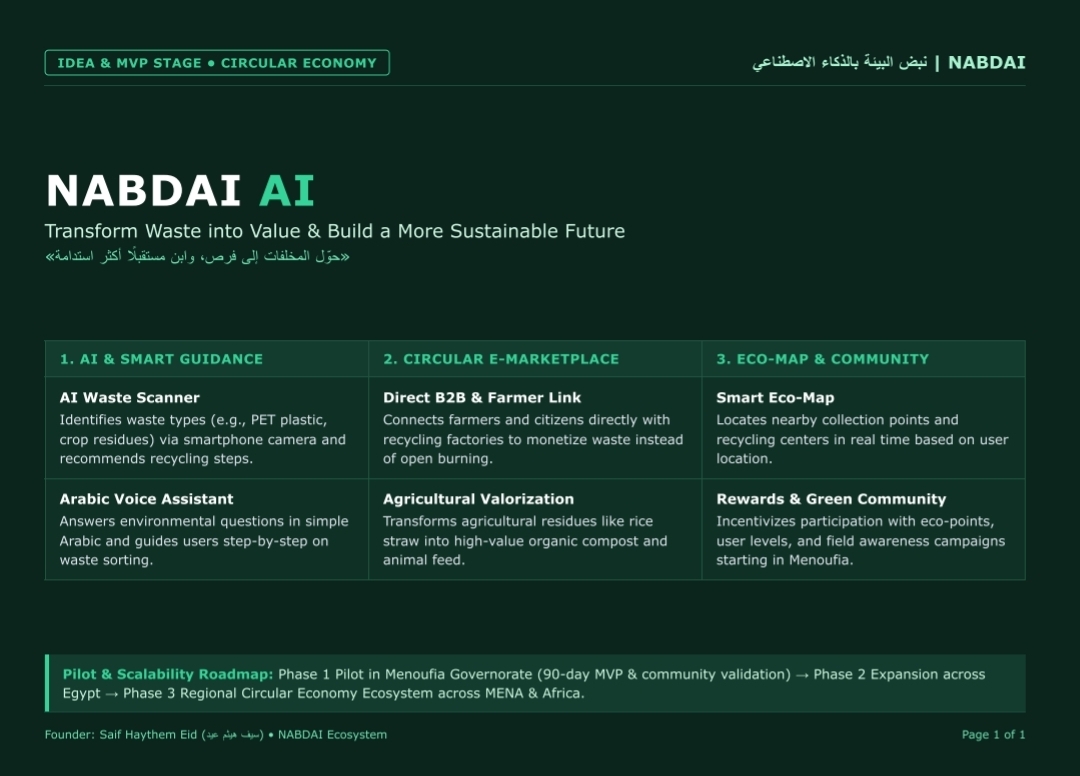
The inspiration behind NABDAI stems from observing everyday environmental challenges in Egypt, specifically focusing on four interconnected crises: unsegregated plastic waste accumulating in streets and waterways, the harmful burning of agricultural residues (such as rice straw) that pollutes the air, the absence of accessible waste-sorting infrastructure, and inefficient water management. We were driven by a vision to harness artificial intelligence to transform these discarded materials from an environmental burden into economic opportunities, building a sustainable and circular economy starting locally from Menoufia.
How We Built Our Project
NABDAI was engineered as a comprehensive, multi-tool ecosystem rather than a standalone app:
AI Waste Scanner: Integrates computer vision to identify waste types through a smartphone camera and suggest recycling pathways.
Smart Voice Assistant: Features an Arabic-language voice assistant designed to answer environmental queries and guide users step-by-step.
E-Marketplace: Connects waste generators (such as farmers and citizens) directly with recycling factories and companies.
Eco-Map & Rewards System: Pinpoints local collection points and recycling centers while gamifying eco-friendly behaviors with points and community levels.
Green Community Initiative: Combines digital tools with on-the-ground awareness campaigns and sorting training in Menoufia.
What We Learned Throughout the ideation and development phase, we learned that solving environmental problems requires a holistic approach that bridges technology with grassroots community engagement. Specifically, addressing agricultural waste like transforming rice straw into organic compost (Compost) or animal feed (Animal Feed) requires bridging the gap between local producers and industrial supply chains. We also learned the importance of structuring a viable business model featuring multiple revenue streams, including marketplace commissions, B2B factory subscriptions, enterprise data services, and sustainability partnerships.
Challenges We Faced
Building NABDAI presented several key hurdles:
Complex Interconnected Problems: Tackling multiple environmental issues simultaneously required a unified framework rather than isolated solutions.
Behavioral and Logistical Barriers: Overcoming low public awareness regarding waste sorting at the source and establishing initial networks in localized pilot regions like Menoufia.
Validating Market Dynamics: Structuring initial phase execution timelines (a 90-day implementation plan spanning problem study, UI design, MVP development, and field testing) while preparing for gradual scalability across Egypt and the Middle East
