Describe your project (max 150 words)
Over the past couple of years, AI has become a core part of our day-to-day lives--from creative work and decision-making to even personal assistance. Yet, as AI reshapes the way we work, create, and connect, there's a growing need to nurture what makes us uniquely human.
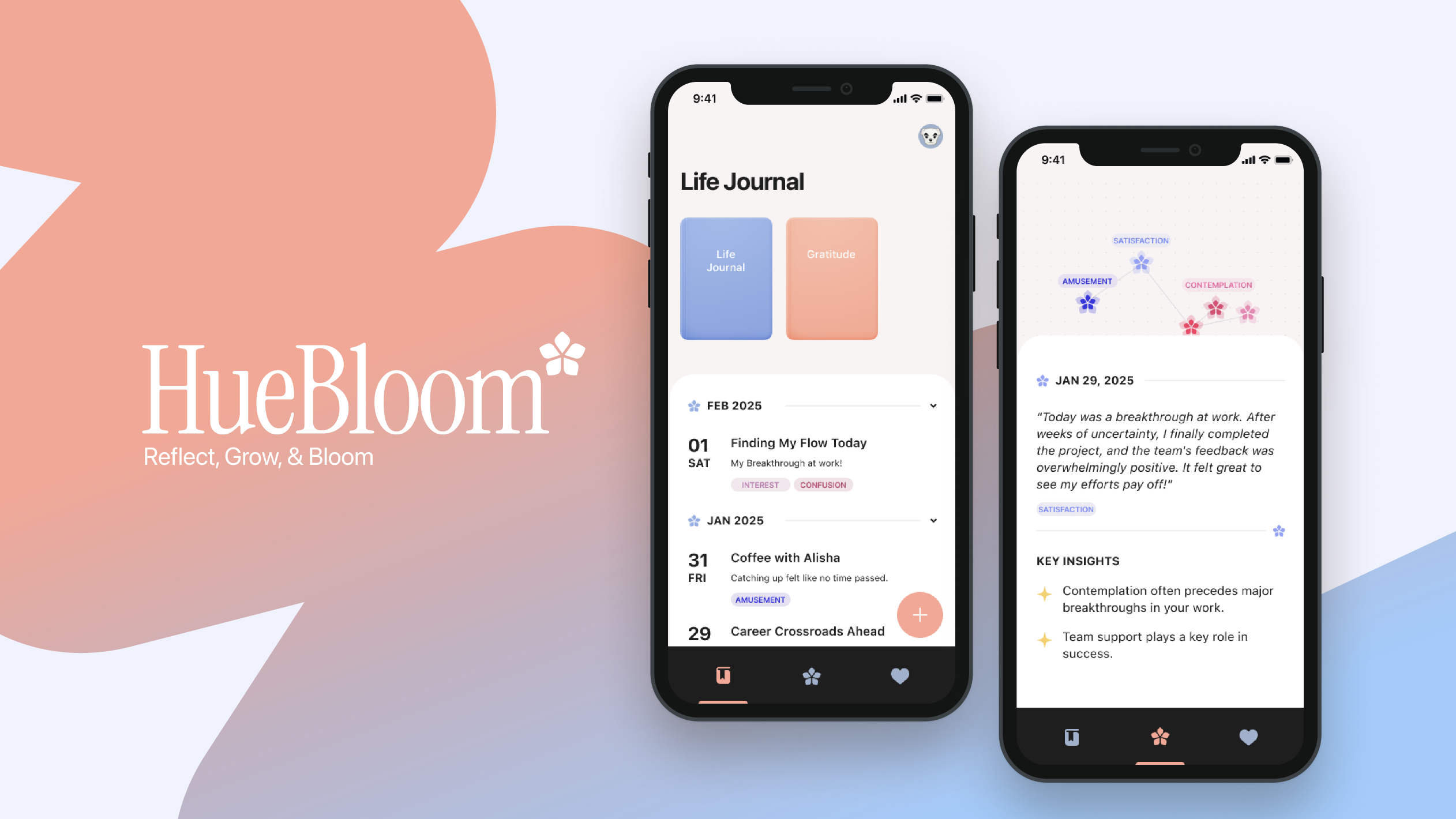
Enter HueBloom, an AI-powered journaling app designed to help users cultivate mindfulness and self-discovery in an increasingly automated world. HueBloom transforms written reflections into visual emotional landscapes, creating an interactive "emotional garden" where journal entries bloom as color-coded flowers in a semantic space. Each flower represents moments of joy, contemplation, or growth, allowing users to visualize emotional patterns, uncover hidden insights, and engage in deeper self-discovery.
Rather than resisting technological advances, HueBloom embraces AI to amplify what makes us fundamentally human: our capacity for self-reflection, emotional depth, and conscious growth.
Describe your research process and findings. If you conducted any surveys or interviews, please include the survey form and/or interview questions here. If you conducted secondary research by pulling from online sources, please include a link to your sources. (Max 500 words)
I conducted a mixed-method research approach combining interviews, surveys, and literature reviews. My research goal was the following:
“To understand how users engage in meaningful self-reflection and explore their attitudes toward AI-assisted emotional intelligence tools, specifically examining the intersection between technology and personal growth."
I began with in-depth interviews with individuals who regularly practice self-reflection through journaling or meditation. These conversations explored their current practices, challenges, and attitudes toward technology-assisted personal growth. I focused particularly on understanding their emotional connection to journaling and their views on AI's role in self-development.
Following the interviews, I distributed an online survey to gather broader insights about journaling habits and technology preferences. The survey explored attitudes toward AI-assisted tools, current journaling practices, and barriers to consistent self-reflection. I also conducted extensive literature reviews focusing on emotional intelligence, digital wellness, and the intersection of AI and personal development.
Key Findings
Survey Findings
- Approximately 70% of respondents expressed a desire to engage in regular self-reflection but struggled to maintain consistent journaling habits. When asked about barriers, around 65% cited lack of time as their primary challenge, while roughly 60% mentioned difficulty in starting entries or knowing what to write about.
- Notably, about 75% of respondents already used some form of digital tool for personal reflection or journaling. However, approximately 80% felt these tools didn't help them discover meaningful patterns in their emotional experiences.
- When asked about AI-assisted journaling, roughly 75% showed interest, provided it could help surface insights while maintaining personal authenticity.
Interview Insights
- "I want to journal more regularly, but when I open a blank page, I often don't know where to start or what to focus on."
- "I've tried various journaling apps, but they feel very linear. It's hard to connect different experiences or see patterns in my emotional responses over time."
- "I'm interested in using AI to help me reflect, but I worry it might make the experience feel less personal or authentic."
The interviews signified the need for structure in reflection practice with authenticity. Many expressed interest in visual representations of their emotional patterns, suggesting this could help them better understand their personal growth over time.
Describe your most important design decisions. What research findings and/or user testing results led you to make these decisions? (Max 500 words)
Based on my research findings, I made several key design decisions for HueBloom that directly address user needs while balancing technology integration with human experience.
The Garden: Semantic-Emotional Mapping
My most significant design decision was developing the Garden interface, which visualizes journal entries as flowers in a semantic-emotional space. This approach emerged from interview insights where users consistently expressed frustration with traditional linear journaling formats. When one interviewee noted, "It's hard to connect different experiences or see patterns in my emotional responses over time," I recognized the need for a more intuitive way to visualize emotional patterns. The garden metaphor creates an organic, evolving representation of the user's emotional landscape while maintaining a sense of authenticity that 75% of survey respondents identified as crucial.
AI-Assisted Reflection with Human Agency
Another critical decision was implementing AI assistance primarily for pattern recognition and prompt generation, rather than emotional interpretation. This choice was informed by survey data showing that while 75% of respondents were interested in AI-assisted journaling, they emphasized the importance of maintaining personal authenticity. I designed the "Dive Deeper" prompts to act as gentle guides rather than prescriptive solutions, addressing the 60% of users who reported difficulty knowing what to write about while ensuring the reflection process remains genuinely personal.
Visual Color-Coding System
The decision to implement color-coding for emotions stemmed from multiple interview participants expressing interest in visual representations of their emotional patterns. This feature helps users quickly identify and understand their emotional trends over time. The system is designed to be intuitive yet nuanced, addressing the 80% of survey respondents who felt existing tools didn't help them discover meaningful patterns in their emotional experiences.
Distraction-Free Writing Environment
Based on the finding that 65% of users cited lack of time as a primary barrier to journaling, I designed a minimalistic writing interface that eliminates unnecessary features and reduces friction in the journaling process. This clean design encourages users to focus on their thoughts without technological distractions, while still maintaining easy access to AI-assisted features when needed.
Monthly Summaries and Interactive Insights
The decision to include automated monthly summaries with interactive elements addresses both the desire for pattern recognition and the need for structured reflection. This feature provides users with meaningful aggregations of their emotional data while encouraging active engagement through tailored reflection prompts. This design choice directly responds to interview feedback about wanting structure in reflection practice while maintaining authenticity.
Ultimately, with these design decisions, I was motivated to create an experience that enhances rather than replaces human emotional intelligence.
Built With
- figma

Log in or sign up for Devpost to join the conversation.