Elevator pitch
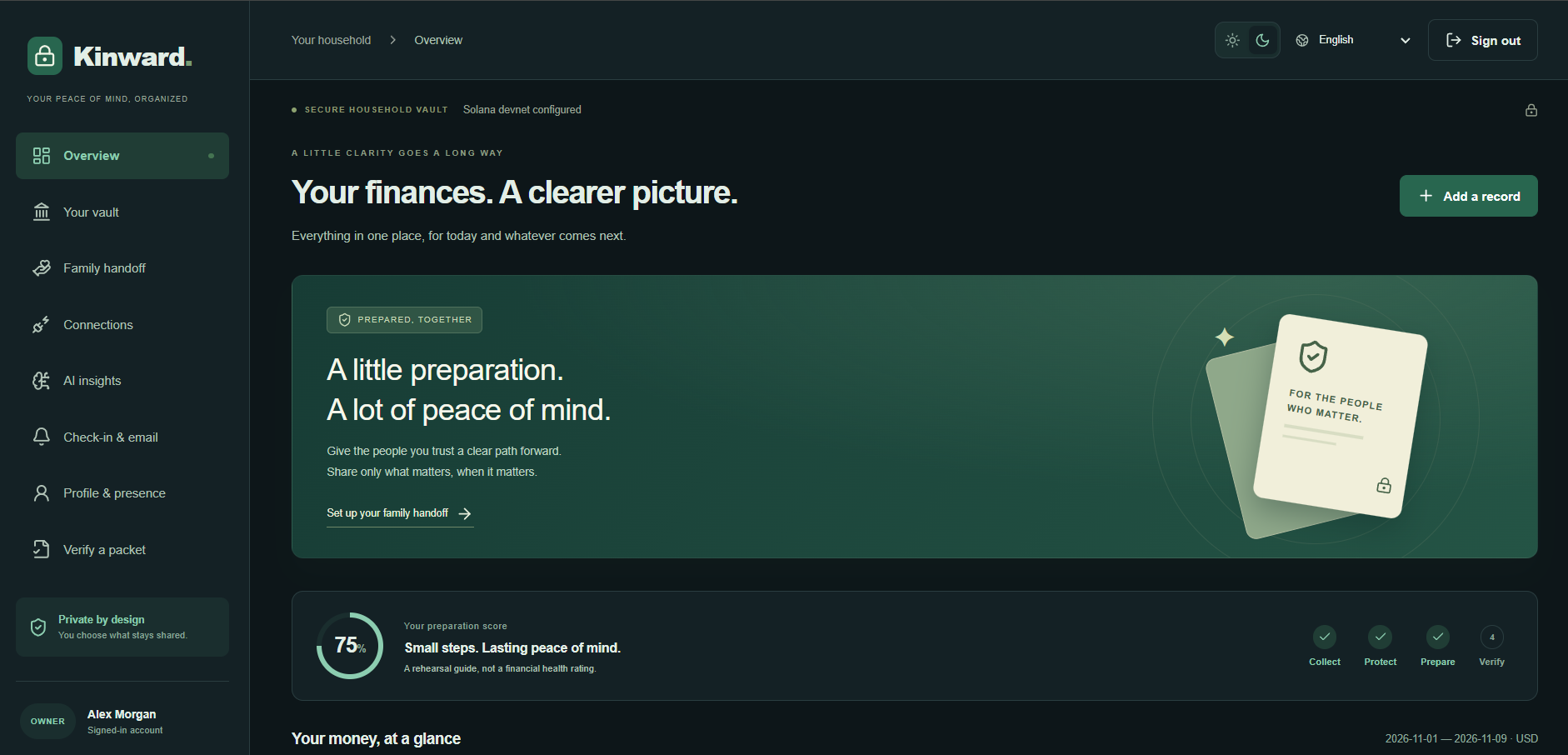
Kinward is a secure financial continuity vault that ensures the right people receive the right information when an emergency prevents someone from managing their affairs. Users organize essential financial records, assign trusted recipients and reviewers, and configure check-ins and safeguards. If something goes wrong, Kinward follows a controlled, auditable process instead of leaving a family searching through accounts, documents, and inboxes.
Project Story
Inspiration
Most people manage their finances with the assumption that they will always be available to explain everything.
Important information is often scattered across emails, folders, devices, and physical documents. If someone becomes seriously ill, incapacitated, or otherwise unavailable, their family may not know which accounts exist, what needs to be paid, where important records are stored, or whom to contact.
Traditional password managers store credentials, and estate documents describe long-term wishes, but neither provides an active continuity process. We created Kinward to bridge that gap.
Our goal was to answer one important question:
If I could not manage my financial life tomorrow, would the people I trust know what to do?
Kinward turns that uncertainty into a structured and controlled plan.
What Kinward does
Kinward is a privacy-focused financial continuity platform that allows a user to:
- Organize essential financial information and continuity instructions in one vault.
- Record accounts, obligations, documents, contacts, and other critical details.
- Nominate trusted recipients who may eventually need the information.
- Assign reviewers who help verify sensitive continuity events.
- Configure periodic check-ins that confirm the owner is still able to manage the plan.
- Send transactional email notifications for invitations, reviews, and important status changes.
- Escalate missed check-ins through a controlled workflow.
- Maintain an audit trail of important actions and decisions.
- Prevent a single missed message or accidental trigger from immediately exposing sensitive information.
The release decision can be represented as a guarded condition:
ReleaseAllowed = TriggerDetected ∧ (Approvals ≥ q) ∧ WaitingPeriodComplete ∧ ¬OwnerRecovery
Here, q is the required number of trusted approvals. This means that one signal alone is never enough to authorize a sensitive action.
Kinward is designed around a simple principle:
Sensitive information should remain private while the owner is active, but it should not become permanently inaccessible when the family genuinely needs it.
How we built it
We modeled Kinward as a state-driven continuity system rather than a simple document repository.
The application separates users into clear roles, including the owner, trusted reviewers, and intended recipients. The core workflow handles invitations, acceptance, check-ins, missed-check-in escalation, review, recovery, and eventual access as distinct states.
The backend automation runs on AWS. Serverless workers process time-based events and send transactional messages through Amazon SES. AWS CloudFormation defines the infrastructure so that the deployment is repeatable, while IAM policies restrict each service to only the permissions it requires.
The user-facing experience is built with TypeScript and standard web technologies. Automated tests exercise both the vault and the continuity workflow, including edge cases such as duplicate processing, incomplete approvals, owner recovery, and invalid state transitions.
A major architectural decision was to keep consequential decisions deterministic. Email delivery may start a workflow, but it does not independently authorize access. Every transition must satisfy explicit application rules.
Challenges we faced
Designing automation without creating dangerous false positives
A missed email does not necessarily mean an emergency. It could be caused by travel, spam filtering, a disconnected device, or simple forgetfulness. We therefore needed several safeguards—reminders, waiting periods, reviewer confirmation, and an owner recovery path—before allowing a sensitive transition.
Modeling a trustworthy state machine
Continuity workflows involve many states and participants. We had to prevent impossible or unsafe transitions, such as a recipient receiving information before the required reviews or a delayed worker repeating an action that had already completed.
Making background jobs idempotent
Scheduled and event-driven workers may retry. Kinward therefore has to recognize completed work so that a retry does not send duplicate invitations, repeat an escalation, or process the same release twice.
Secure transactional email
Email was more complicated than simply calling an API. We needed verified sender identities, correct IAM permissions, safe message content, and clear handling for delivery failures and development environments such as the Amazon SES sandbox.
Balancing preparation with privacy
A continuity plan is valuable because it contains sensitive information. However, collecting that information also creates responsibility. We learned to minimize unnecessary exposure, separate roles, and make every important action explicit and auditable.
What we learned
We learned that a trustworthy vault is not defined only by how it stores information. It is defined by the rules governing who may access that information, under what circumstances, and with whose approval.
We also learned that automation must be conservative when dealing with sensitive personal information. A useful continuity system should reduce the burden on a family without making irreversible decisions from a single unreliable signal.
Working with serverless AWS infrastructure taught us how Lambda functions, SES identities, IAM policies, and CloudFormation resources interact in a production-style event-driven system. Writing automated tests around the state machine also showed us how important idempotency and explicit transition rules are for background workflows.
Most importantly, we learned that preparedness is not just a technical problem. The product must make a difficult subject feel calm, understandable, and manageable.
Accomplishments we are proud of
- Building a working end-to-end continuity workflow rather than only a static vault.
- Separating owners, reviewers, and recipients into well-defined roles.
- Implementing guarded escalation and recovery paths.
- Creating repeatable AWS infrastructure and email automation.
- Testing sensitive state transitions and duplicate-event scenarios.
- Designing the experience around clarity and trust instead of fear.
What is next for Kinward
Future improvements could include:
- Stronger client-side encryption and external key-management options.
- Multi-channel check-ins through SMS or push notifications.
- Configurable reviewer thresholds and escalation timelines.
- Document-expiration and plan-health reminders.
- Emergency-access simulations so families can rehearse the process.
- Encrypted exports and offline recovery packages.
- More detailed security and audit dashboards.
- Accessibility, localization, and additional threat-model testing.
Built With
- amazon-bedrock
- amazon-cognito
- amazon-dynamodb
- amazon-ses
- amazon-sqs
- amazon-web-services
- aws-kms
- aws-lambda
- aws-step-functions
- diversity
- elevenlabs
- express.js
- gemini
- godaddy
- mongodb-atlas
- node.js
- react
- solana
- typescript
- vite

