Inspiration
FaZe fans spend years following their players, but outside of merch drops there’s nothing they can own that grows with the team. We loved how Pokémon cards and the Steam Community Market made collecting feel exciting and valuable, and this year’s HackUTA theme, The Odyssey, gave us the hook. The Greeks won Troy with a gift that had something hidden inside. That became our idea: every pack is a Trojan horse, and sometimes there’s a legend inside.
What it does
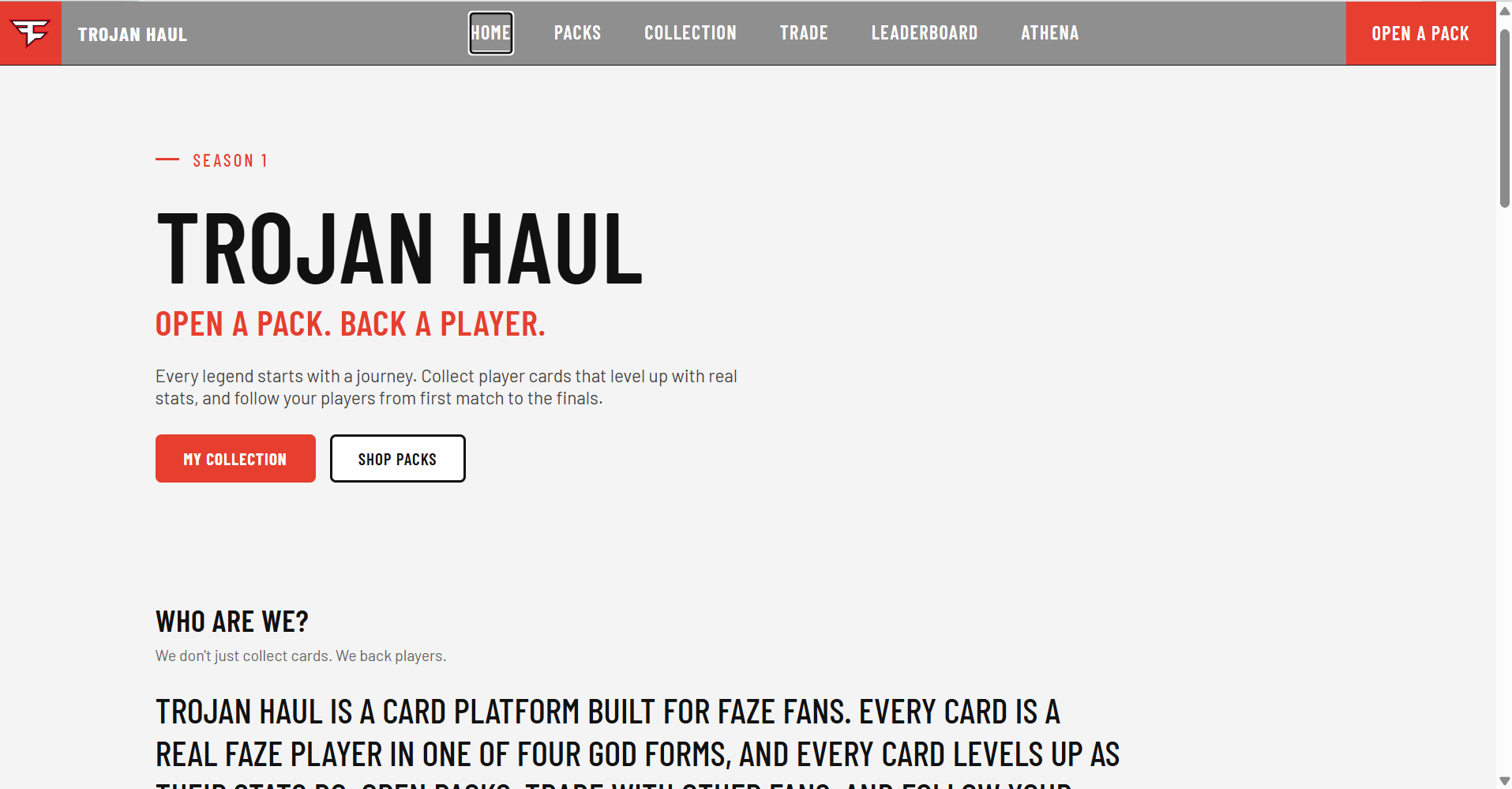
Trojan Haul is a digital trading card game for FaZe Clan fans.
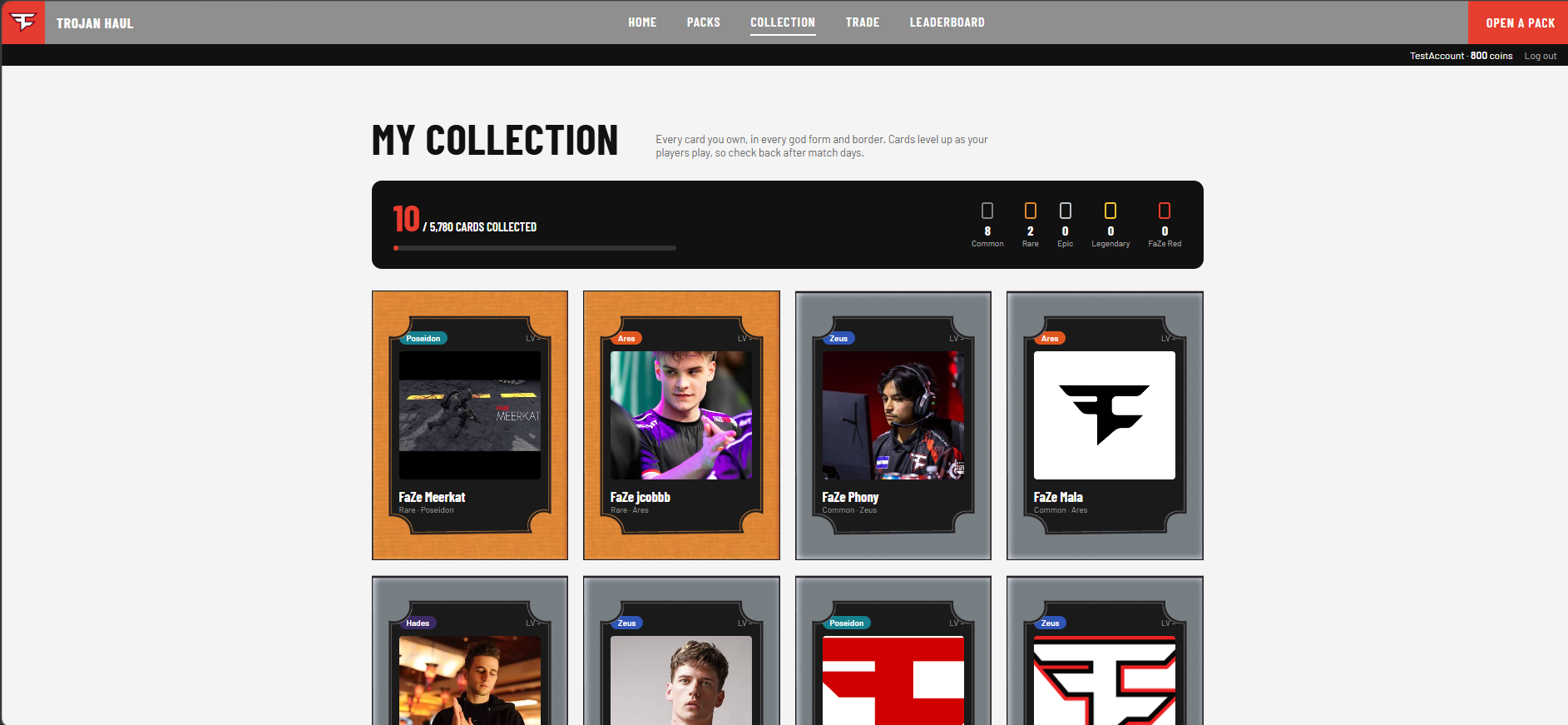
Collect: every card is a real FaZe player in one of four god forms (Zeus/Lightning, Poseidon/Water, Hades/Shadow, Ares/Fire) and one of five borders: Common, Rare (Bronze), Epic (Silver), Legendary (Gold) and the ultra-rare FaZe Red. That’s 289 players × 4 forms × 5 borders = 5,780 cards.
Open packs: packs go from Starter up to Legendary, plus limited FaZe Event and Collab packs that are only available while an event or partnership runs. Higher packs guarantee rarer borders, and the odds are shown before you buy.
Living card values: a card’s value, its Fate Score, moves with the real player’s performance. Recent scores and K/D feed into it, so when your player pops off, your card is worth more.
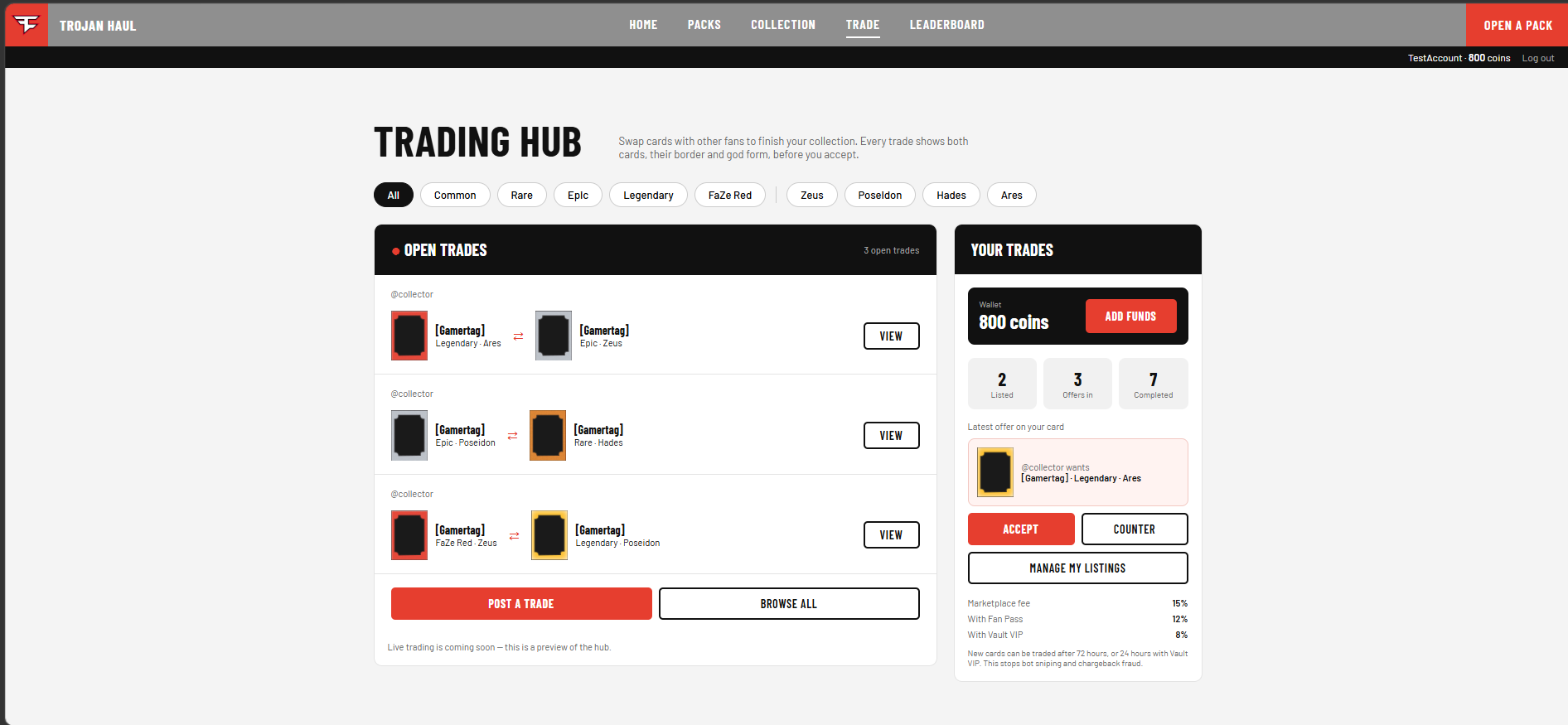
Trade: a trading hub lets fans swap cards to finish their collections, with a closed-loop FaZe Wallet and short trade holds to stop bots and fraud.
Ask Athena: our AI oracle reads the live card market and tells you, in a Homeric voice, which card is worth chasing.
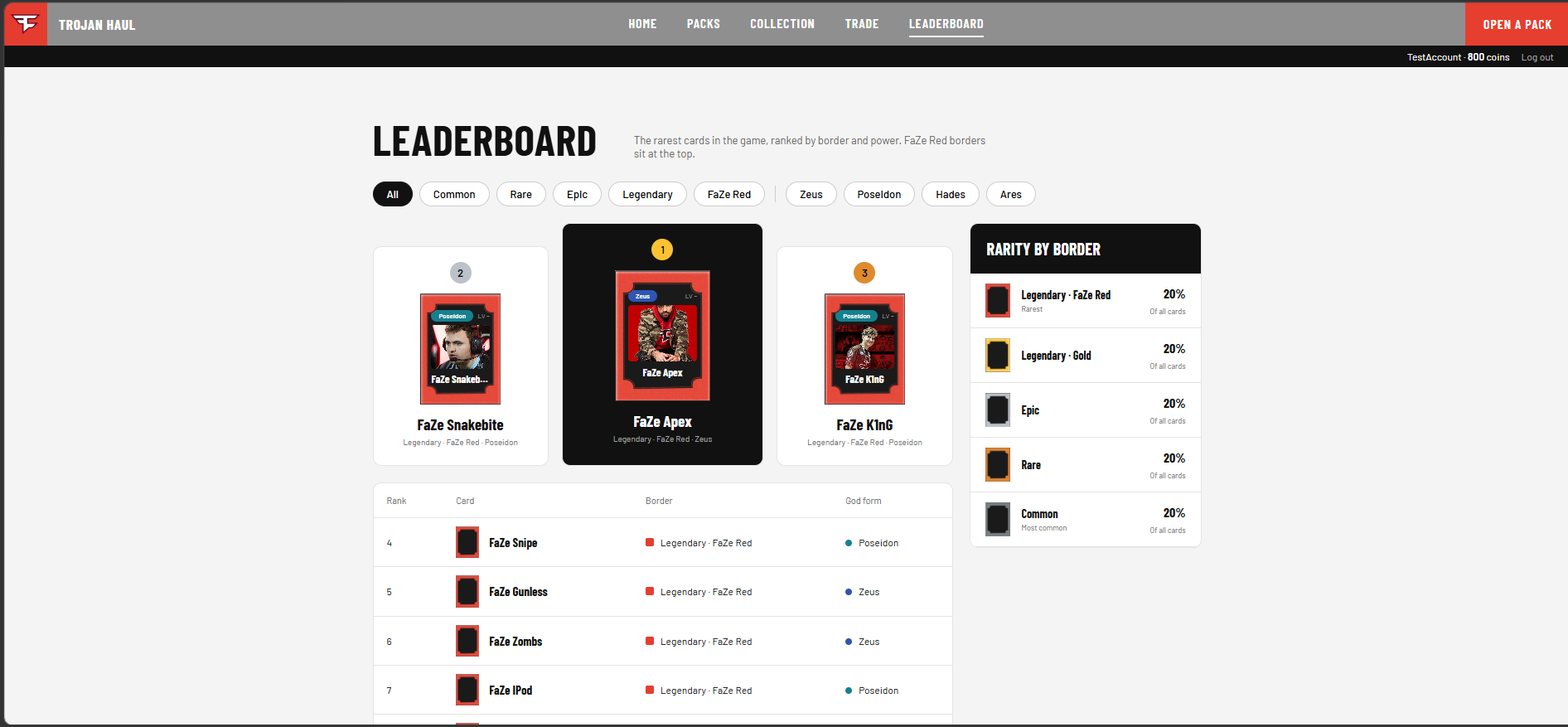
Leaderboard: ranks the rarest cards by how few copies exist.
Memberships: Fan Pass and Vault VIP give monthly packs, lower marketplace fees, Pro Shop perks and early access to drops.
How we built it
Design: we designed the full site in Figma (homepage, packs, memberships, collection, trading hub and leaderboard) in FaZe’s red, black and white with Greek touches like the key-pattern border. The five card borders were drawn by hand in Adobe Illustrator and rebuilt as reusable Figma components, so every card in the design updates from one source.
Frontend: Next.js (React).
Backend and database: Supabase for login, user profiles, card data, inventories and player stats.
Packs: each pack has its own weighted odds per rarity tier, and seasonal cards only drop inside their date window.
Live stats: a stats pipeline posts each player’s average score and K/D to our API, which updates every card’s Fate Score. AI: Athena runs on Google Gemini and answers using only our live market data. A social pulse feature uses xAI’s Grok to summarize what people are saying about a player. Business plan: we modeled the economy (pack prices and odds, memberships, a 15% marketplace fee and sponsor drops) and projected about $7.1M in Year 1 bookings for a North America launch.
Challenges we ran into
Keeping design and code in sync: our rarity system, currency and pack lineup changed several times in one weekend, and getting the Figma design, the database and the business plan to match took real coordination.
Balancing the economy: setting odds that feel rewarding without making rare cards worthless took a lot of math. We also had to think about how paid random packs can look like gambling, so we show odds up front and keep funds inside the FaZe ecosystem.
Getting artwork into Figma: our hand-drawn borders were textured images, so we rebuilt their shapes and colors as vectors to use them across every page.
Connecting real stats: we had to define how player data flows in and how it should move a card’s value without making prices swing wildly.
Accomplishments that we’re proud of
A complete design system and five page designs, built in one weekend.
Original hand-drawn card borders that make the cards feel collectible, not generic.
Cards with “living” values tied to real player performance. Athena, an AI advisor that stays in character and only uses real market data.
A full business model with pack odds, memberships, marketplace fees and a Year 1 revenue projection.
What we learned
How to design a whole product, not just screens: a design system, reusable components, and matching the visual language to a real brand.
How game economies work: odds, scarcity, guarantees, and why trade holds and closed-loop wallets matter.
How to plug AI into a product in a focused, useful way instead of as a gimmick.
How much faster a team moves when design, code and business decisions are agreed early.
What’s next for Trojan Haul
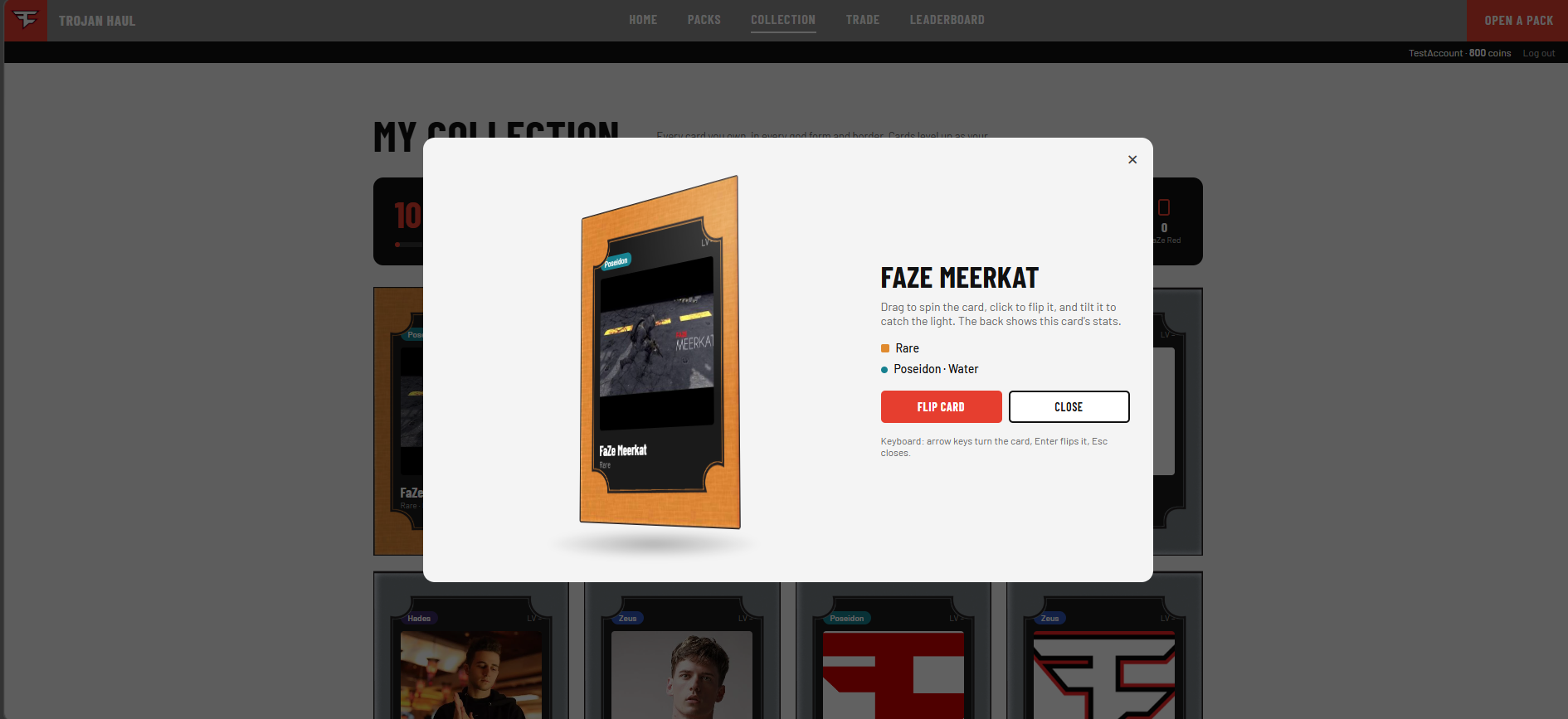
3D card inspect view: tap a card in your collection to spin it, flip it to see the player’s stats, and watch the glossy finish catch the light as you tilt it.
Era stamps: cards minted before a major championship get a permanent “Pre-Title” stamp.
Set-completion rewards: profile frames and Discord roles that stay active only while you hold the complete set.
Sponsor collabs and retail codes: co-branded card variants and redemption codes inside partner products like CORSAIR gear.
Real roster data: replace placeholder players with the vetted FaZe roster and alumni, and connect live tournament stats.
Built With
- claude
- css
- figma
- geminiai
- javascript
- sql


