
Inspiration
Starting a new project is exciting. Understanding someone else's existing codebase is not.
Developers joining a new team, contributing to an open-source project, or returning to an old repository often spend hours answering the same questions: Where does the application start? How does the frontend communicate with the backend? Which files are important? Where is the database logic? What depends on what?
Traditional documentation quickly becomes outdated, while generic AI assistants often explain individual files without understanding the architecture of the entire repository.
We wanted to build something different: an AI-powered memory layer for a codebase.
That idea became Mytrix — a repository onboarding platform that analyzes a codebase, builds structured knowledge about it, and gives developers an AI mentor they can ask questions about the project using evidence from the actual repository.
What it does
Mytrix turns a GitHub repository into an interactive, queryable knowledge base.
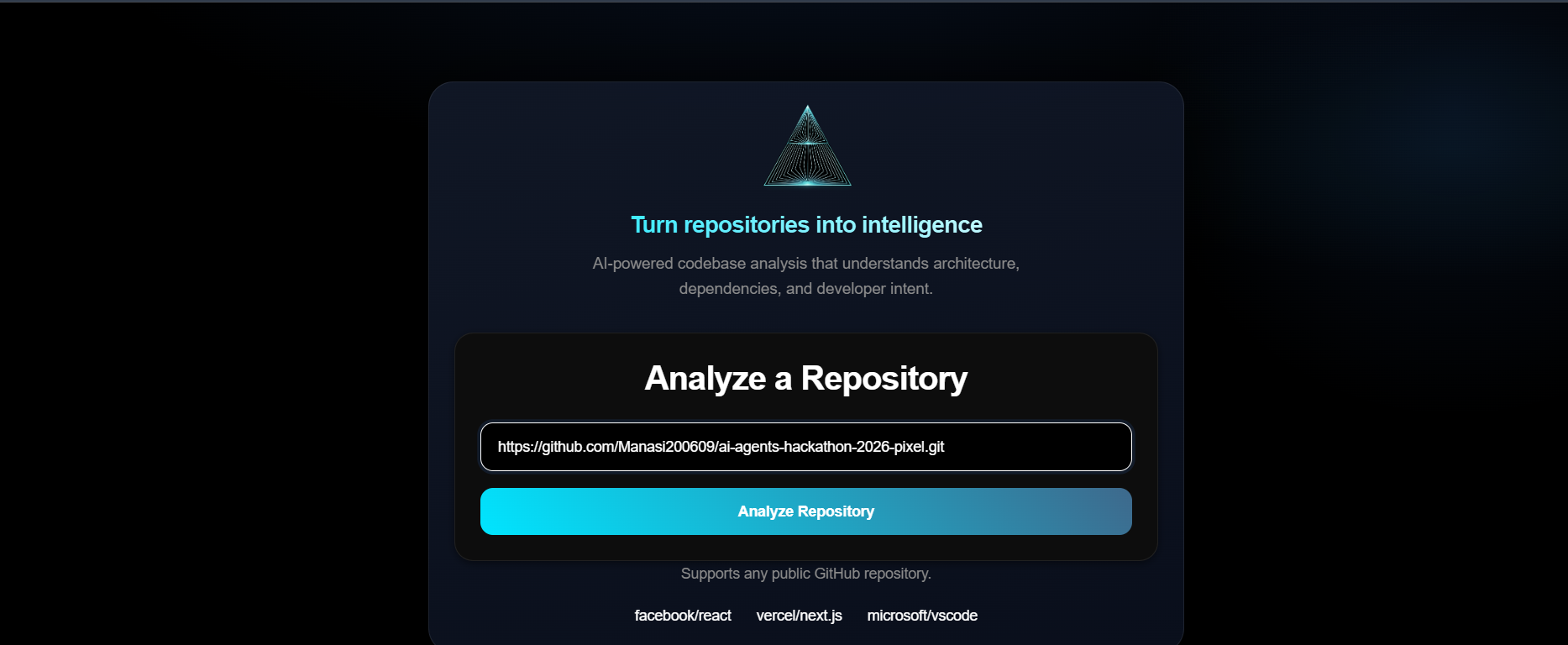
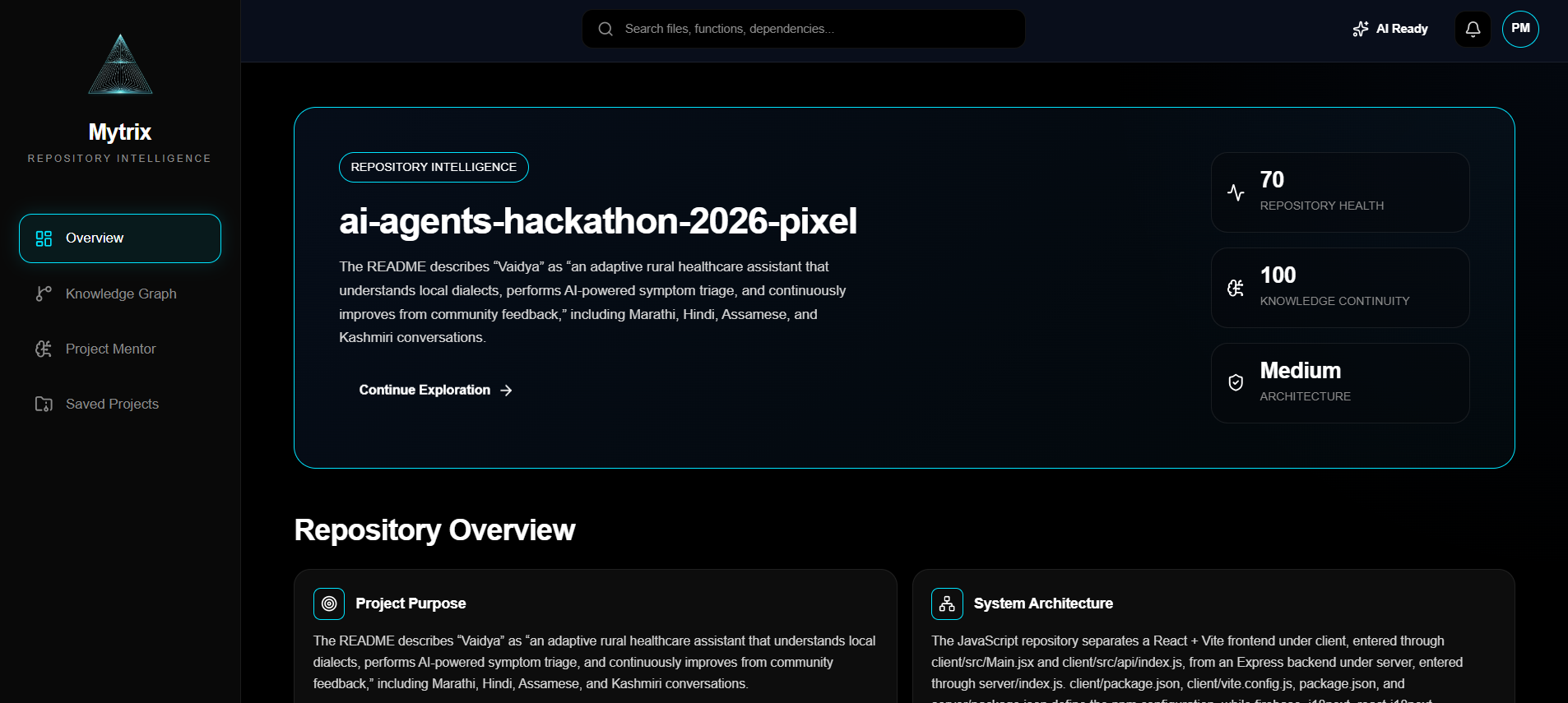
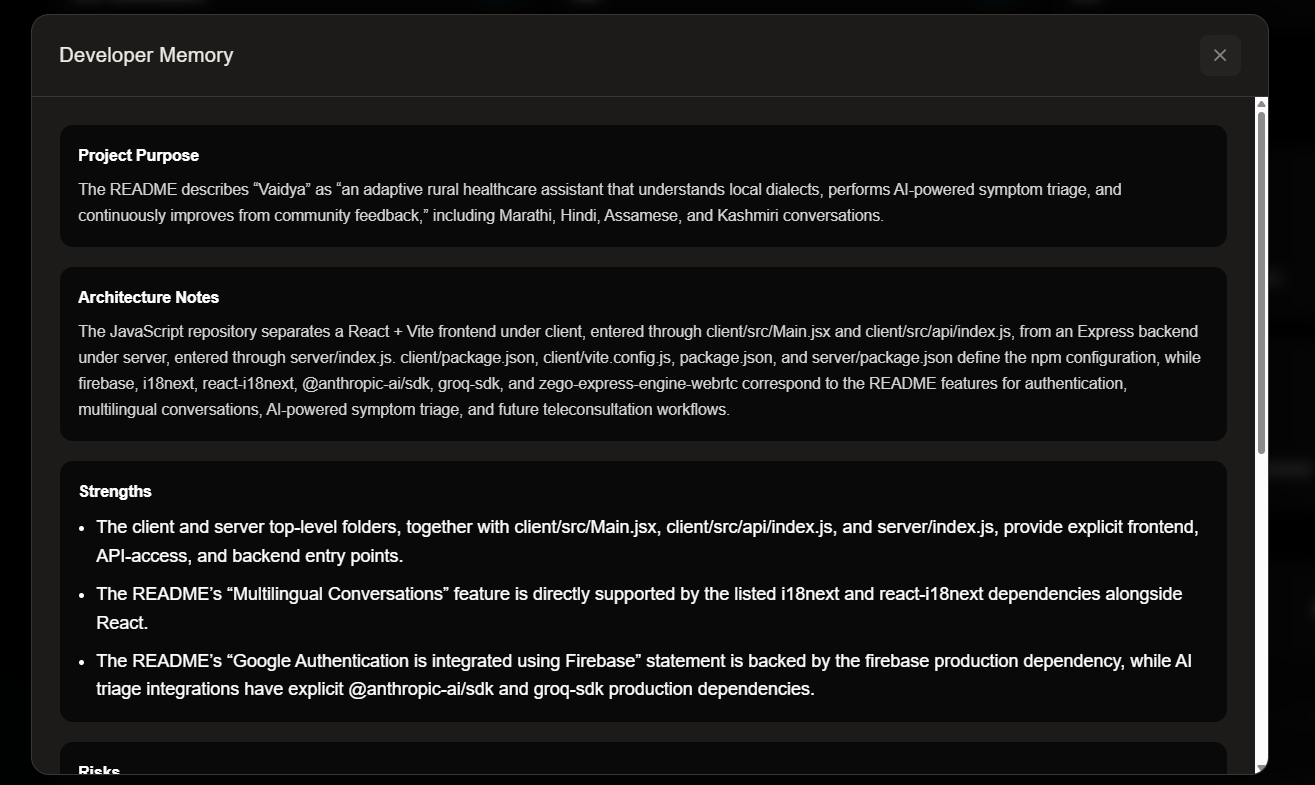
A developer simply provides a repository URL. Mytrix analyzes the project and creates a persistent project memory containing its structure, important files, technologies, relationships, and architectural information.
Instead of repeatedly searching through folders and files, developers can use Mytrix to understand the repository through:
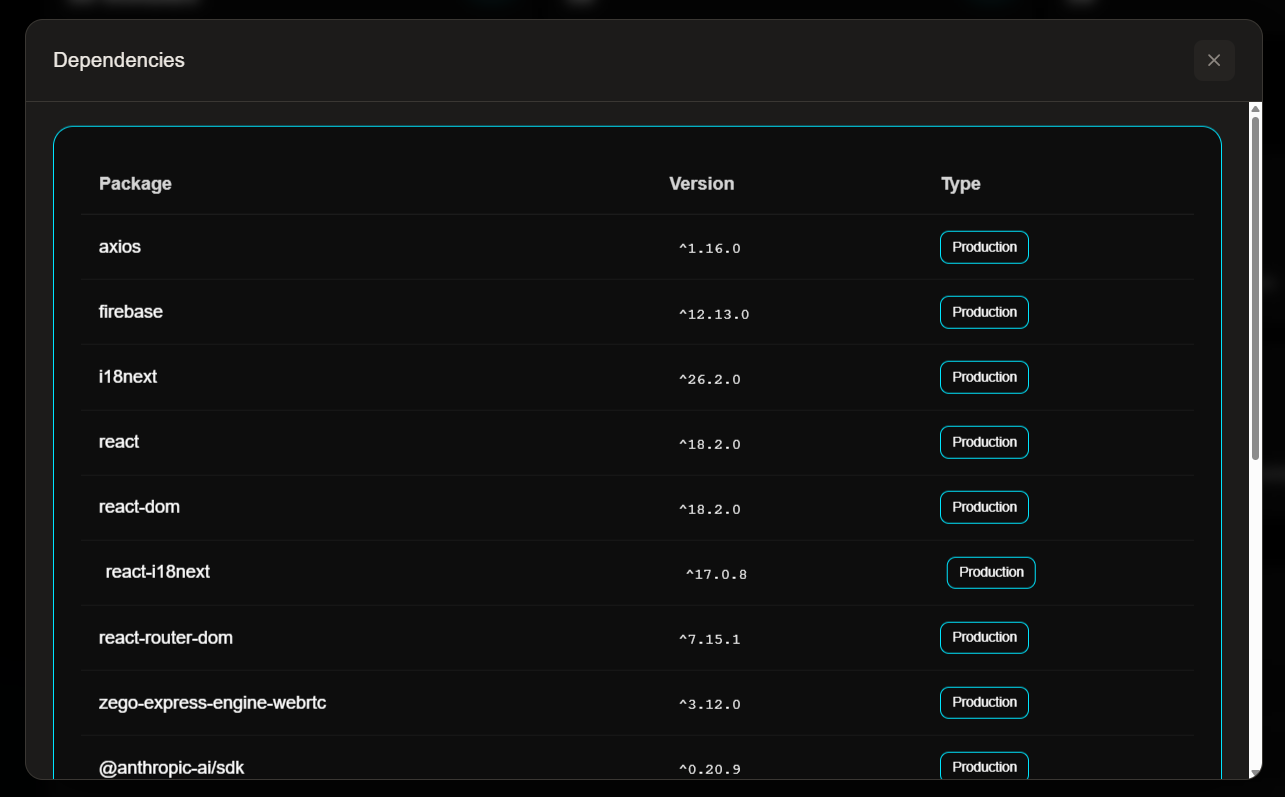
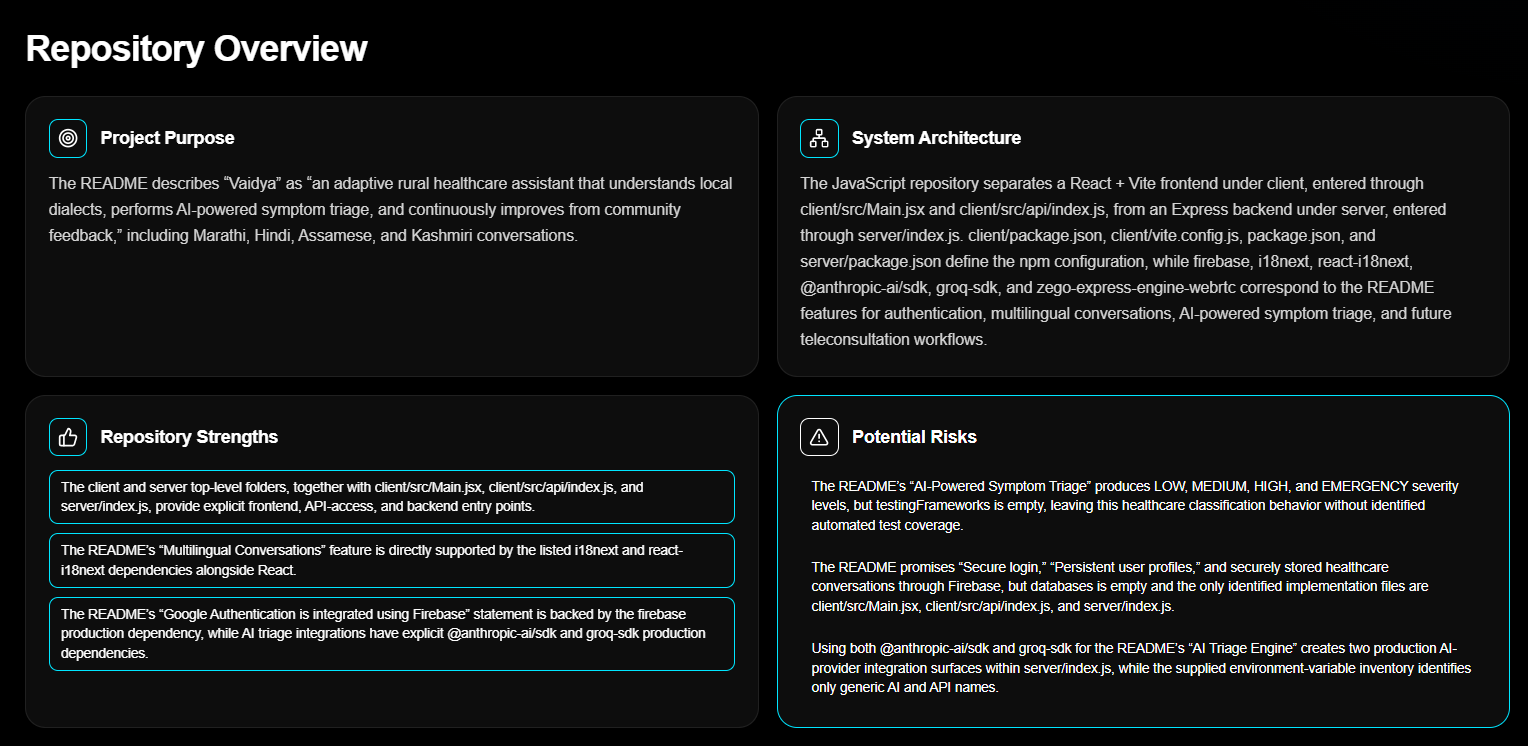
- Repository Intelligence — analyzes the actual project structure and extracts meaningful technical information.
- Project Memory — preserves the generated understanding of the repository so developers can return to it later.
- AI Mentor — lets developers ask natural-language questions about the codebase and receive grounded explanations.
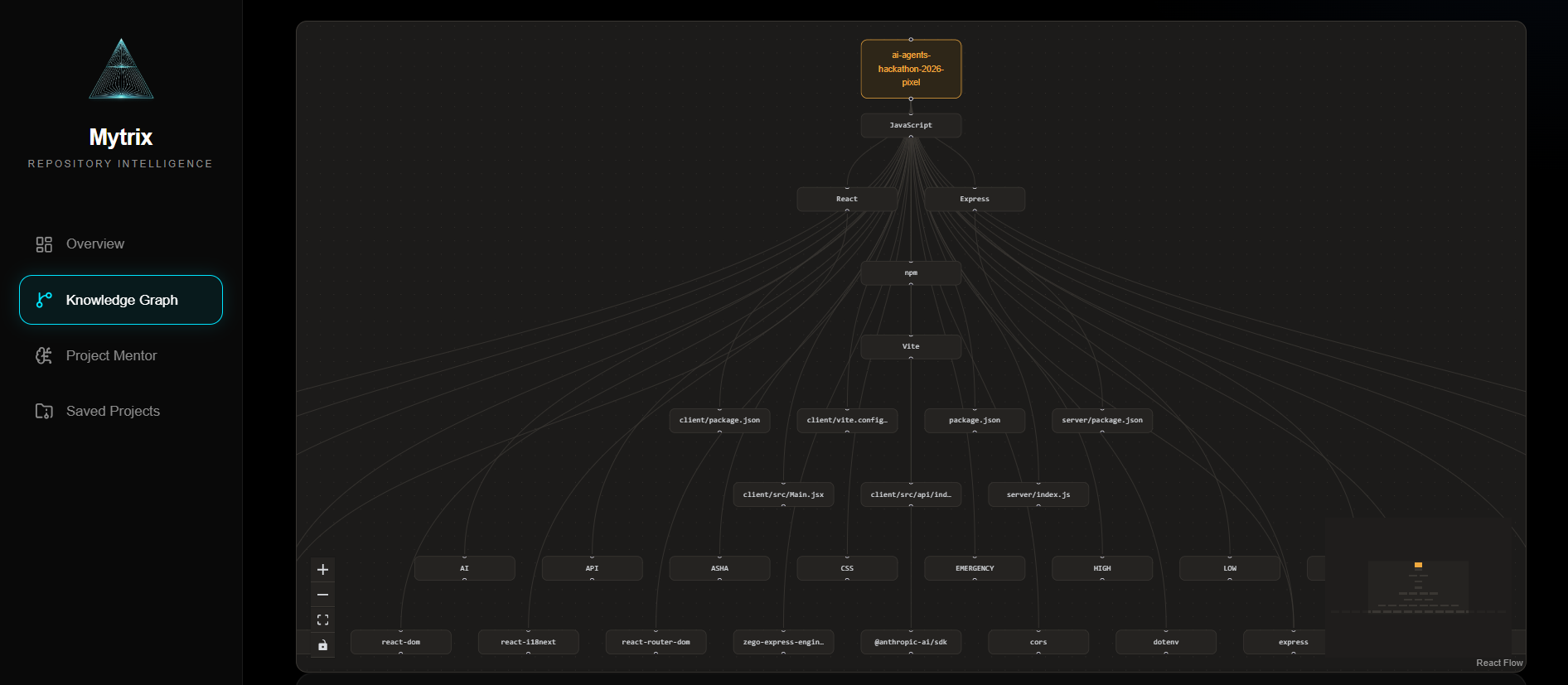
- Architecture Visualization — presents important relationships and project structure in an interactive way.
- Evidence-based answers — responses are tied back to repository information rather than allowing the model to freely invent an explanation.
- Onboarding-focused guidance — helps answer questions such as “Where does the application start?”, “How does authentication work?”, and “How does the frontend communicate with the backend?”
The goal is simple:
Instead of making developers learn the repository by digging through it, Mytrix helps the repository explain itself.
How we built it
Mytrix is built as a full-stack application using React, Vite, Node.js, Express, JavaScript, and AI-powered analysis.
The important architectural decision was to avoid treating the LLM as the source of truth.
Mytrix first performs deterministic repository analysis to understand the actual structure and relationships within a project. This structured information is then provided to the AI layer, where GPT-5.6 synthesizes it into useful explanations and conversational answers.
This separation helps reduce a common problem with AI coding tools: confidently explaining something that does not actually exist in the repository.
The application follows a pipeline of:
Repository → Analysis → Structured Project Knowledge → AI Reasoning → Persistent Memory → Developer Interaction
We also built the frontend as a complete product rather than a single chatbot screen. Developers can connect a repository, view its generated intelligence, explore the project, and return to its memory later.
How we used Codex and GPT-5.6
Codex and GPT-5.6 were used as development partners throughout the build.
Codex helped us implement and iterate on the full-stack application, including backend routes, repository-processing logic, frontend components, API integration, debugging, and deployment-related work.
GPT-5.6 was also used to reason through architecture, improve implementation decisions, debug issues, review edge cases, and help us refine the product experience.
However, GPT-5.6 is not the source of truth for the repository. Mytrix deliberately combines deterministic repository analysis with AI synthesis so that the model reasons over actual project evidence instead of blindly guessing the architecture.
Challenges we ran into
The biggest challenge was making Mytrix useful without turning it into another generic “chat with your code” application.
We had to solve several problems:
- Understanding repositories with very different structures and technology stacks.
- Extracting useful information without overwhelming the AI with an entire codebase.
- Separating deterministic repository facts from AI-generated explanations.
- Preventing hallucinated answers when the repository does not contain enough evidence.
- Designing a useful persistent memory model instead of simply starting a new chat every time.
- Building a frontend that makes complex repository information understandable without requiring developers to manually inspect dozens of files.
- Connecting the complete pipeline from repository ingestion to analysis, AI interaction, and persistent project memory.
- Deploying and testing the system as an actual working product rather than stopping at a prototype interface.
These challenges pushed us toward a more structured architecture where the repository provides the evidence and the AI provides the explanation.
Accomplishments that we're proud of
We are most proud that Mytrix evolved from an idea into a working end-to-end developer product.
Instead of building only an AI chatbot, we built an entire repository onboarding experience around the concept of persistent codebase memory.
We are particularly proud of:
- Building a complete repository-to-AI pipeline.
- Combining deterministic repository analysis with GPT-5.6 reasoning.
- Creating persistent project memory instead of treating every interaction as isolated.
- Building an interactive developer-focused interface.
- Designing the AI Mentor around the actual repository rather than generic programming knowledge.
- Making the system usable for real onboarding scenarios.
- Deploying the application so the concept can be experienced as a real product.
Most importantly, Mytrix addresses a problem we repeatedly experienced ourselves:
The hardest part of joining a new project isn't writing code. It's building a mental model of the code that already exists.
What we learned
We learned that building an AI application is not simply about adding an LLM to an existing workflow.
The quality of the system depends heavily on what information the model receives, how that information is structured, and how confidently the system knows when it does not have enough evidence.
We also learned that developer tools should reduce cognitive load rather than add another interface developers have to learn.
This shaped one of our core principles:
AI should help developers build a mental model of the codebase, not replace the developer's understanding of it.
Working with Codex and GPT-5.6 also changed how we approached development. Instead of using AI only for code generation, we used it for implementation, debugging, architectural reasoning, review, and iteration while keeping the final product decisions and engineering direction human-driven.
What's next for Mytrix
Mytrix is currently focused on repository onboarding, but the underlying idea can grow into a much broader persistent memory layer for software projects.
Next, we want to expand Mytrix with:
- Deeper dependency and architecture analysis.
- More accurate cross-file and cross-service reasoning.
- Git history awareness to understand why parts of a codebase evolved.
- Team-shared project memory.
- Pull request and commit understanding.
- Automatic onboarding paths for different developer roles.
- Better support for large and multi-service repositories.
- Integrations with development workflows so project memory stays continuously updated.
Our long-term vision is for Mytrix to become the place developers go when they need to answer:
“How does this entire project work, and why is it built this way?”
Mytrix doesn't just help developers read code.
It helps them remember, understand, and navigate the codebase.
Built With
- ai
- codex
- express.js
- llm
- mongodb
- node.js
- openai
- react.js

Log in or sign up for Devpost to join the conversation.