-
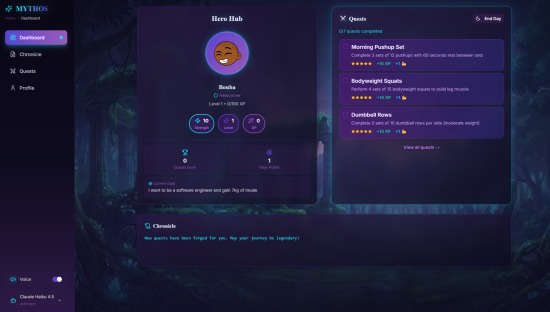
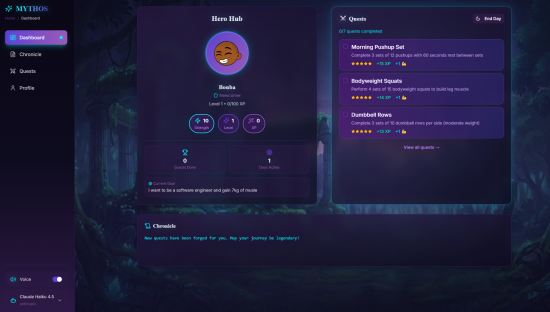
Dashboard
-
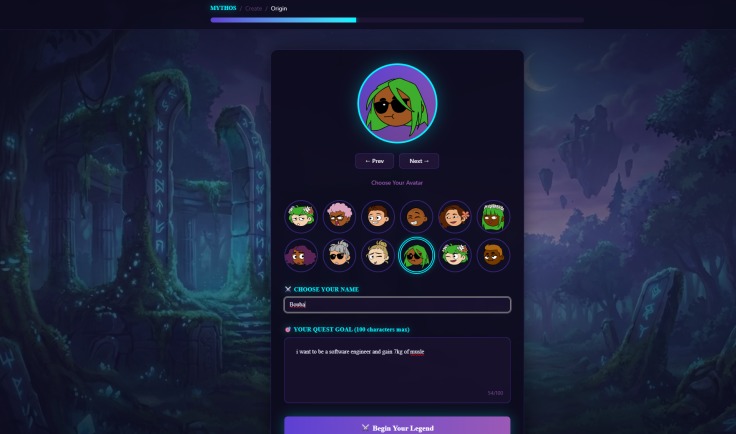
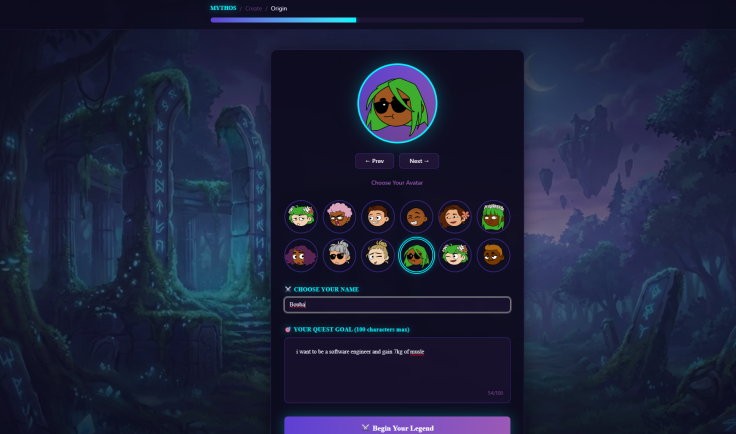
Character Creation
-
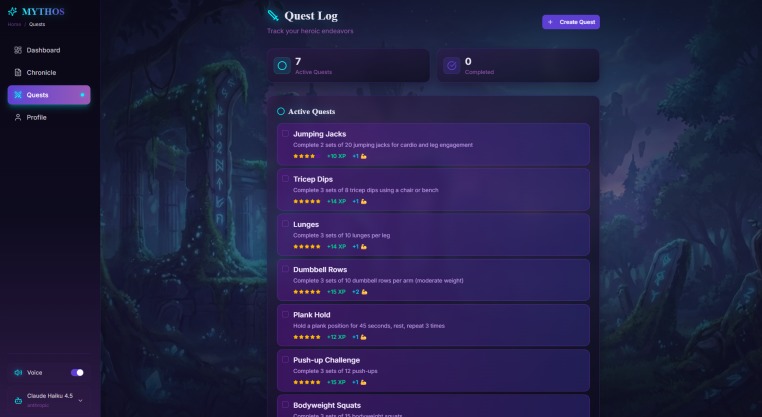
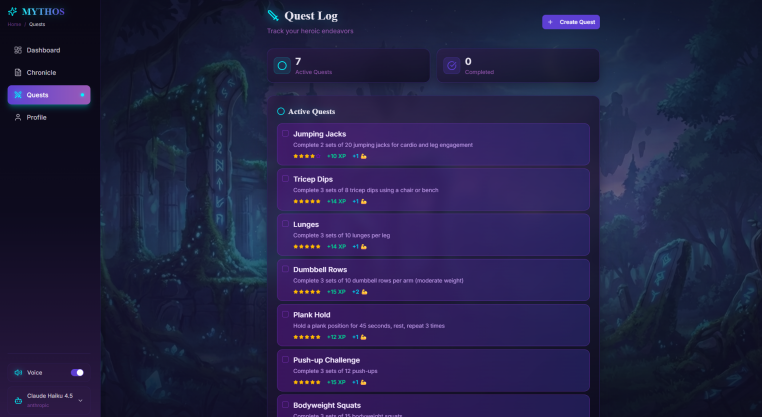
Quests
-
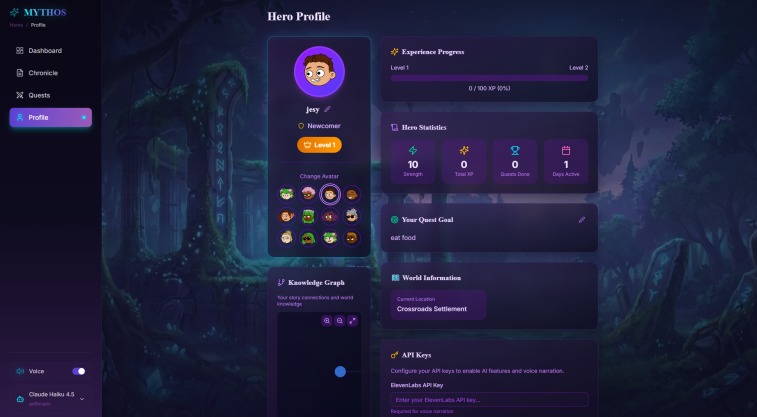
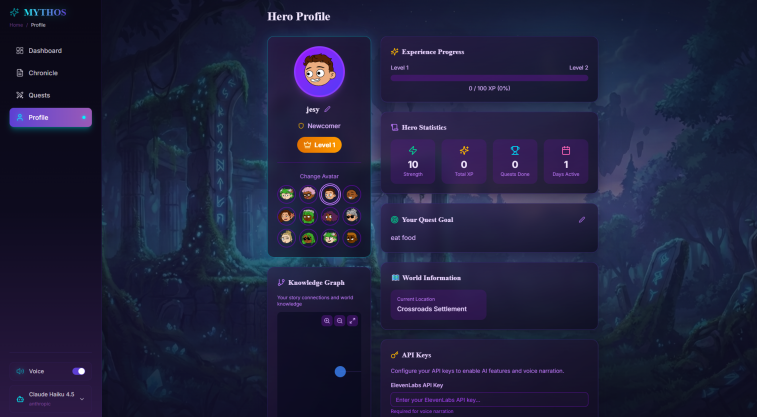
Profile
-
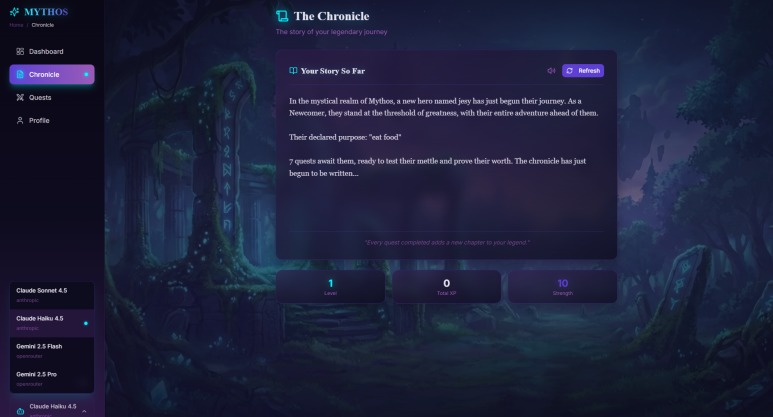
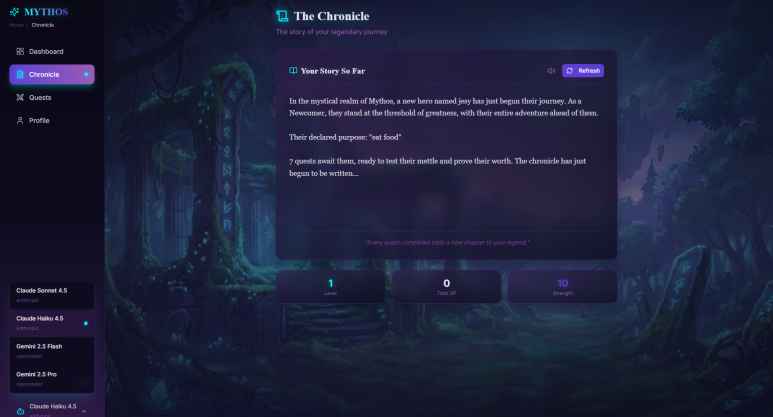
Chronicles (Story summary)
Mythos - Gamify Your Life Through Epic Storytelling
Inspiration
Mythos began as a proof-of-concept for thesis research exploring a novel concept: the Self-Identity Knowledge Graph (SIKG). The idea is to use AI-maintained knowledge graphs to track not just what you do, but who you're becoming. Your behavioral patterns, personality insights, evolving story, and relationships. Instead of a static user profile, SIKG creates a dynamic, interconnected representation of your identity that grows and changes with you. This was the theoretical framework. We needed a practical application to test it.
When ConUHacks came around, we saw the perfect opportunity: take this growing vision (It was a 40 page design document full of scope creep and naive ambition) and scope it down to what could actually be built in 24 hours.
The core belief driving Mythos is simple: discipline is hard for all of us. As a species, we struggle with consistency. We know we should exercise, build better habits, learn new skills. BUT! Knowing isn't doing. Yet we'll grind for hours in games, optimizing builds and chasing achievements for purely virtual rewards.
We wanted to build something that makes a genuine positive difference in people's lives. Something that harnesses that same gaming motivation for real-world growth.
Our motto: Self-improvement should be fun.
What it does
Mythos transforms your fitness journey into an evolving fantasy RPG where your real-world workouts directly shape your character's story.
- Unique worlds: AI generates a fresh fantasy scenario for each user (no generic chosen-one narratives)
- Personalized daily tasks: 2-10 fitness tasks calibrated to your goals and difficulty preference
- Optional quests: Accept or decline challenges with stat requirements and real-world exercise goals
- Reflection system: Write about your workout; AI grades authenticity for bonus rewards
- Knowledge graph: Tracks your story, behavior patterns, personality insights, and world lore
- Character evolution: Stats grow slowly from 0, class evolves based on your actual training patterns
Your pushups aren't just exercises—they're the strength training that lets your character lift the ancient gate or impress a legendary warrior.
How we built it
Architecture:
- Backend (Python FastAPI): SIKG narrative engine with Claude (Haiku 4.5/Sonnet 4), PostgreSQL via Supabase for knowledge graph storage
- Frontend (React, TypeScript, TailwindCSS, Vite): UI components with shadcn/ui, API communication via axios, motion/react for animations
We separated concerns: the backend generates narratives, manages the knowledge graph, and stores all game state (character stats, XP, quests). The frontend provides the user interface and communicates with the backend via REST API.
AI was instrumental in this project. It generated much of our initial code, allowing us to focus on features, fine-tuning prompts, and debugging integration issues rather than writing boilerplate. The app also supports switching between AI models (Claude Haiku, Sonnet, and Opus) at runtime.
Key technical pieces:
- Knowledge graph with nodes (story events, observations, personality insights) and edges (relationships)
- Pattern-based edge creation to connect concepts
- Stat-check quest system with tiered outcomes
- Reflection authenticity grading to combat cheating
- Reward scaling math for meaningful progression over months
Challenges we ran into
Implementing SIKG in practice: This was the first time we'd built a real application around the Self-Identity Knowledge Graph concept. Moving from theoretical framework to working system meant solving problems we hadn't anticipated: How do you prevent node duplication? How do you create meaningful edges automatically? How do you query a graph for narrative context efficiently? We were learning the practical challenges of knowledge graphs while also building everything else.
Integration complexity: We had team members with different expertise (backend, frontend, AI). Getting everyone's pieces to work together was harder than any individual component. Two PostgreSQL databases, async AI responses, auth flows, etc. Every integration point required negotiation.
Learning new tools together: Most of our projects are standalone, not full-stack end-to-end systems. We were learning so much simultaneously.
Wrangling AI outputs: Getting LLMS to return consistent, parseable JSON took extensive prompt engineering and multiple fallback parsers. The AI would occasionally add markdown fences, explanatory text, or slight malformations.
Edge generation: Initially our knowledge graph had nodes but almost no edges. We rebuilt our prompt architecture to explicitly request edges and created pattern-matching to connect nodes.
24-hour scope management: We had to cut multiplayer guilds, world maps, character classes, items, skill trees, inventory, even stats other than strength. everything except the core narrative loop. Brutal but necessary.
State synchronization: Keeping the SIKG backend and frontend game state in sync across async operations and potential failure points.
Accomplishments that we're proud of
- Built an end-to-end system in 24 hours when most of our experience was standalone projects
- Created a genuinely novel approach to fitness gamification using knowledge graphs and AI narratives
- Made different tech stacks work together despite steep learning curves
- Implemented sophisticated AI features like reflection grading and adaptive quest outcomes
- Shipped something that actually works and demonstrates the core vision, even if feature-complete dreams hit the cutting room floor
Most importantly: we built something we'd actually want to use. An app that might genuinely help people enjoy their fitness journey.
What we learned
Technical:
- How to architect microservices that separate concerns cleanly
- Effective prompt engineering for consistent AI outputs
- Managing async operations across frontend/backend boundaries
- Graph database patterns for behavioral tracking
- Balancing game progression math for long-term engagement
Process:
- How to scope ruthlessly when time-constrained
- The importance of clear API contracts between team members
- That AI assistance can accelerate development if you know how to direct it
- When to cut features vs. when to polish core experiences
Personal:
- We can build way more than we thought in 24 hours
- Integration is always harder than expected
- Good architecture decisions early save debugging time later
- Hackathons force clarity on what actually matters
What's next for Mythos
Short-term:
- Polish the UI/UX based on user testing
- Add more task types (flexibility, mindfulness, learning)
- Implement the class system with unique abilities
- Add achievement badges for milestone moments
Medium-term:
- World exploration with discoverable locations
- NPC relationship system with branching dialogues
- Guild/party system for accountability groups
- Mobile app for easier daily task completion
Long-term:
- Multi-modal fitness tracking (integrate with wearables)
- Procedurally generated side quests
- User-created content and world-building
- Research publication on SIKG effectiveness for behavior change
The thesis research continues, but now we have a real product to test it with.
Built With
- anthropic
- asyncpg
- css
- elevenlabs
- fastapi
- knowledge-graphs
- node.js
- npm
- postgresql
- pydantic
- python
- react
- sql
- supabase
- tailwind
- typescript
- uvicorn
- vite
- voyage


Log in or sign up for Devpost to join the conversation.