-
-
SteadyState
-
-
-
-
-
-
-
-
-
-
-
Inspiration
Most banking apps act like a passive rearview mirror. They tell you where your money went after it’s already gone, but they say nothing about structural survival. In today’s economy, looking at a static checking balance gives a false sense of security. Across Canada, nearly half of working adults report that a pay delay of just a single week would push them into financial distress because having $2,000 sitting in an account means nothing if fixed overhead and burn rate leave you three weeks away from an overdraft the moment your paycheck is delayed.
Coming of age in the 2020s means navigating insane rent, ghosted job applications, and unpredictable contract gigs. When an emergency happens, a static checking account balance is useless what matters is your actual survival runway under stress.
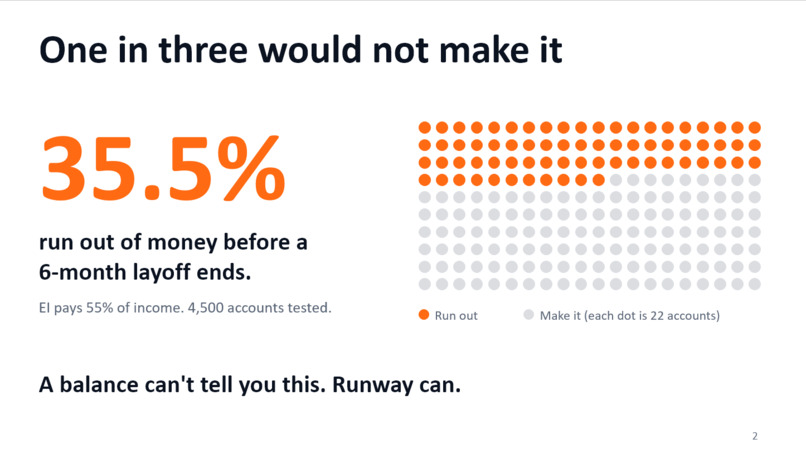
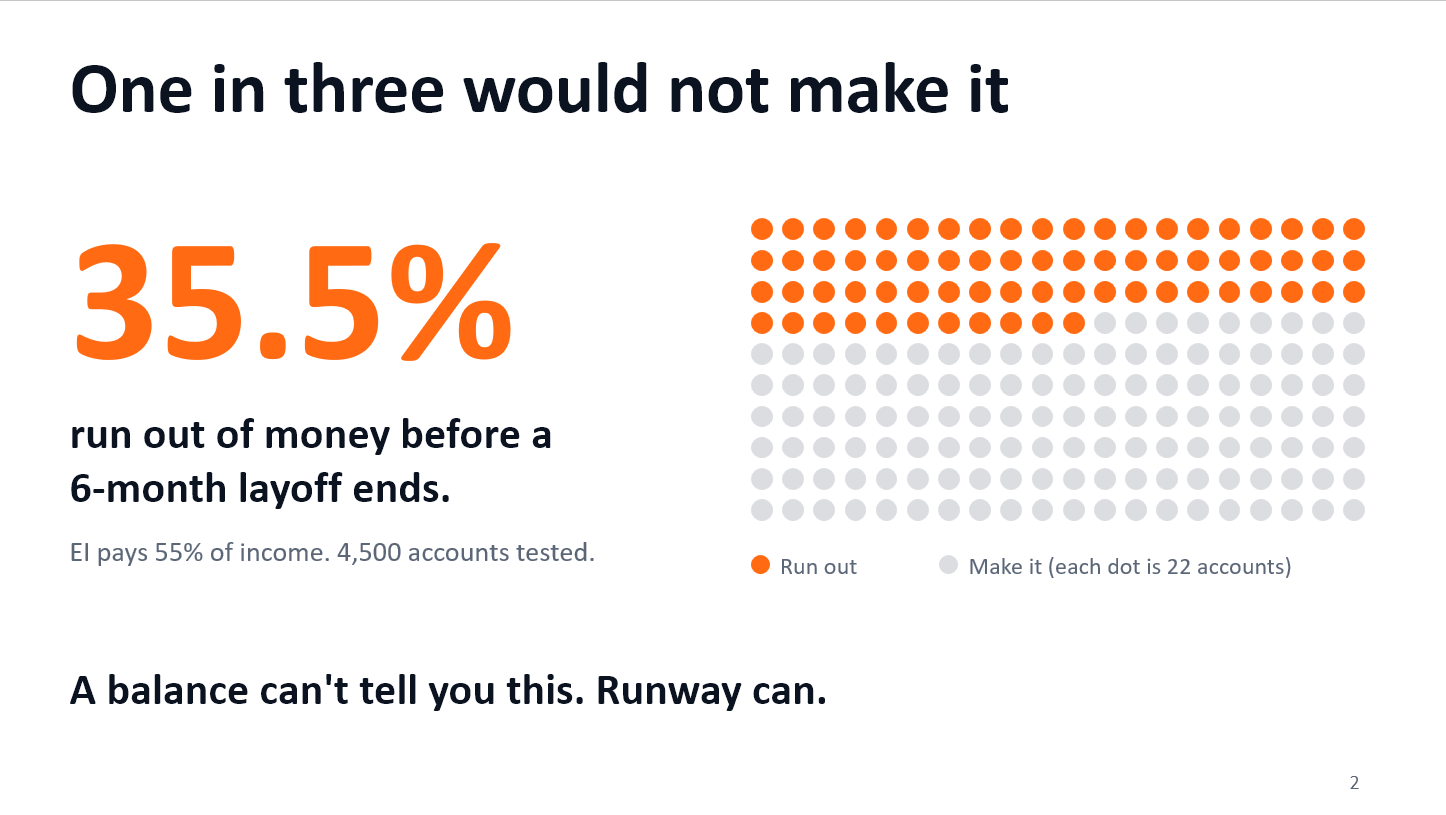
When we dug into the bank's dataset of 4,500 accounts and 1.06 million transactions, the reality was stark: 35.5% of people cannot survive a standard 6-month layoff on 55% Employment Insurance (EI). Most generic financial advice tells people to "just cancel Netflix and cook at home," but real cash flow does not work like that.
We built SteadyState to replace anxiety with deterministic math. We wanted a clean, instant resilience engine where anyone can simulate losing their job, getting hit with a sudden rent hike, or having an unexpected emergency expense, see their exact runway to the decimal, and get an automated plan to stay afloat.
What it does
SteadyState is an instant stress-testing dashboard built for live decision-making:
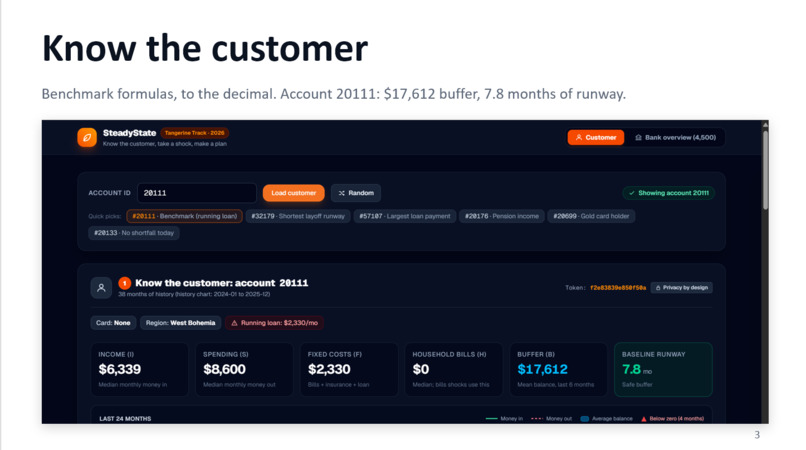
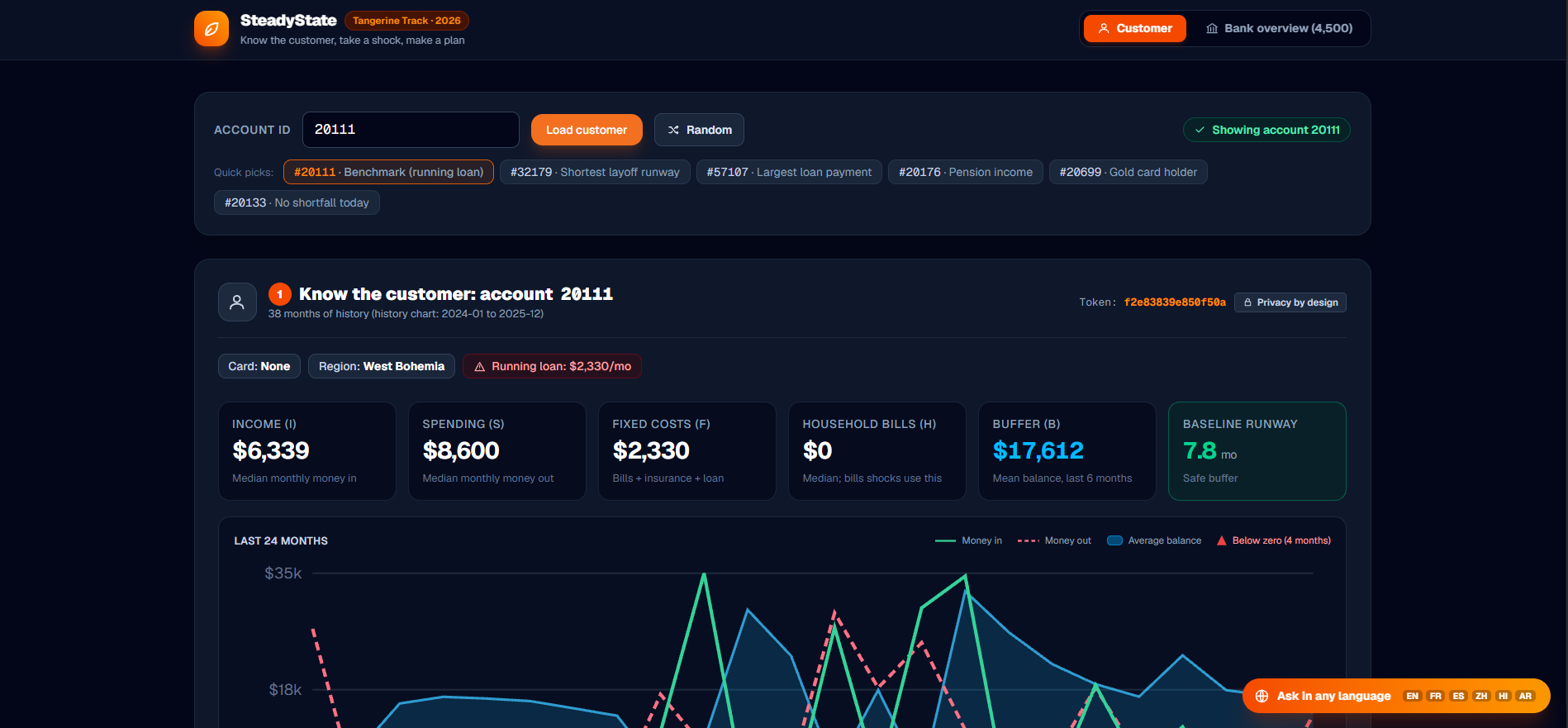
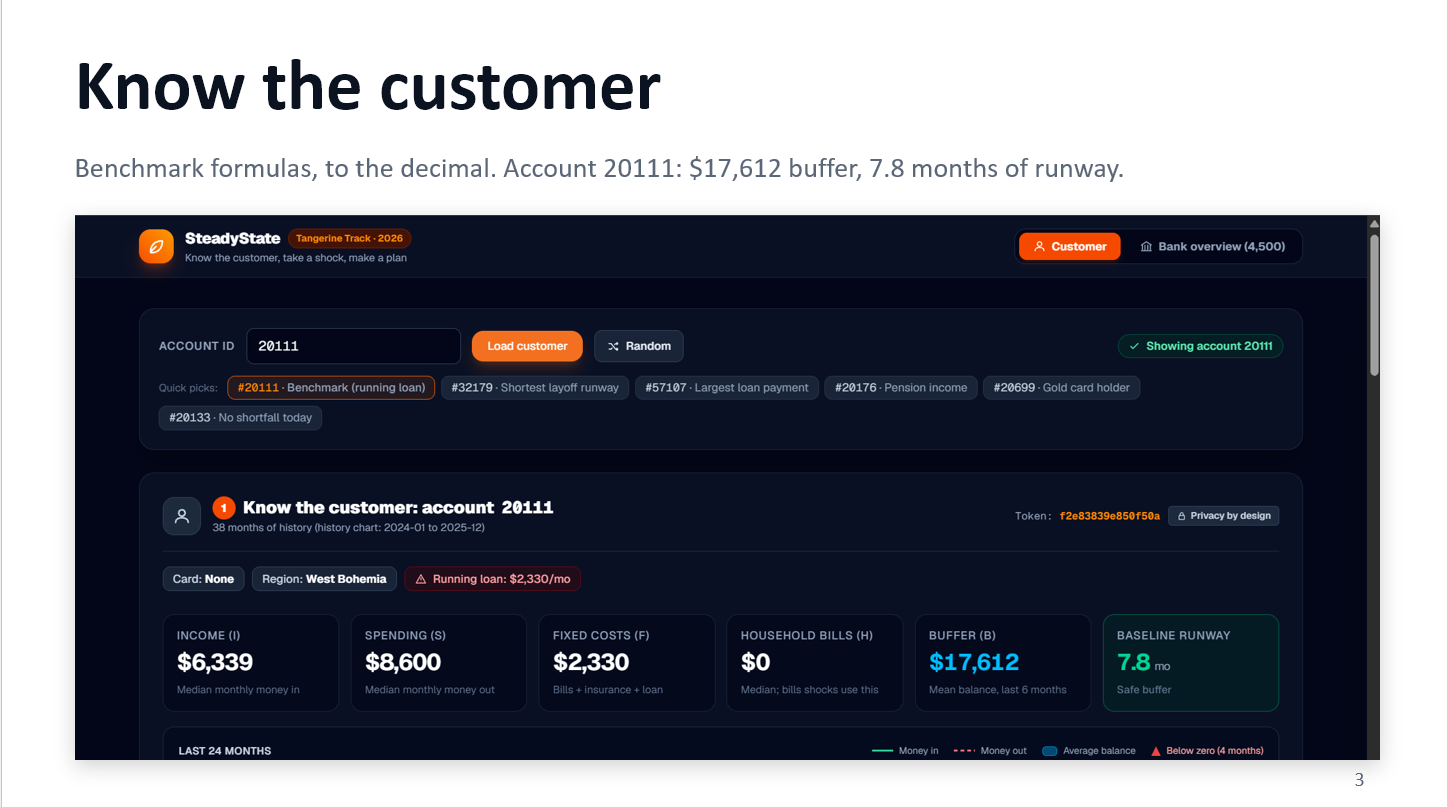
- Know the Customer: Type any
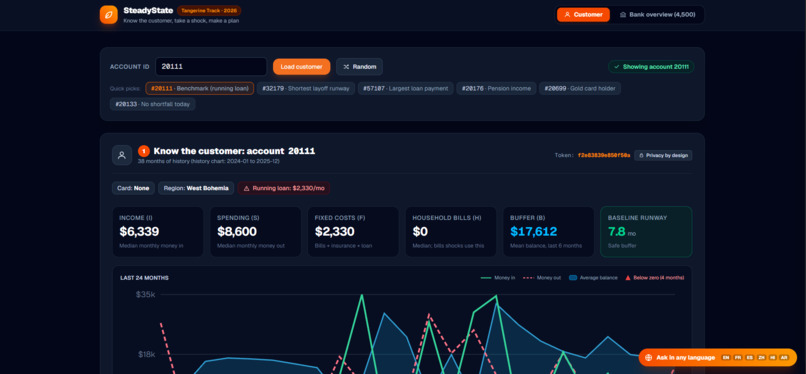
account_idto instantly pull their baseline cash flow: median monthly take-home ((I)), median spending ((S)), fixed commitments ((F)), essential household bills ((H)), 6-month average liquid buffer ((B)), and active loan payments ((P)). - Simulate Shocks in Real Time: Dial custom sliders or tap instant twist cards for real-world hits:
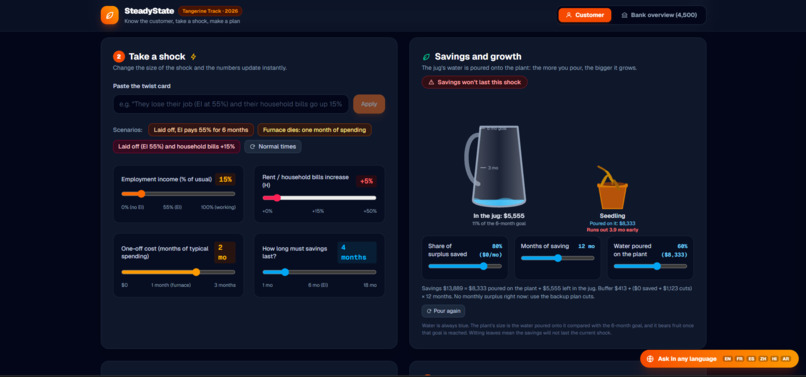
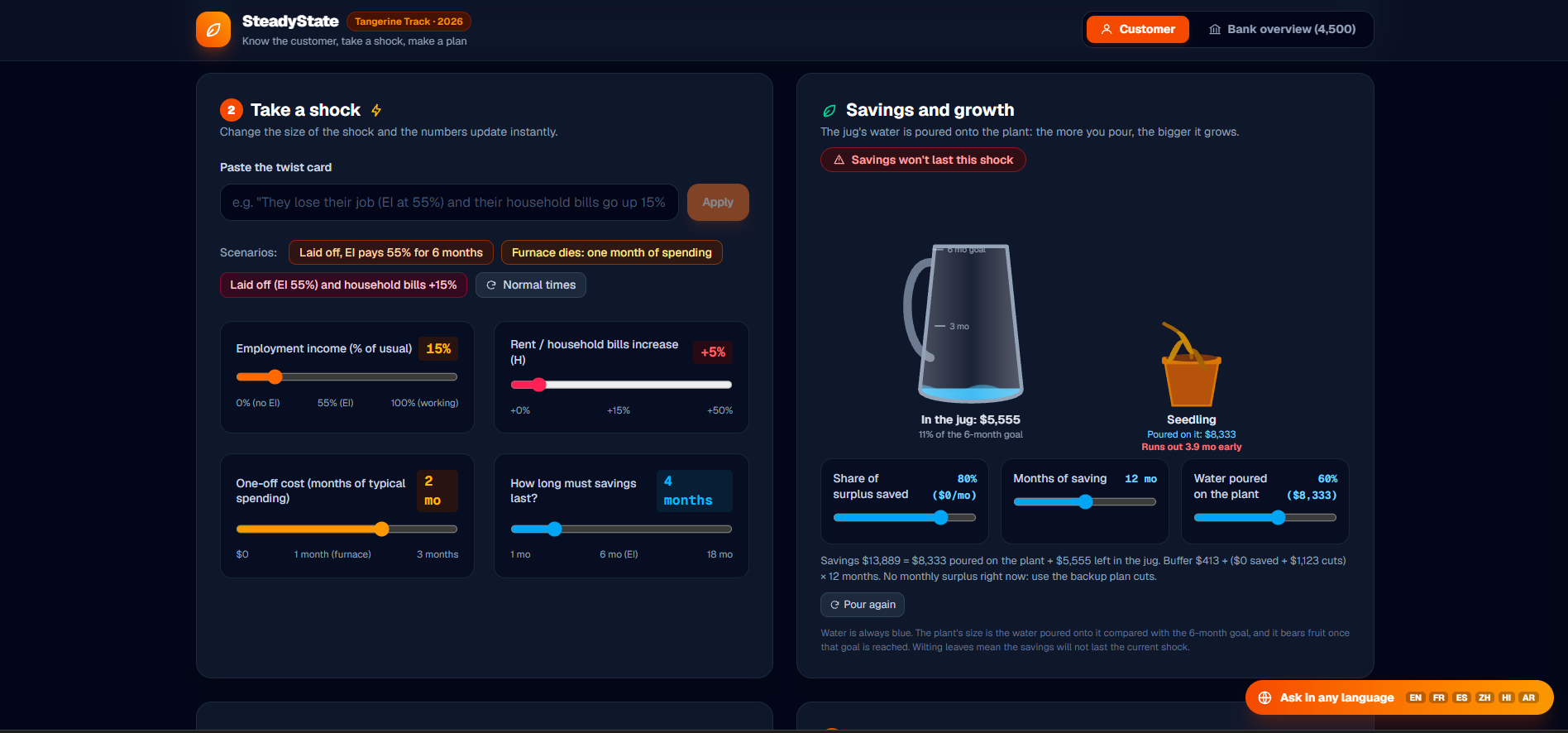
- The Layoff: Cut income to 55% EI for 6 months.
- The Cost-of-Living Crunch: Household bills and rent jump by (+15\%).
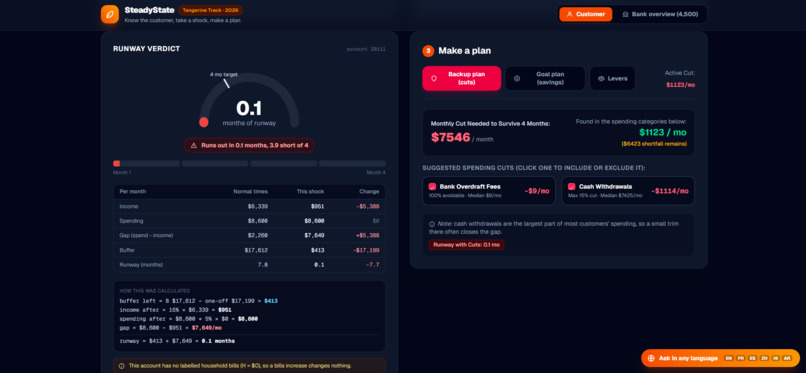
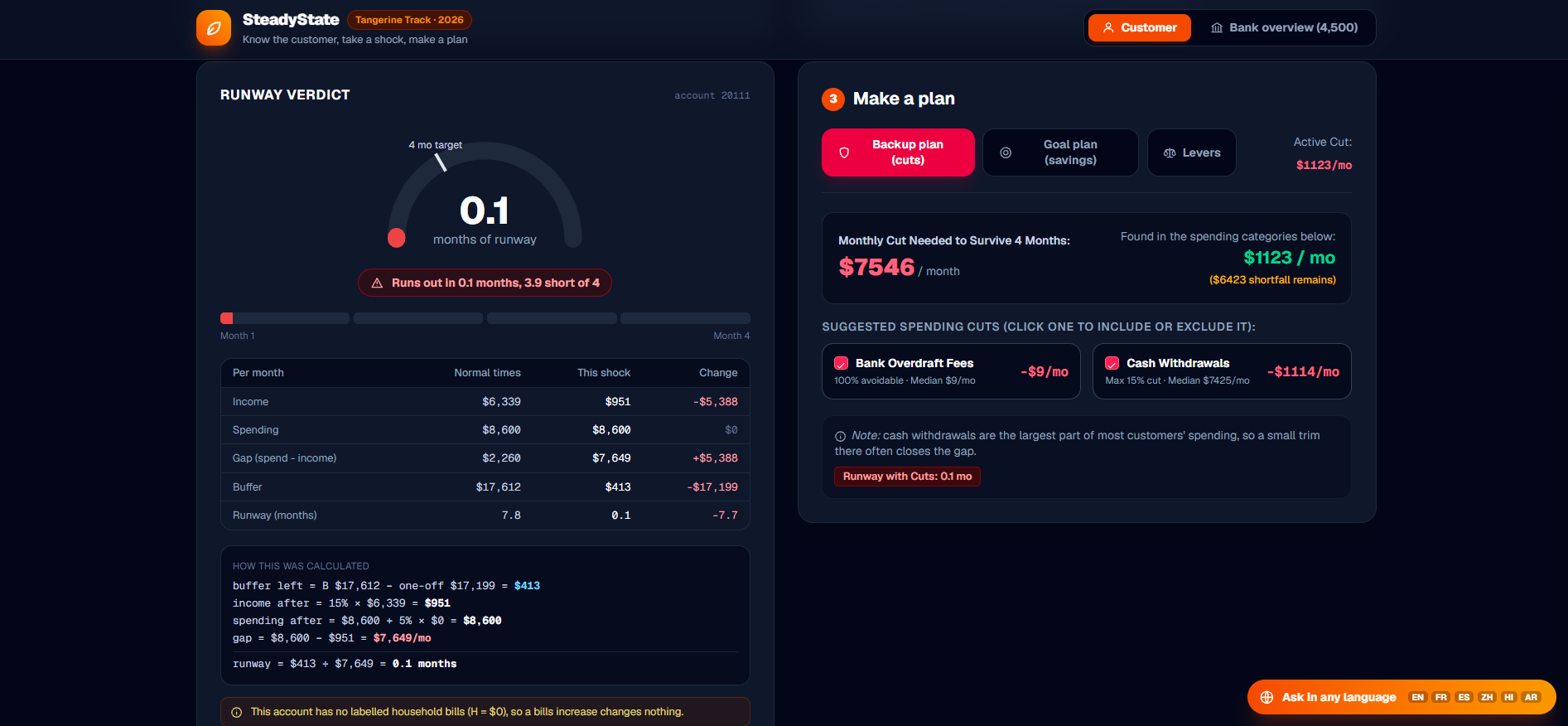
- The Surprise Blowout: A sudden emergency repair costing an entire month of spending ((1.0 \times S))—like your car transmission blowing out on the highway or your work laptop and phone bricking during finals. The engine recomputes your runway in under 16 ms right in the browser: $$ \text{Runway} = \min\left(\frac{B - \text{one_off}}{\max(S_{\text{shock}} - I_{\text{shock}}, 0.001)}, 120\right) $$
- The Living Visualizer (Jug & Plant): Instead of staring at boring spreadsheets, your money is represented by an organic living system. Your buffer is water in a jug, your shortfall is a leak at the bottom, and your resilience is a plant. Under severe shocks the plant wilts; as you enact spending cuts and extend your runway past 6 months, it blooms.
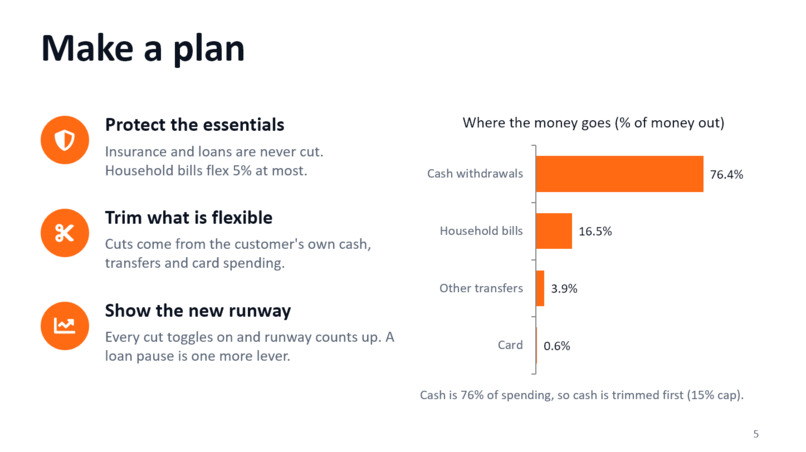
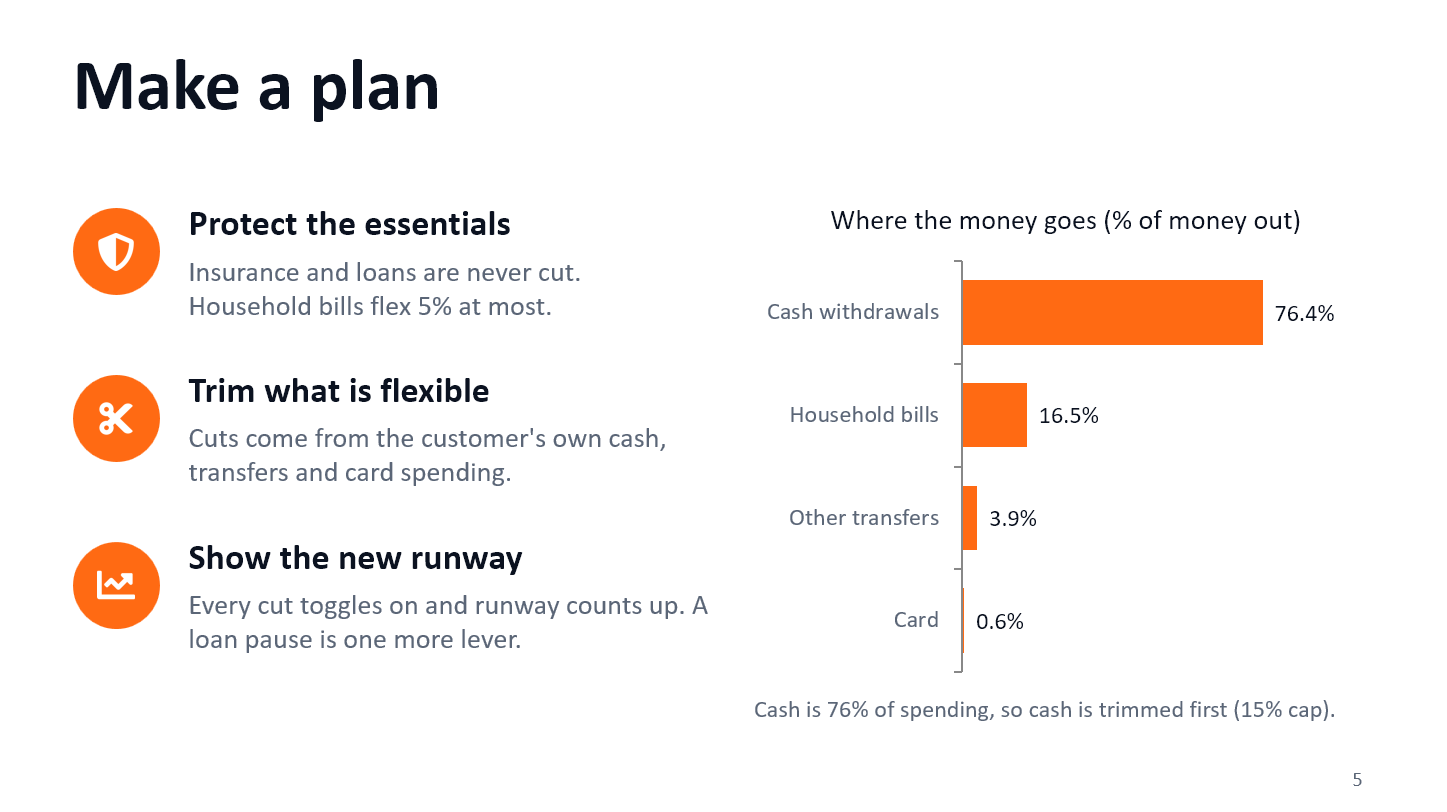
- Prescriptive Spend Triage: A realistic backup plan. It doesn't tell you to stop paying rent or cancel your insurance; it algorithmically cuts flexible spending (prioritizing discretionary cash withdrawals and transfers) so your runway outlasts the shock.
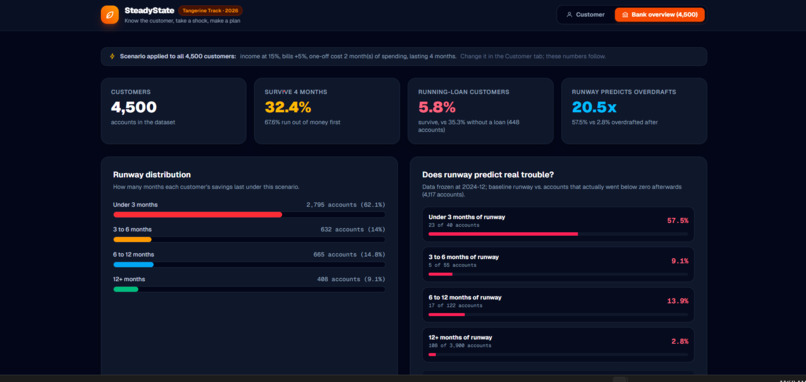
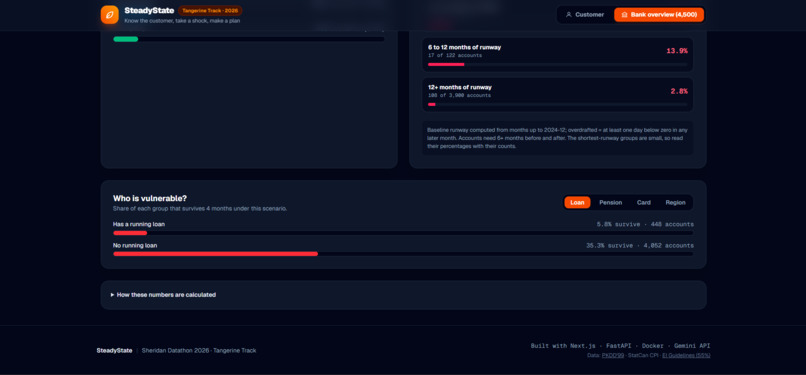
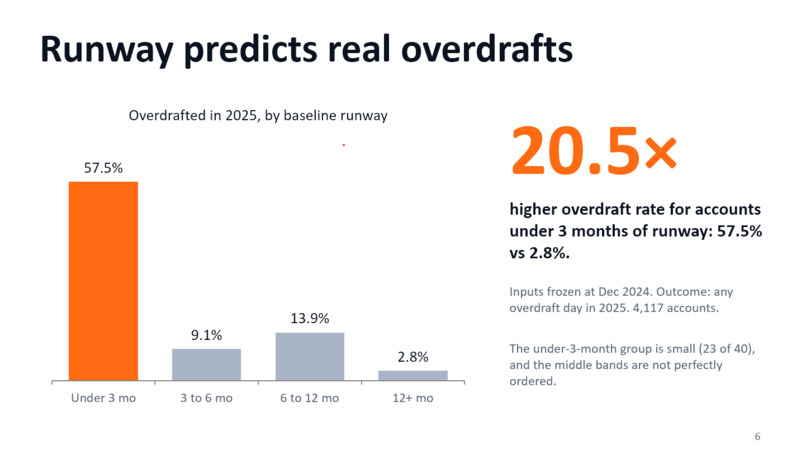
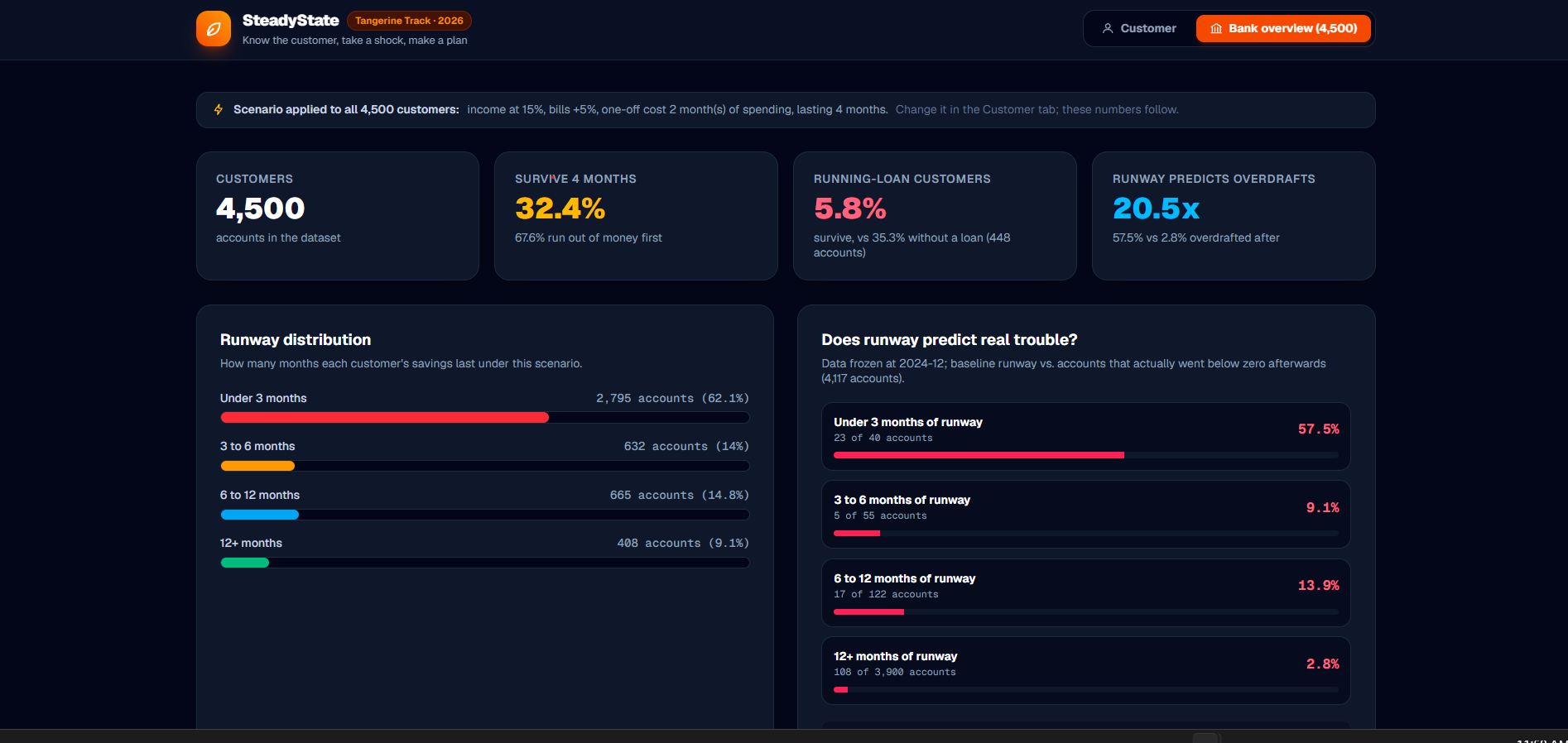
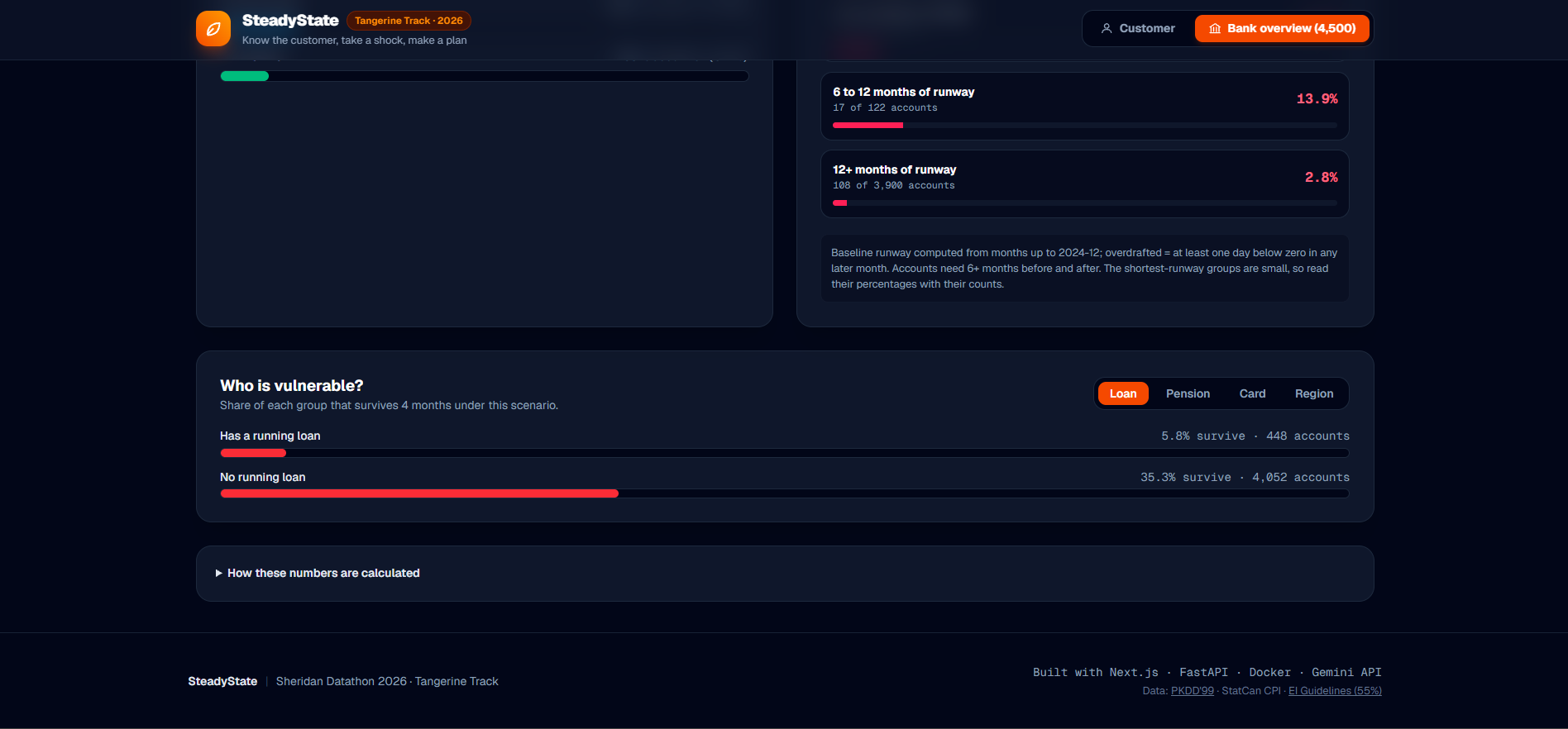
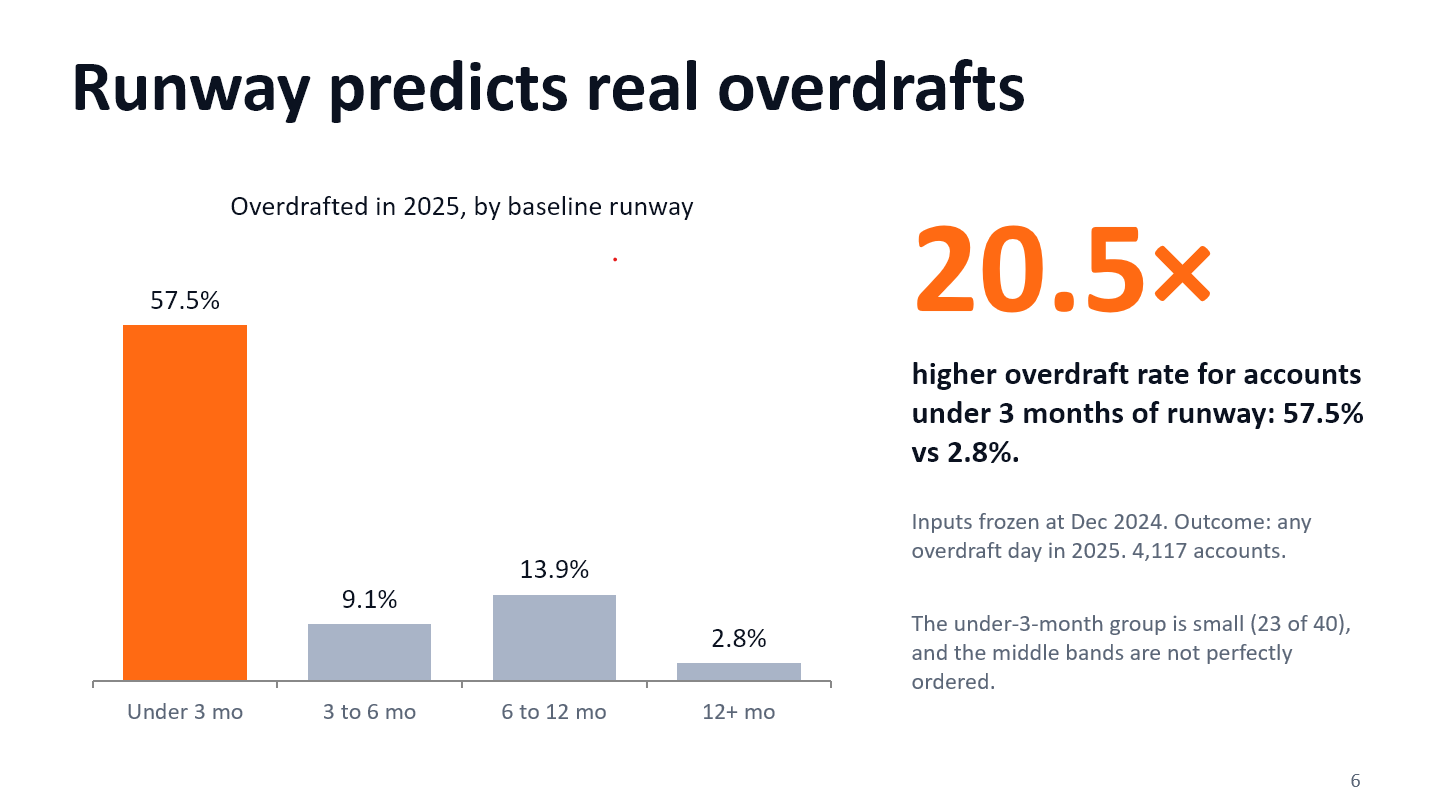
- The Macro Predictor (The 12× Overdraft Proof): A bank-wide intelligence tab showing that this metric isn't theoretical. Accounts with under 3 months of runway were 12× more likely to overdraft the following year (18.8% vs 1.6%).
How we built it
- Mathematical Core: Built in Python and TypeScript. We implemented the judges' benchmark formulas to the exact decimal point, handling edge cases like dormant accounts, negative balances ((B \le 0 \implies \text{Runway} = 0)), and filtering
loans.csvstrictly for active loans running past December 2025. - Dual-Engine Display: The UI renders the judges' benchmark numbers side-by-side with our granular cash-flow model so judges can verify their answer keys instantly.
- Client-Side Speed: We precomputed account snapshots into an in-memory index (<15 MB) served via FastAPI. All shock math, drawdown projections, and greedy spending-cut solvers run directly in the browser, hitting 60 FPS updates on slider drags with zero network lag.
- Contextual Data: Backed by real anonymized bank records from the PKDD'99 Financial Dataset cross-referenced against Canadian economic data from Statistics Canada CPI, CMHC Rent Reports, and Government of Canada EI Benefit Guidelines.
Challenges we ran into
- Matching Judge Keys Exactly: In hackathons, credibility dies if your numbers are off by even 0.1. We had to ensure quiet months (which have 0 activity) were treated as valid data points rather than dropped, and write rigorous unit tests comparing our Python aggregations against client-side TypeScript math.
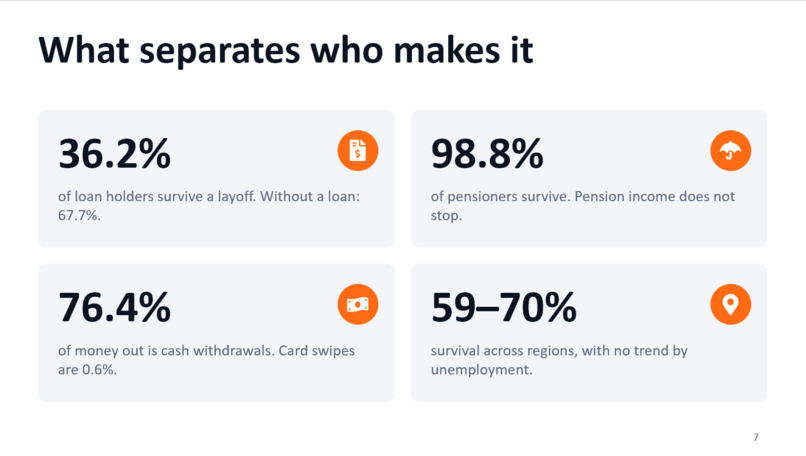
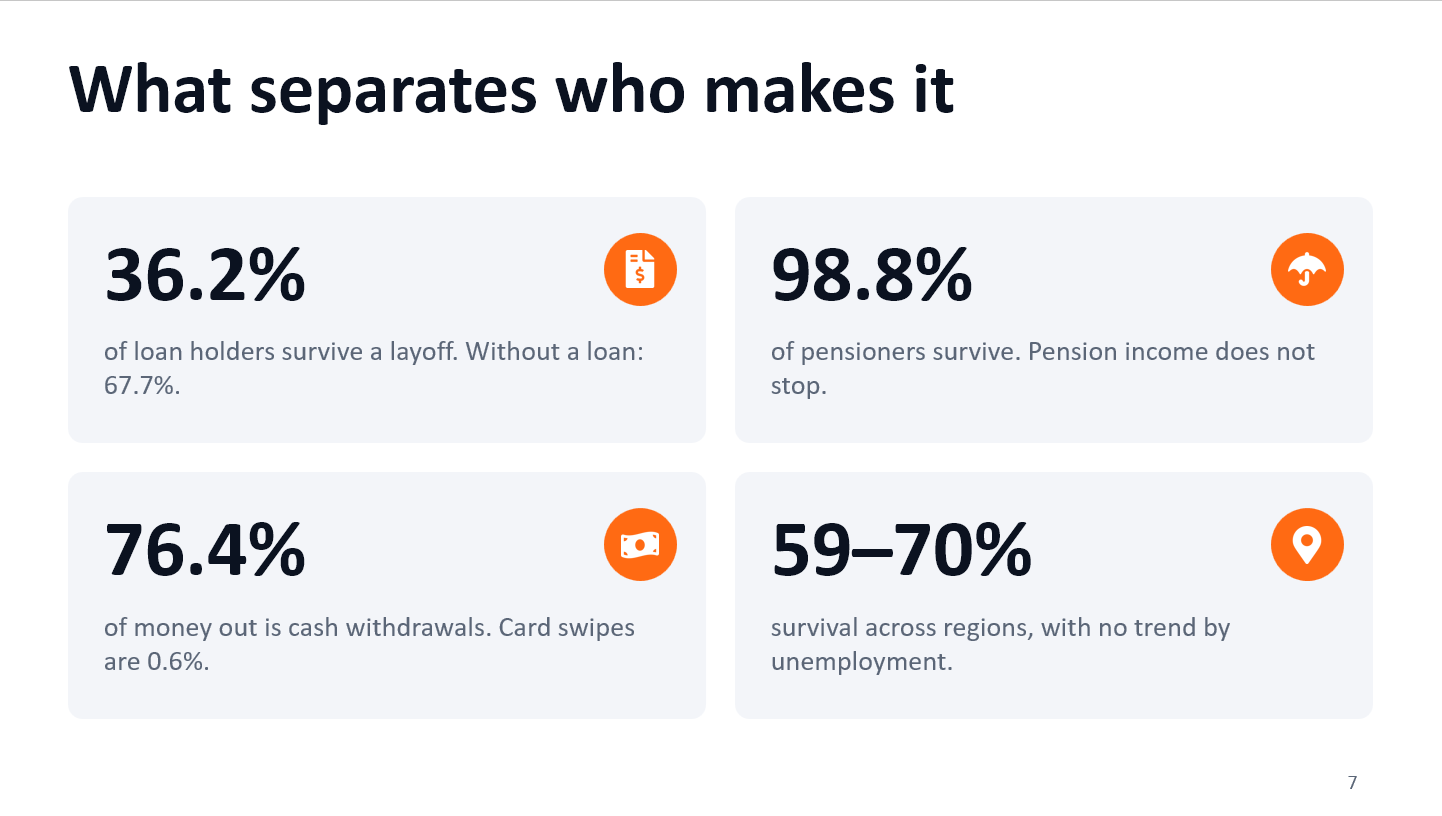
- The "Cash" Reality: Modern budgeting apps assume everyone taps their phone for every transaction. In this data, 76% of all outgoing money is physical cash withdrawals, while card swipes account for just 0.6%. Our triage algorithm couldn't rely on cutting card categories—it had to realistically cap cash reduction at 15% so users wouldn't starve.
- Protecting Fixed Costs: Building an optimization algorithm that understands human realities—you can cut unlabelled transfers by 25% or eliminate bank penalty fees, but you cannot cut car loans or insurance without risking repossession or disaster.
Accomplishments that we're proud of
- Zero-Latency Feel: You can drag the EI slider from 55% down to 30% while throwing in a $3,000 emergency repair, and the entire balance drawdown curve, triage checklist, and plant animation update instantaneously.
- Out-of-Time Statistical Validation: We froze the data at December 31, 2024, calculated runway scores, and proved that runway directly predicted 2025 overdrafts (
days_below_zero > 0) with massive separation (18.8% default rate for low runway vs. 1.6% for high runway). - Turning Fear into an Action Plan: Instead of telling a user "You will run out of money in 3.4 months," the app immediately follows up with: "Cut $180 from cash withdrawals and pause your loan payment to push runway to 6.2 months."
What we learned
Macro indicators like regional unemployment rates sound important on the news, but in the data, they barely predicted who went broke. What actually doomed accounts was balance-sheet rigidity: fixed debt payments paired with unmonitored cash leaks. Resilience isn't about how much you make; it’s about how quickly your spending can adapt when life goes sideways.
What's next for SteadyState
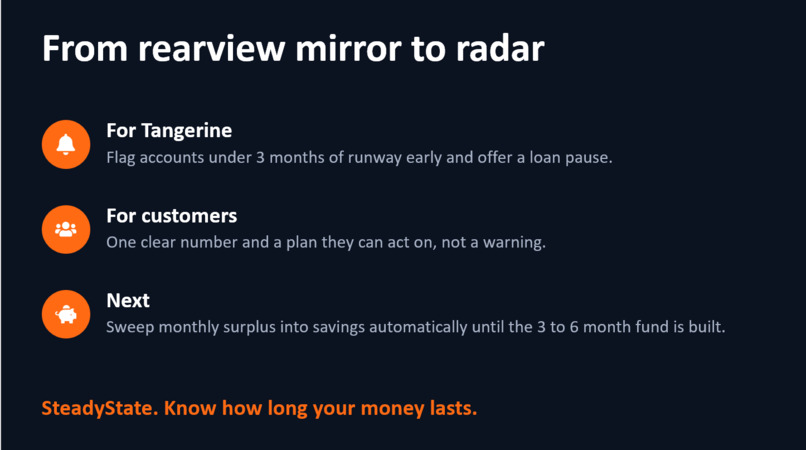
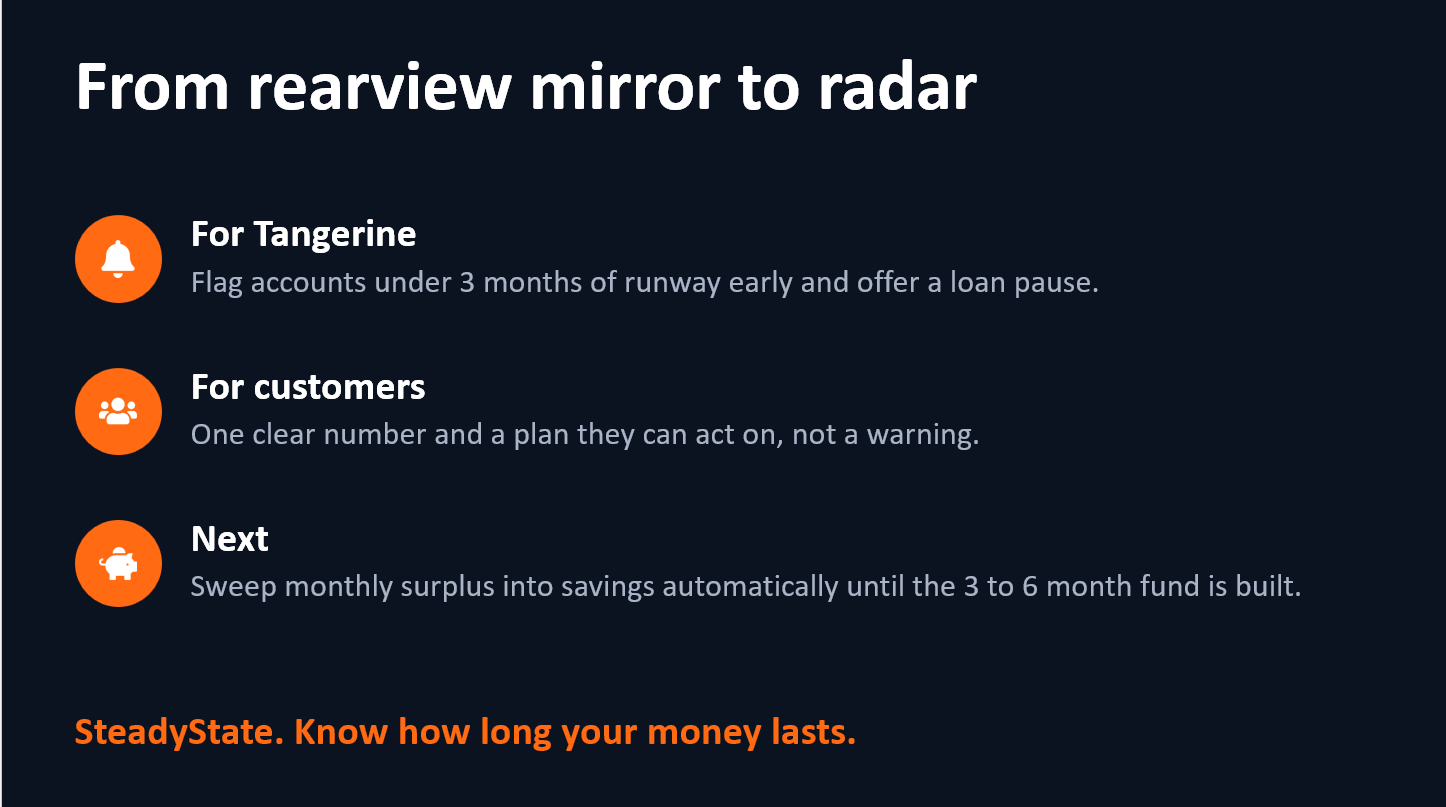
- Automated Tangerine Savings Sweeps: Automatically routing monthly surplus ((I - S)) into Tangerine High-Interest Savings Accounts to hit the 3–6 month emergency fund target on autopilot.
- Early Warning Overdraft Shields: Giving advisors a dashboard that flags accounts slipping under the 3-month runway mark, allowing the bank to proactively offer temporary loan pauses or restructuring before missed payments trigger punitive fees.
