-
-
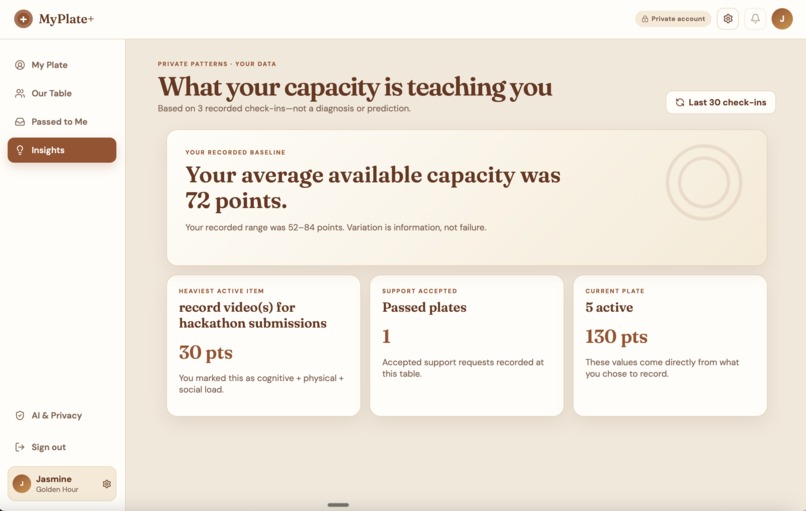
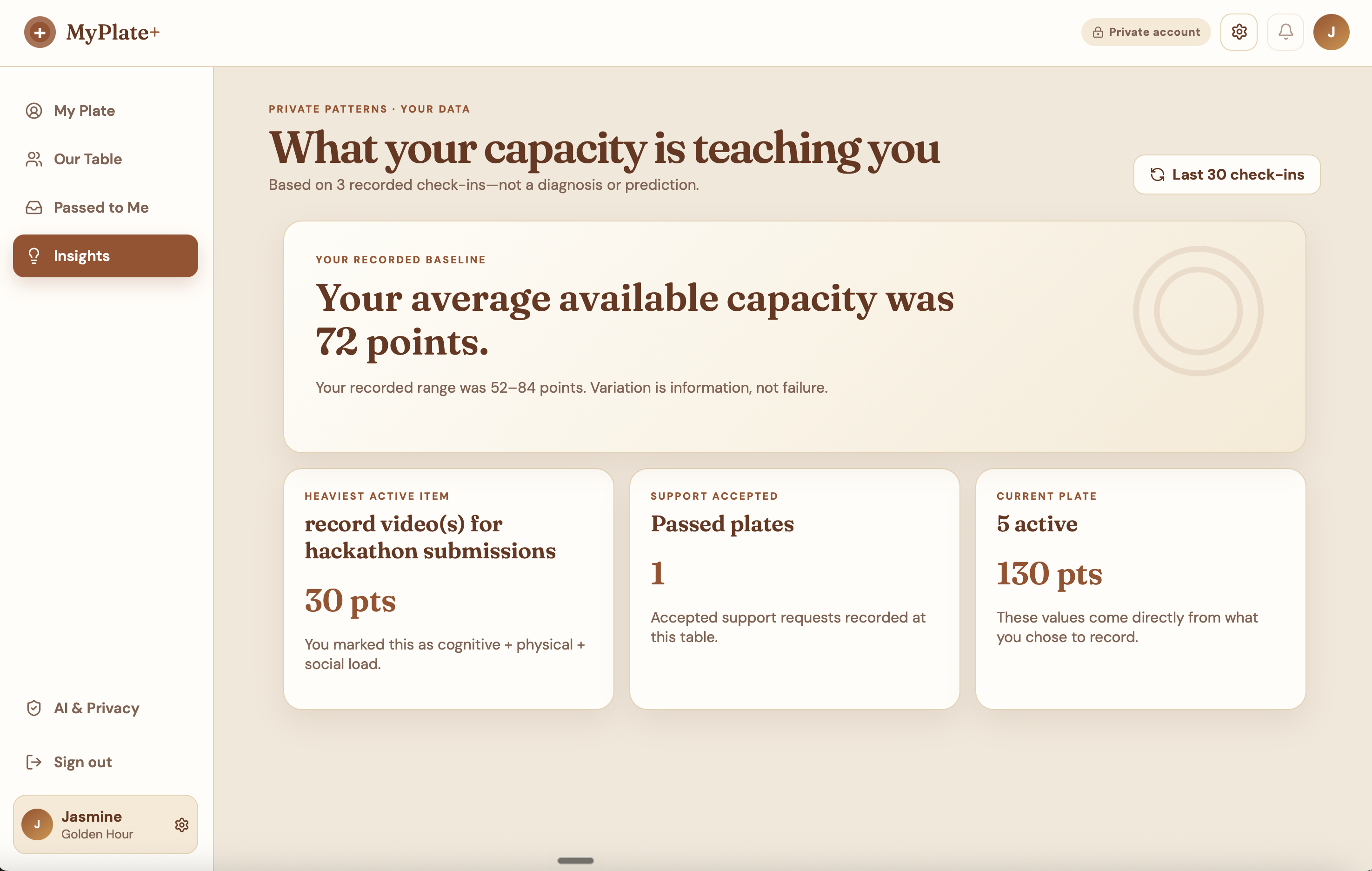
Get insights after 3 check ins
-
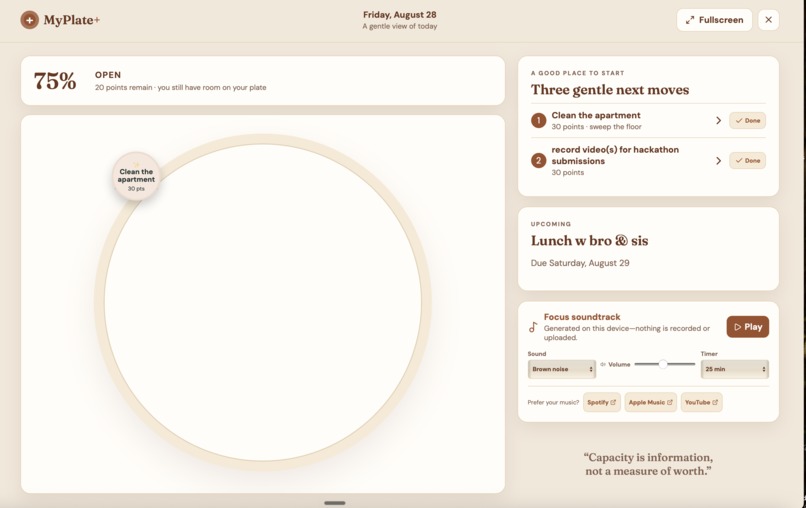
focus mode -less clutter
-
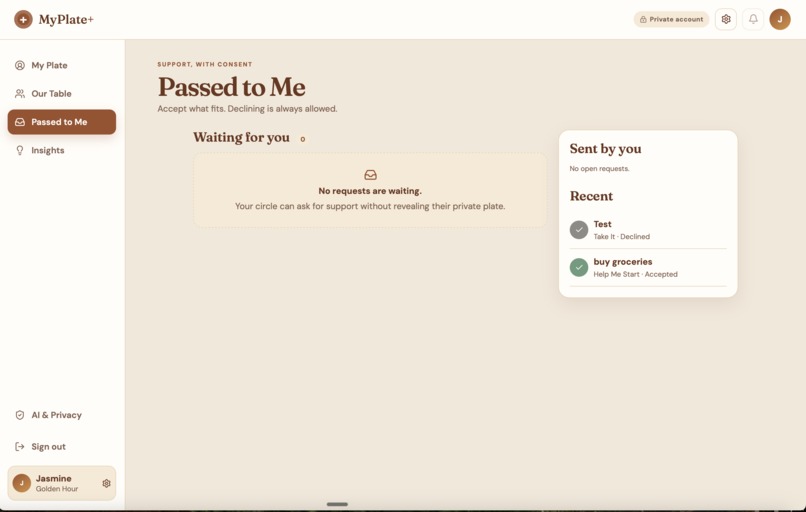
Pass a plate! Share the load
-
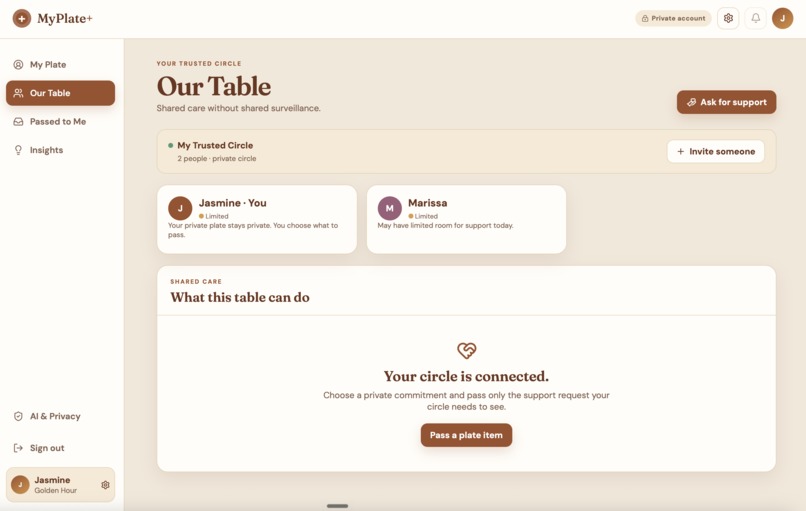
Choose who sits at your table and who share the load
-
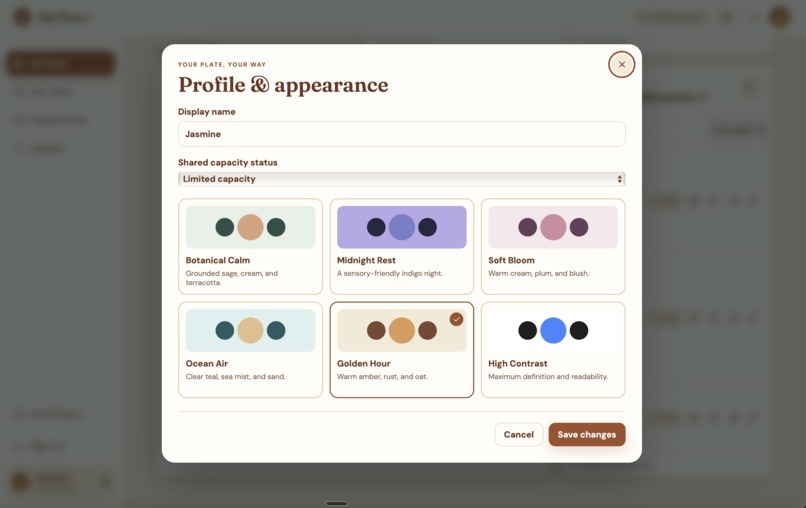
settings for theme
-
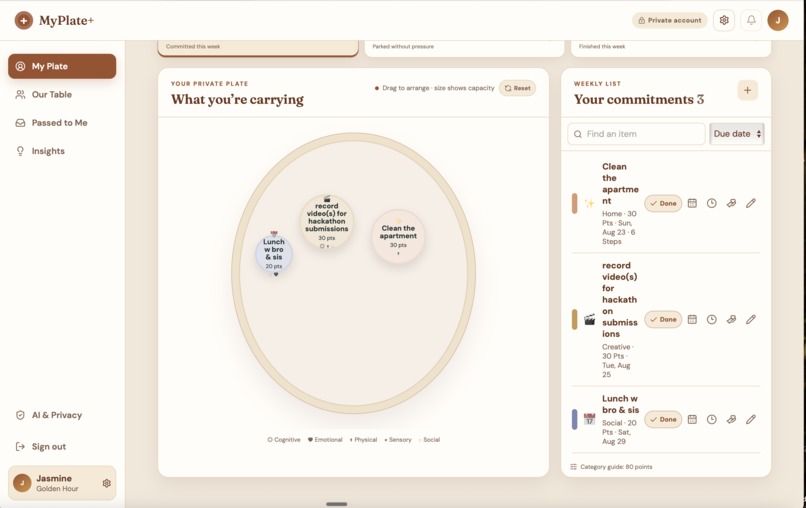
my plate
-
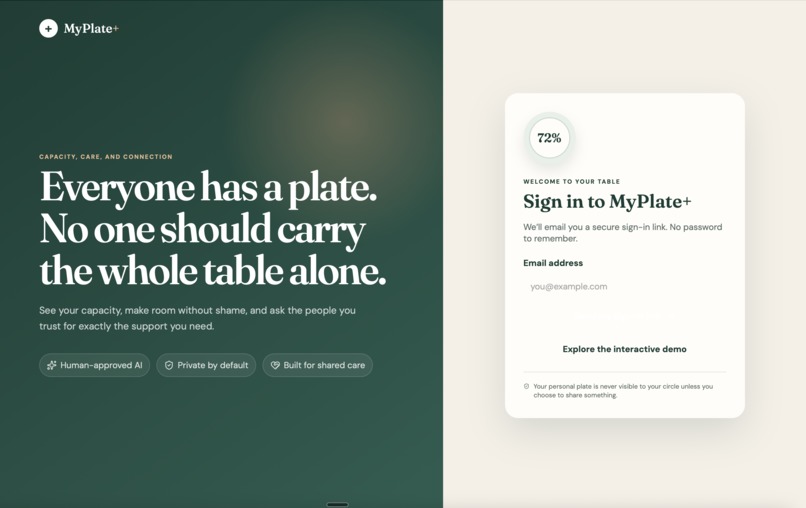
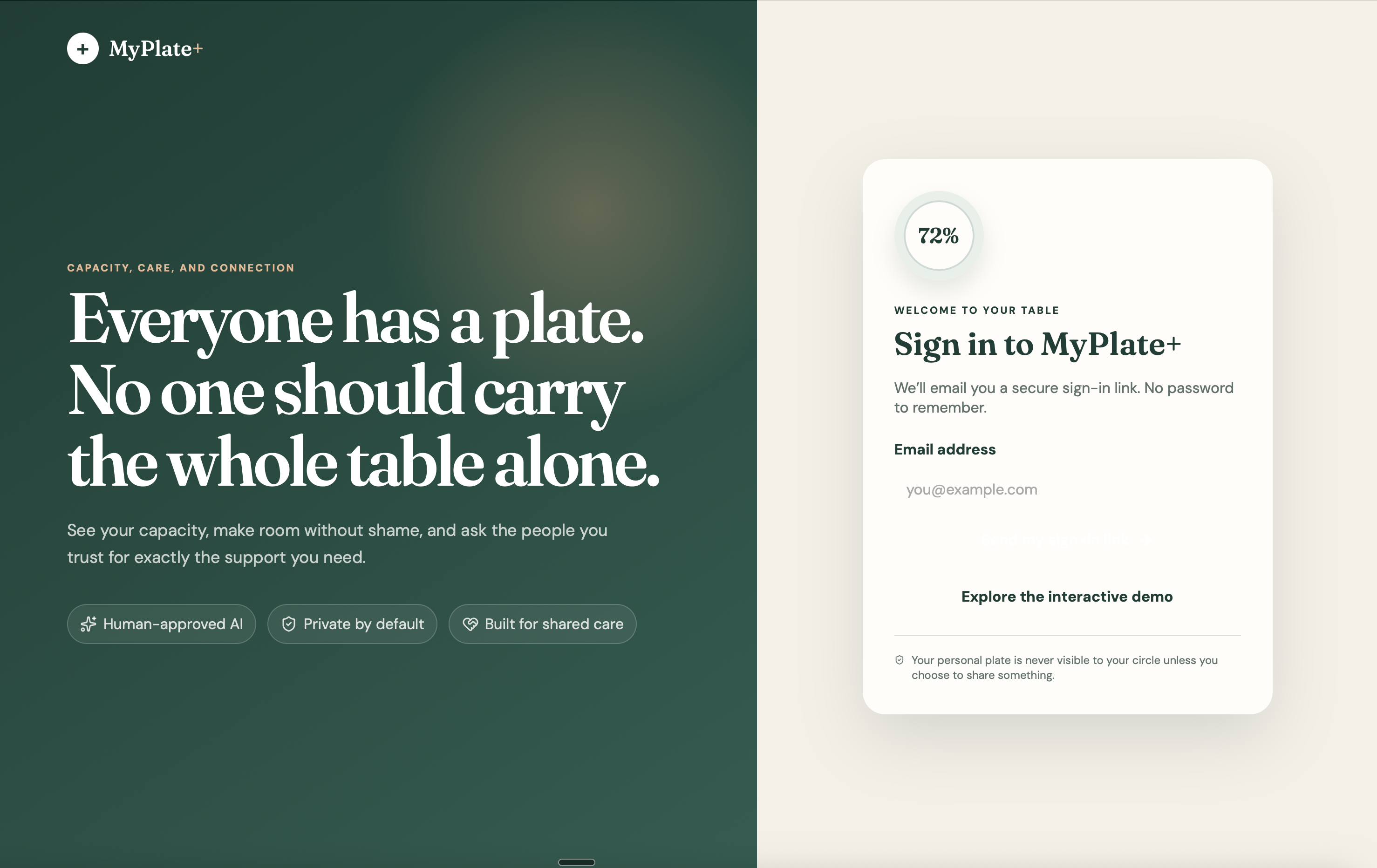
main welcome page and login
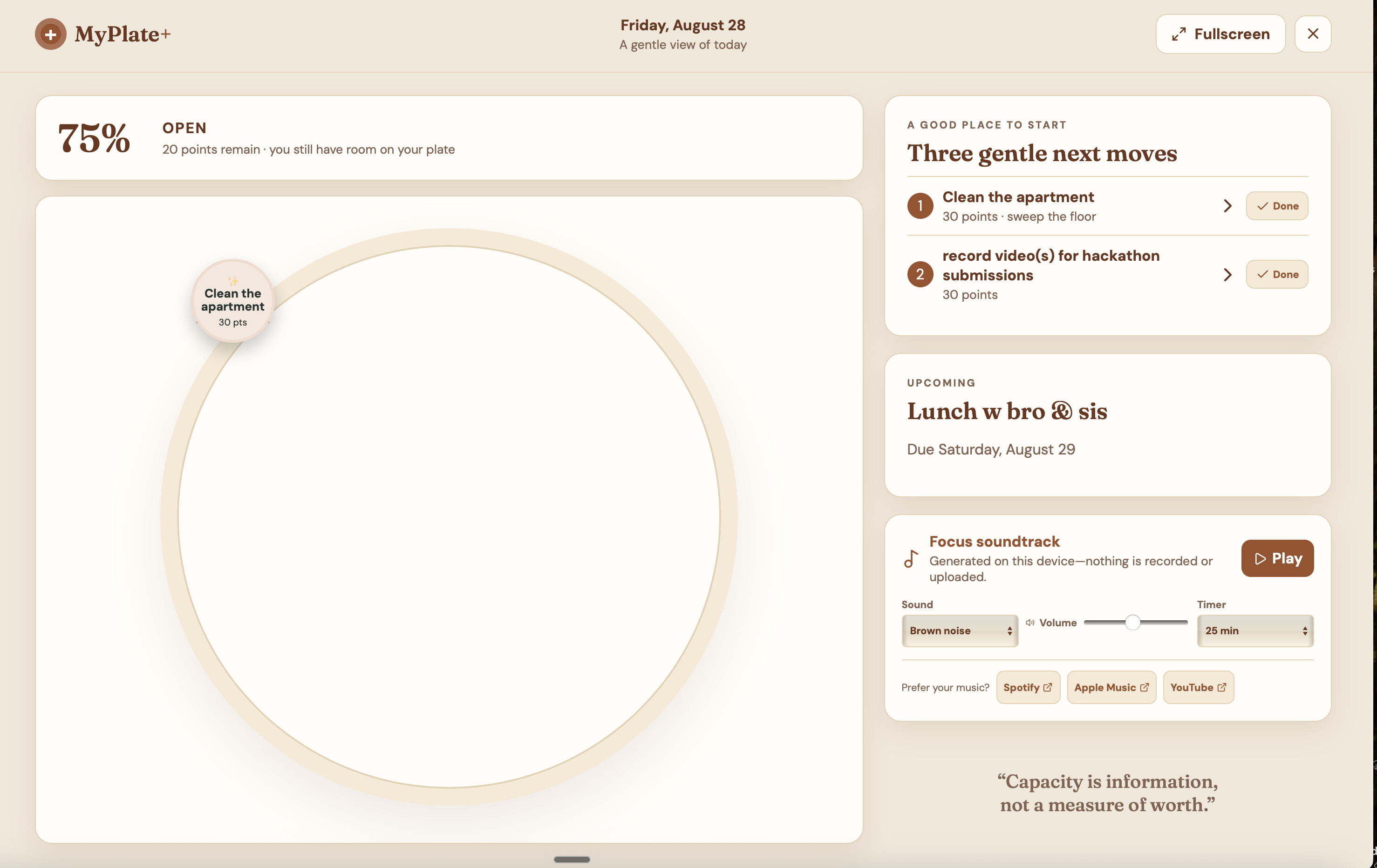
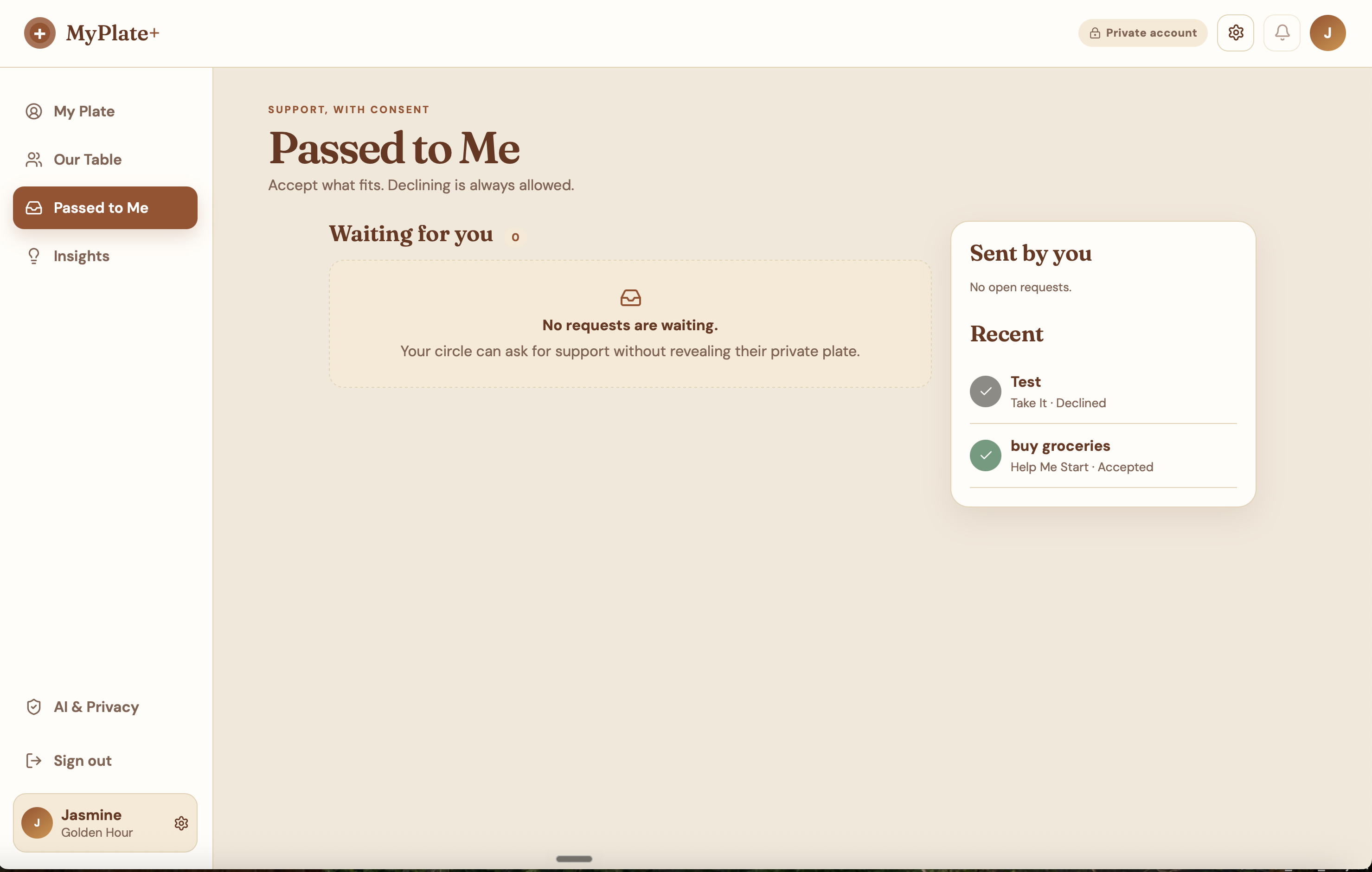
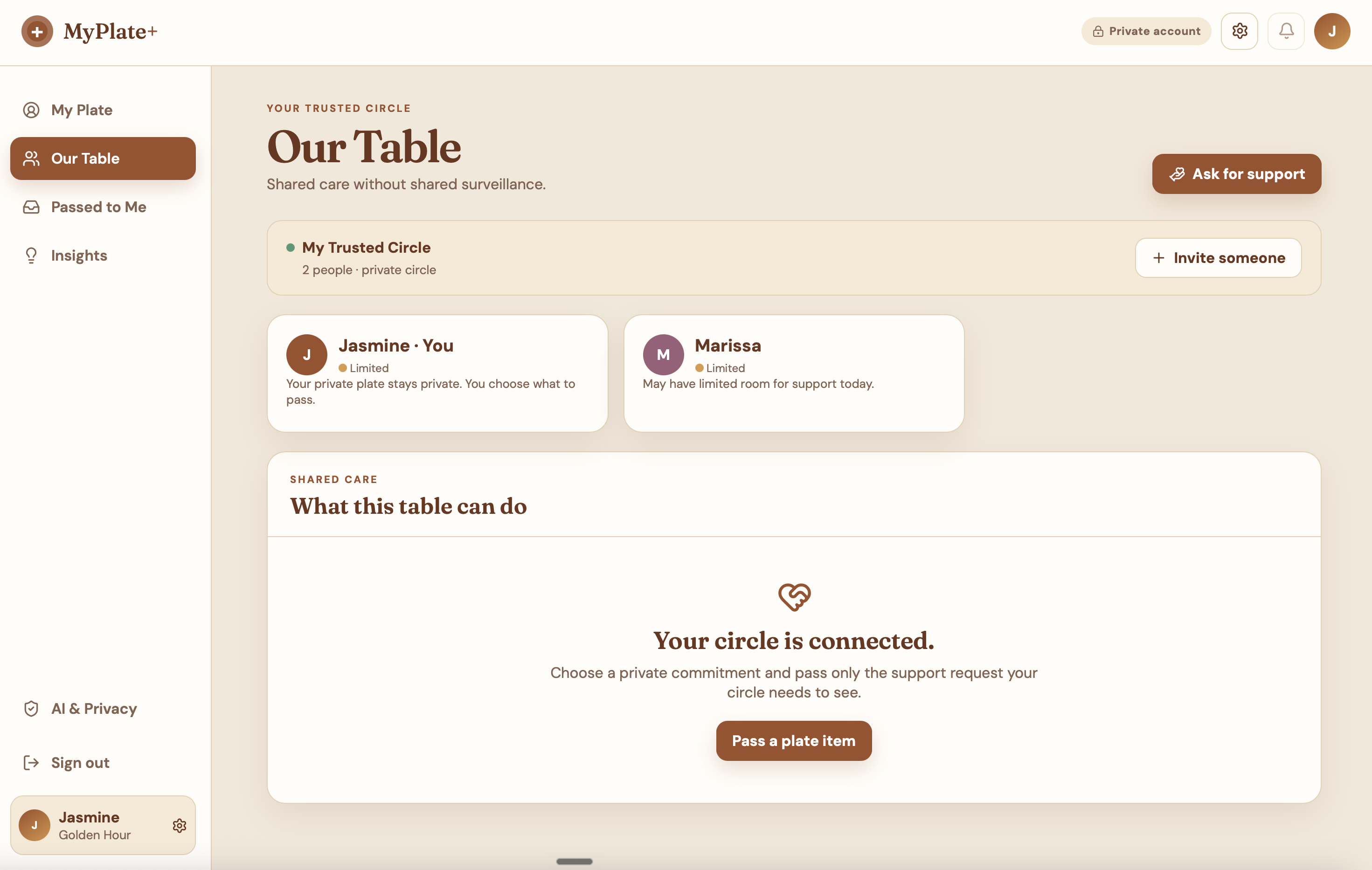
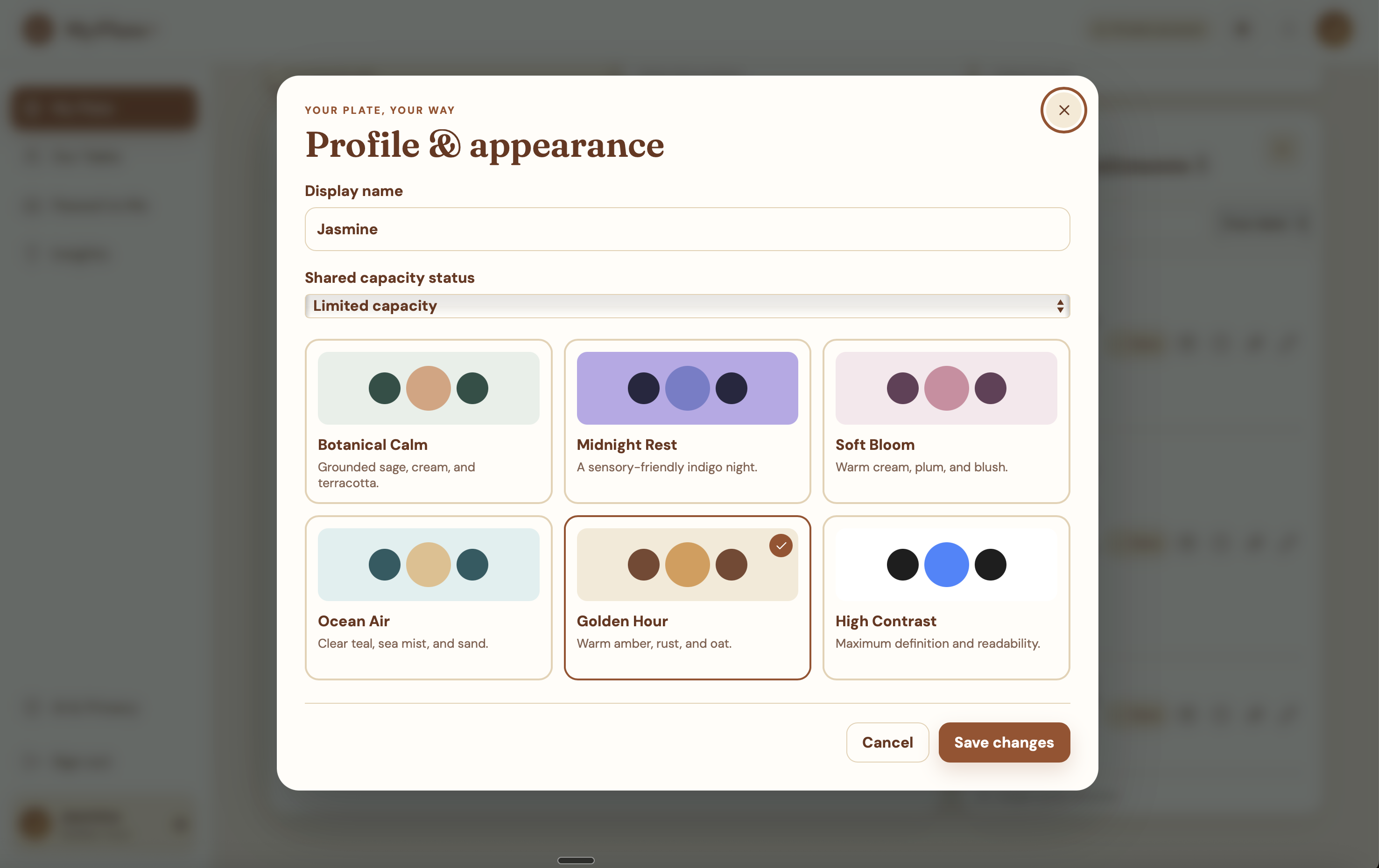
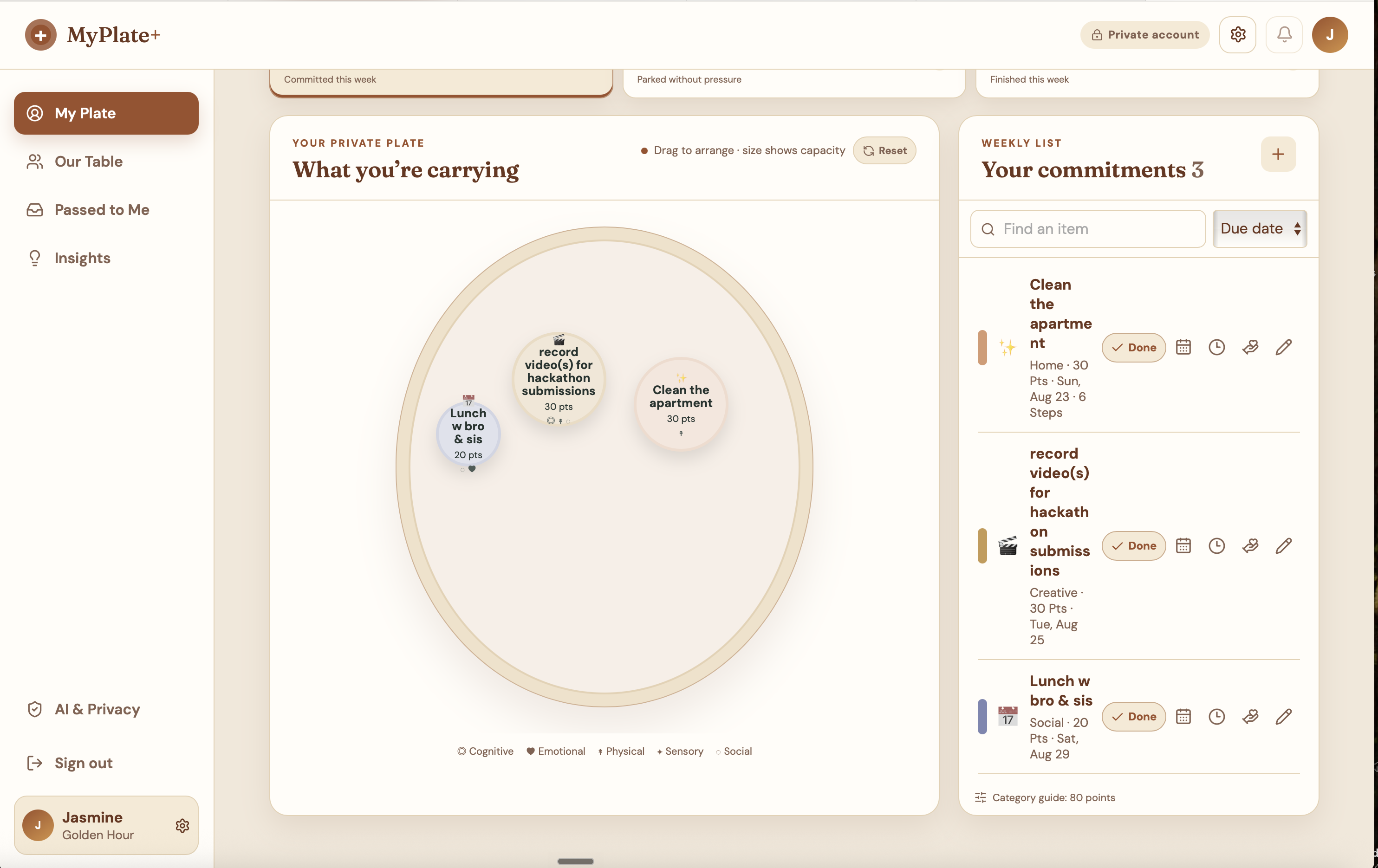
Inspiration My inspiration for MyPlate+ came from thinking about my own capacity as a neurodivergent person. Some days, I know I am overwhelmed, but I cannot clearly see everything competing for my cognitive, emotional, physical, sensory, and social energy. I imagined a visual tool that could show me what I really and truly have on my plate—not just how many tasks I have, but how much those tasks are asking of me.
Then I thought about what if it could become not only a solo experience. What if I could connect with family, friends, a partner, or another trusted person? Understanding what someone chooses to share about their capacity could create deeper empathy and make asking for help easier. That idea became MyPlate+: a private personal plate connected to a shared table of support.
What it does MyPlate+ is a visual capacity-planning and collaborative-care system designed to help people recognize overload, create more realistic plans, and request support without exposing everything they are carrying.
Users begin with a multidimensional capacity check-in covering physical energy, cognitive clarity, emotional bandwidth, sensory tolerance, social capacity, and recovery needs. MyPlate+ translates that check-in into an editable planning estimate and compares it with the responsibilities currently on the user’s visual plate. When the plate becomes overloaded, Make Room+ suggests options such as dividing a responsibility into smaller steps, moving it to a side plate, protecting recovery time, or asking someone for help. Every suggestion requires the user’s approval. Through Trusted Circles and Pass the Plate, users can ask family members, friends, partners, or other trusted people for a specific kind of support. They can ask someone to take a responsibility, share it, do it together, help them start, remind them, or simply listen. Only the approved request is shared—not the user’s private plate, check-ins, notes, or AI conversation.
How we built it MyPlate+ was built as a responsive React and TypeScript web application and deployed through ChatGPT Sites. GitHub serves as the project’s source repository and documents the application architecture, database schema, privacy controls, tests, and deployment configuration.
Supabase provides passwordless account authentication, a Postgres database, Realtime infrastructure, and an authenticated Edge Function for the Plate Assistant. The database contains separate structures for private plates, capacity check-ins, Trusted Circles, circle memberships, shared responsibilities, support requests, and sharing history. Row-level security protects every database table. Anonymous visitors have no database privileges, and authenticated users can only access information allowed by the ownership and circle-membership policies. New users automatically receive a private profile and their own Trusted Circle. Codex helped turn the original MyPlate concept into a multi-user product, implement and test the interface, design the Supabase schema, strengthen its privacy policies, deploy the application, and keep the hosted Site aligned with GitHub.
Challenges we ran into One of our largest challenges was turning something as personal and variable as capacity into a useful visual without presenting it as a medical diagnosis or an objective score. We addressed this by making capacity an editable planning estimate and repeatedly reminding users that changing capacity is information—not a measure of worth.
The multi-user experience created another important challenge: helping people understand one another without creating surveillance. We had to carefully separate the private plate from the shared table. Pass the Plate therefore creates a new, limited support request instead of giving another person access to the original private responsibility. Authentication and deployment also required careful coordination between ChatGPT Sites, GitHub, and Supabase. We had to adapt the application for the Sites runtime, configure account authentication, build secure database policies, and verify that anonymous users could not access protected data. Finally, we had to make the product immediately understandable to hackathon judges while still supporting real accounts. We solved this by placing the login experience first while also providing a complete interactive demo.
Accomplishments that we're proud of We are especially proud that MyPlate+ grew from a personal visual-planning idea into a thoughtful system for collaborative care.
The current build includes: A responsive visual plate that represents the weight of different responsibilities Multidimensional daily capacity check-ins Make Room+ strategies for adjusting overloaded plans Six customizable and accessible color themes Trusted Circles and the Our Table shared-care experience Pass the Plate requests with multiple forms of support Passwordless Supabase accounts A private-by-default database with row-level security on all eight tables Zero anonymous database privileges An authenticated Plate Assistant Edge Function Human approval before AI suggestions can change or share anything A complete interactive demo for judges who do not want to create an account Most importantly, we built privacy and consent into the product’s structure instead of treating them as disclaimers added at the end.
What we learned We learned that capacity planning is not simply task management. Two responsibilities can take the same amount of time while requiring completely different amounts of cognitive, emotional, sensory, physical, or social energy.
We also learned that shared-care technology must balance connection with autonomy. People may want their loved ones to understand that they are overloaded without sharing every private detail about why. Designing that boundary led to one of the project’s strongest ideas: share the request, not the entire plate. Building MyPlate+ also deepened our understanding of responsible AI. Responsible AI is not only about writing a safe prompt. It requires limited data access, authenticated requests, structured outputs, human approval, privacy controls, secure storage, and a useful non-AI experience when the model is unavailable.
What's next for MyPlate+ The next phase is connecting every interactive workflow to persistent Supabase data so that plates, check-ins, themes, support requests, and circle activity remain synchronized across devices.
We also plan to: Add Realtime notifications for new and updated support requests Add account export, sharing-history, access-revocation, and deletion controls Expand Make Room+ with additional user-approved AI suggestions Conduct accessibility and usability testing with neurodivergent users, couples, families, and caregivers Add stronger end-to-end testing for authentication and multi-user privacy boundaries Explore concussion-recovery adaptations with reduced sensory load, pacing support, and caregiver collaboration Our long-term goal is for MyPlate+ to become a gentle, privacy-respecting way for people to understand their capacity, communicate their needs, and remember that they do not have to carry the whole table alone.
Built With
- chatgpt
- css
- javascript
- openai
- typescript
Log in or sign up for Devpost to join the conversation.