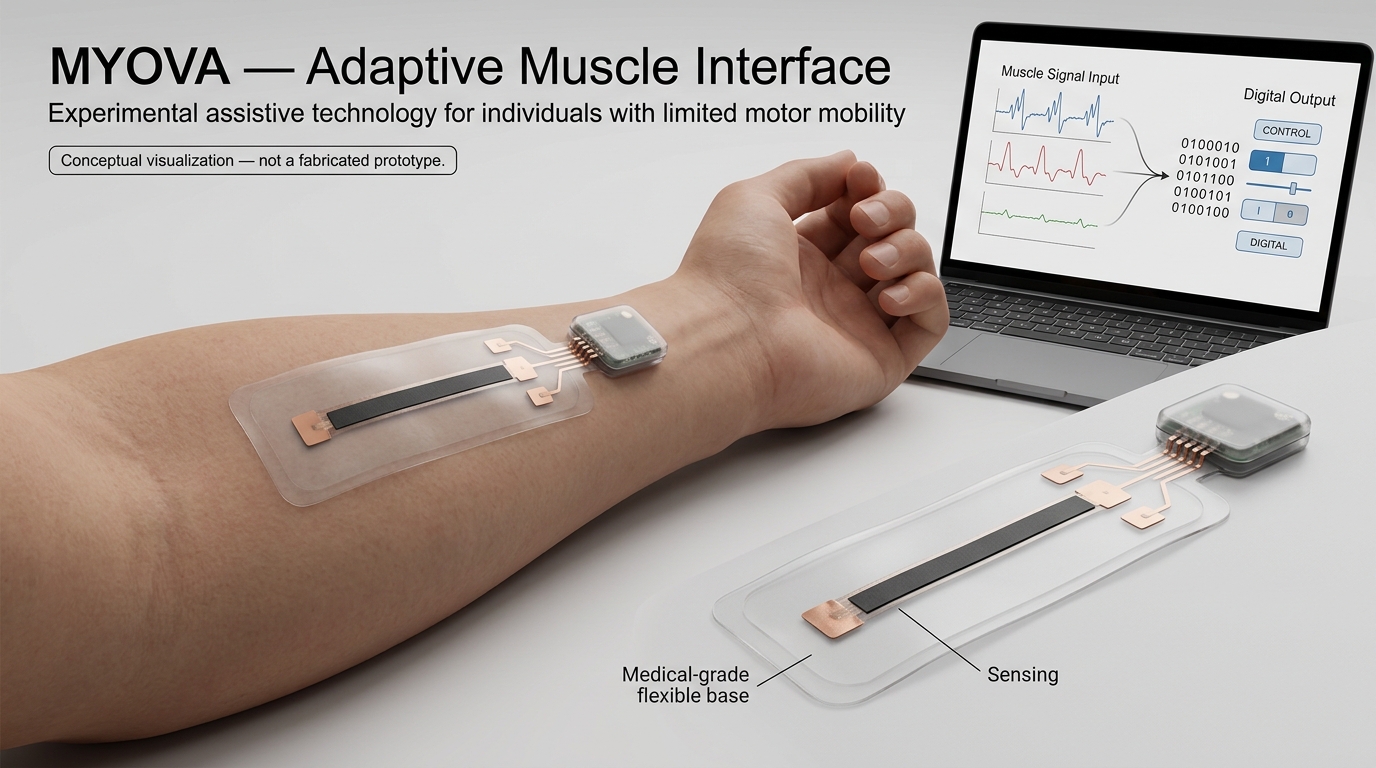
MYOVA — Adaptive Muscle Interface
Inspiration
For many people, using a computer is something that requires little thought. Moving a cursor, pressing a key, or selecting an option takes only a moment. But most digital interfaces are designed around an assumption: that users can perform a specific set of physical movements.
For someone with severely limited mobility, even a simple command can become a barrier.
MYOVA began with a different question: What if a digital interface learned to recognize the movements a person can perform, instead of requiring the person to adapt to the interface?
What it does
MYOVA is a proposed adaptive assistive interface that aims to translate subtle muscle contractions into digital commands.
Its central concept combines a flexible, skin-mounted movement sensor with a personalized machine-learning system. Instead of relying on predefined gestures, MYOVA would learn from the user's available muscle movements and associate distinguishable signal patterns with commands.
A person capable of producing only two reliably distinguishable contractions could potentially use them to navigate a scanning keyboard, select characters, and interact with digital tools.
The long-term goal is to explore a more adaptable and affordable approach to assistive technology.
How it works
The proposed system consists of four stages:
- Signal acquisition: A flexible sensor placed on the skin measures deformation associated with muscle movement.
- Personalized calibration: The user performs a small number of movements, creating a reference dataset.
- Adaptive classification: A machine-learning model analyzes the signals and attempts to distinguish intentional commands.
- Accessible interaction: Recognized commands control a simplified digital interface, such as a two-input scanning keyboard.
An important part of the design is confidence-aware interaction. If the system cannot reliably distinguish two signals, it should request recalibration rather than execute an uncertain command.
What makes MYOVA different?
The project's focus is not simply recognizing muscle activity. It is investigating whether an assistive interface can adapt to the user's individual movement capabilities while accounting for uncertainty in the sensor data.
MYOVA explores three design priorities:
- Individual adaptation: Calibration based on movements the user can actually perform.
- Reliability: Detection of ambiguous signals before they trigger unwanted actions.
- Accessibility: A simplified interface that can operate with a very small number of distinct commands.
Challenges and limitations
Several technical challenges must be addressed before MYOVA can become a reliable assistive device.
Small muscle movements can generate weak or inconsistent signals. Sensor placement, skin movement, noise, and changes in posture may affect measurements. A classifier that works during one calibration session may perform differently later.
Another challenge is distinguishing intentional commands from involuntary movements.
These limitations motivate the project's emphasis on signal quality, personalized calibration, and uncertainty detection.
What I learned
Developing the MYOVA concept highlighted an important distinction between detecting a biological signal and building a usable assistive system.
A successful classifier alone would not guarantee accessibility. The interface must also account for fatigue, false activations, individual differences, and the effort required to recalibrate.
The project also reinforced the importance of separating a technical proof of concept from a clinically validated device.
What's next?
The next development milestones are:
- Build and characterize a working flexible-sensor prototype.
- Collect labeled movement signals under controlled conditions.
- Train and evaluate a personalized classifier.
- Connect the classifier to a functional scanning keyboard.
- Measure classification accuracy, false activations, and recalibration performance.
- Explore usability testing with appropriate accessibility and research safeguards.
Current status: MYOVA is a proposed assistive-technology concept. Physical sensor performance, machine-learning accuracy, and effectiveness for users with motor disabilities have not yet been validated.
The goal is to move from concept to a reproducible prototype, with transparent testing and realistic claims about its capabilities.
Built With
- artificial
- google-colab
- machine-learning
- matplotlib
- numpy
- python
- scikit-learn

Log in or sign up for Devpost to join the conversation.