MyoControl: Control Your World With a Gesture
Inspiration
I didn't want to get up to turn off the light.
That's it. That's where this started.
Then I thought, why should I have to find a remote to change the TV channel? Why do I need to pull out my phone, open an app, and tap through menus just to interact with the room I'm already sitting in?
We call our homes smart, but somehow we've made interacting with them more complicated. Everything needs an app, a screen, a remote, or a voice assistant.
What if our environments could just understand us?
Imagine pointing at a light and dimming it with a gesture. Flicking your wrist to skip a song. Moving your hand to control your computer. All without touching a single screen.
Computer vision could accomplish some of this, but who wants cameras watching their every movement at home?
I wanted something more natural, more personal, and more private.
That's how MyoControl was born.
What It Does
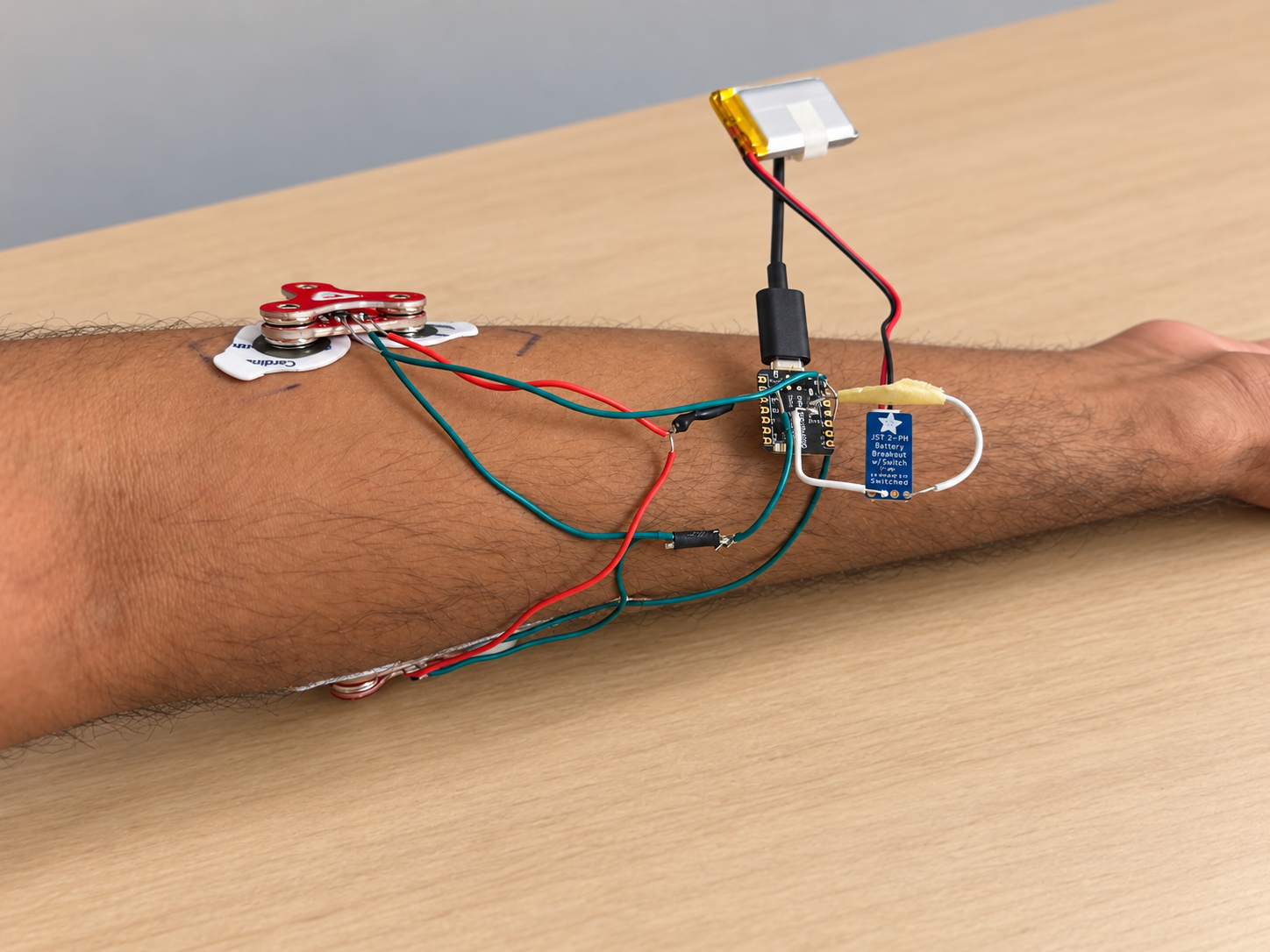
MyoControl is a wearable device that turns muscle activity and hand movements into commands for the world around you.
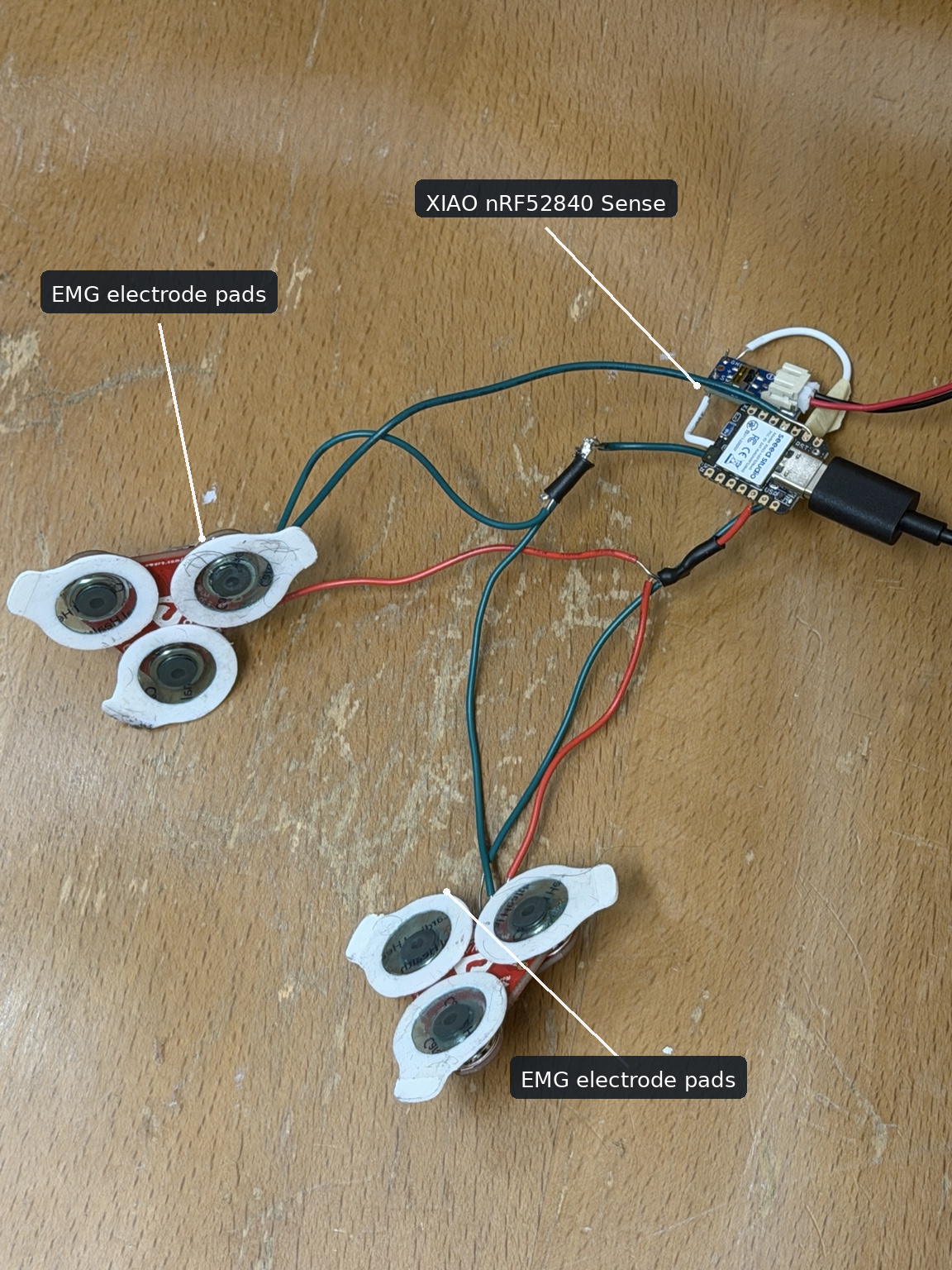
It combines electromyography (EMG) sensors, which detect electrical activity in your muscles, with an inertial measurement unit (IMU), which tracks how your hand moves through space.
Together, they help the wearable understand not just how you're moving, but what you're trying to do.
Flex your muscles to activate a command. Swipe your hand to interact with your computer. Control a light, adjust its brightness, or interact with connected devices without reaching for a switch.
But the most exciting part is that MyoControl isn't limited to one device or one purpose.
We designed it around switchable control modes. By holding a muscle flex, users can change what their gestures control. The same wearable can go from controlling smart-home devices to interacting with a computer, without needing to take it off or open an app.
And that's the bigger vision. Your TV, your lights, your phone, your car, your computer. Why should each need a completely different interface?
Your body becomes the interface, and your environment becomes responsive to you.
How We Built It
At the heart of MyoControl is an nRF52840 microcontroller running Zephyr RTOS.
We used MyoWare 2.0 EMG sensors to measure muscle activity and an onboard IMU to capture hand movements. Rather than streaming raw sensor data to a computer for interpretation, we designed the wearable to recognize gestures locally.
For muscle recognition, we collected training data for different hand states, trained lightweight machine learning classifiers using Python and scikit-learn, and translated the resulting model into C for embedded execution.
For motion recognition, we developed an IMU-based gesture detector that identifies directional swipes while filtering out ordinary movement.
We then built a shared gesture-processing system that translates these classifications into actions. Bluetooth Low Energy allows the wearable to communicate with external receivers, while USB HID support enables computer interactions such as mouse and media controls.
We also incorporated mode switching directly into the wearable's gesture logic, allowing it to take on different roles without adding more physical buttons or screens.
Challenges and What We Learned
It turns out that teaching a device to understand your intentions is much harder than teaching it to detect movement.
Muscle signals are noisy. The same flex can produce different readings depending on sensor placement, arm position, and how strongly you contract your muscles.
And recognizing a swipe is only half the problem. We also had to distinguish intentional gestures from everyday movements, prevent commands from triggering repeatedly, and manage different control modes without creating conflicts.
One of our biggest challenges was bringing everything together. EMG classification, IMU detection, Bluetooth communication, device control, and USB input all needed to operate as parts of one responsive system.
We learned that designing a natural interface isn't just about recognizing gestures accurately. It's about understanding context, avoiding accidental actions, and making the technology disappear into the interaction.
What's Next
MyoControl started with a light switch, but we don't want it to end there.
We envision a wearable that adapts to its user over time, learns their individual muscle patterns, and seamlessly switches between the devices and environments they interact with.
Imagine walking into your living room and controlling your TV, moving to your desk and controlling your computer, then getting into your car and interacting with its interface, all using the same familiar gestures.
We also see possibilities for accessibility, especially for people who find conventional switches, remotes, or touchscreens difficult to use.
Ultimately, we don't believe the future of smart environments should revolve around more screens.
It should revolve around people.
Because the smartest home isn't the one with the most technology. It's the one that feels the most natural to live in.
And sometimes, all that should take is a wave of your hand.

Log in or sign up for Devpost to join the conversation.