Inspiration
Myocle began as a simple meal-planning idea for someone I care about. As I worked on it, my own experience with addiction, mental health challenges, disrupted routines, and rebuilding showed me a wider problem: support is often fragmented, generic, or arrives only after someone is already overwhelmed.
I wanted to build something that helps earlier. Myocle is designed around small, practical actions, user control, safer connection, and progress that does not disappear after a setback. The name reflects the purpose: breaking my old cycle.
What it does
Myocle brings private wellbeing tools, adaptive guidance, a growing companion, and safety-aware social connection into one Flutter application.
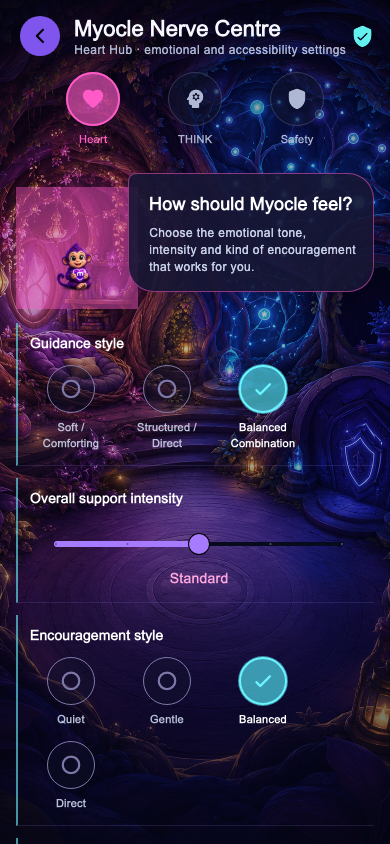
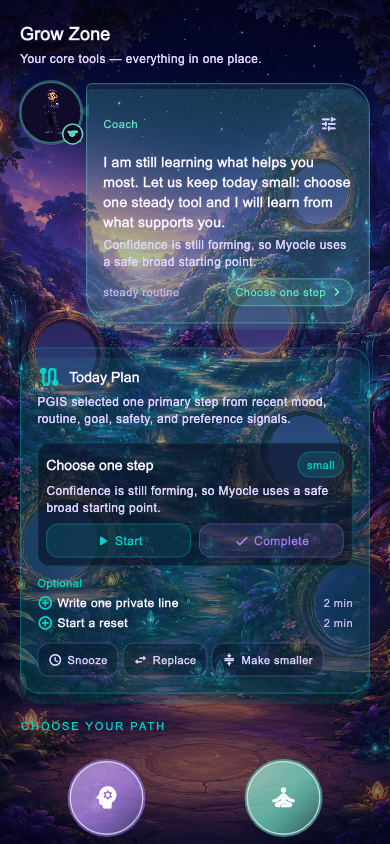
Users configure the Personal Growth Intelligence System (PGIS) around the areas they want support with, how direct or gentle guidance should feel, how often the app should prompt them, which characters they want visible, and which modules should stay active. PGIS uses sanitised activity signals to offer a realistic next action without exposing raw private writing.
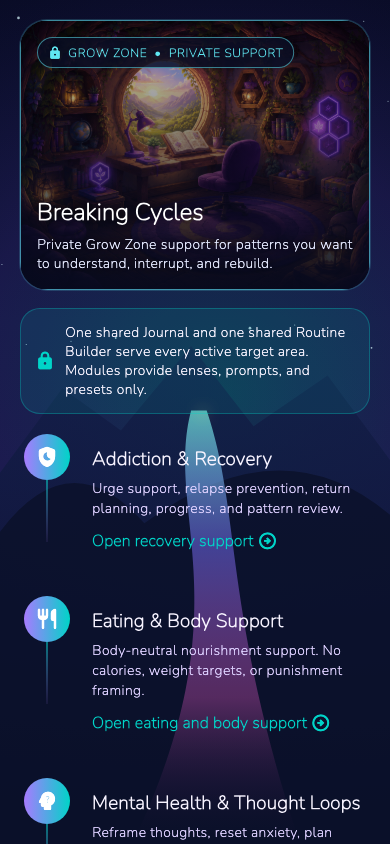
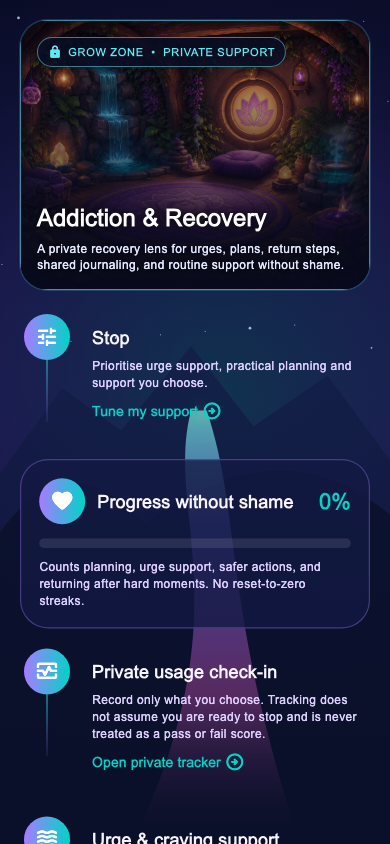
Grow Zone contains practical wellbeing and Breaking Cycles pathways, including addiction and recovery support, eating and body support, mental health and thought-loop tools, movement, nourishment, meditation, routines, relationship recovery, and Family Bridge. Shared journals and routine builders use contextual lenses so users do not face duplicate tools scattered across the app.
The companion starts as an egg. Meaningful wellbeing actions help it progress until Monkey hatches and grows with the user. Monkey provides emotional encouragement, Coach provides structure, and the AI Bodyguard handles safety, privacy, moderation, and calmer routes to support. Glow Up Wall is designed around encouragement and milestones rather than anonymous targeting or follower-chasing.
Myocle is a support tool, not a medical service, emergency service, diagnostic system, or replacement for qualified professional care.
What we built during OpenAI Build Week
Myocle existed before the event. During the July 13-20, 2026 Build Week window, Codex and GPT-5.6 were used to make a substantial engineering and product extension rather than simply repackage the existing app.
The Build Week work includes:
- consolidating the old Vault into the private PGIS Nerve Centre for guidance, privacy, safety, character, notification, and feature controls;
- consolidating duplicated journal and planner entry points into shared Grow Zone systems with module-specific lenses;
- implementing and strengthening Breaking Cycles routes, state, non-shaming recovery language, and adaptive support controls;
- adding Relationship Recovery and Family Bridge surfaces with neutral, child-centred, procedural-fairness boundaries;
- connecting healthy actions to lifecycle-aware Egg-to-Monkey progression and character encouragement;
- implementing Ask Myocle safety policy, moderation, sanitisation, healthy-engagement, and escalation-routing services;
- strengthening authentication, app lock, onboarding, accessibility, privacy, entitlement, and release-contract coverage;
- adding service, policy, route, widget, contract, and visual baseline tests.
The repository history, dated source files, and Codex session evidence distinguish this work from the pre-existing product.
How we built it
The application is built in Flutter and Dart for iOS and Android. Provider coordinates application state and adaptive preferences, while GoRouter keeps feature ownership and deep links explicit. Firebase Authentication, Cloud Firestore, Storage, and Remote Config support account and cloud features. Secure local storage, local notifications, RevenueCat entitlements, and modular PGIS, moderation, lifecycle, and engagement services support the wider experience.
Codex and GPT-5.6 worked as an engineering collaborator throughout the extension. They helped recover and lock the correct source of truth, trace duplicated routes and ownership, implement Flutter screens and services, write focused tests, diagnose CI and store build failures, audit privacy and safety boundaries, and translate a large set of product directives into a coherent architecture. I retained the product decisions and reviewed sensitive wellbeing, safety, privacy, and family-support behavior.
Challenges we ran into
The hardest problem was not adding more screens. It was turning years of ideas and several overlapping prototypes into one coherent product without duplicating journals, planners, settings, emergency routes, or character roles.
We also had to prevent visual ambition from obscuring safety and usability. Sensitive recovery features needed non-shaming language. Family tools needed neutral records rather than custody scoring. Public sharing needed moderation without anonymous targeting. Character guidance needed to respect the companion lifecycle. Store builds required careful versioning, signing, entitlement, and CI handling.
Codex helped trace those cross-cutting constraints across routes, services, providers, tests, assets, and release configuration rather than treating each screen as an isolated mockup.
Accomplishments that we are proud of
The PGIS Nerve Centre is the clearest expression of the product: users can shape how the app supports them instead of being forced into one generic wellness routine.
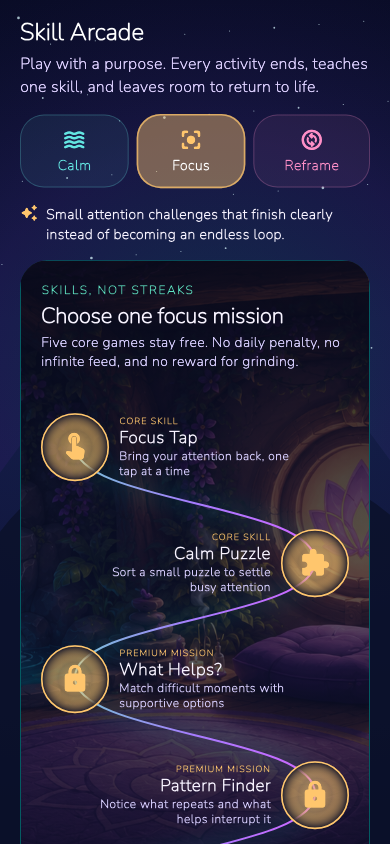
We are also proud of the shared Grow Zone architecture, the return-after-setback recovery framing, and the separation of character roles. Monkey offers emotional connection, Coach turns intention into a plan, and the AI Bodyguard protects privacy and safer interaction. The companion grows through meaningful actions, not passive screen time.
What we learned
The strongest AI-assisted development came from clear product boundaries, evidence, and tests, not from asking a model to generate more features. Codex was most valuable when it could compare implementation against a locked source of truth, identify duplicate ownership, and turn broad goals into services, routes, state, and acceptance tests.
We also learned that responsible wellbeing design means knowing what the app must not do. Myocle should not diagnose, promise recovery, rank parents, expose private writing, reward conflict, or make emergency support dependent on a subscription.
What's next for Myocle
The immediate focus is release-quality evidence: final physical-device accessibility QA, credentialed review of sensitive wellbeing wording, approved production character animation assets, and fresh iOS and Android distribution builds.
After that, Myocle will expand carefully through measured user testing, consent-aware analytics, stronger regional support resources, and features that demonstrably help people take useful action without creating another compulsive feed.

Log in or sign up for Devpost to join the conversation.