-
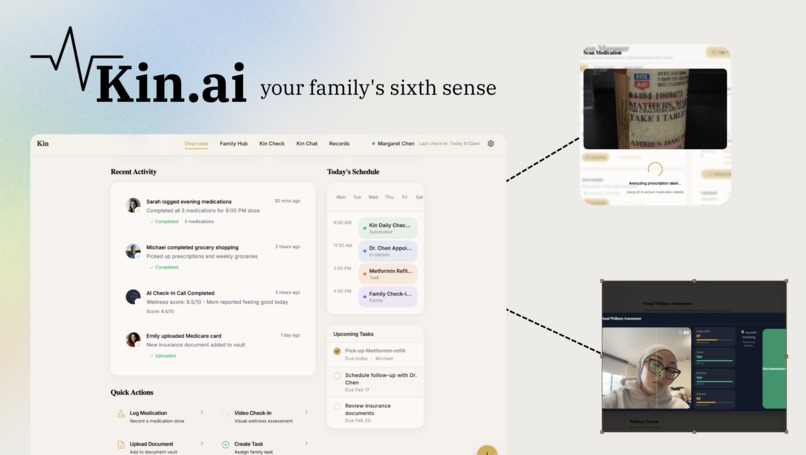
Kin.ai - Your Family's Sixth Sense
-
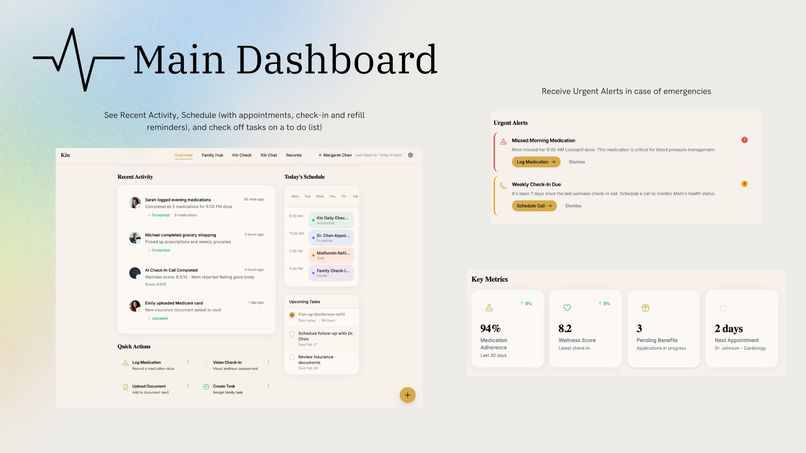
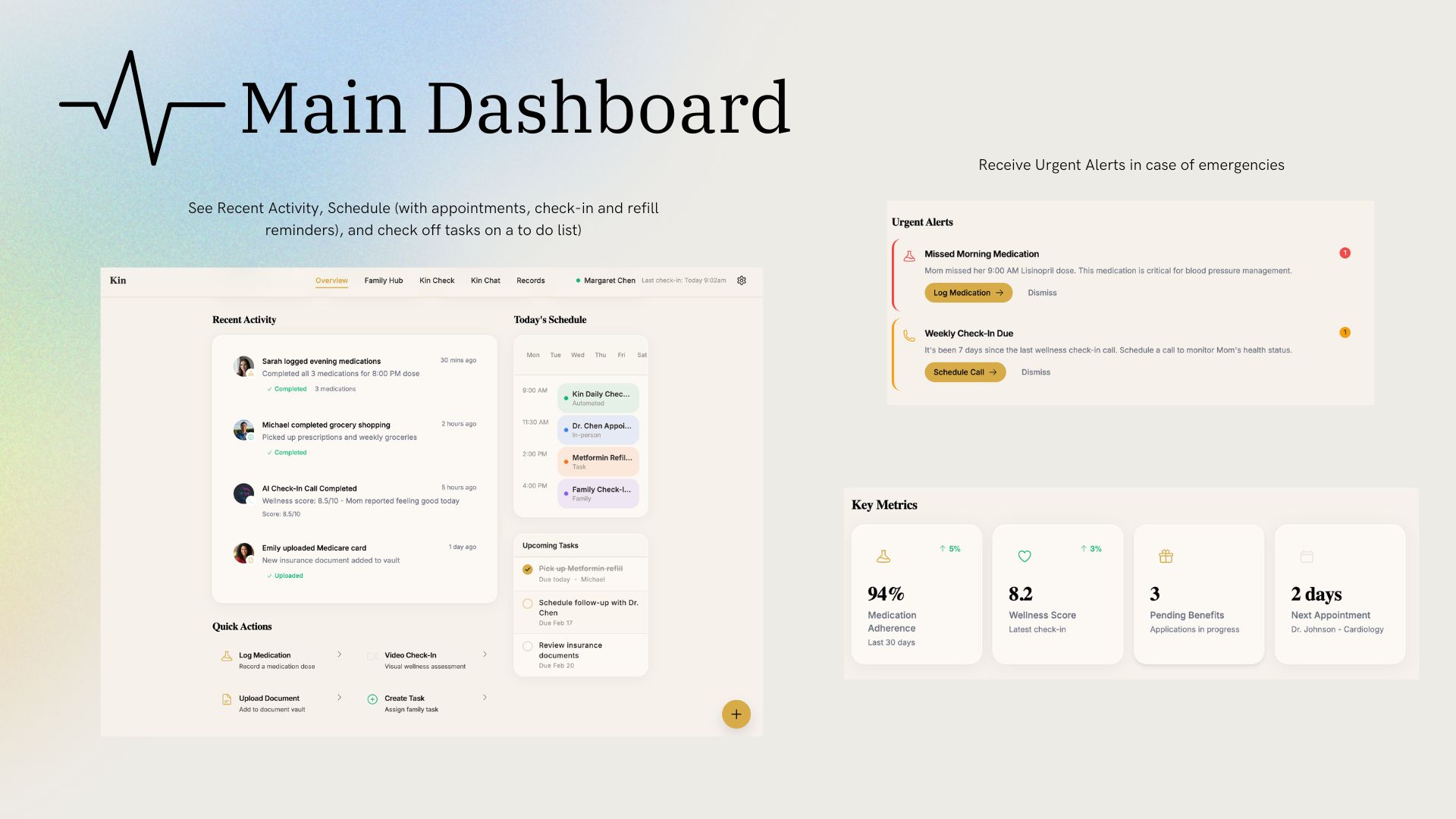
Main Dashboard
-
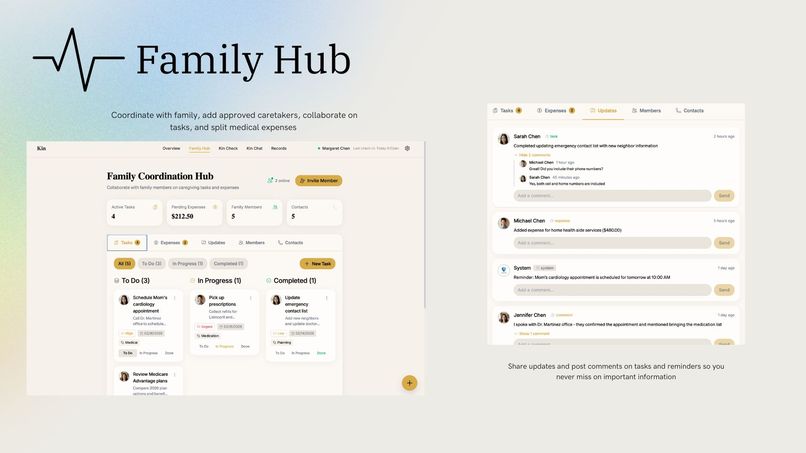
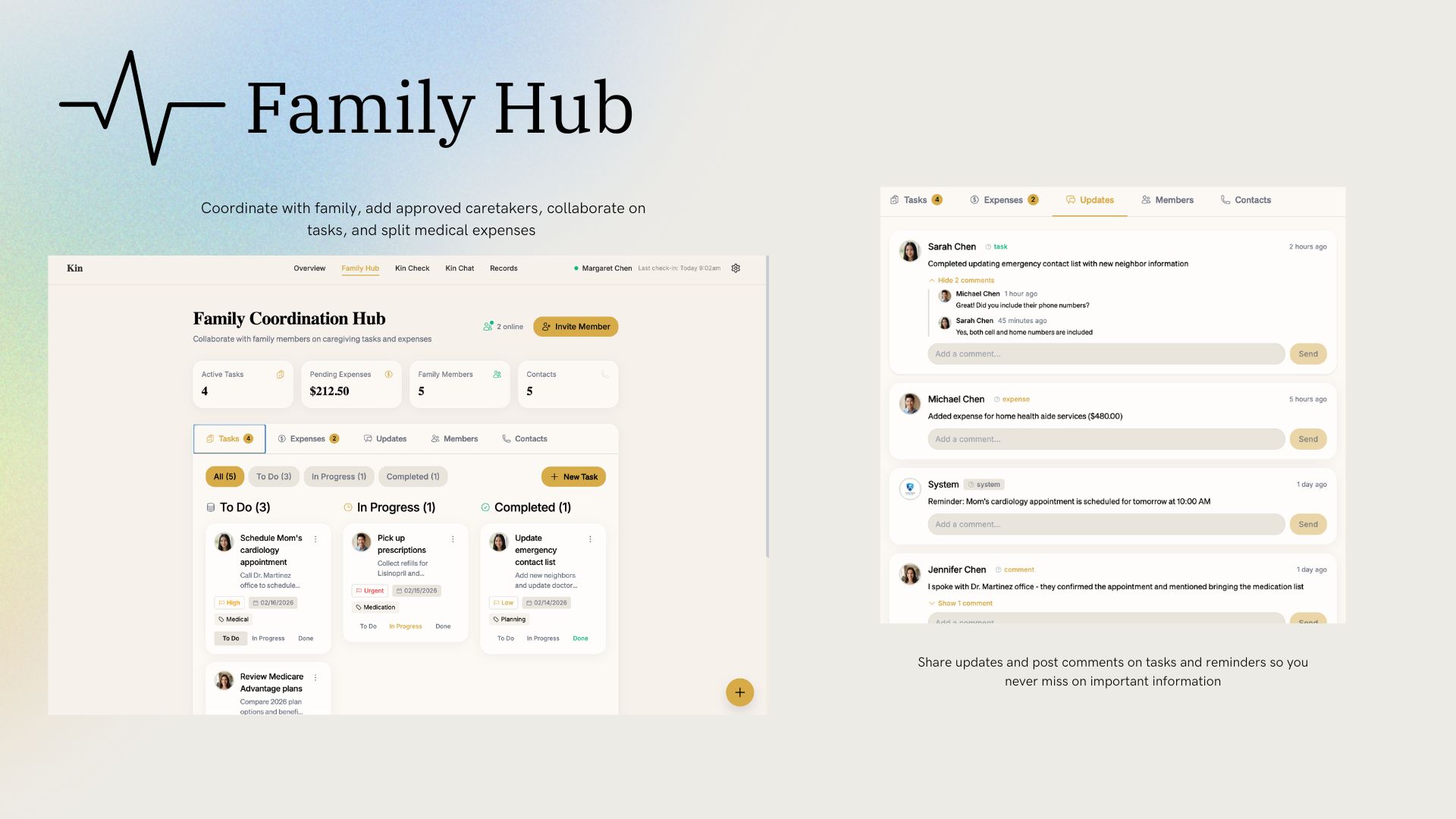
Family Hub - Align with other caretakers
-
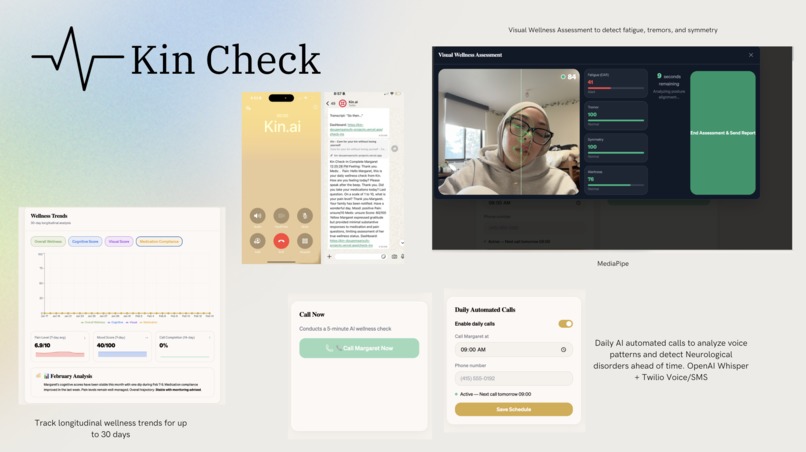
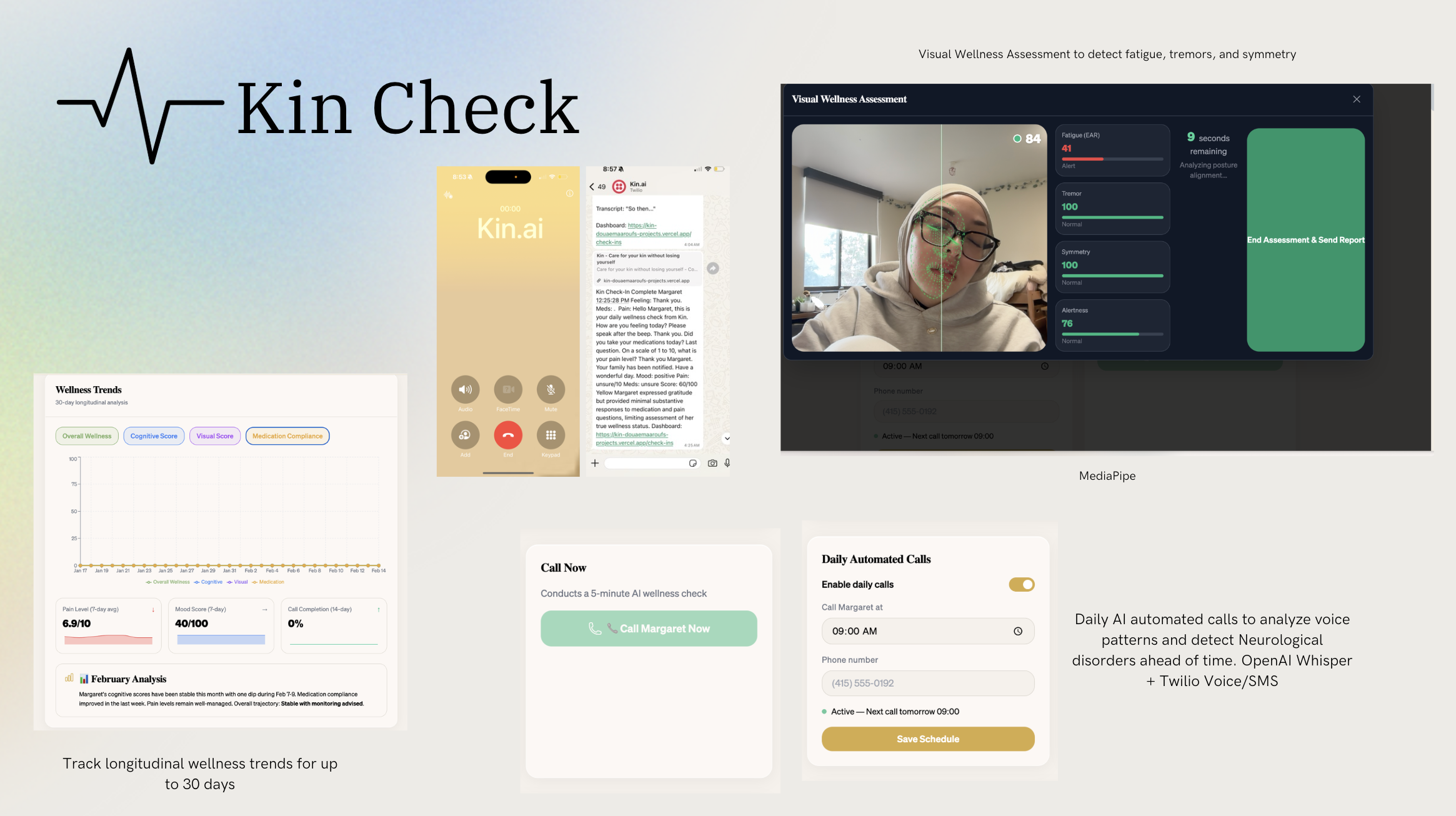
Kin Check - Stay ahead of detection
-
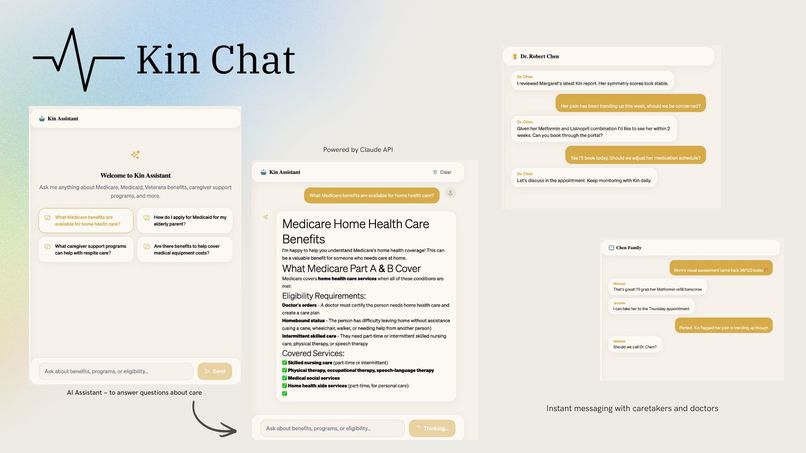
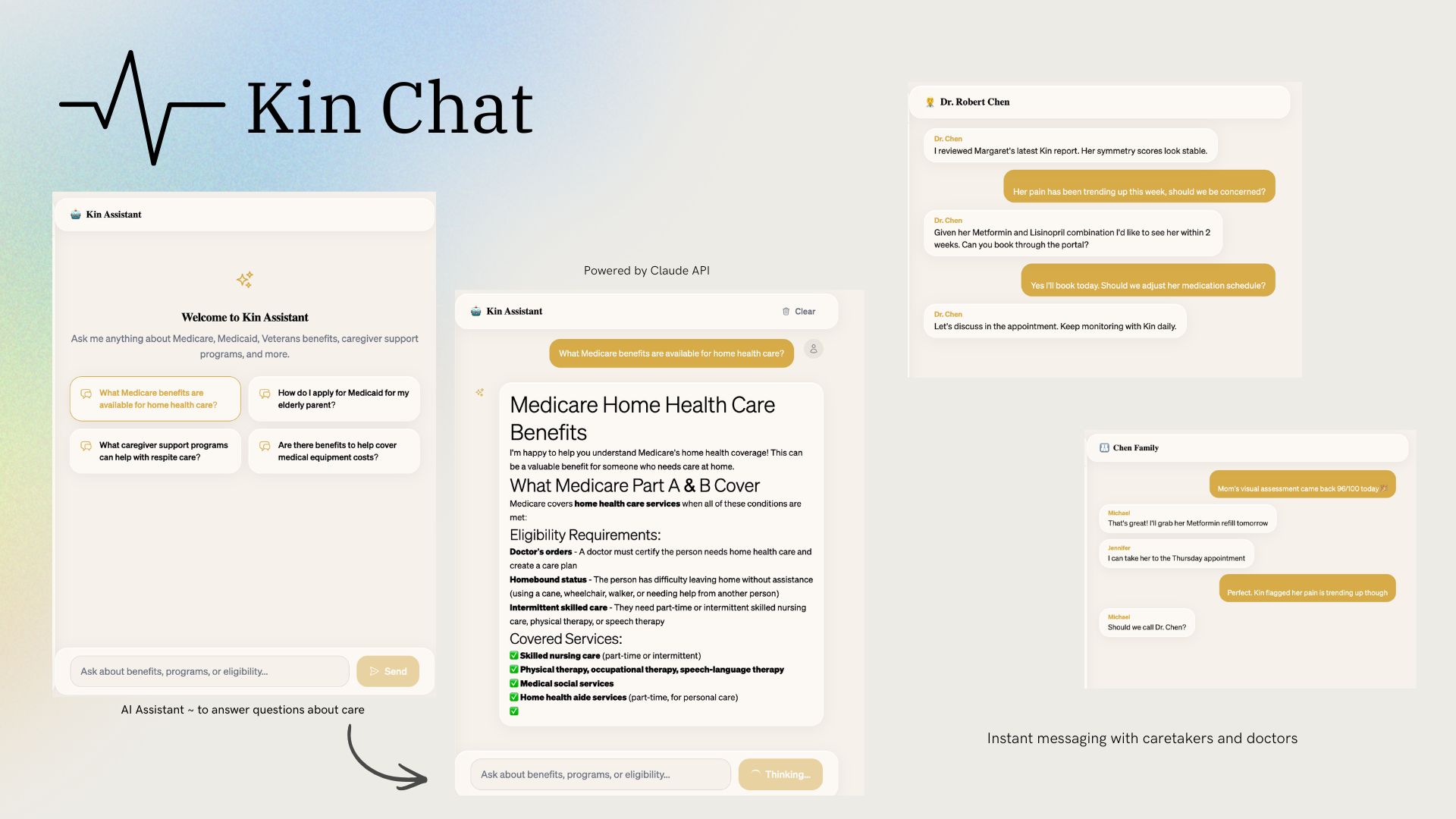
Kin Chat - Ask AI bot questions + chat with family and doctor
-
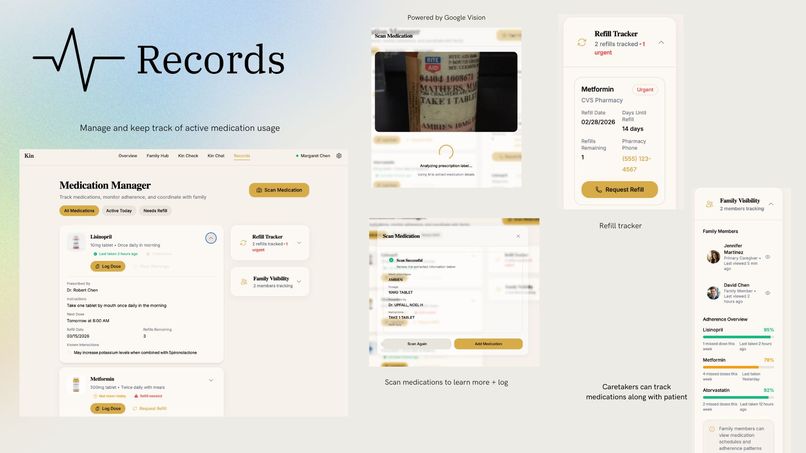
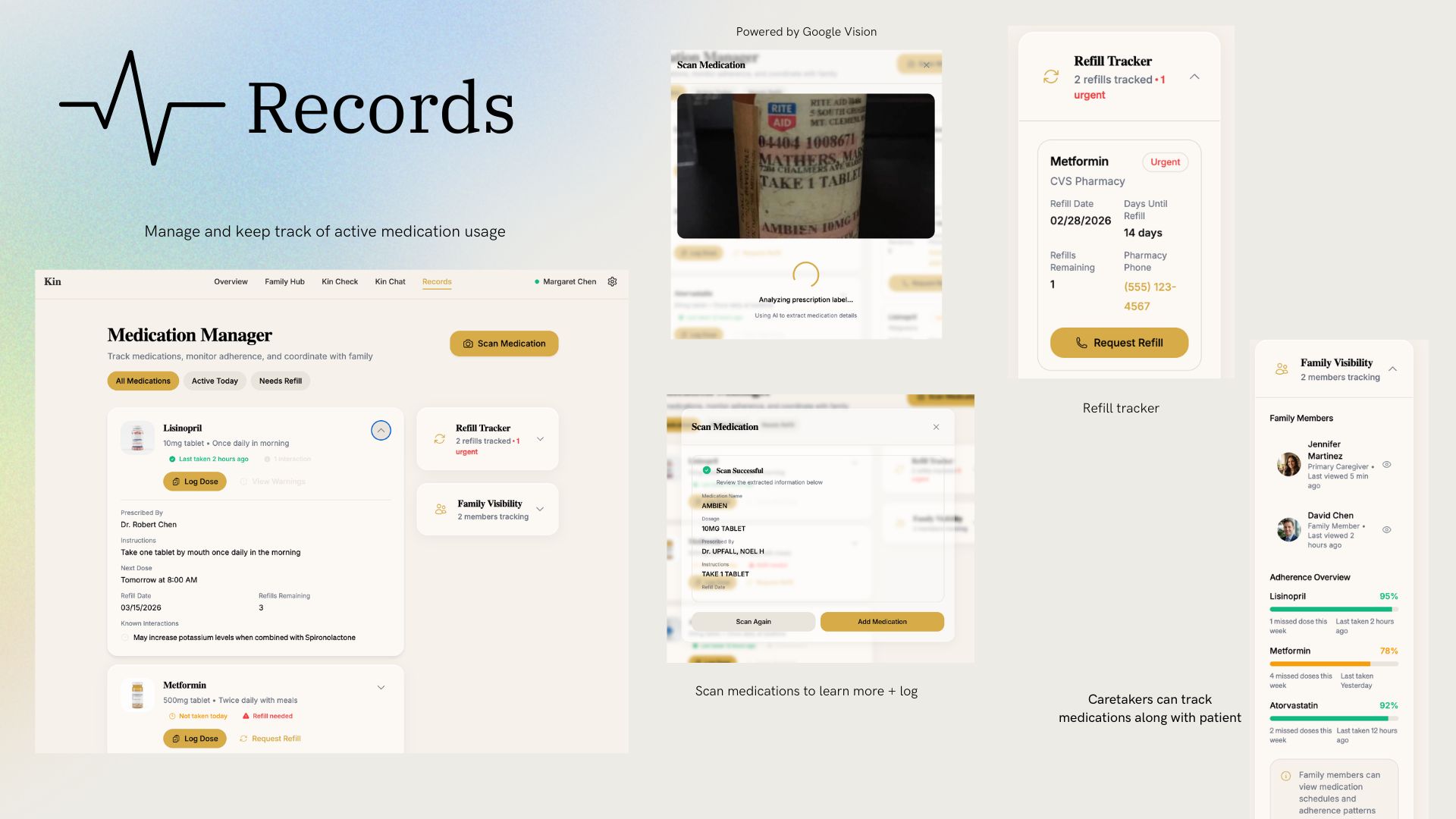
Records - Log medications and scan pill boxes for more information
Inspiration
Most Americans grow up watching their parents do the impossible.
During the day, they raise us. At night, they're on the phone with grandparents across the country: coordinating doctors, translating diagnoses, wiring money for medications, and carrying the invisible weight of loving someone who is aging and far away. They were the middle of a sandwich they didn't really sign up for: children on one side, aging parents on the other, and no infrastructure to hold any of it together.
That's the sandwich generation. An estimated 53 million Americans living it right now -- managing careers, raising kids, and simultaneously trying to keep an eye on a parent who insists they're fine. They lose an average of $304,000 in lifetime wages to caregiving. They spend 24 hours per week on tasks that are invisible to everyone else. 1 in 5 has reduced their work hours. 1 in 10 has left their job entirely.
For the elderly, the numbers are just as devastating. 1 in 4 adults over 65 falls each year. 40% of seniors don't take their medications as prescribed. 70% of hospital readmissions are preventable, caused by missed medications, skipped follow-ups, and symptoms nobody caught in time.
The hardest part isn't the logistics. It's the guilt. The 2am anxiety. The phone call you didn't make. The signal you missed. The moment you realize you haven't actually checked in since Tuesday.
We built Kin because we've watched that guilt eat people alive. And because we believe the right infrastructure could make it unnecessary.
What it does
Kin is a shared family health command center. It's a living dashboard that gives every sibling, caregiver, and doctor a real-time, complete picture of an elderly parent's health and daily needs.
No more scattered group texts. No more one sibling carrying everything. No more finding out too late.
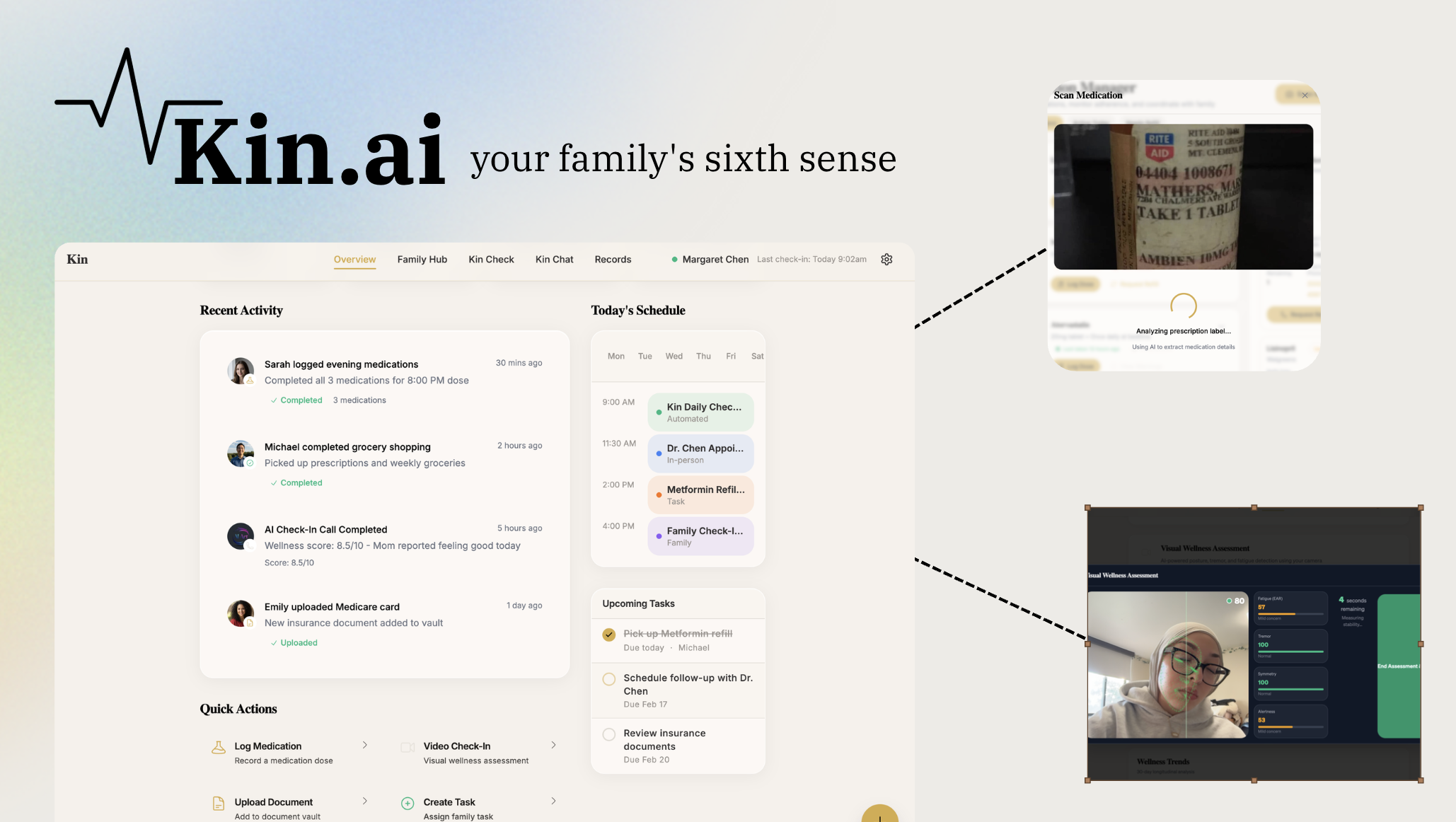
The Shared Dashboard One view for the entire care team. Upcoming appointments, medication schedules, refill deadlines, wellness trends over 30/60/90 days, family task assignments, and live health status. Always up to date, visible to everyone.
Medication Intelligence Kin tracks every medication, sends refill reminders before prescriptions run out, and uses Gemini Vision to scan pill bottles and automatically flag dangerous drug interactions.
Family Coordination Tasks get assigned across siblings. Expenses get tracked and split. Everyone sees the same information. No one is left out of the loop and no one has to be the designated worrier.
Longitudinal Wellness Monitoring Kin builds a 90-day health baseline -- tracking pain levels, mood, medication compliance, and cognitive patterns over time. It doesn't just tell you how Mom is doing today. It tells you if she's been slowly declining for three weeks.
Daily AI Check-In Calls Every morning, Kin places an automated wellness call and asks your parent how they're doing -- in plain conversation, no app required. Whisper transcribes the call. Claude analyzes it for clinical signals: mood, pain, medication compliance, confusion markers, red flags. Within 60 seconds of the call ending, the whole family receives a complete health update. It's not the main feature -- it's the heartbeat of the platform. The daily data point that makes everything else smarter.
Visual Wellness Assessment Kin uses MediaPipe computer vision to perform facial wellness scans — detecting fatigue, tremors, facial asymmetry, and alertness changes that could signal an early stroke or neurological event. Trends are tracked over time, not flagged in isolation.
How we built it
- Frontend: Next.js 15, React, Tailwind CSS, deployed on Vercel
- Voice AI: Twilio Voice API for outbound daily calls with multi-question TwiML conversation flow
- Transcription: OpenAI Whisper for real-time speech-to-text from call recordings
- Clinical Intelligence: Anthropic Claude for extracting mood, pain levels, medication compliance, and red flags from transcripts
- Computer Vision: Google Gemini Vision for medication bottle scanning and drug interaction detection
- Real-time Alerts: Twilio WhatsApp API for instant family notifications
- Database: Supabase (PostgreSQL) for longitudinal health tracking
- Face Analysis: MediaPipe Holistic for 468-point facial landmark wellness assessment
Challenges we ran into
Let's be honest.
The biggest challenge wasn't technical — it was me. I'm a product thinker at heart. I came into this hackathon with a strong vision for user journeys, family dynamics, and the emotional reality of caregiving. What I didn't come in with was the technical depth to execute everything I imagined.
That gap showed up constantly. Twilio's TwiML XML parsing broke at 1am because of an unescaped ampersand in a URL parameter. Vercel's serverless functions timed out silently at 10 seconds while Whisper was still transcribing. Supabase migrations failed mid-build and took down half the data layer. A2P 10DLC SMS regulations blocked delivery entirely, forcing a full pivot to WhatsApp at 3am.
Every one of these was a wall I had to figure out how to climb with limited sleep and limited experience. Features I had fully designed — real-time voice streaming, predictive crisis modeling, Google Calendar sync — didn't make it because I ran out of time and technical runway.
What this build represents is a product thinker's honest first attempt at a full-stack AI healthcare platform. The foundation is real. The user journey is right. The gaps are a roadmap, not a failure.
Accomplishments that we're proud of
We built a live, end-to-end AI healthcare loop that actually works.
A real phone call goes out. A real person answers. Whisper transcribes their words. Claude extracts clinical intelligence from natural speech. A WhatsApp alert arrives on a real phone within 1 minute. That entire pipeline, from voice to insight to family notifications, is deployed and running in production.
We're proud that Margaret, the elderly parent in our demo, doesn't interact with any AI. She answers a phone call. That invisibility ( AI working in the background so the human experience stays human ) is the design principle we're most proud of. The best healthcare AI disappears.
We're also proud of building something emotionally honest. Kin isn't a productivity tool. It's an anxiety reducer. It's the thing that lets you sleep at night knowing someone is watching, even when you can't be there. Getting that emotional truth right mattered as much to us as getting the code right.
What we learned
Building with LLMs in a real product context is fundamentally different from building with traditional APIs. LLMs aren't deterministic. They hallucinate. They return malformed JSON when you least expect it. They hit rate limits at the worst possible moment. Designing around that uncertainty — building fallbacks, validating outputs, prompting defensively — is a skill that took most of the weekend to develop.
We learned that prompt engineering is product design. The difference between Claude returning clean structured JSON with mood, pain level, and a one-sentence clinical summary versus an unstructured paragraph — that's entirely determined by how precisely you define the task. Vague prompts produce vague outputs. In healthcare, vague is dangerous.
We learned something deeper about what AI is actually good for in healthcare. It's not diagnosis. It's not replacing doctors. It's the connective tissue between visits — the daily signal that builds a longitudinal picture no single appointment ever could. A doctor sees your parent for 15 minutes every three months. Kin talks to them every morning. That asymmetry is where AI creates real value: not in the dramatic intervention, but in the quiet accumulation of data that makes the intervention unnecessary.
We learned that family caregiving is a coordination problem as much as a medical one. The hardest part of caring for an aging parent isn't finding good doctors — it's making sure three siblings in three cities all have the same information at the same time. Technology that solves coordination reduces burnout.
And we learned that the sandwich generation doesn't need more apps. They need less to manage. Every design decision in Kin was made through that lens: does this reduce cognitive load, or add to it?
What's next for Kin.ai
What needs to be fixed first:
The data infrastructure needs a rebuild. Several Supabase migrations broke mid-hackathon, meaning the crisis prediction score is currently pulling from seeded mock data rather than real call history. Before anything else, the data pipeline needs to be reliable, validated, and properly structured.
The AI models need tighter prompting and real training data. Claude's clinical extraction is promising but inconsistent without a large enough dataset of real wellness call transcripts. With real data, the prompts can be condition-specific — Margaret's diabetes means her medication questions should look different from a patient with early dementia.
The roadmap:
- Google Calendar sync — OAuth integration so appointments automatically appear in the dashboard without manual entry, and the family never misses a follow-up
- HIPAA compliance pathway — encrypting PHI at rest, audit logging, and business associate agreements before any clinical deployment
- EHR integration — direct read/write access to Epic and Cerner so physicians can see Kin wellness trends without leaving their existing workflow
- Better model training — personalized clinical intelligence built on condition-specific prompting and longitudinal user data
- Predictive crisis scoring — 30-day hospitalization risk modeling based on wellness trends, medication adherence, and social isolation signals
Kin is a foundation. The product vision is clear. The path forward is building infrastructure worthy of the problem — and worthy of the 53 million people carrying it.
Built With
- anthropic-claude
- figma
- google-gemini-vision
- mediapipe
- next.js
- node.js
- openai-whisper
- openfda-api
- postgresql
- react
- supabase
- tailwind-css
- twilio-voice-api
- twilio-whatsapp-api
- twiml
- typescript
- vercel

Log in or sign up for Devpost to join the conversation.