-
-
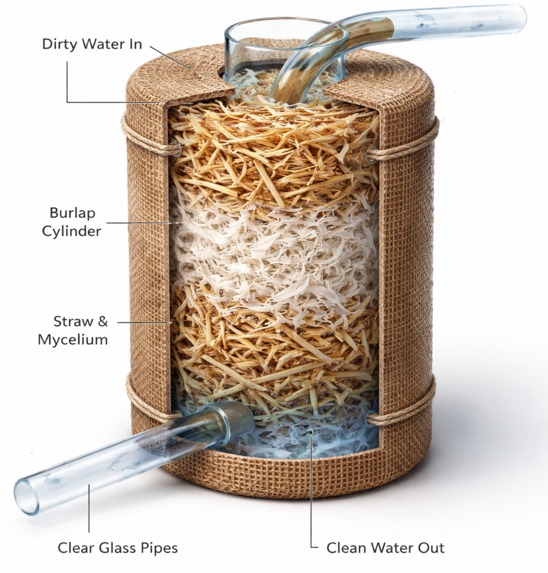
Concept Visualization: The Myco-Bale Filter
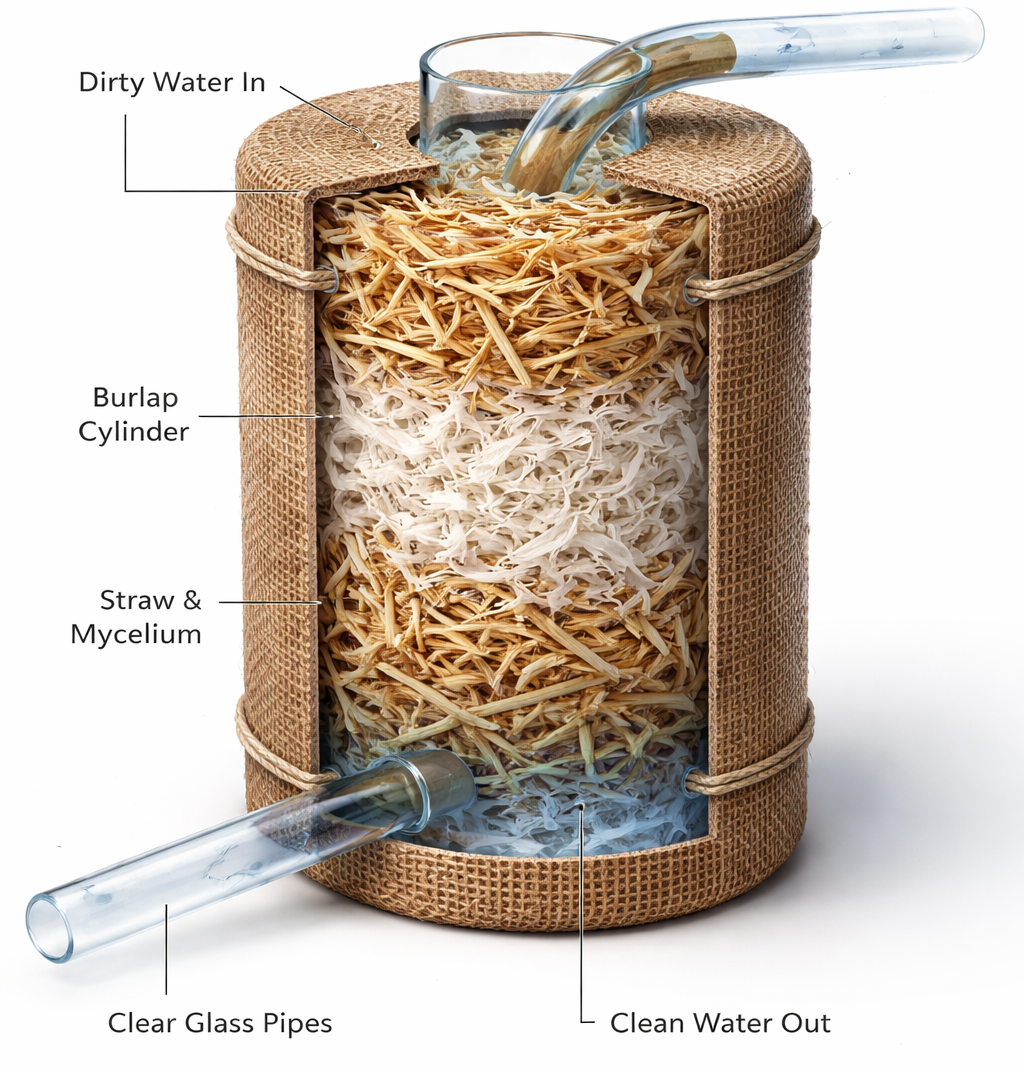
Inspiration:
Nature has always been the world’s best recycler but climate change is rapidly rewriting the rules of our environment. We are no longer seeing the gentle rains of the past. Instead, our warming atmosphere is fueling extreme precipitation events, sudden violent downpours that our aging urban infrastructure simply wasn't built to handle.
When these intense storms hit, they create a phenomenon we call the "Toxic Flush." Because the ground is paved and the drains are overwhelmed, the water moves with incredible force, scouring city streets and sweeping up lead, copper, hydrocarbons, and industrial chemicals. In a matter of minutes, this concentrated toxic cocktail is pushed directly into our rivers and ecosystems.
Traditional water treatment is a 20th-century solution to a 21st-century climate crisis. It is too expensive, too centralized, and too slow to stop these flash-pollution events at the source. We realized that to fight a decentralized problem, we needed a decentralized solution. We looked to the humble Oyster Mushroom. It is a natural powerhouse capable of breaking down complex toxins to create a low-cost, "smart" defense system that stands ready whenever the clouds break.
What it does:
The Chemical Reaction: The Myco-Bale works through Adsorption and Enzymatic Degradation. The mycelium cell walls carry a negative charge, acting as a bio-magnet for positively charged heavy metal ions like Lead (Pb2+) and Copper (Cu2+). Simultaneously, the fungus secretes Lignin-modifying enzymes that catalyze a redox reaction, breaking down the carbon-heavy chains of industrial dyes and hydrocarbons into harmless organic matter.
MycoGuard is a two-part system designed to clean and monitor urban runoff:
The Myco-Bale: A physical, biological filter made of mushroom roots (mycelium) grown on agricultural waste. These bales act as a chemical magnet, pulling heavy metals and toxins out of the water.
The Diagnostic App: Since it’s hard for a human to tell if a biological filter is healthy or saturated, we built an AI-powered app. By simply pointing a smartphone at the filter, the AI analyzes the texture of the mycelium and tells the user if the filter is working, degrading, or needs immediate replacement.
Glossary:
- Mycelium: Think of this as the root system of the mushroom: a dense, white web that acts as the physical filter.
- Gabion: A durable steel mesh cage that protects the living filter from urban debris.
- Biosorption: The mushroom's cell walls naturally pull toxic metals (like Lead) out of the water.
- Enzymatic Degradation:The mushroom releases enzymes that are a kind of chemical scissors that chop up complex toxins into harmless pieces.
- Substrate: The soil or organic waste (like straw) that the mushroom eats to grow.
- Inference: This is the AI's Decision Moment. It’s when our model looks at a new photo and decides if the filter is healthy.
How we built it:
We combined biology with deep learning:
Biology: We utilized Pleurotus ostreatus (Oyster Mushroom) for its unique enzymatic ability to break down complex pollutants.
Hardware: The mycelium is packed into galvanized steel gabions, creating a bale that is heavy enough for floods but porous enough for filtration.
AI Backend: We trained a custom EfficientNet-B0 model using PyTorch. We used transfer learning and fine-tuned the top layers to recognize microscopic biological health markers.
Frontend: A responsive interface built to give field workers instant and actionable data.
Challenges we ran into:
Training an AI to understand biology is difficult. Unlike rigid objects like cars or buildings, mycelium is organic and changes its look based on the environment. One of our biggest hurdles was that there is no public database available yet of mushrooms filtering toxic city water.
To solve this, we had to be creative. We took existing images of healthy and decaying mushrooms and used data augmentation to simulate what they would look like in a dark, grimy storm drain. It took a lot of trial and error to make the AI smart enough to recognize a stressed filter without a perfect dataset to learn from.
We initially struggled with a small dataset, so we implemented data augmentation: rotating, flipping, and adjusting colors to teach the AI to recognize health even in bad lighting or at weird angles.
It’s one thing to get code working on a laptop, but it’s a whole different challenge to get it to run perfectly on a live website for everyone to see. We had to do a lot of work to make sure our AI model and the web app talked to each other without crashing.
Accomplishments that we're proud of:
We are incredibly proud of creating a Circular Economy solution. Our filters don't just go to the trash when they are full. They are turned into high-grade organic fertilizer.
We successfully built a bridge between a low-tech solution (growing mushrooms on straw) and a high-tech monitor (Deep Learning AI).
What we learned:
Building MycoGuard was a lesson in interdisciplinary problem-solving. We learned that the most effective climate solutions exist at the interface of both Biology and Technology.
We learned how to "fine-tune" a world-class AI (EfficientNet-B0) to recognize microscopic organic textures. We discovered that by unfreezing specific blocks of the model, we could teach it to detect biological stress that is invisible to the human eye.
We learned that real-world data is messy. Unlike clean lab photos, field images have shadows, dirt, and varied lighting. We learned to use data augmentation as a necessity for reliability.
We embraced the concept of combining indigenous/natural wisdom (nature’s ability to heal) with Western science (deep learning). This approach helped us view the mushroom as a living partner in climate mitigation.
We broadened our understanding of extracellular enzymes. We learned that the Oyster Mushroom traps dirt and it actively secretes enzymes like Laccase and Manganese Peroxidase to chemically dismantle the molecular bonds of complex pollutants.
The Four Lenses:
Equity & Justice: Toxic flood pollution disproportionately impacts low-income urban communities built near industrial zones and rivers. These communities cannot afford centralized water treatment. MycoGuard uses agricultural waste material that poor farming communities already have to build filters that protect the people most harmed by climate change, at a cost they can actually afford. Women and children, who collect water and are most exposed to contaminated sources, are the primary beneficiaries.
Practical Lens: Oyster mushrooms grow on straw in 2-3 weeks. Gabion cages cost under $20. The AI app runs on any smartphone. A community could deploy a pilot network of 10 Myco-Bales within one month of receiving this design. No specialized equipment, no permits, no imported materials are required.
Two-Eyed Seeing: Indigenous and traditional communities have used fungi and wetland plants for water purification for centuries. MycoGuard formalizes this relationship pairing ancestral knowledge of living systems as natural purifiers with modern deep learning to create something neither approach could achieve alone.
Systems Approach: Cleaner runoff → healthier rivers → restored aquatic biodiversity → healthier fish populations → food security for riverside communities → reduced pressure on overfished coastal waters. Simultaneously, spent Myco-Bales become fertilizer → healthier soil → more agricultural waste for new bales → circular economy with zero waste. One intervention, a cascade of connected benefits.
What's next for Myco Guard:
Our next step is the Field Test. We want to deploy a pilot network of Myco-Bales in various urban drainage points to gather more real-world imagery. This data will help us refine our AI to detect even more specific types of chemical saturation.
We also hope to partner with local municipalities to turn agricultural waste which is otherwise burned into a community-wide water protection network.
We view this hackathon as the seed stage for a much larger environmental infrastructure:
Multi-Species Filtration: We plan to research and identify fungal species for using multiple types of fungi in one bale to target different toxins (e.g., one for heavy metals and another for microplastics).
IoT Integration: While the app works manually, our next goal is to embed low-cost moisture and pH sensors directly into the Bale's gabion, sending push notifications to the MycoGuard app when a filter needs a health check.
Hyper-Local Substrates: We want to create a substrate map that tells communities which local agricultural waste (rice husks, corn stover, or sawdust) is best suited for growing Myco-Bales in their specific region.
Public API for Citizen Science: We aim to open-source our classification model so that environmental hobbyists and students around the world can contribute photos and help us build the world's largest database of fungal health markers.
Policy & Partnerships: We are looking to pitch MycoGuard to urban planning boards as a green infrastructure alternative to traditional concrete drainage systems.
Built With
- canva
- colab
- efficientnet-b0
- gitbook
- github
- html5
- javascript
- leaflet.js
- lumalabs.ai
- python
- pytorch
- railway
- tailwindcss


Log in or sign up for Devpost to join the conversation.