-
-
Homepage
-
Login
-
Tree
-
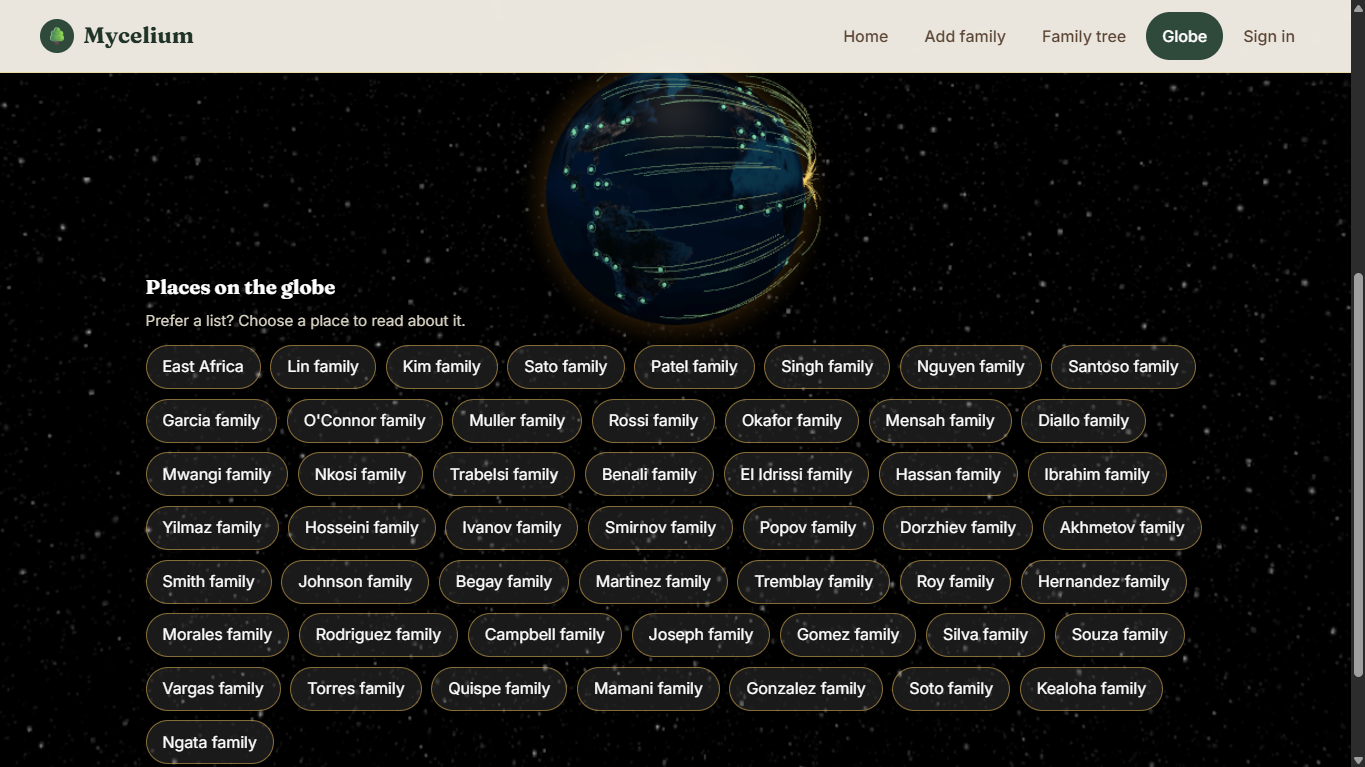
Globe
-
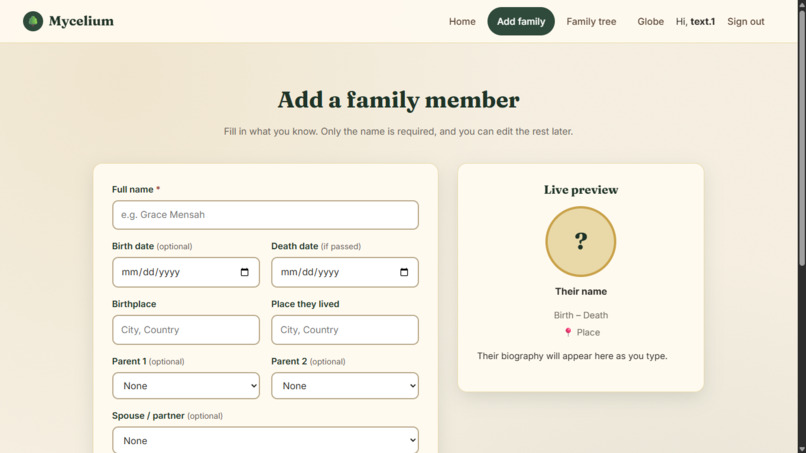
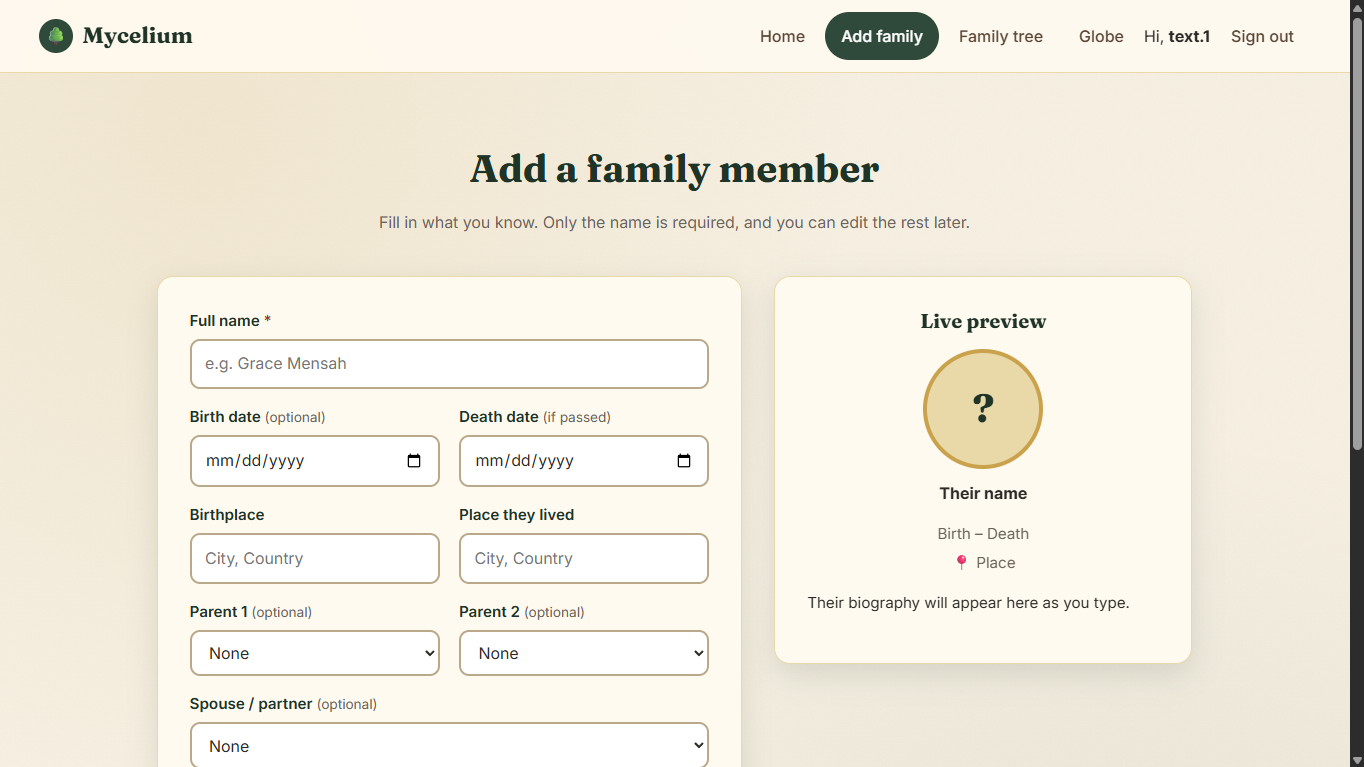
Add Member
-
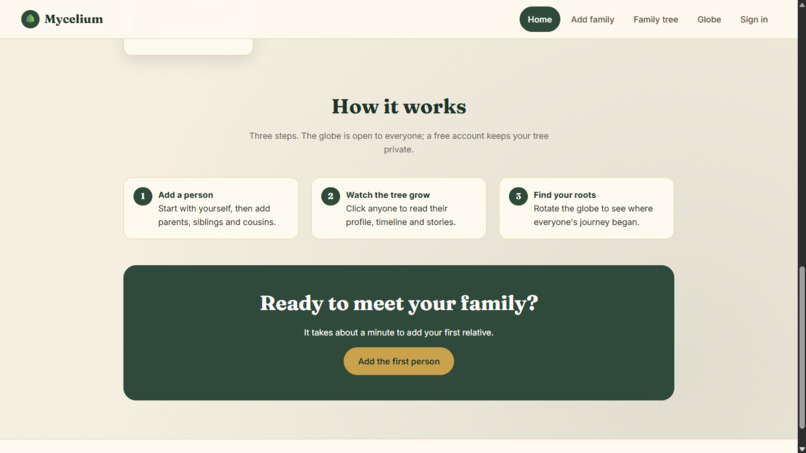
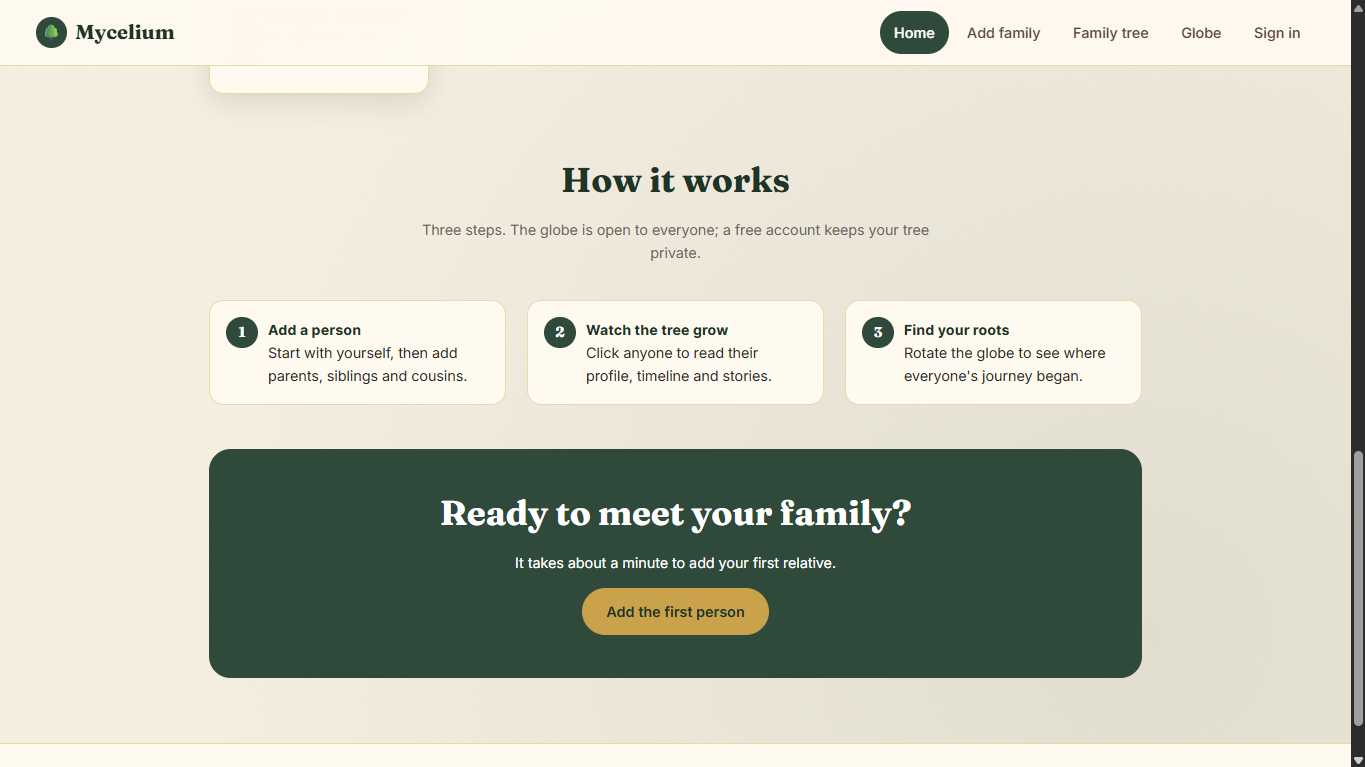
How it Works
-
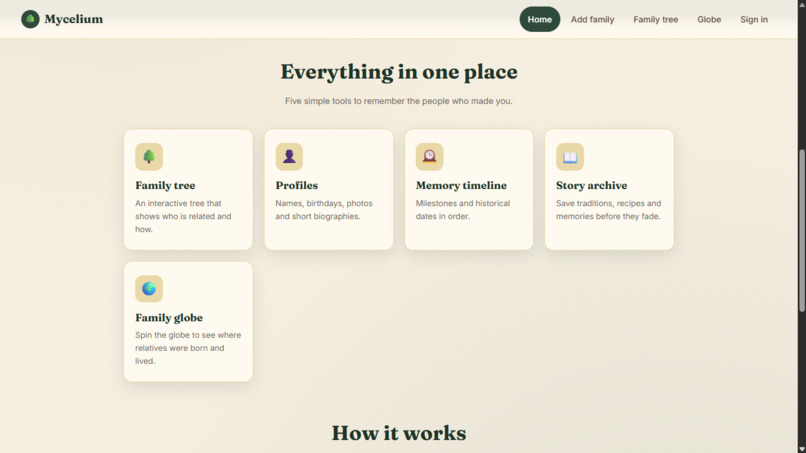
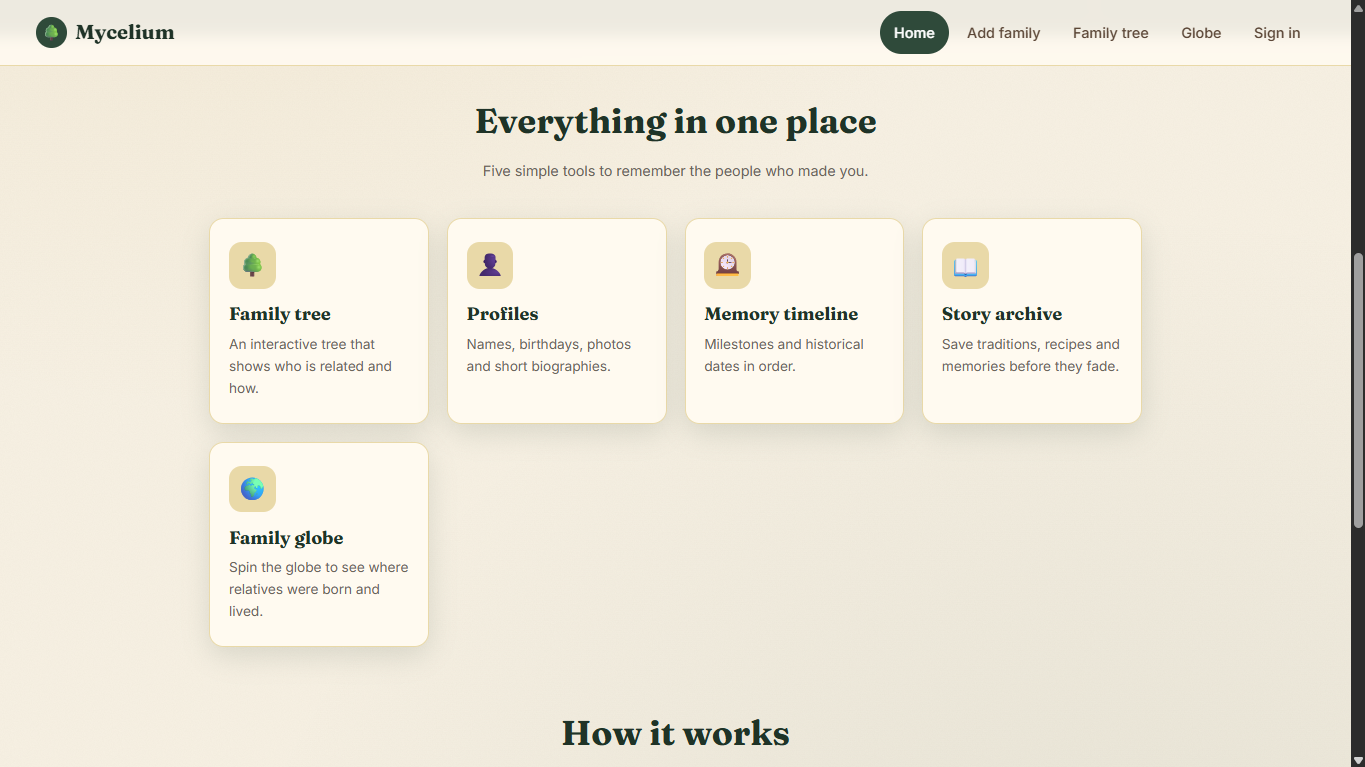
Functions
-
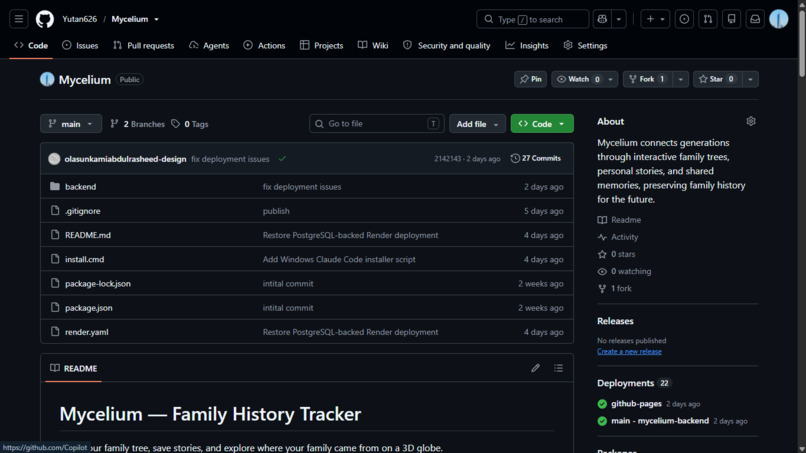
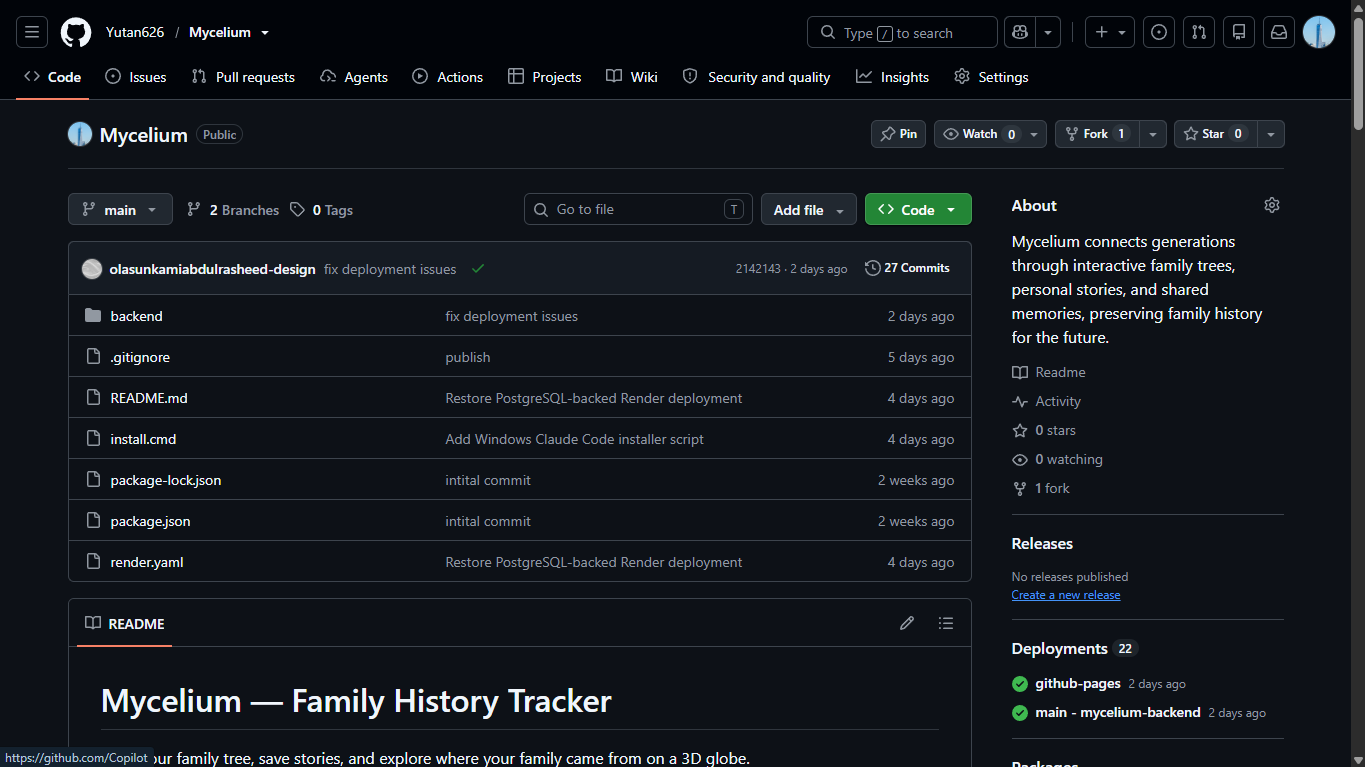
Github
-
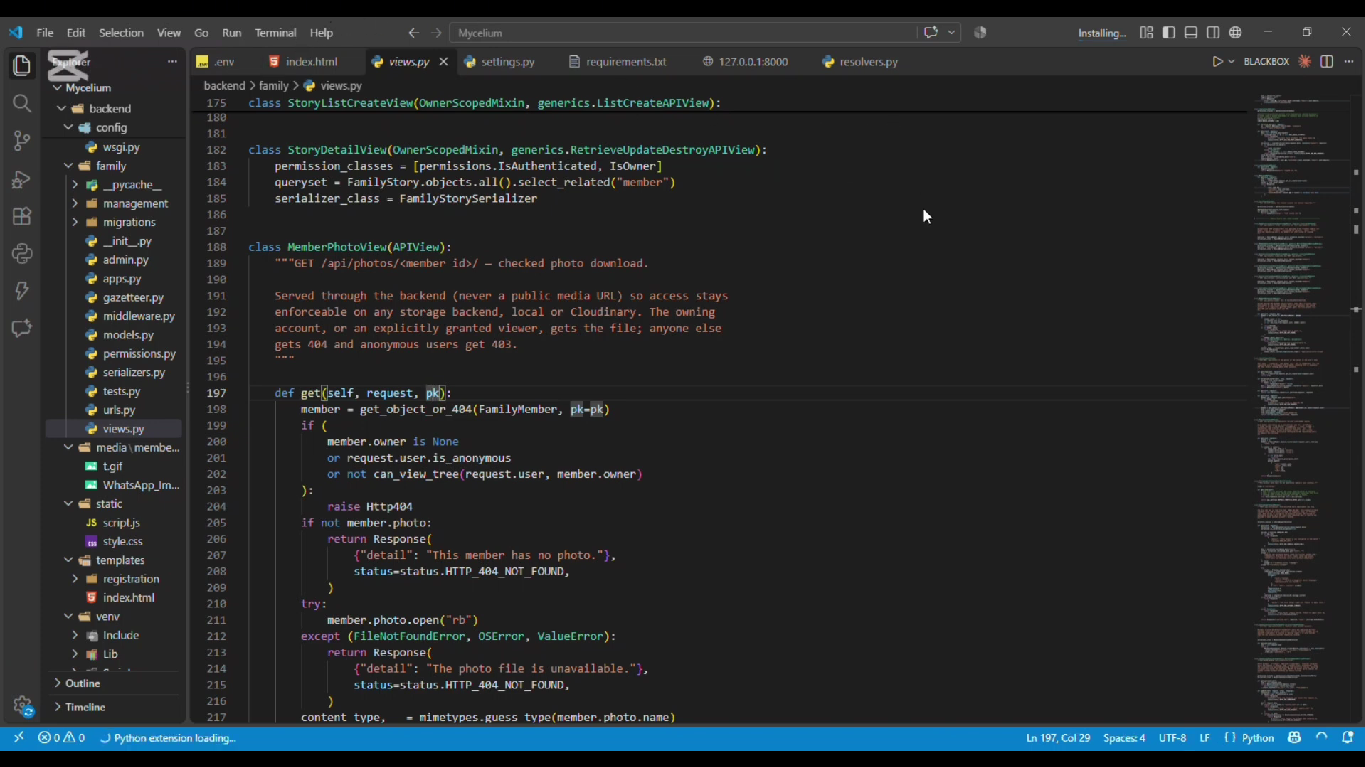
Backend
Mycelium — Every Root Tells a Story
Inspiration
Have you ever asked your parents or grandparents about your family history and realized that there are so many stories you don't know? Maybe there are relatives you've never met, places your family used to live, or stories that have been passed down for generations. What happens when those stories are forgotten?
That question inspired us to create Mycelium.
Family history is more than a collection of names and dates. It's about the people who came before us, the places they lived, the challenges they faced, and the experiences that shaped the next generation. Unfortunately, this information isn't always easy to keep track of. Some families have old photographs in boxes, others have information scattered across different devices, and many stories only exist in the memories of older relatives.
We wanted to make it easier for people to bring these pieces together. Instead of having family information scattered everywhere, we wanted to create one place where people could organize their relatives, understand their relationships, and preserve the stories that make their family unique.
That's where the name Mycelium comes from. In nature, mycelium forms an underground network that connects organisms and helps sustain an entire ecosystem. You might not see the network itself, but its connections are everywhere. We see families in a similar way. Every generation is connected to the ones before and after it, even when those connections aren't immediately obvious.
We wanted our project to represent those hidden connections and help people discover more about where they came from.
What It Does
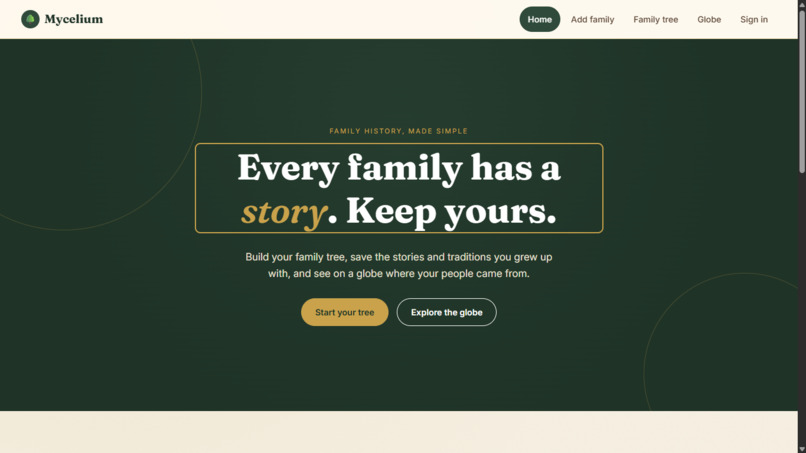
Mycelium is a family-history tracker that helps people organize their relatives and explore the connections between generations.
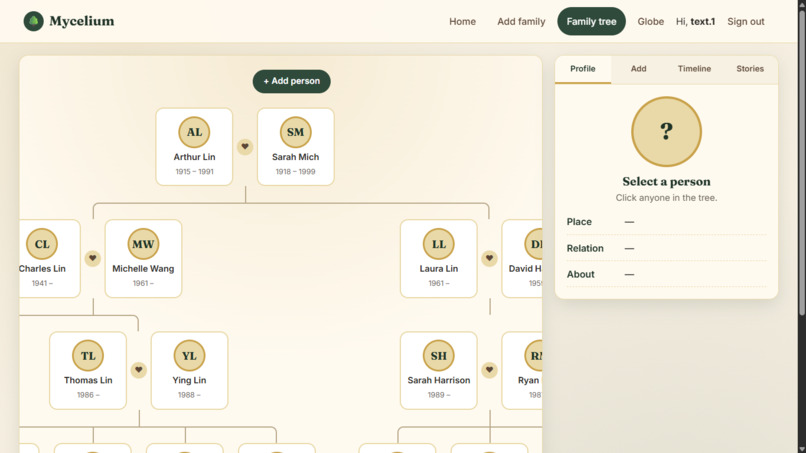
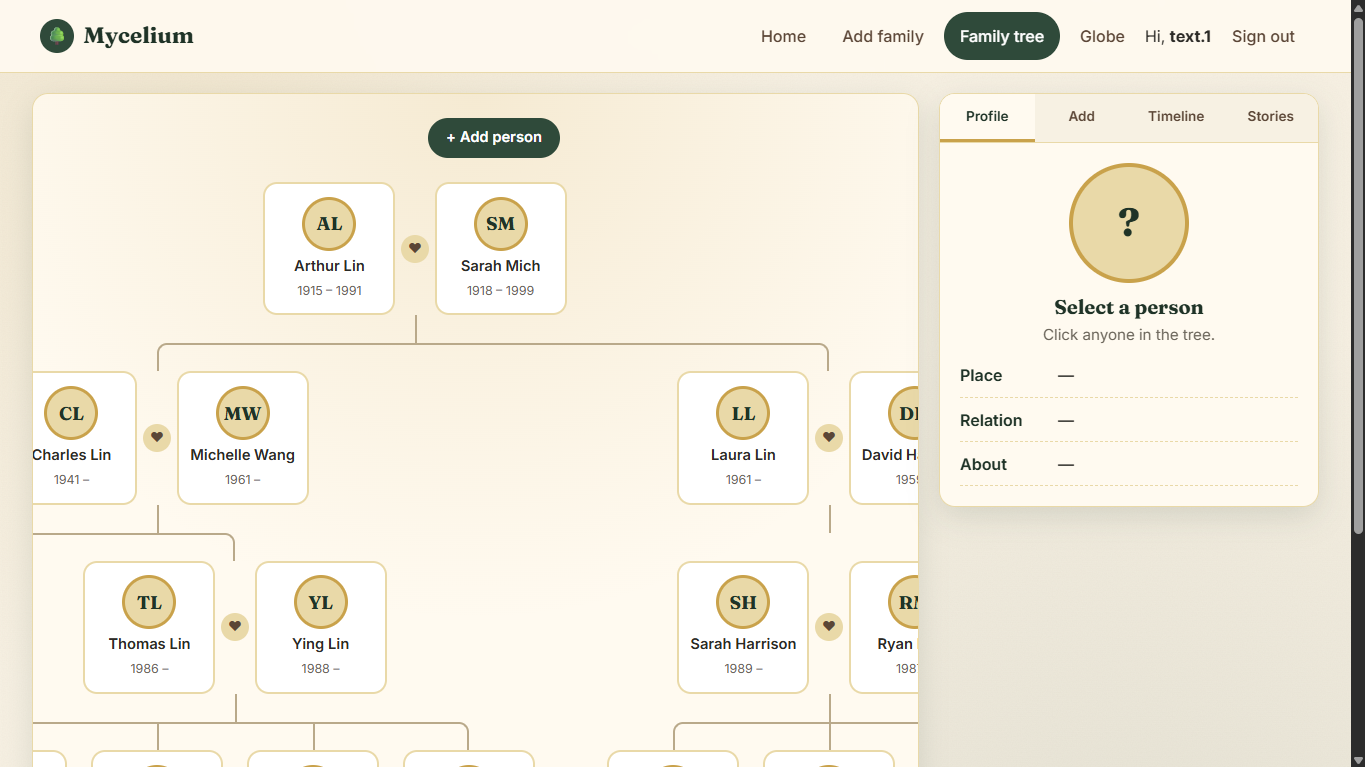
Users can keep track of family members and information such as birth dates, places, relationships, and personal biographies. Instead of treating family history as a list of names, Mycelium aims to make those details part of a bigger picture, helping people understand how their relatives connect.
We also wanted the project to feel approachable. You shouldn't need to be a genealogy expert to start documenting your family. Whether someone is recording information about their grandparents, adding their children to a family tree, or simply learning more about their relatives, the experience should feel straightforward.
Our goal is to make family history something people can actively build and maintain, rather than something they only think about when they need to complete a family tree for a school assignment.
How We Built It
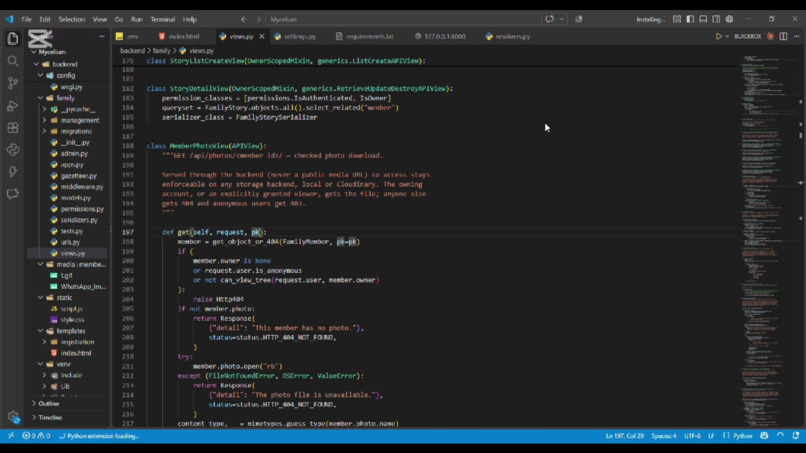
We built Mycelium as a web application, with a frontend for users to interact with family information and a backend to handle that information.
One of our priorities was thinking about how family data should be organized. Each person is part of a larger network of relationships, so storing information about individuals is only one part of the challenge. The application also needs to represent how those individuals are connected across generations.
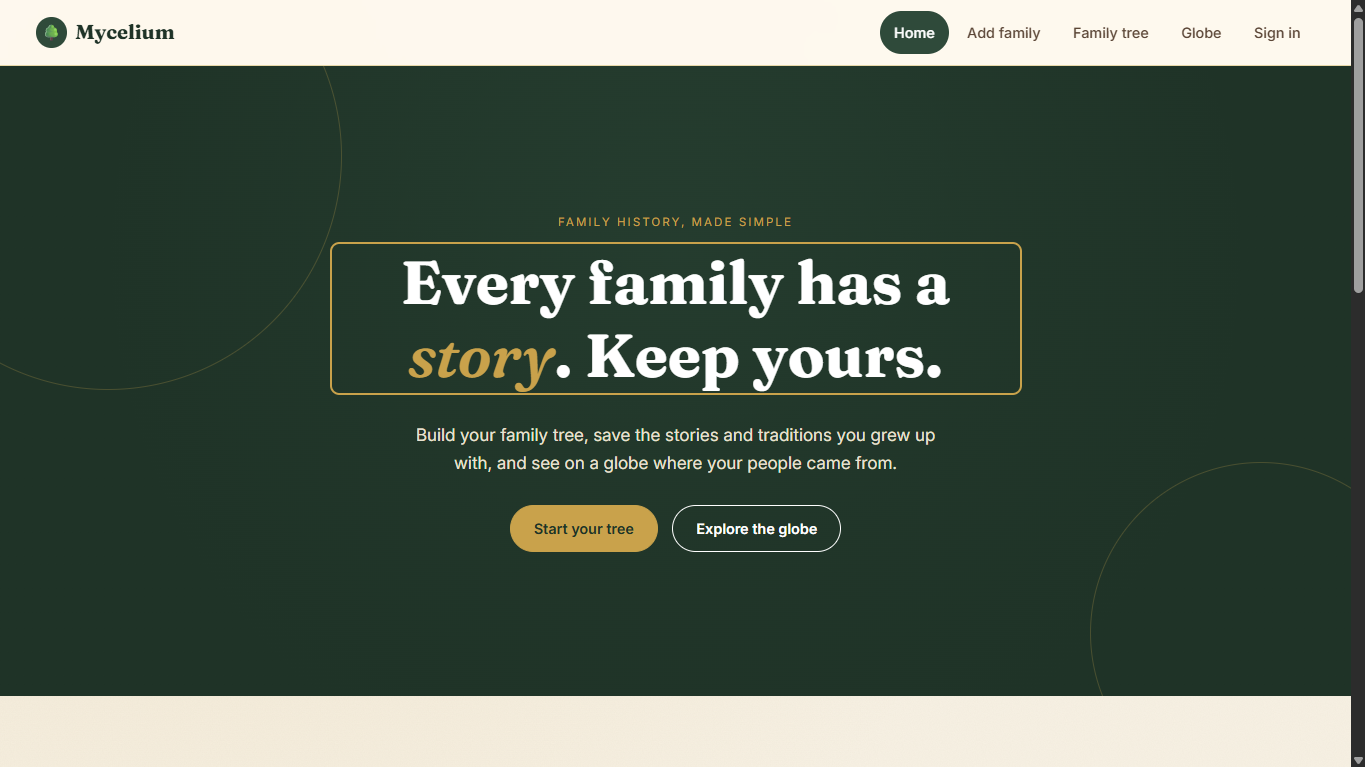
We approached the design with the idea that a family-history tool should feel welcoming rather than overly technical. We chose a natural visual direction inspired by forests, roots, and interconnected networks. The colors and overall concept reflect the idea that every person is part of a larger story.
Throughout development, we had to think about both the technical side of managing family information and the human side of making that information understandable. We wanted to build something that could eventually be useful to people with different levels of technical experience.
Challenges We Faced
One of our biggest challenges was figuring out how to represent family relationships clearly. Real families aren't always simple. There can be multiple generations, different branches, and relatives whose connections aren't immediately obvious. As more people are added, keeping the information organized becomes increasingly important.
We also had to consider how to make the experience easy to understand. A tool can have useful features, but if people struggle to navigate it, they may never use it consistently. We wanted Mycelium to be something people could return to whenever they wanted to add another relative or learn something new about their family.
Another challenge was deciding how to approach a problem that is both technical and personal. Family information can carry a lot of meaning, so the project isn't just about storing data. It's about presenting that information in a way that helps people understand and appreciate their connections.
These challenges helped us think beyond simply making something that works. We wanted to build a foundation that could grow into something families might use for years.
What We Learned
Building Mycelium taught us that even a familiar problem can have a lot of complexity behind it. Most people understand what a family tree is, but creating a tool that can organize family information and represent relationships across generations requires careful planning.
We also learned the importance of connecting technical decisions to a real user need. Organizing data, building a backend, and designing an interface are not separate goals. They all need to work together to make the application useful.
Most importantly, this project made us think about how technology can help preserve things that are easy to lose. We often use technology to communicate with people in the present, but it can also help us understand the people who came before us and preserve information for those who come after us.
Mycelium is an opportunity to explore that idea and continue improving it.
What's Next for Mycelium?
We see Mycelium as the beginning of something much bigger than a personal family tree.
First, we want to make it possible for families to grow their trees more easily. Users should be able to add more relatives, expand different branches, and gradually build a more complete picture of their family across generations.
We also want to explore ways for family members to connect with one another through the platform. Imagine starting a family tree yourself and then inviting your parents, grandparents, siblings, or cousins to contribute. One person might know the birth dates, another might have old photographs, and someone else might remember a story that nobody else has written down. Bringing those contributions together could help families create a much richer record of their history.
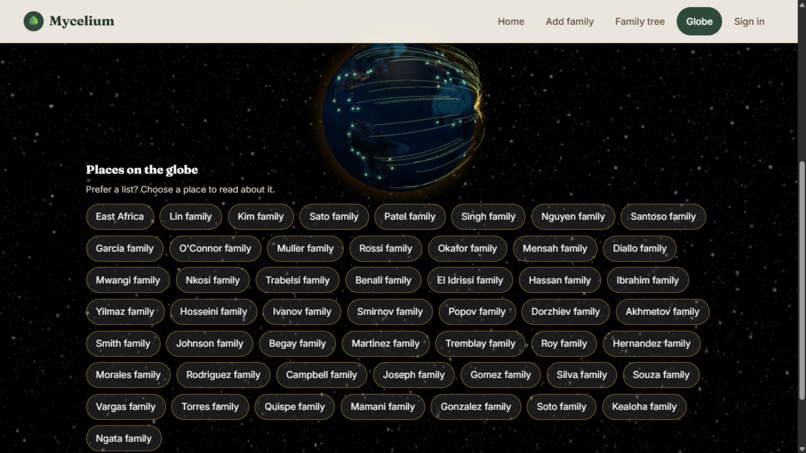
Another major goal is to make Mycelium accessible to people around the world. Families live in different countries, speak different languages, and often have relatives spread across continents. We want to explore international support and features that make it easier for families separated by distance to preserve and share their histories.
In the future, we would also like to explore ways for users to discover connections with other family trees, where appropriate and with the necessary privacy controls. This could help people learn more about their ancestry and potentially discover relatives or shared family connections they didn't know existed.
Of course, sharing family information requires trust. Privacy and user control would need to be important parts of any feature that connects different users or makes family information available to others.
Ultimately, we want Mycelium to become a place where families can build their histories together, no matter how far apart they live. A family tree should not have to stop growing because one person doesn't have all the answers. Every relative has a piece of the story, and every new contribution can help complete the picture.
Our Vision
We started Mycelium with a simple idea: family connections matter, and the stories behind them deserve to be preserved.
Our long-term vision is to make it easier for people everywhere to explore their roots, share memories, and keep their family histories alive for future generations.
Because a family isn't just a group of names connected on a chart. It's a network of people, experiences, and stories that continues to grow.
Mycelium — Every Root Tells a Story.


Log in or sign up for Devpost to join the conversation.